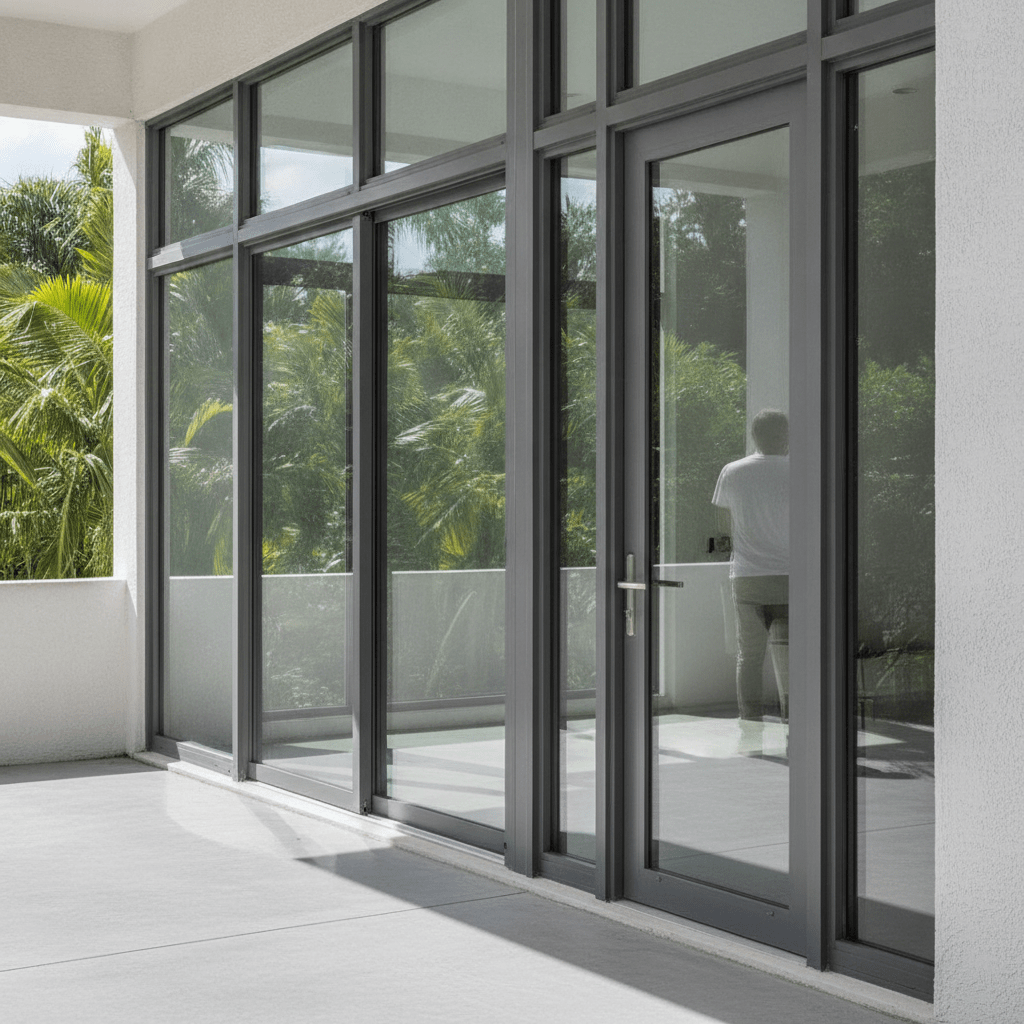
Last updated: July 2026 by the Bigfoot Windows & Roofing editorial team.
Impact windows are made by bonding two panes of glass around a polymer interlayer — either PVB (polyvinyl butyral) or ionoplast — using heat and pressure in an autoclave, producing a single laminated unit that holds together on impact rather than shattering. That laminated glass unit is then installed into a reinforced aluminum frame engineered to meet specific wind-load and pressure ratings. The finished assembly — glass, interlayer, frame, hardware, and fasteners — is tested as a complete unit under Miami-Dade NOA protocols before it can be legally installed in South Florida.
Key Takeaways
- Impact windows use two panes of glass bonded by a polymer interlayer — the interlayer is what stops debris from penetrating.
- The interlayer is either PVB (polyvinyl butyral) or ionoplast — ionoplast is stiffer and better suited for large or high-rise openings.
- Glass and interlayer are bonded under heat and pressure in an autoclave — skipping this step produces an inferior product.
- The finished glass unit is then installed into a reinforced aluminum frame engineered to meet specific wind-load and pressure ratings.
- Miami-Dade NOA (Notice of Acceptability) testing certifies the entire assembly — frame, glass, hardware, and fasteners — not just the glass alone.
- Manufacturing quality determines whether the window performs in a Category 4 storm or fails at the frame before the glass is ever tested.
Why This Matters
Most Homeowners Focus on Price. The Factory Is Where Performance Is Decided.
If you’re comparing impact window quotes in South Florida, the number on the page doesn’t tell you what’s actually inside the window.
Every impact window quote you receive represents a specific glass composition, a specific interlayer, a specific frame alloy, and a specific set of test results. Two windows priced $200 apart can have meaningfully different performance profiles — not because the installer is padding margins, but because the manufacturing decisions made 1,000 miles away in a factory already locked in the outcome.
This article walks through how impact windows are actually built, step by step. Understanding the process will help you ask better questions, read a product approval correctly, and know whether the window being proposed for your home was manufactured to survive South Florida conditions.
South Florida Context
HVHZ Is the Strictest Test Environment in the United States
Miami-Dade and Broward counties sit inside the High-Velocity Hurricane Zone — the only jurisdiction in the U.S. with its own independent approval process for building products.
The Florida Building Code sets a statewide baseline. HVHZ goes further. Every window installed in Miami-Dade or Broward must carry a Miami-Dade Notice of Acceptability (NOA) — a document issued only after the product survives large-missile impact testing, cyclic pressure testing, and water infiltration testing as a complete assembly. A window with only a Florida Product Approval but no Miami-Dade NOA cannot be legally installed in the HVHZ. When you see an installer quoting a cheaper product, the first question worth asking is: does it have the NOA?
Manufacturing Deep Dive
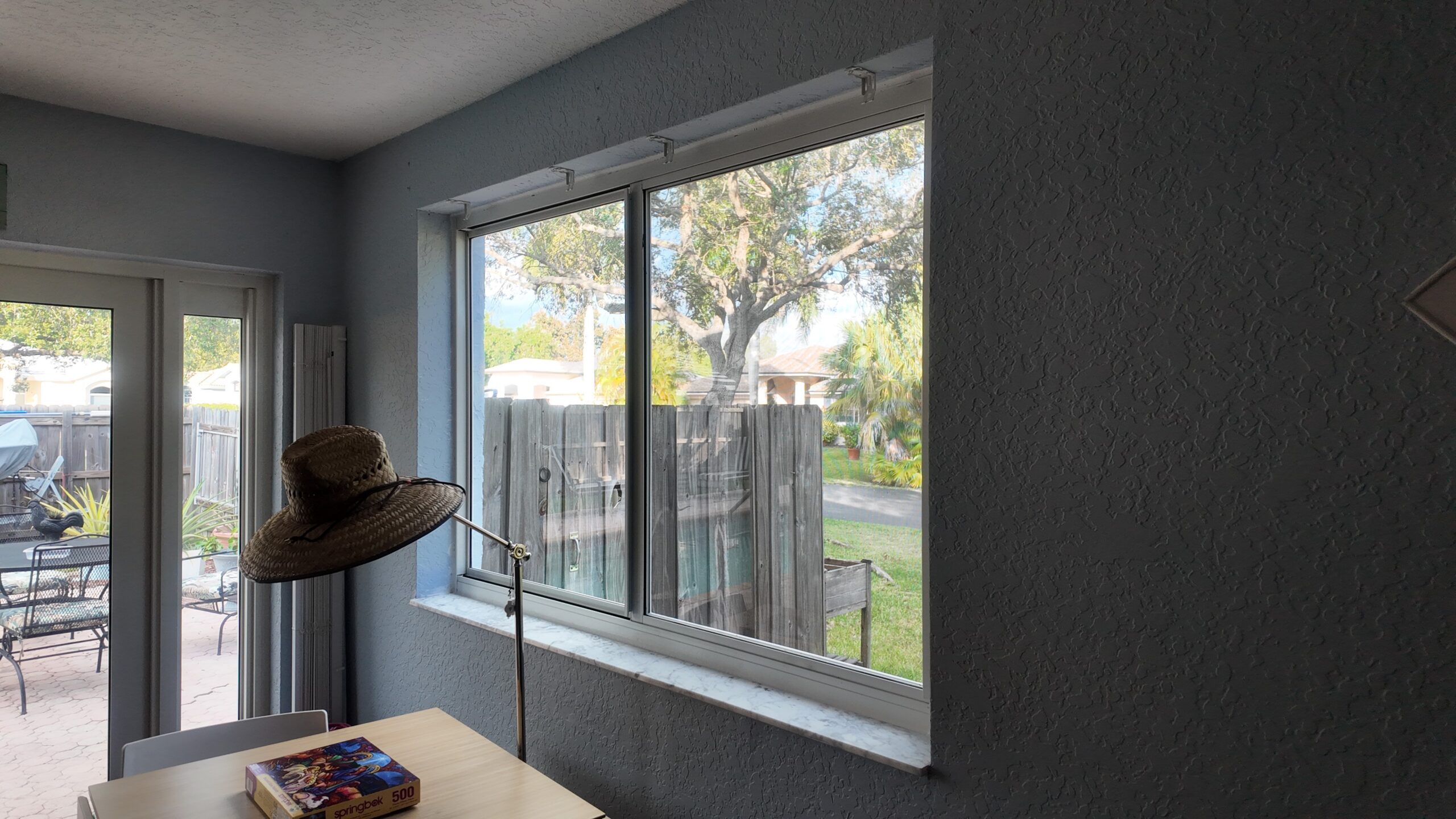
How Impact Windows Are Built: Step by Step
From raw float glass to a tested, frame-assembled product — here is what the process actually involves.
Step 1 — Float Glass Production
All impact glass starts as float glass. Molten silica, soda ash, limestone, and dolomite are mixed at roughly 1,500 °C, then poured onto a bed of molten tin. The glass floats on the tin surface and spreads into a uniform sheet — this is where the optical flatness comes from. Once cooled, sheets are cut to size. Thickness options relevant to impact windows are 5/16", 7/16", and 9/16". Thicker glass carries more mass and is better suited for larger openings and high-rise applications where wind loads are higher.
Step 2 — Applying the Low-E Coating
Most modern impact glass receives a Low-E (low-emissivity) coating during or immediately after float production. The coating is a microscopically thin metallic oxide layer — typically silver or tin oxide — applied via a magnetron sputtering process (a vacuum deposition method). This coating reflects infrared radiation, which is the primary driver of heat gain through glass in South Florida. SB 70 is a common high-performance coating that provides strong solar heat rejection with a dark green tint. It is one of the primary recommendations for homes in the HVHZ where cooling loads dominate year-round.
Step 3 — Cutting and Tempering (Where Applicable)
Glass is cut to the dimensions required for the specific window unit before any bonding occurs — you cannot cut laminated glass cleanly after the fact. Some units use tempered glass as one or both lites. Tempering involves heating the cut pane to approximately 620 °C and then rapidly cooling it with pressurized air jets, which creates compressive stress on the surface and tensile stress in the core. Tempered glass, when broken, fractures into small blunt pieces rather than sharp shards. Not all impact glass is tempered — the lamination process itself satisfies safety glazing requirements — but tempering combined with lamination is common in doors and large fixed panels.
Step 4 — The Interlayer: PVB vs. Ionoplast
The interlayer is the single most important component in an impact window’s performance. It is placed between the two glass lites and is what physically holds the glass in place after impact. Without it, even fractured glass would separate and create a breach in the building envelope.
| Property | PVB (Polyvinyl Butyral) | Ionoplast (e.g., SentryGlas) |
|---|---|---|
| Stiffness | Flexible, softer | 5× stiffer than PVB |
| Thickness | 0.030"–0.090" typical | 0.060" typical, denser |
| Best use case | Residential, smaller openings | Large panels, high-rise, heavy-duty |
| Post-impact hold | Good — minor deflection | Excellent — minimal deflection |
| Cost | Lower | Higher |
PVB interlayer is the industry standard for residential impact windows and performs well across the range of residential opening sizes typical in South Florida single-family homes. Ionoplast is specified when the opening is large, the building is tall, or the design wind pressure rating must exceed what PVB construction can achieve. Neither is universally superior — the right choice depends on the opening and the required pressure rating.
Step 5 — Autoclave Bonding
After the interlayer is laid between the two glass lites, the assembly goes through a nip-roller (or vacuum bagging) pre-press stage to remove trapped air, then into an autoclave — a pressurized oven. Inside the autoclave, heat (typically 135–145 °C) and pressure (around 150–200 psi) are applied simultaneously. This forces the interlayer to flow into the micro-surface irregularities of both glass panes and create a true chemical and mechanical bond. The result is a single laminated unit — not two panes with material between them, but one composite structure. Laminated glass made without proper autoclave bonding will delaminate over time, especially under the UV exposure and thermal cycling common in South Florida.
Step 6 — Frame Engineering and Assembly
The laminated glass unit is fitted into an extruded aluminum frame. In South Florida, aluminum is the correct frame material — it is more dimensionally stable than vinyl under sustained heat and UV exposure, and it has a longer track record in HVHZ conditions. Frame profiles are engineered to specific wall thicknesses and pressure ratings. Glazing compounds and structural silicone sealants are applied to secure the glass to the frame, and stainless steel or corrosion-resistant hardware is installed. The frame depth does not change when glass thickness increases — the frame accommodates different glass thicknesses through changes to the glazing bead and pocket dimensions, not by rebuilding the extrusion.
Step 7 — Quality Control and Documentation
Before a window leaves the factory, it goes through dimensional verification, air infiltration checks, and visual inspection for delamination, edge voids, and coating defects. Each unit is logged against the product approval it was manufactured to satisfy. The product approval number — a Florida Product Approval or a Miami-Dade NOA number — is the document that connects the physical window in your home to the test reports that prove it was built to survive the conditions it is rated for.
Assembly Comparison
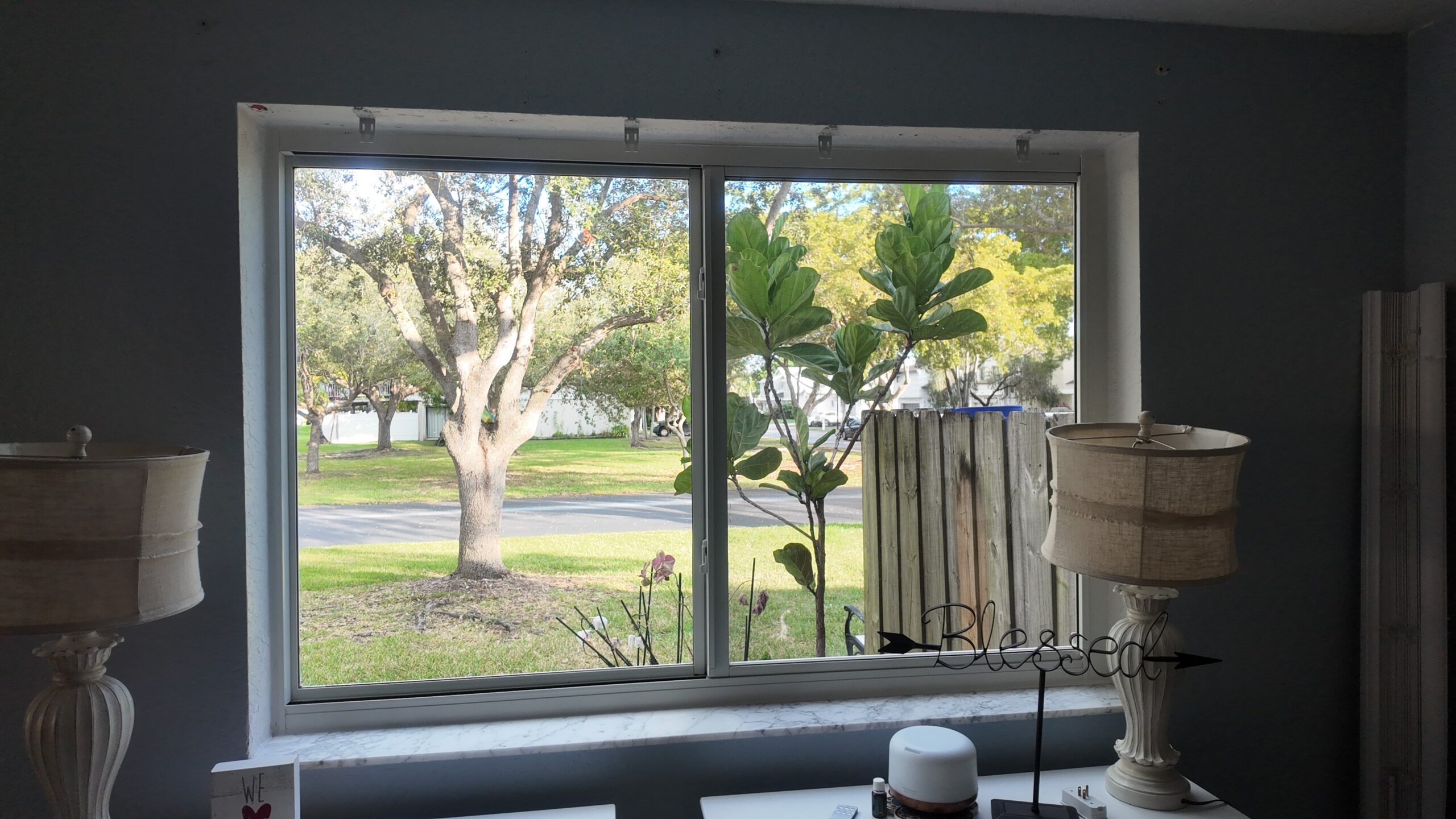
What the Miami-Dade NOA Actually Tests
NOA testing is an assembly test — every component must pass together, not independently.
| Test | What It Evaluates | Miami-Dade HVHZ Requirement |
|---|---|---|
| Large Missile Impact | 9 lb 2×4 at 50 ft/s | No penetration through glass or frame |
| Cyclic Wind Pressure | Repeated positive & negative pressure loads | 9,000 cycles without failure |
| Static Structural | Peak positive and negative design pressure | Varies by product; must meet or exceed rated DP |
| Water Infiltration | Water intrusion at specified pressure | No water through frame or glazing at test pressure |
| Air Infiltration | Air leakage rate at pressure differential | Maximum 0.30 cfm/ft² for most residential units |
A window that passes large missile impact but fails cyclic pressure testing does not get an NOA. A window that passes all glass tests but whose frame deflects enough to allow water infiltration does not get an NOA. The approval only exists when the complete assembly — glass, interlayer, frame, sealants, hardware, and fasteners — survives every test protocol. This is why a valid Miami-Dade NOA number on a window product is a more meaningful quality signal than any marketing claim.
You can verify any Miami-Dade NOA at the Miami-Dade County product control search portal. If an installer cannot provide the NOA number for the specific product they are quoting, that is a meaningful red flag before you sign any contract for impact window installation.
Why It Matters Who Installs It
Manufacturing Quality and Installation Quality Are Both Required
A properly manufactured window, incorrectly installed, fails the same way a poorly manufactured window does — just at a different point in the assembly.
Installation to NOA specifications means using the correct fastener type, correct fastener spacing, correct structural silicone, and correct shim clearances — all documented in the NOA itself. Deviating from any of these requirements voids the product approval and can void the manufacturer warranty. A contractor with a Certified Specialty Contractor with a Glass & Glazing Specialty license is specifically licensed to perform this work under Florida law.
Where a project also involves structural modifications — removing a load-bearing wall to widen an opening, reinforcing a header, or addressing structural issues discovered during the rough opening inspection — having a Certified General Contractor on the same project means that scope can be handled under a single permit pull without bringing in a separate GC. That coordination matters in South Florida where permit sequencing and inspection scheduling affect how long your home is exposed during a window replacement project.
“The window is only as good as the test it passed and the installation that put it there. We verify the NOA before we quote any product. If it doesn’t have one, we don’t install it.”
Bigfoot Windows & Roofing
Product Guidance
What to Look for in an Impact Window Product
Not all impact windows are built to the same standard — here is what to verify before you commit.
At Bigfoot Windows & Roofing, the primary window line we install is Mr. Glass. The Mr. Glass Series 200 flagship single-hung uses a 2-7/8" frame and spiral adjustable balances — it is high-rise capable and carries Florida Product Approval. The Series 300 horizontal roller is rated to design pressures suitable for panels up to 127-5/8" wide in a three-panel configuration — verify the current product approval for the specific configuration you need. The Series 1000 sliding glass door ships with 9/16" glass as standard — not an upgrade. Casements come with stainless steel hardware as a default, not an option.
One thing homeowners consistently misunderstand: the frame depth does not change when you upgrade glass thickness. The frame accommodates thicker glass through the glazing bead, not by deepening the extrusion. This means a quote that upgrades glass from 5/16" to 7/16" should not reflect a frame change — only a glass and glazing compound cost difference.
If you are considering impact doors as part of the same project, the same manufacturing principles apply — laminated glass unit, aluminum frame, NOA-tested assembly. The door’s frame reinforcement requirements are typically more demanding than windows because door frames carry more structural load and see more operational wear.
For homeowners exploring how to fund a full-house impact window project, PACE financing is available — it is paid through your property tax bill, not a bank loan, and requires no credit score impact. Monthly payments on a 20-year PACE term are often comparable to a utility bill increase — consult your PACE provider for a rate-specific calculation. There is no prepayment penalty. Roofing and window projects must be submitted as separate PACE applications.
The Installation Process
From Signed Contract to Final Inspection
Knowing the sequence helps you hold any contractor accountable at each stage.
- Measure & Product Selection — Openings are measured to the rough frame. Product is confirmed against opening size, design pressure requirement, and NOA.
- Permit Application — In Miami-Dade and Broward, impact window permits require the NOA number, installation drawings, and product specification sheets. No permit = no legal installation.
- Fabrication — Custom-sized units are ordered and fabricated to the measured opening dimensions. Standard lead times vary by product line.
- Removal of Existing Windows — Existing windows or shutters are removed and the rough opening is inspected. Structural issues (rot, failed framing, header damage) are identified here.
- Installation to NOA Specs — Fastener type, spacing, silicone, and shimming per the NOA installation instructions. This step is not improvised.
- Rough Inspection — Inspector verifies fastener pattern and frame alignment before any finishing work is done.
- Finishing & Final Inspection — Trim, stucco patch, or drywall work completed. Final inspection closes the permit.
Ready to see what impact windows are right for your home?
Get a detailed estimate — no pressure, no obligation. We verify the NOA on every product we quote.

Written by Darryl Henry Rosenbaum, Founder of Bigfoot Windows & Roofing.
Darryl Henry Rosenbaum, doing business as Bigfoot Windows and Roofing, holds four active Florida licenses recognized by the Florida Department of Business and Professional Regulation (DBPR): Certified General Contractor (CGC1531370), Certified Residential Contractor (CRC1331693), Certified Roofing Contractor (CCC1333168), and Certified Specialty Contractor with a Glass & Glazing Specialty (SCC131153098).
Who We’re Not the Right Fit For
- Budget shoppers seeking the lowest per-unit price regardless of NOA status. We only install products with valid Miami-Dade NOAs for HVHZ installations. If the priority is the cheapest unit available regardless of approval documentation, we are not the right installer.
- Homeowners who need a single window replaced on a very tight timeline without a permit. Every window installation we perform goes through the permit process. There is no shortcut option.
- Projects outside Miami-Dade, Broward, and Palm Beach counties. Our service area is South Florida. We do not serve the rest of the state.
- Commercial high
Related Articles