
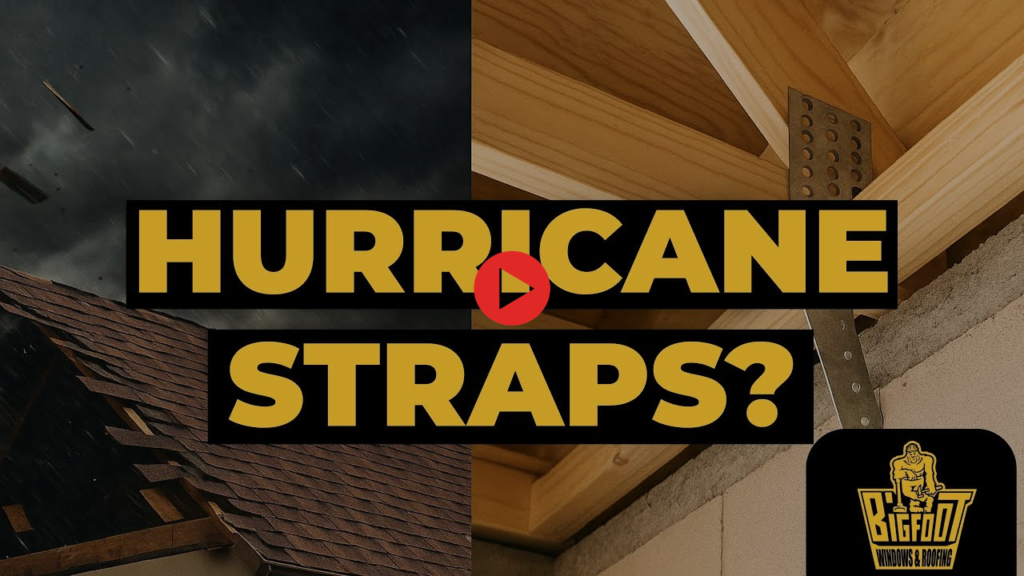
Today I want to talk about hurricane straps, based on an appointment I had earlier today with a homeowner.
She’s an older woman, later in life, and her long-term plan is to eventually pass her home down to her children. During the inspection, I went into the attic and noticed that her roof structure is still attached using an older method called toe-nailing.
Toe-nailing is when the roof trusses sit on the concrete block wall and are held in place by a few nails driven at an angle. That was common decades ago, but by today’s standards, it’s the weakest form of roof attachment.
After toe-nails, the next level up is clips, then single straps, and finally double straps, which provide the highest level of wind resistance.
This homeowner needs a new roof — and because it’s tile, we’re easily talking about a $40,000 investment. When I explained what I saw in the attic, I told her honestly:
If you’re already making this kind of investment, now is the time to address the hurricane straps.
Here’s why.
Hurricane straps are what actually hold your roof to your home during a storm. If strong winds lift the roof, everything underneath is exposed — water intrusion, interior damage, electrical issues, mold — and that’s where damage goes from manageable to catastrophic.
In her case, this conversation was even more important because she self-insures. She owns her home outright and does not have windstorm insurance. So if a hurricane were to hit and the roof were torn off, she wouldn’t just lose the roof — she’d be responsible for all the interior damage as well.
That’s a $40,000 roof, plus potentially tens of thousands more in repairs, completely out of pocket.
We discussed adding hurricane straps during the reroof. In her case, it would be around $3,500.
When you step back and look at it logically, paying $3,500 to better secure a $40,000 roof — especially without windstorm insurance — is a no-brainer.
There’s also the long-term value to consider.
Even if her children decide not to keep the home and choose to sell it instead, a future buyer will hire a home inspector. That inspector will note whether the home still has toe-nails or minimal clips. When the buyer goes to insure the home, that directly impacts their insurance rates.
Higher insurance costs give buyers more leverage to negotiate a lower sale price.
So while I completely understand her mindset of “when I’m gone, it won’t be my problem,” from an investment standpoint, it’s not setting the home up for success — either for safety, resale value, or future insurability.
A lot of homeowners don’t fully understand this because hurricane straps aren’t something you see every day. They’re hidden in the attic, and they’re rarely explained unless someone takes the time to walk you through it.
At Bigfoot Windows and Roofing, our goal isn’t pressure — it’s education. If you’re already investing in a new roof, it’s important to understand what’s holding that roof in place and whether your home is truly protected when the next storm comes.
Because the worst time to learn how your home performs is during a hurricane.