
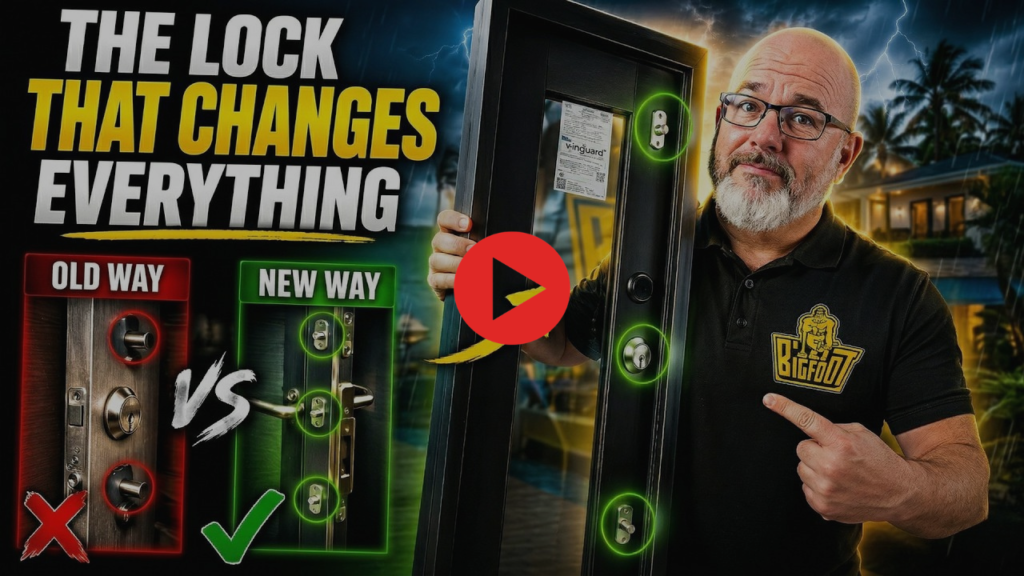
Most South Florida homeowners upgrade to impact doors for hurricane protection, but few realize how much the locking system matters for security and performance. The difference between a standard deadbolt and a three‑point lock can be the difference between a door that holds firm and a door that gives under pressure.
What Is a Traditional Deadbolt?
A traditional deadbolt is the lock most people are familiar with: one locking point that extends from the door into the frame, usually around handle height. It provides basic resistance against forced entry, but all that force is concentrated in a single spot.
On an impact door, a simple deadbolt is often the weakest link, not the glass or the frame. Under heavy wind pressure, prying, or repeated impact, that single locking point can start to flex, shift, or fail.
What Is a Three‑Point Locking System?
A three‑point lock connects your impact door to the frame at three separate points: typically at the top, middle, and bottom of the door panel. Instead of one bolt, there are multiple locking hooks or bolts that engage into the frame when you operate the handle or key.
This spreads force across the entire height of the door, rather than focusing everything on one latch. During a storm or an attempted break‑in, the door is far less likely to twist, bow, or pop open because it is anchored in multiple places.
Why Three‑Point Locks Matter in South Florida
In South Florida, doors have to stand up to two big threats: hurricanes and break‑ins. A three‑point lock helps with both.
- Better wind resistance: When high winds push against the door, the pressure is distributed into three locking points and deeper into the frame. That reduces the chances of the door bending or the lock area failing.
- Stronger against prying: With a basic deadbolt, an intruder only has to attack one area of the door edge. With a three‑point system, they’re fighting against multiple locks along the entire panel.
- Less flex, tighter seal: A door that stays straight and tight against the frame also helps maintain the weather seal, which can improve comfort and reduce drafts during storms.
For a region where insurance, safety, and code compliance all matter, upgrading the lock system is just as important as choosing the right impact glass.
Common Myths About Impact Door Locks
Many homeowners assume that because a door is labeled “impact,” everything about it is automatically top‑tier—including the lock. In reality, not all impact doors come standard with a three‑point system, and not all lock packages are created equal.
Another common myth is that three‑point locks are complicated to use. In practice, most systems are designed so that locking the door feels almost identical to using a regular handle and deadbolt—just with much more going on inside the hardware.
How Bigfoot Helps You Choose the Right Lock
At Bigfoot Windows & Roofing, we don’t just sell impact doors—we walk you through what’s happening inside the frame and the hardware so you know exactly what you’re getting. When we explain deadbolt vs three‑point locking systems, we focus on how each option affects:
- Security and forced‑entry resistance
- Performance during high winds and storms
- Long‑term durability and alignment of the door
- Insurance and peace‑of‑mind for your family
Our goal is to match your door, frame, glass, and lock system so they all work together as a single, strong unit—not a mix of strong glass with a weak lock.
Thinking About New Impact Doors?
If you’re considering new impact doors or replacing older ones, this is the perfect time to look beyond just the glass and frame. Ask specifically about deadbolt vs three‑point locking systems, and make sure your door is built to handle both everyday use and South Florida’s toughest weather.
Bigfoot Windows & Roofing helps homeowners across Miami‑Dade, Broward, and Palm Beach choose the right combination of impact doors, locks, and installation so the whole system works together. When we secure your home, we’re not just installing a door—we’re building a stronger, safer entry point for your family.