Roofing · South Florida homeowner guide
Hidden Roof Replacement Costs: What Should Have Been Disclosed Before You Signed?
By Darryl Rosenbaum, Bigfoot Windows and Roofing · Reviewed September 2026 · General information, not legal advice.
Quick answer: is an added roofing charge legitimate?
An added roofing charge is not automatically a scam, but it should never be unexplained. Predictable work should be included, excluded, or assigned a written allowance or unit price before you sign. Truly concealed damage may justify a change order after tear-off, but the contractor should document the condition, explain why it must be corrected, price it in writing, and obtain authorization before proceeding whenever the roof can be left safe.
Florida’s contractor statutes set rules on deposits, permits and lien notices. They do not write the extra-work rules for you. Your contract does. For example, a contractor who takes more than a small initial payment must apply for permits within thirty days, and a residential contract must carry the state’s construction-lien notice (s. 489.126, Florida Statutes; s. 713.015, Florida Statutes). Everything about how extra work is priced and approved comes from the paperwork you sign.
Decking
Decking (also called sheathing) means the wood panels or boards nailed over the rafters or trusses. The roof covering sits on it.
Dry-in
Dry-in means the stage when the bare deck is covered with underlayment, the water-resistant layer that protects the house before the finished roof goes on.
Allowance
An allowance means a set amount or quantity written into the contract for work whose final amount is not known yet. You pay or are credited the difference.
Unit price
A unit price means a fixed price per unit, such as per sheet of plywood or per foot of fascia board, applied to whatever quantity the job actually needs.
Concealed condition
A concealed condition means a defect that could not reasonably be seen or confirmed before the old roof came off.
Change order
A change order means a written, signed document that adds, removes or changes contract work and adjusts the price and the schedule.
What does “hidden cost” actually mean?
Homeowners use one phrase for six different things. Only one of the six is a problem with the contractor’s proposal. The table sorts them.
| Six kinds of “extra” roofing cost and what the proposal should show | ||
|---|---|---|
| Category Plain-English meaning What the proposal should show | ||
| Included | Plain-English meaning: Part of the agreed project | What the proposal should show: Clear written scope |
| Excluded | Plain-English meaning: Not part of the contract price | What the proposal should show: Specific exclusion and responsibility |
| Allowance/unit price | Plain-English meaning: Quantity is unknown, pricing method is known | What the proposal should show: Rate, unit, trigger, and approval process |
| Concealed condition | Plain-English meaning: Could not reasonably be verified before opening the roof | What the proposal should show: Documentation, explanation, written price/change order |
| Proposal omission | Plain-English meaning: Predictable scope was left undefined | What the proposal should show: Clarification/revised proposal before signing |
| Owner-requested change | Plain-English meaning: Homeowner changes selections or scope | What the proposal should show: Written price and schedule effect |
One more category matters: not stated. If the proposal says nothing about an item, that does not prove it is excluded. It does not prove it is included. It does not prove anyone meant to deceive you. It means you should ask for clarification in writing before you sign.
Apply the same test to every company, including Bigfoot. A good proposal makes it easy to see which row each item lands in.
Which costs can legitimately stay uncertain until tear-off?
Even a careful inspection cannot see through a roof covering. The items below can be true concealed conditions. For each one, the questions are the same: why is it invisible, what evidence should you be shown, how should the price already be defined, and does it need an engineer or another licensed trade?
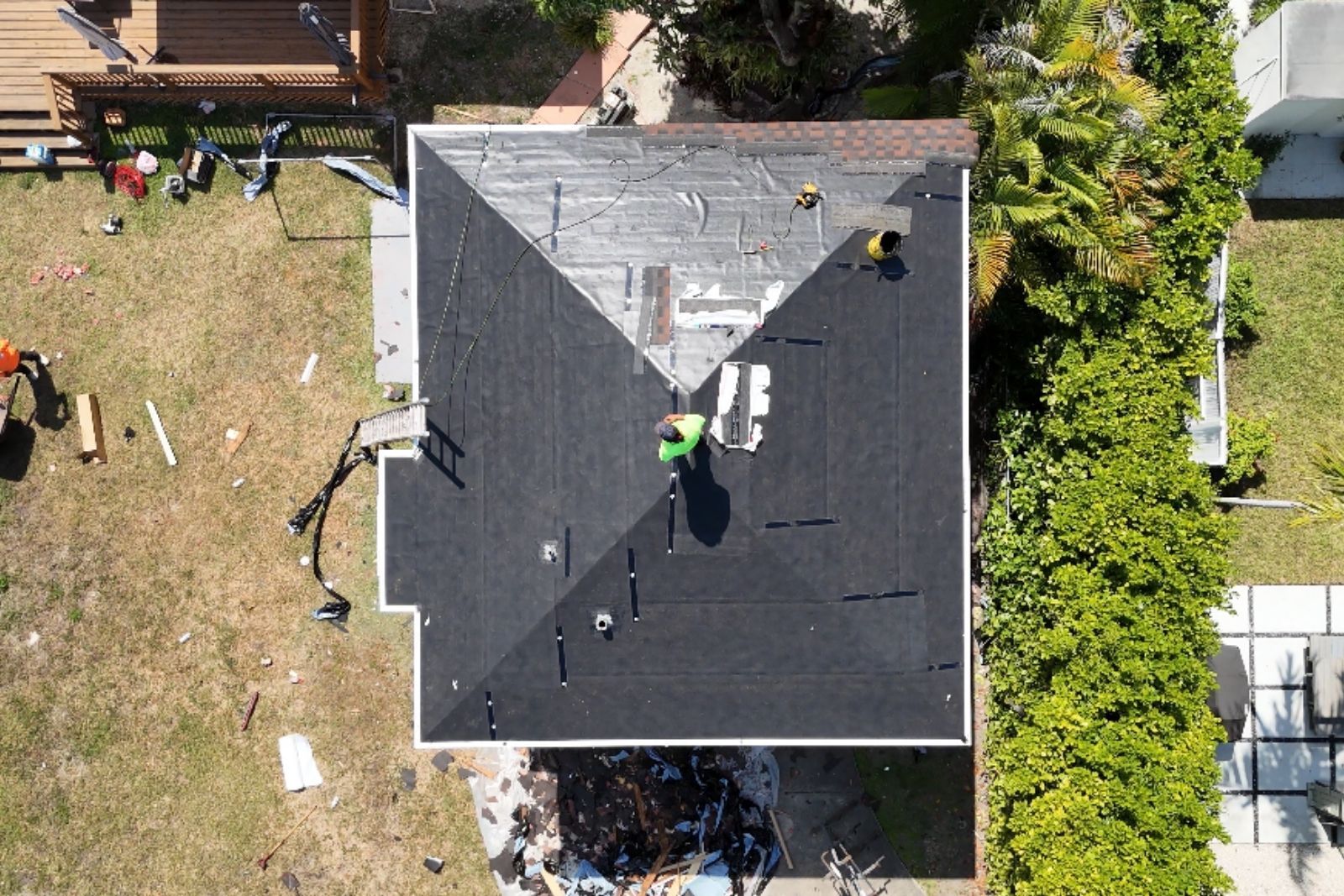
The roof at dry-in. Only at this stage can the deck and framing be seen and checked. (Bigfoot job, drone view)
Deteriorated plywood or board decking
Rot, delamination and soft spots hide under the old covering. You should be shown photos of the bad panels in place and a count of what was replaced. The price should already be defined as a unit price per sheet or per board. No engineer is needed for ordinary panel replacement. For the numbers, see the decking replacement cost guide; this article does not repeat them.
Damaged framing: fascia, sub-fascia, rafter tails, trusses
Fascia rot is sometimes visible from the ground. Rafter tails and truss members usually are not. Ask for photos of the damaged member and a measurement of the length replaced. Carpentry should be priced per linear foot of each board size. Truss or rafter repair beyond simple sistering may need an engineer’s letter, and the inspector may ask for it.
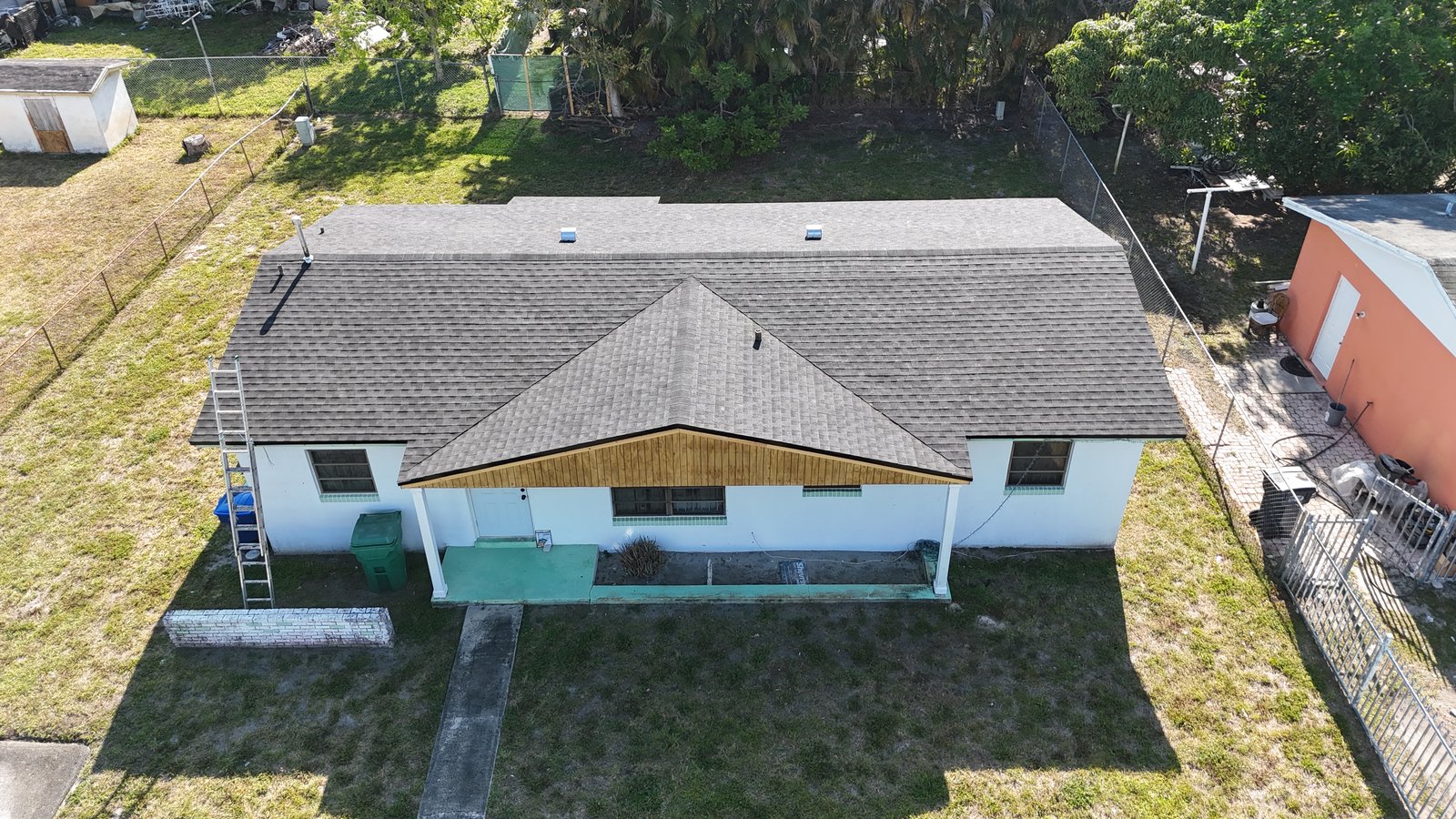
New gable trim lumber on a completed re-roof. Wood like this is often found rotten only after the old roof comes off. (Bigfoot job, drone view)
Extra roof layers or assemblies nobody documented
A second layer of shingles, an old built-up roof under tile, or insulation board under a flat membrane may not show on the surface. The evidence is simple: a photo of the cut edge showing the layers. Removal and disposal should be priced per square foot or per layer. Under the Florida Building Code, a new covering may not be installed over an existing one where the old roof is water-soaked or deteriorated, so the layers you actually have change the work (Florida Building Code, Residential, Chapter 9). For older homes, the older-home tear-off guide covers what each category tends to involve.
Flashing and transition conditions
Where a roof meets a wall, chimney or another roof, the old flashing may be rusted through or buried in mastic. It cannot be judged until the covering is off. Ask for a photo of the exposed transition. Flashing for a specified system should be in the base scope; rebuilding a rotted wall transition is the concealed part and should be priced by the foot.
Wet insulation or trapped moisture on low-slope roofs
Flat and low-slope roofs can hold water inside the insulation with no sign on top. A moisture scan before tear-off can narrow the risk but does not remove it. Evidence is a core cut or a scan map. Removal of wet material should be priced per square foot. Drainage redesign may need an engineer.
Hidden drainage and slope problems
Ponding areas and dead-level sections often appear only when the old membrane comes off. You should be shown where water sits and why. Tapered insulation or added drains are usually priced as a separate written item, not as a unit price. A licensed plumber or an engineer may be required for new drains or scuppers.
Code corrections that could not be confirmed beforehand
Florida law directs the Building Commission to build wind-mitigation upgrades into the code for older homes when they are re-roofed, including secondary water barriers, roof-deck fastening, and in some cases roof-to-wall connection improvements (s. 553.844, Florida Statutes). Whether your straps meet the standard is often unknown until the deck is open. Evidence is the inspector’s comment or a photo of the connection. Ask how strap work is priced before you sign, and read the roof-to-wall strap page for what the work involves.
Conflicts with skylights, solar, electrical, HVAC and penetrations
A skylight curb, a solar rack, a conduit run or an old vent stack may be rotted, undersized or non-compliant underneath. You should be shown the item and told whether it can be reused. Relocating solar or electrical work is another licensed trade and should be an explicit exclusion or a separate written price. Bigfoot’s terms make the customer responsible for removing or relocating satellite dishes, solar equipment, signage and other rooftop items at the customer’s expense, and for telling Bigfoot about exposed sheathing, septic tanks and drain fields before work starts. The proposal should state whether skylights, gutters, HVAC or electrical conflicts and drainage corrections are included, excluded, covered by a unit price or handled through a separate written change order.
Which items should never be a surprise?
Companies structure prices differently, and no law forces one estimating format. Scope clarity matters more than a line-item breakdown of internal material and labor cost. Even so, a written proposal should address each item below in some form:
- Tear-off and disposal scope, including the number of layers assumed.
- The roof system by name and its major components.
- Underlayment or secondary water-barrier system.
- Drip edge, flashing, penetrations, valleys, transitions and ventilation as they apply to that system.
- Permits, standard municipal fees, inspections, and who closes the permit. Miami-Dade publishes its own roofing permit requirements (Miami-Dade County, Roofing Permits); the roof permit guide walks through the process.
- Material delivery, staging and ordinary access assumptions.
- Cleanup and debris removal.
- Known HOA or association requirements and who handles them.
- Payment milestones.
- Exclusions and the change-order procedure.
If one of these is missing, that is a proposal omission, not a concealed condition. Ask for it before signing. The guide to what a roof replacement estimate should include goes item by item.
Which South Florida conditions commonly affect the final cost?
These are not reasons to fear a re-roof. They are reasons the paperwork needs to be specific here. It helps to keep four sources of rules apart.
Jurisdiction rules
- HVHZ versus non-HVHZ. The Florida Building Code carries separate High-Velocity Hurricane Zone sections, including their own re-roofing rules, and sends HVHZ homes to those sections (Florida Building Code, Building, Chapter 15). Miami-Dade and Broward projects follow them; Palm Beach projects generally do not.
- Existing-building rules. Re-roofing an existing home falls under the Existing Building volume’s roofing section (Florida Building Code, Existing Building, Chapter 7).
- Product approval. Every product in the assembly needs a current approval for its use. Florida approvals are searchable in the state database (Florida Product Approval search), and Miami-Dade runs its own product control program on top of it.
- Strict municipalities, associations and existing violations. Some cities add review steps, and an open violation on the property can hold a permit. The HOA roof approval guide covers association review.
Manufacturer instructions
- Each system has an installation manual and an approval document that fix fastening, underlayment and accessory requirements. Those, not preference, decide what a compliant assembly contains.
Project-specific conditions
- Older or previously modified decks: board decks, mixed thicknesses, past repairs.
- Tile availability: a discontinued profile or color can change the plan from repair to replacement.
- Metal fabrication: panels are field-measured and made to order, so lead time and measurement affect schedule.
- Flat-roof drainage and roof-to-roof transitions.
- Storm-season weather protection and scheduling.
- Coastal corrosion and material compatibility where the manufacturer’s data supports it.
Which system you have matters for what can stay hidden. Learn what each one involves on the shingle, tile, metal and flat roofing pages. Do not assume one rate schedule applies to every roof system. Confirm the applicable carpentry and concealed-condition rates in the specific written proposal before signing.
Bigfoot policy
Company policy is the fourth source, and it belongs in the contract, not in a blog post. The next section quotes Bigfoot’s deployed terms where they exist and marks what still needs confirming.
How does Bigfoot handle a concealed condition?
This section is based on the Terms and Conditions attached to Bigfoot’s current roofing proposals. Where those terms do not define a project-specific step, the article tells homeowners what to confirm in writing rather than guessing.
- The crew opens the roof and finds something. Bigfoot’s terms state that during tear-off the condition of the existing roof deck, sheathing and framing cannot be fully known until the covering is removed. The proposal is based on observable visual conditions, and rotten, damaged or non-code wood (roof deck, fascia, soffit, truss, furring) is described as frequently concealed until tear-off.
- Replacement waits for a written change order. Where rotten, damaged or non-code material is found, the terms say it is documented by change order before the work proceeds, and the customer is notified of the condition and the cost before replacement. If a concealed condition requires a decision, ask how the affected area will be made safe and protected from weather while written authorization is pending. The project-specific plan should be documented before work begins.
- Photos and measurements. Ask for dated photos, measurements and quantities showing the condition before approving additional work, and confirm who is responsible for placing that documentation in the project record.
- Someone explains what kind of work it is. Bigfoot’s proposal deck promises one named contact from the day you sign to the day the permit closes. The written explanation should identify whether the work is optional, recommended, required by code or an inspector, structurally necessary, or subject to engineering or another licensed trade. The terms exclude permit, architectural and engineering fees unless the Scope of Work says otherwise, and note that prices can change with final engineering or architectural analysis. Violations not related to Bigfoot’s scope of work are treated separately from final payment. Do not assume permit, inspection, processing, closeout, architectural, engineering or HOA/association charges are included. The project Scope of Work should list each inclusion, exclusion and responsible party.
- The price is already defined for carpentry; other unforeseen work is priced in writing. Concealed carpentry is replaced at the published Carpentry Replacement Rates disclosed in the proposal and billed as used at the next progress payment; larger or specialty lumber, roof scuppers and insulation are additional. Those rates are printed in the proposal by board size and sheet type so the homeowner sees the wood bill before work starts. For other unforeseen conditions that visual inspection could not reveal, the terms provide for the additional work to be performed on a time-and-materials or firm-bid basis after the customer has been notified. A change order adjusts both the contract sum and the contract time.
- The homeowner decides. A change order takes effect only when the document is mutually agreed and signed by the owner and Bigfoot, one signature from each side. The contract should state how quickly the homeowner must respond to a concealed-condition price and how the roof will be protected while a decision is pending. Do not assume repair by another contractor is permitted. If that option matters, have the contract explain approval, licensing, scheduling, inspection and warranty consequences before work begins. The guaranty clause states that work done by others than Bigfoot or its authorized agents relieves Bigfoot of obligations under the guaranty for that work. If corrective work is required for safety, code compliance or the approved installation, the contractor should document why the roof cannot proceed as proposed and explain the available written options.
- The decision goes in the project record. Signed change orders are paid in full at the next progress payment or the final payment, whichever comes first. Bigfoot also offers an optional pre-purchased wood allowance at a discount, with any unused wood refunded at job close-out. Bigfoot’s terms note that a design, estimating and coordination fee may be charged for researching and pricing a change, whether or not the change is elected. Payment timing should follow only the milestones written in the specific signed contract. The change order should state when its amount becomes due.
Nothing above says work always stops. Whether a roof can be left open depends on weather, the size of the finding and safety. The contract language and the site conditions decide that together.
What should a good proposal say before work starts?
- What is included.
- What is excluded, and who is responsible for it.
- What is an allowance, and how unused amounts are handled.
- Which unit prices apply, with the measurement unit for each.
- What triggers replacement or correction, and who decides.
- Who documents and authorizes additional work.
- How the roof is protected while a decision is pending.
- Timing and payment effects of a change; Florida also limits how a deposit is handled (roofing deposit law guide).
- Responsibility for permits, engineering, inspections, violations and association approvals.
- What happens if required work is declined.
The roofing estimator helps homeowners explore the project before requesting a formal proposal, and the estimate-contents guide linked above goes deeper. This article will not recreate them.
How do you evaluate an unexpected charge?
- Find the original contract language on unforeseen conditions, unit prices and change orders.
- Ask whether the condition was visible or reasonably knowable before signing.
- Request photos, measurements, the inspector’s comments, or an engineer’s letter as appropriate.
- Ask whether the work is required or optional, and by whom: code, inspector, manufacturer, or the contractor’s recommendation.
- Compare the proposed rate with the unit price or allowance already in the contract.
- Request the cost and the schedule impact in writing.
- Do not authorize verbally if the contract requires written authorization.
- For a major dispute, consult the appropriate licensed professional or a Florida attorney.
Do not let a dispute leave the house exposed. Emergency protection of an open roof is a separate decision from the disputed charge, and it should not wait.
What are the warning signs, without accusations?
None of the following alone proves fraud or poor workmanship. Each one is a reason to ask a question.
- Predictable components left out of the proposal entirely.
- No written change-order method.
- Phrases such as “additional cost as needed” with no pricing basis.
- Significant extra work requested without photos or an explanation.
- A price demanded after the work was done when advance authorization was reasonably possible.
- Pressure to pay immediately without a written description.
- Quantities or measurement units that do not match from one document to the next.
- Refusal to explain whether the work is required, recommended, or elective.
What should you ask before signing?
- Which costs are fixed, and which can change?
- What concealed conditions are most plausible on this specific roof?
- What unit prices or allowances apply to decking and carpentry?
- What documentation will I receive before approving additional work?
- Who determines whether corrective work is required?
- Will work pause, and how will the roof be protected?
- How much time will I have to decide?
- Can I use another properly licensed contractor for excluded work?
- How will a change affect the schedule and payment milestones?
- Are permits, municipal fees, inspections, engineering, HOA fees, cleanup, and disposal included?
Take the answers in writing. You can check any contractor’s license on the state site (Florida DBPR license search). The roofing contract checklist covers the rest of the document.
The bottom line
The goal is not a roof contract that pretends nothing unexpected can happen. It is a contract that explains what is already included, identifies foreseeable exclusions, prices uncertainty where possible, and defines what happens when the roof reveals something no one could see beforehand.
Want a roofing proposal that explains the known scope and the unknowns? Ask Bigfoot for a clear South Florida roof evaluation and written estimate.
Request a roof evaluation Call 786-886-2088 Text 786-358-7754
Related reading: the South Florida roofing pricing guide, the roofing buyer’s guide, and Bigfoot roofing in Miami.
Sources
- Section 489.126, Florida Statutes — permit-application and start-of-work timing after an initial payment.
- Section 713.015, Florida Statutes — mandatory construction-lien notice in residential direct contracts.
- Section 553.844, Florida Statutes — windstorm loss mitigation; secondary water barriers, roof-deck fastening and roof-to-wall connections when re-roofing older homes.
- 2023 Florida Building Code, Residential, Chapter 9 Roof Assemblies — roof assemblies, existing roofing, HVHZ referral.
- 2023 Florida Building Code, Building, Chapter 15 — High-Velocity Hurricane Zone roofing and re-roofing sections.
- 2023 Florida Building Code, Existing Building, Chapter 7 — existing roofing under Level 1 alterations.
- Florida Product Approval search — statewide product approvals.
- Miami-Dade County, Roofing Permits — county roofing permit requirements.
- Florida DBPR license search — contractor license verification.
- Bigfoot Windows and Roofing, roofing proposal Terms and Conditions (pages 1–3) and Carpentry Replacement Rates, as deployed in the current proposal deck — quoted for company-policy statements only.
Author and reviewer: Darryl Rosenbaum, founder, Bigfoot Windows and Roofing (Bigfoot Construction, Inc.).
Florida licenses: CGC1531370, CCC1333168, CRC1331693, SCC131153098.
Contact: 786-886-2088 · Contact Bigfoot
Update log: September 2026 — reviewed for publication. Company-policy statements are quoted from the current proposal terms; project-specific items direct homeowners to confirm the applicable terms in writing.