
Home Improvement Financing · South Florida

What Is PACE Financing and Is It Right for Your Home Improvement Project?
Updated June 2026
Key Takeaways
- PACE financing is repaid through your property tax bill — not a monthly bank payment.
- Qualification is based on available home equity, not your credit score or income.
- The assessment stays with the property; a buyer must pay it off or assume it at closing.
- PACE rates are typically higher than a home equity loan — compare total cost carefully.
- In Miami-Dade and Broward, PACE can fund impact windows, roofing, and related structural scope.
- Bigfoot also offers contractor-arranged financing — ask about both options before deciding.
The Problem
Why South Florida Homeowners Are Looking at PACE
Impact windows, roofing, and storm upgrades cost real money. Traditional loans aren’t always accessible.
A full set of impact windows for a South Florida home can run $8,000–$25,000 or more depending on opening count, frame material, and structural conditions. Add a roof replacement and you’re looking at a significant capital decision — often on a tight timeline driven by insurance renewal or an upcoming hurricane season.
For homeowners who have equity in their property but don’t qualify for a traditional loan — or who don’t want another monthly bill hitting their bank account — PACE financing offers a different structure. It isn’t right for every situation, but understanding exactly how it works helps you decide whether it fits yours.
South Florida Context
PACE in Miami-Dade, Broward, and Palm Beach
Florida authorized PACE programs under Chapter 163 of the Florida Statutes (the “Florida PACE Funding Act”). Miami-Dade, Broward, and Palm Beach counties all participate. This matters because Florida’s High-Velocity Hurricane Zone (HVHZ) — which covers Miami-Dade and Broward — requires impact-rated products and specific installation standards under the Florida Building Code. PACE can be used to fund those qualifying improvements, including impact doors, impact windows, roofing, and certain other permanent upgrades.
Because HVHZ projects often involve structural scope — hurricane straps, permit-required structural modifications, or multi-trade coordination — working with a contractor who holds a Certified General Contractor license (CGC1531370) means structural and non-structural scopes can be managed under one roof, without hiring separate subcontractors for each trade. That reduces scheduling friction and helps keep the project moving through the permit and inspection process.
How It Works
PACE Financing Explained Step by Step
What PACE stands for: Property Assessed Clean Energy. Originally created for solar and energy-efficiency upgrades, Florida expanded eligible improvements to include wind-resistance upgrades — which is how impact windows and roofing entered the picture.
The core mechanic: Instead of borrowing money from a bank and making monthly payments, PACE attaches a special assessment to your property. You repay it as a line item on your annual property tax bill — typically over 5, 10, 15, or 20 years depending on the program and the amount financed.
Qualification logic: PACE programs qualify you based on available equity in your home, not on your credit score or income. The basic test: your home’s value must be sufficient relative to existing liens plus the new PACE assessment. If you own a significant portion of your home’s value, you may qualify even with bruised credit or inconsistent income — which is why PACE appeals to self-employed homeowners and retirees in South Florida.
Interest rates and terms: PACE rates are generally higher than conventional home equity products. As a reference point, Renew Financial has publicly cited rates in the range of 9–10% (e.g., 9.49%) with terms up to 20 years. Always request a full amortization schedule and compare the total repayment cost against a HELOC or personal loan before signing — PACE is convenient but not always cheapest.
| Feature | PACE Assessment | Home Equity Loan / HELOC | Contractor-Arranged Financing |
|---|---|---|---|
| Repayment method | Property tax bill | Monthly bank payment | Monthly payment (varies by lender) |
| Qualification basis | Home equity / lien position | Credit score + income | Varies; some programs equity-based |
| Credit check required? | Typically no hard pull | Yes | Depends on program |
| Lien on property? | Yes — senior or parity position | Yes — second position | No property lien in most cases |
| Rate range (approx.) | ~8–12% fixed | ~7–10% variable or fixed | Varies widely |
| Typical term | 5–20 years | 5–30 years | 12–144 months |
| Transferable at sale? | Assessment stays with property | Must be paid off at closing | No — personal obligation only |
Rate ranges above are general market references only. Always verify current program terms directly with the PACE provider or lender before applying.
What PACE can fund in Florida: Eligible improvements generally include impact windows, impact doors, roofing, insulation, solar, and certain HVAC upgrades — though each program has its own eligibility list. Confirm with your PACE provider that your specific scope qualifies before starting the project.
If you want to explore financing for roofing alongside window upgrades, ask your contractor whether both scopes can be batched into a single PACE application — some providers allow this, which simplifies the paperwork.
Comparison

PACE vs. Other Financing Paths — How to Decide
Before comparing options, define your criteria: monthly cash-flow impact, total interest paid, whether you plan to sell in the near term, and whether your credit profile limits traditional lending. PACE wins on accessibility; it often loses on total cost and on sale-complication risk.
| Scenario | Best-Fit Option | Why |
|---|---|---|
| Strong credit, staying 5+ years | HELOC or home equity loan | Lower rate, no property lien complication at sale |
| Limited credit, significant equity, staying long-term | PACE | Equity-based qualification; no monthly bank payment |
| Selling within 2 years | Personal loan or cash | PACE assessment complicates title; must disclose to buyers |
| Moderate credit, mid-range project | Contractor financing | Simpler, no property lien, competitive programs available |
| Large multi-trade project (windows + roof + structural) | PACE or HELOC | Higher limits; PACE batches well for large scopes |
When PACE Is the Better Fit
- You have meaningful equity but limited income documentation (self-employed, retired).
- You prefer to avoid adding a monthly bank payment to your budget.
- You plan to stay in the home for 10+ years and want to spread cost over time.
- Your project scope is large enough that smaller financing programs don’t cover it.
When PACE Is NOT the Better Fit
- You plan to sell or refinance within 1–3 years — the assessment must be disclosed to buyers and typically paid off at closing.
- Your mortgage lender’s rules prohibit senior-lien PACE assessments — always check with your lender first.
- You qualify for a HELOC at a materially lower rate — the total interest cost of PACE will be higher.
- You’re purchasing a home in a community with HOA or condo restrictions that complicate PACE enrollment.
Why Contractor Credentials Matter Here
A Licensed Contractor, Not a Lead Aggregator
When PACE funds a large project, the contractor you choose determines whether the work actually passes inspection and qualifies for the assessment reimbursement.
✓ Certified Roofing Contractor (CCC1333168)
✓ Certified Residential Contractor (CRC1331693)
✓ Glass & Glazing Specialty (SCC131153098)
✓ Miami-Dade · Broward · Palm Beach
“PACE is a funding mechanism. The value of the project still depends entirely on the installation quality and whether it passes inspection. We pull the permits, we do the work, and we stand behind it.”
President, Bigfoot Windows & Roofing
What We Install
Impact Windows and Roofing Eligible for PACE Funding
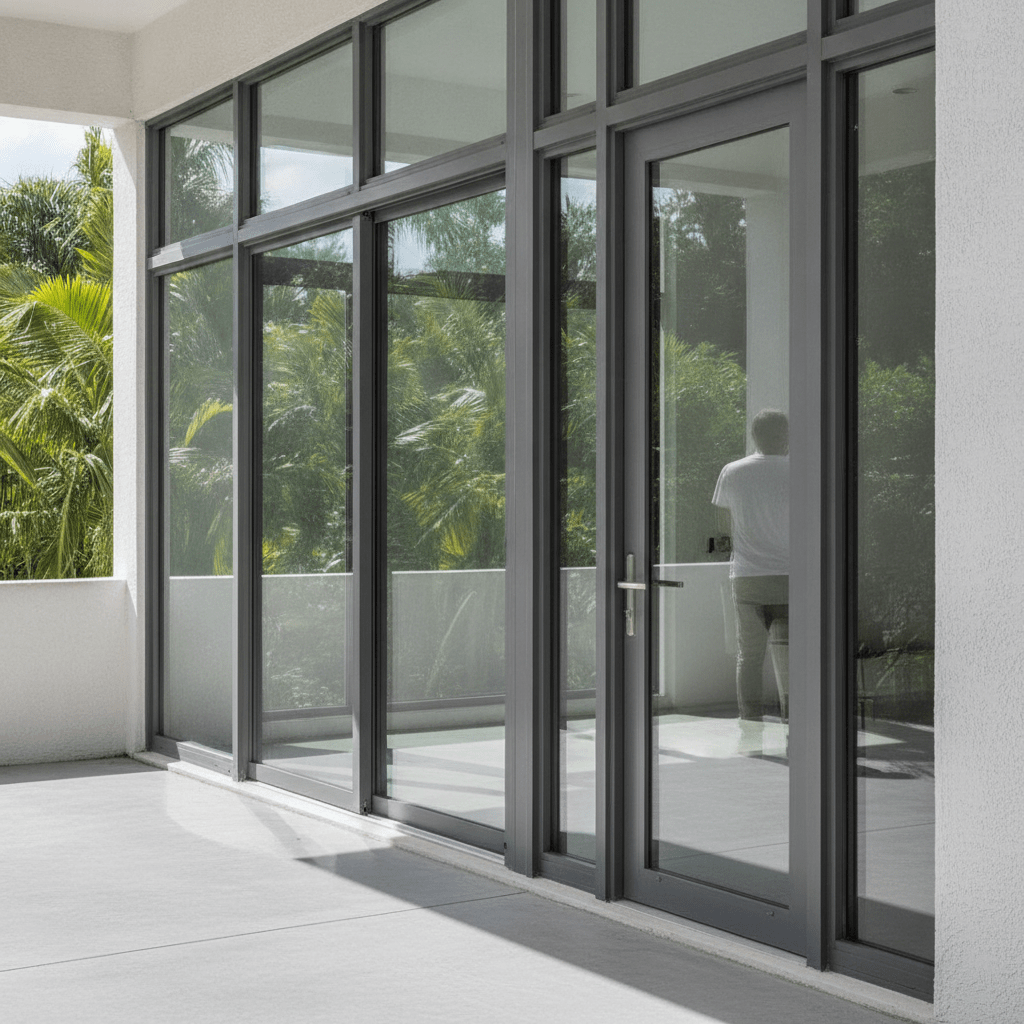
The products that qualify for PACE wind-resistance improvements in Miami-Dade and Broward are the same products required under the Florida Building Code for HVHZ: impact-rated windows and doors with Florida Product Approval (NOA), and roofing systems that meet the applicable wind-speed and attachment requirements.
Bigfoot primarily installs aluminum-framed impact windows and doors. In South Florida’s heat, humidity, UV exposure, and salt-air environment, aluminum frames have a longer track record than vinyl — particularly in HVHZ coastal applications. When energy performance is a priority, thermally broken aluminum frames reduce heat transfer while maintaining structural integrity. We work with Mr. Glass and ES Windows for our window and door product lines.
For homeowners using PACE to bundle windows and roofing into a single project, our Certified General Contractor license means structural scope — hurricane strap upgrades, decking repairs, structural modifications required to bring openings into code compliance — can be handled in-house rather than requiring a separate GC to oversee the work. That matters when a PACE-funded project involves both trades and you need clean permit closeout on all scopes.
Process
How a PACE-Funded Project Works in Practice
- Get a project estimate first. Know your total scope and cost before applying for PACE. Use our online windows estimator to get a starting number.
- Apply with a PACE provider. Your contractor can refer you to participating PACE programs in Florida. You apply based on your property value and existing liens — no income documentation is typically required.
- Receive approval and sign the assessment agreement. You’ll receive a disclosure document outlining rate, term, total repayment amount, and the lien position. Read it carefully — specifically the payoff clause for home sales.
- Contractor pulls permits. Work cannot begin until permits are issued. For HVHZ projects, this step is non-negotiable under the Florida Building Code.
- Installation and inspection. The contractor completes the work. Final inspection by the local building department closes the permit. PACE funds are released to the contractor after documented project completion.
- Assessment appears on property tax bill. Your annual property tax bill will reflect the PACE assessment as a line item, beginning with your next tax cycle.
Ready to explore financing for impact windows or roofing in South Florida?
Who We’re Not the Right Fit For
We’d rather be honest upfront than waste your time or ours.
- You’re planning to sell within 12–24 months. A PACE assessment stays with the property and must be disclosed to buyers. If your timeline is short, a different financing path is cleaner. We can still do the work — just with a different funding approach.
- You need the absolute lowest possible rate. If you have excellent credit and strong income documentation, a HELOC will likely beat PACE on total interest paid. We’re happy to work with homeowners using any funding source, including their own bank.
- Your project is a small single-window repair or minor patch job. PACE programs have minimum project sizes and are not efficient for small scopes. Bigfoot is set up for full-scope projects — full window replacement, full roofing systems, or combined multi-trade scopes.
- You want a cash-and-carry, no-permit installation. All our work is permitted and inspected per the Florida Building Code. If you’re looking for an unpermitted install, we’re not your contractor.
Frequently Asked Questions
Frequently Asked Questions
What is PACE financing and how is it different from a loan?
PACE (Property Assessed Clean Energy) is a property assessment — not a bank loan. You repay it through your annual property tax bill rather than a separate monthly payment. Because repayment is tied to the property, qualification is based on home equity rather than your credit score or income. The assessment creates a lien on your home that travels with the property if you sell.
How does paying through my property tax bill work?
After your project is completed and verified, the PACE assessment is added as a line item to your annual property tax bill. You pay it once or twice a year alongside your regular taxes — either directly or through your mortgage escrow account. Your lender will adjust your escrow payment if PACE is included, which may increase your monthly mortgage payment.
Does PACE financing affect my credit score?
PACE programs typically do not require a hard credit pull for approval, so the application itself generally does not lower your credit score. However, if you fall behind on property taxes — including the PACE assessment — delinquency can affect your credit and potentially trigger tax certificate proceedings. Timely payment protects both your credit and your property.
What happens to the PACE lien if I sell my house?
The PACE assessment stays with the property and must be disclosed to buyers. At closing, it is typically paid off from sale proceeds — similar to how a mortgage balance is handled. Some buyers may agree to assume the remaining assessment, but this requires the buyer’s lender to approve the lien position. If you plan to sell soon, get a payoff figure before signing a PACE agreement.
Who qualifies for PACE — is it based on income or equity?
Qualification is primarily equity-based. PACE providers evaluate your property’s current value against existing mortgage balances and the proposed new assessment. Income documentation is generally not required. This makes PACE accessible to retirees and self-employed homeowners who have significant home equity but may not qualify for traditional financing. Each program has its own maximum loan-to-value threshold.
What is the typical interest rate and term on a PACE program?
Rates vary by program and project type, but PACE rates in Florida have generally ranged from approximately 8% to 12% fixed, with terms of 5 to 20 years. Renew Financial has publicly cited rates around 9.49% on 20-year terms as a reference. Compare the full amortization schedule — total interest paid over the life of the assessment — against HELOC or contractor-arranged financing before you decide.
Can PACE fund both impact windows and roofing in the same application?
In many cases, yes. Florida PACE programs allow multiple eligible improvements to be bundled into a single application. Impact windows, impact doors, and qualifying roofing systems may all be included in one PACE assessment. Confirm eligibility with your PACE provider before scoping the project. Working with a contractor who holds both roofing and window licenses simplifies the documentation and permit process for a multi-trade application.
Sources & References
- Florida Statutes, Chapter 163, Part III — Florida PACE Funding Act (leg.state.fl.us)
- Florida Department of Business and Professional Regulation (DBPR) — Licensee Search, verified June 2026
- Florida Building Code, 8th Edition — HVHZ wind-resistance and product approval requirements (floridabuilding.org)
- Miami-Dade County Building Department — Notice of Acceptance (NOA) database (miamidade.gov)
- ENERGY STAR — Certified windows and doors program (energystar.gov)
- Renew Financial — publicly cited program terms (referencedfor illustrative rate range only; verify current terms at renewfinancial.com)
Have questions about financing your impact window or roofing project?
Call Bigfoot Windows & Roofing or request a free estimate online — we’ll walk you through your options.