
Florida Building Code & HVHZ Compliance
Key Takeaways
- Egress windows require 5.7 sq ft net clear opening (24" H × 20" W minimum) per Florida Building Code R310.
- Miami-Dade and Broward are HVHZ — every window replacement needs a product approval or NOA, which means impact-rated glazing.
- Sill height must be ≤44" from the finished floor so an occupant can exit without a ladder or tool.
- Adding or enlarging an egress window often involves a structural header — this is where a Certified General Contractor scope matters.
- Cost varies widely by opening size, frame material, glass thickness, and permit complexity; get a line-item estimate before committing.
Why This Matters for South Florida Homeowners
The Real Risk of a Non-Compliant Egress Window
A window that “looks fine” may still fail a code inspection — and cost you at closing.
Most South Florida homeowners discover egress window problems in one of three ways: a permit inspection rejection during a renovation, a 4-point insurance inspection, or a last-minute flag from a buyer’s inspector at closing. All three can stall or kill a deal.
The stakes are higher here than in most of the country. Miami-Dade and Broward sit inside the High-Velocity Hurricane Zone (HVHZ) — the strictest residential building code jurisdiction in the United States. A window that meets the IRC baseline in Georgia or Tennessee likely does not meet Florida’s requirements here. If you’re replacing a bedroom window or converting a space to a bedroom, you need to verify compliance with both the life-safety egress rules and the wind/impact standards that apply in coastal South Florida.
Beyond the code, there is a practical safety issue: egress windows exist so that a person can exit — or a firefighter can enter — a sleeping room during an emergency. Undersized or improperly installed windows put occupants at risk.
Miami-Dade & Broward Specifics
How South Florida HVHZ Rules Layer on Top of State Code
Florida Building Code is the floor. HVHZ adds another layer on top.
Florida follows the Florida Building Code (FBC), Residential Volume, which is based on the International Residential Code (IRC) but substantially amended. Section R310 governs egress windows statewide. But in Miami-Dade and Broward counties — the HVHZ — two additional requirements apply:
- Product Approval or Miami-Dade NOA: Any window installed in the HVHZ must have either a Florida Product Approval number or a Miami-Dade Notice of Acceptance (NOA). This document proves the unit has been tested to HVHZ wind-load and impact standards.
- Impact-rated glazing: Standard annealed or tempered glass does not meet HVHZ requirements for habitable spaces. You effectively need impact-laminated glass — or a panel shutter system over a non-impact window, which is impractical for an egress opening.
Palm Beach County is outside the HVHZ but still follows the FBC and has its own wind-load requirements. Many Palm Beach projects use the same impact-rated products because the supply chain and permit process are nearly identical in South Florida.
If you’re unsure whether your address falls in the HVHZ, search the Miami-Dade County product control portal or ask your contractor to pull the NOA documentation before ordering product.
Working with impact-rated egress windows is the simplest path to satisfying both the life-safety code and the HVHZ product requirements in a single installation.
Florida Building Code R310 — What the Numbers Actually Mean
Egress Window Size, Height, and Opening Requirements
| Requirement | FBC R310 Minimum | Notes for HVHZ |
|---|---|---|
| Net clear opening area | 5.7 sq ft | Measured as the operable open area, not the frame size |
| Minimum clear height | 24 inches | Same in HVHZ; applies to open position |
| Minimum clear width | 20 inches | Same in HVHZ; applies to open position |
| Maximum sill height | 44 inches from finished floor | Allows exit without a step stool or tool |
| Window type allowed | Single/double hung, casement, horizontal roller | Must open fully to egress dimensions without tools |
| Product approval | Florida Product Approval (statewide) | Miami-Dade NOA or a Florida Product Approval that covers HVHZ use required for HVHZ installations |
| Glazing | Tempered or laminated per FBC | Impact laminated required in HVHZ habitable spaces |
One detail many homeowners miss: the 5.7 sq ft measurement is the net clear opening — the actual hole you can crawl through when the window is fully open, not the rough opening or the frame size. A 36" × 48" frame window does not automatically produce 5.7 sq ft of net clear area. Measure the operable opening with the sash fully open. Some single-hung designs only open 50% of the sash height, which can drop the clear area below the threshold.
Casement Windows and Egress
Casement windows are often the easiest window type to satisfy egress requirements because the entire sash swings open — giving you close to the full frame area as the net clear opening. In the HVHZ, casement impact windows from lines like Mr. Glass come with stainless steel hardware as a standard feature (not an upgrade), which matters for corrosion resistance in South Florida’s salt-air environment.
Horizontal Rollers and Egress
The Mr. Glass Series 300 horizontal roller is tested to 80/80 psf and spans up to 127-5/8" wide in a 3-panel configuration. For egress applications, the sliding panel must independently meet the 5.7 sq ft net clear requirement — the fixed panel does not count toward the opening.
Window Type Comparison for Egress Use
Which Window Style Best Satisfies Egress Rules in South Florida?
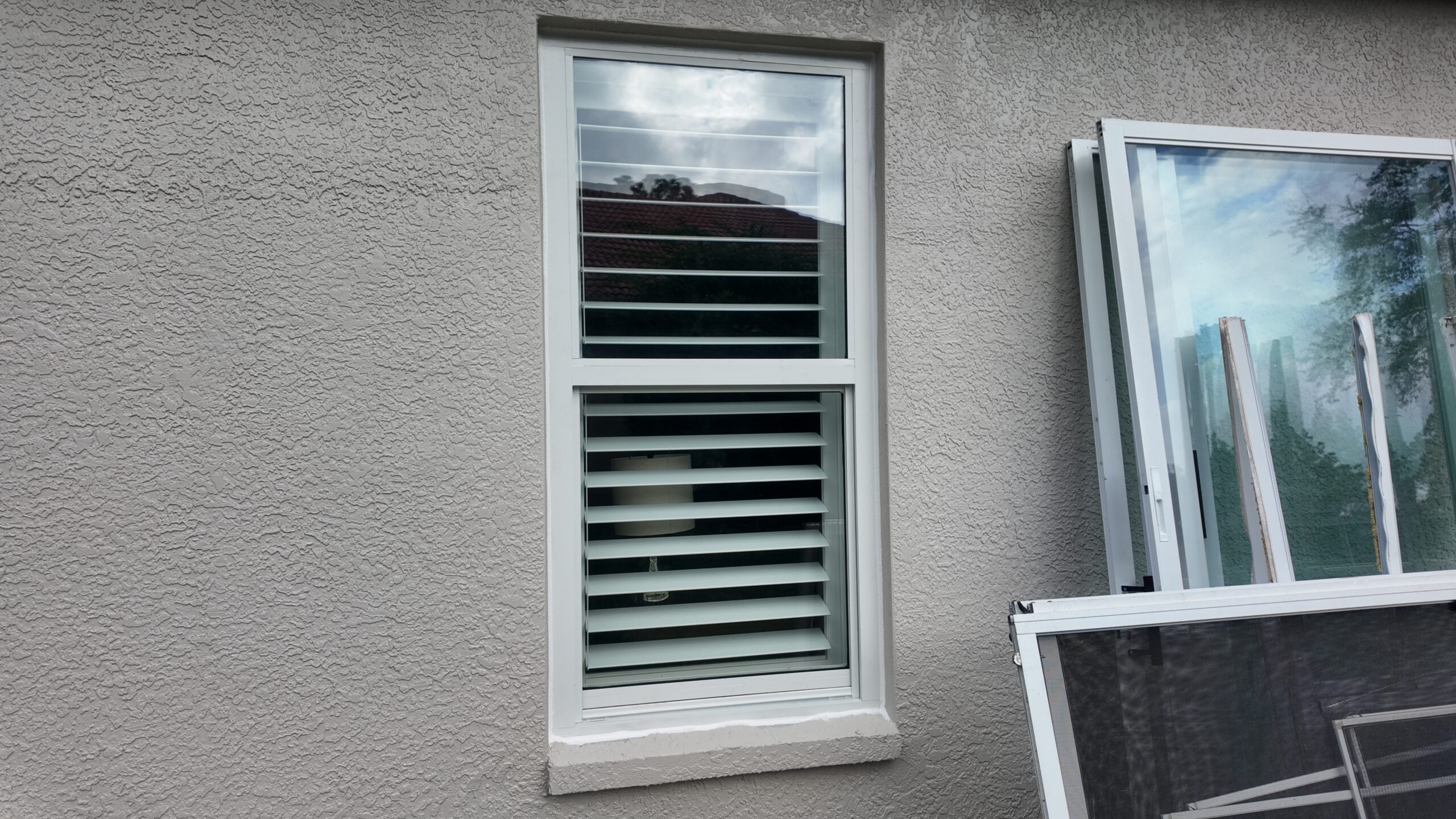
Not every style is equally practical for egress compliance — here is how the common types compare.
| Window Style | Egress Ease | HVHZ NOA Available | Notes |
|---|---|---|---|
| Casement (aluminum) | Easiest — full sash opens | Yes (Mr. Glass, ES Windows) | Stainless hardware standard; best egress area per frame size |
| Single hung (aluminum) | Moderate — lower sash only | Yes | Upper half fixed; verify net clear on smaller frames |
| Horizontal roller (aluminum) | Moderate — one panel slides | Yes | Only the operable panel counts; 3-panel configs may help |
| Double hung (aluminum) | Good — both sashes move | Yes | Lower sash egress is standard; verify clear height |
| Fixed / picture window | None — does not open | Yes (but no egress credit) | Cannot be used as egress opening; supplemental operable unit required |
When a non-Bigfoot option may be the better fit
If you are replacing a single egress window without any structural change and your builder or developer has already specified a different HVHZ-approved product line with an active NOA, staying with that specified product may be more efficient for your project. We are not the right call for one-window jobs that are already mid-permit with another contractor. We are built for whole-house and multi-opening scopes where impact window coordination across rooms benefits from a single licensed entity pulling one permit.
Why Licensing Matters for Egress Work
A Licensed Contractor, Not a Lead Aggregator
Egress projects that touch structural headers require a scope most window-only installers cannot legally perform.
✓ Certified Roofing Contractor (CCC1333168)
✓ Certified Residential Contractor (CRC1331693)
✓ Glass & Glazing Specialty (SCC131153098)
✓ Miami-Dade • Broward • Palm Beach
“When a homeowner needs to enlarge a bedroom opening for egress, that almost always means cutting into the wall framing and sizing a structural header. That is not a glazing-only job. Our Certified General Contractor license means we can handle the structural scope and the window install under one permit, with one point of accountability.”
Product Guidance for Egress Windows in South Florida
What We Install — and Why We Recommend Aluminum
For HVHZ egress applications, aluminum frames outperform alternatives in heat, humidity, UV, and long-term structural integrity.
We primarily install Mr. Glass and ES Windows aluminum impact window lines for egress applications in South Florida. Here is why aluminum is our recommendation for this climate:
- Dimensional stability: South Florida heat and UV cause vinyl frames to expand and contract more than aluminum, which can affect the precision of the egress opening over time.
- Salt air durability: Coastal properties (within 2 miles of water) require a 2605 anodized finish for warranty compliance. Aluminum frames with the proper finish handle salt air reliably over decades.
- Structural rigidity: Aluminum frames meet HVHZ structural requirements without the wall-thickness trade-offs that some other frame materials introduce.
For egress in condos, high-rise buildings, or properties requiring 9/16" laminated glass, the Mr. Glass Series 200 (flagship single hung) with spiral adjustable balances and a 2-7/8" frame is high-rise capable. The frame depth does not change when upgrading glass thickness — a common misconception that can cause homeowners to over-spec the rough opening.
If energy efficiency is a priority, ask about thermally broken aluminum frames, which add a thermal-barrier break inside the aluminum extrusion to reduce heat transfer without sacrificing structural performance in HVHZ conditions.
All Mr. Glass lines carry Florida Product Approval. For full Miami-Dade NOA coverage, confirm the specific series and configuration with your installer before ordering — not every size variant within a product line carries an active NOA.
Explore our full impact window installation services or get details specific to your county on our Miami-Dade service page.
From Estimate to Final Inspection
How the Egress Window Installation Process Works
Understanding the steps helps you plan your timeline and avoid surprises.
- Site measurement and code verification: We measure the existing rough opening and verify whether it already meets R310 net clear dimensions. If enlarging is needed, we scope the structural header work as part of the same estimate.
- Product selection and NOA confirmation: We confirm the selected window series, size, and glass spec carry an active Miami-Dade NOA or Florida Product Approval for your jurisdiction.
- Permit application: We pull the permit in your county. HVHZ permits require a Miami-Dade NOA or a Florida Product Approval that covers HVHZ use to be submitted with the application.
- Structural work (if required): If the opening needs to be enlarged, the structural header is sized and installed before the window is set. This scope is performed under our Certified General Contractor license, which authorizes structural modifications of this type — homeowners do not need to hire a separate framing contractor.
- Window installation: The impact window is set, flashed, and sealed per the NOA installation instructions and FBC requirements. Any deviation from the NOA-specified installation method can void the product approval.
- Inspection and close-out: The county inspector verifies the installation. We provide the inspection records for your permit file, which matters for insurance wind mitigation documentation.
A new or enlarged egress window that passes inspection and is documented in a wind mitigation report can contribute to lower homeowner’s insurance premiums in South Florida. The actual savings vary by insurer and policy — consult your agent after the permit is closed.
Ready to check egress compliance or replace a bedroom window in Miami-Dade or Broward?
Who We’re Not the Right Fit For
We are direct about this because it saves everyone time:
- Single-window, no-structural-change jobs on a tight budget: Our process — licensed pull, NOA documentation, inspection coordination — has overhead. If you need one window swapped with no structural work and price is the only criterion, a smaller operation with lower overhead may give you a lower number. We are typically a better fit for multi-window scopes or projects where structural scope is involved.
- Projects in counties outside our service area: We focus on Miami-Dade, Broward, and Palm Beach. If your property is in a different county, we are probably not the most efficient choice.
- Homeowners seeking the lowest possible bid, regardless of documentation: We pull permits, follow NOA installation instructions to the letter, and do not skip inspections. If a competing bid is significantly lower and skips the permit, that is a liability you will carry at resale or on a claim — but we understand not every homeowner prioritizes that the same way.
- Projects requiring window brands or systems we do not carry: We install Mr. Glass and ES Windows. We do not carry every brand in the market. If you’ve already committed to a specific product line we do not stock, we are likely not the right fit.
Common Questions
Frequently Asked Questions
What are the egress window requirements in South Florida?
South Florida egress windows must meet Florida Building Code Section R310: minimum 5.7 sq ft net clear opening, 24" minimum clear height, 20" minimum clear width, and sill height no more than 44" from the finished floor. In Miami-Dade and Broward (HVHZ), the window must also carry a Miami-Dade NOA or Florida Product Approval, which in practice means impact-rated laminated glass is required.
Does every bedroom in Miami-Dade need an egress window?
Yes. Florida Building Code requires every sleeping room to have at least one egress window or exterior door. In a code-compliant bedroom, one of the windows must meet the R310 size and sill-height requirements. Rooms that do not have a compliant egress opening cannot legally be classified as bedrooms — which matters for appraisals, insurance, and resale.
Do egress windows in South Florida need to be impact-rated?
In Miami-Dade and Broward (HVHZ), yes — any window replacement or new installation in a habitable space must have HVHZ product approval, which requires impact-laminated glazing. A panel shutter over a non-impact window technically satisfies the wind standard but creates a practical egress problem: you cannot open a shutter from inside during an emergency. Impact glass is the functional solution for egress in the HVHZ.
How much does an egress window installation cost in South Florida?
Cost depends on opening size, frame material, glass thickness, whether the rough opening needs to be enlarged (structural work), and permit complexity. A straightforward single-window replacement in an existing compliant opening typically costs less than a project that requires framing modification and a structural header. Get a line-item estimate that separates product, labor, permit, and any structural scope so you can compare bids accurately. We do not publish a single price because the variables are too significant.
Can I enlarge an existing window to meet egress requirements?
Yes, but enlarging a rough opening almost always involves modifying the wall framing and installing or resizing a structural header. This work requires a contractor authorized for structural modifications — in Florida, that typically means a Certified General Contractor or Certified Residential Contractor. A glazing-only sub-contractor may not be licensed to perform this structural scope. Verify your contractor’s license type before signing.
Will a new egress window affect my homeowner’s insurance in Florida?
A permitted impact window installation documented in a wind mitigation report can support a premium reduction request with your insurer. The actual savings depend on your insurer, current policy structure, and the total scope of your home’s wind protection. We are not insurance advisors — consult your agent after the permit is closed and you have the inspection documentation in hand.
What window styles work best for egress in a South Florida bedroom?
Casement windows are often the most efficient egress style because the full sash swings open, maximizing the net clear area relative to frame size. Single-hung and double-hung windows can also work if the frame is large enough to deliver 5.7 sq ft of open area at 24" minimum height. Horizontal rollers qualify if the operable panel alone meets the dimensions. Fixed windows provide zero egress credit regardless of size.
Related Articles
Sources
- Florida Building Code, Residential Volume, Section R310 — Emergency Escape and Rescue Openings (current edition).
- Miami-Dade County Product Control Division — Notice of Acceptance (NOA) database.
- Florida Department of Business and Professional Regulation (DBPR) — Contractor license verification.
- Florida Statute 553 — Florida Building Code adoption and enforcement authority.
Need an egress window in Miami-Dade, Broward, or Palm Beach? We pull the permit, handle structural scope if needed, and install HVHZ-approved impact windows under a single licensed entity.