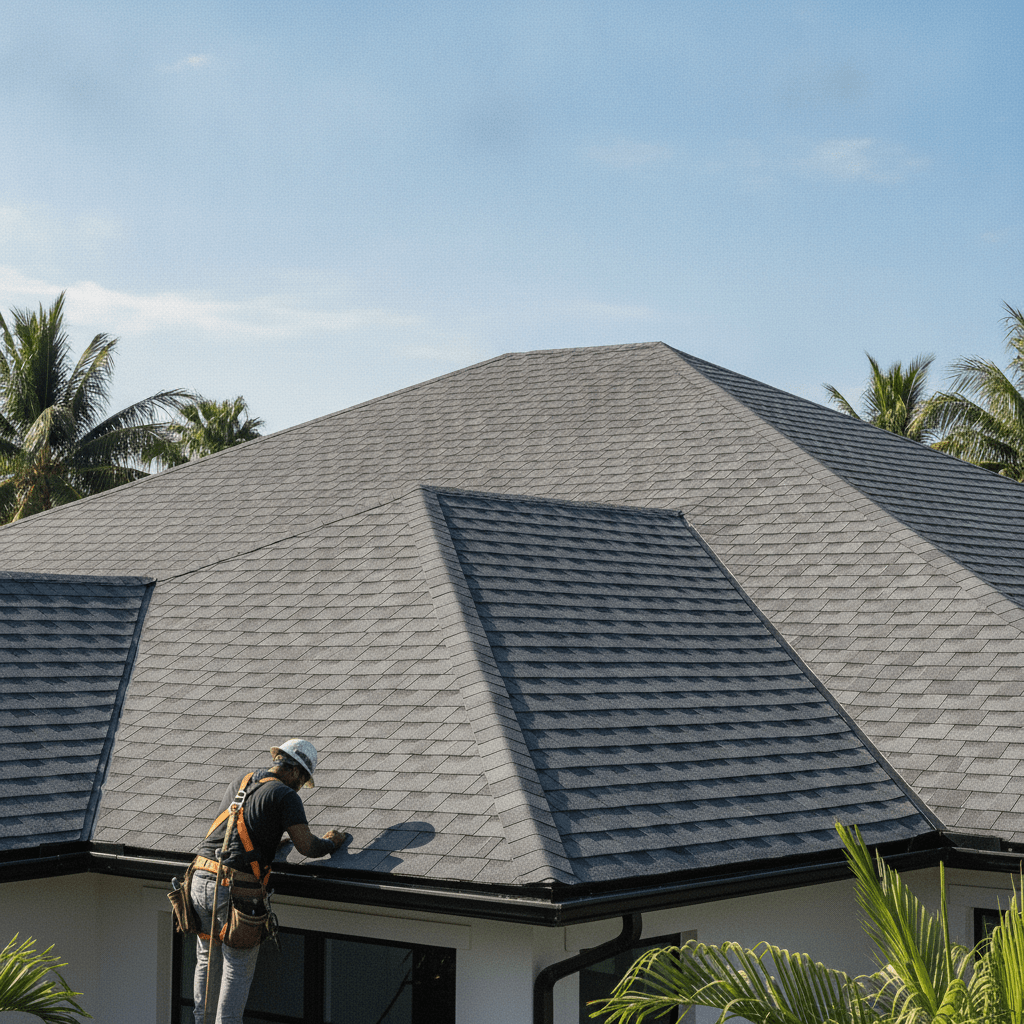
Bigfoot Homeowner Decision Center · Roofing
What to Expect From a Roof Repair in South Florida
The short answer
A professional roof repair should begin with diagnosis, not an automatic patch. The contractor should identify the likely entry point, define the repair area and exclusions in writing, explain what could change if concealed damage is found, document the work, and tell you what the repair does—and does not—cover.
This guide is about repairs, not full replacements. If you are weighing a whole new roof, the timeline and steps are different, and Bigfoot has separate pages for that decision and its cost (linked below where they apply).
One fact shapes everything that follows: water rarely drips where it gets in. The U.S. Environmental Protection Agency’s building-moisture guidance puts it plainly: water from rain “may travel many feet along the bottom of a floor joist or roof truss before collecting in a drop big enough to fall” (EPA,Moisture Control Guidance for Building Design, Construction and Maintenance, 2013). A stain on the ceiling is a symptom. The entry point is usually somewhere uphill, and finding it is the actual job.
What can a roof repair do—and what can’t it do?
A repair is a targeted fix. Used for the right problem it is the responsible choice, and it is not a second-class option. It helps to be clear about its limits before you sign anything.
- A localized repair corrects an identifiable, localized failure. A cracked pipe boot, a slipped tile, a lifted seam, a separated piece of flashing—flashing being the metal pieces that seal the joints where a roof meets a wall, pipe, chimney or valley—can each be fixed on their own.
- A repair does not reset the age or condition of the whole roof. The rest of the surface keeps the wear it already had.
- Fixing one entry point does not guarantee that an unrelated leak cannot open somewhere else later. Two leaks on one roof can have two separate causes.
- Repeated symptoms can point to a wider problem—drainage, flashing, decking (the plywood or boards the roofing is nailed to), or the places where two roof planes or two roof systems meet.
- The proposal should define the repaired area and the limits of responsibility so both sides know what “done” means and what is outside the scope.
Small repairs are not inherently bad, and replacement is not automatically safer. What matters is whether the diagnosis supports the fix.
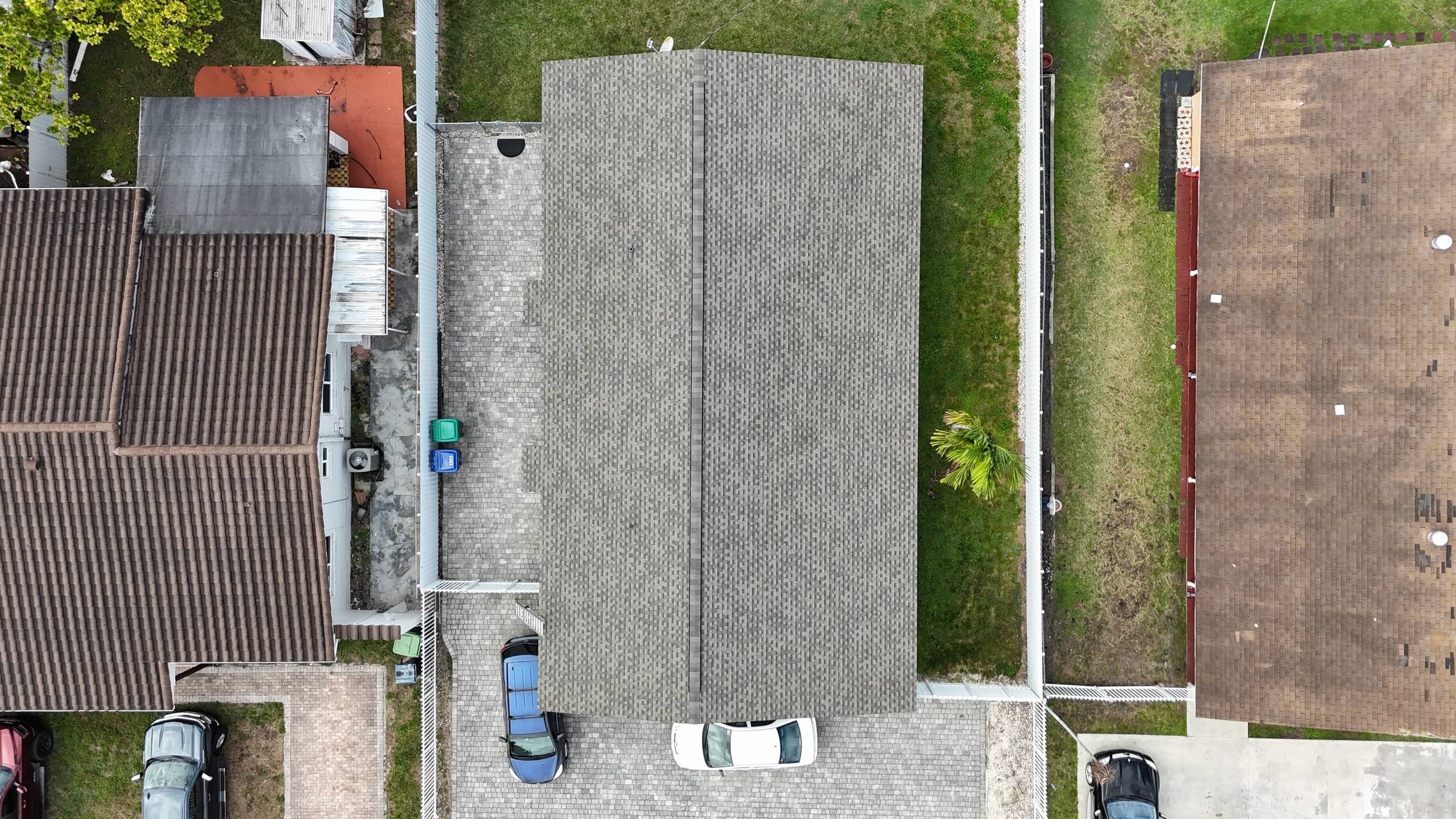
Aerial view of completed roof in Miami by Bigfoot Windows and Roofing — after
How does Bigfoot diagnose the problem?
Bigfoot’s published roofing process begins with an initial call to discuss the need and scope, followed by a scheduled site visit, an on-site inspection and measurements, and a written estimate. Repair intake and availability can vary, so confirm the current process when scheduling.
Bigfoot’s proposal is based on visible conditions. If conditions that could not be identified through visual inspection appear after work begins, any additional work should be documented and authorized in writing before it proceeds.
A thorough repair diagnosis generally involves:
- You describe the symptom: where the water shows up inside, when it started, and what the weather was doing.
- Roof type, age, repair history and any recent storm are reviewed.
- The roof surface is inspected for likely entry points and the condition of the area around them.
- Interior or attic evidence may be checked when it is safe, accessible and relevant. Confirm whether that inspection is included in your written evaluation scope.
- Findings should be documented. Ask the written proposal to state whether photographs will be supplied and how they will be delivered.
- The recommendation may be a defined repair, further investigation, temporary protection or a replacement evaluation. Emergency tarping or temporary mitigation is not guaranteed; confirm current availability, price and conditions directly with Bigfoot.
- The written scope states the repair area, the materials, the exclusions, and what happens if concealed damage is found.
Repair pricing and accepted scope vary by project. Before the visit, confirm any diagnostic fee, whether it may be credited toward approved work, which testing methods are included, and whether the requested repair meets the current service criteria. Advanced testing is used only when appropriate and included in writing.
A photograph of a stain, or a description over the phone, is a starting point—not a diagnosis. Nobody can responsibly tell you the cause from a symptom alone.
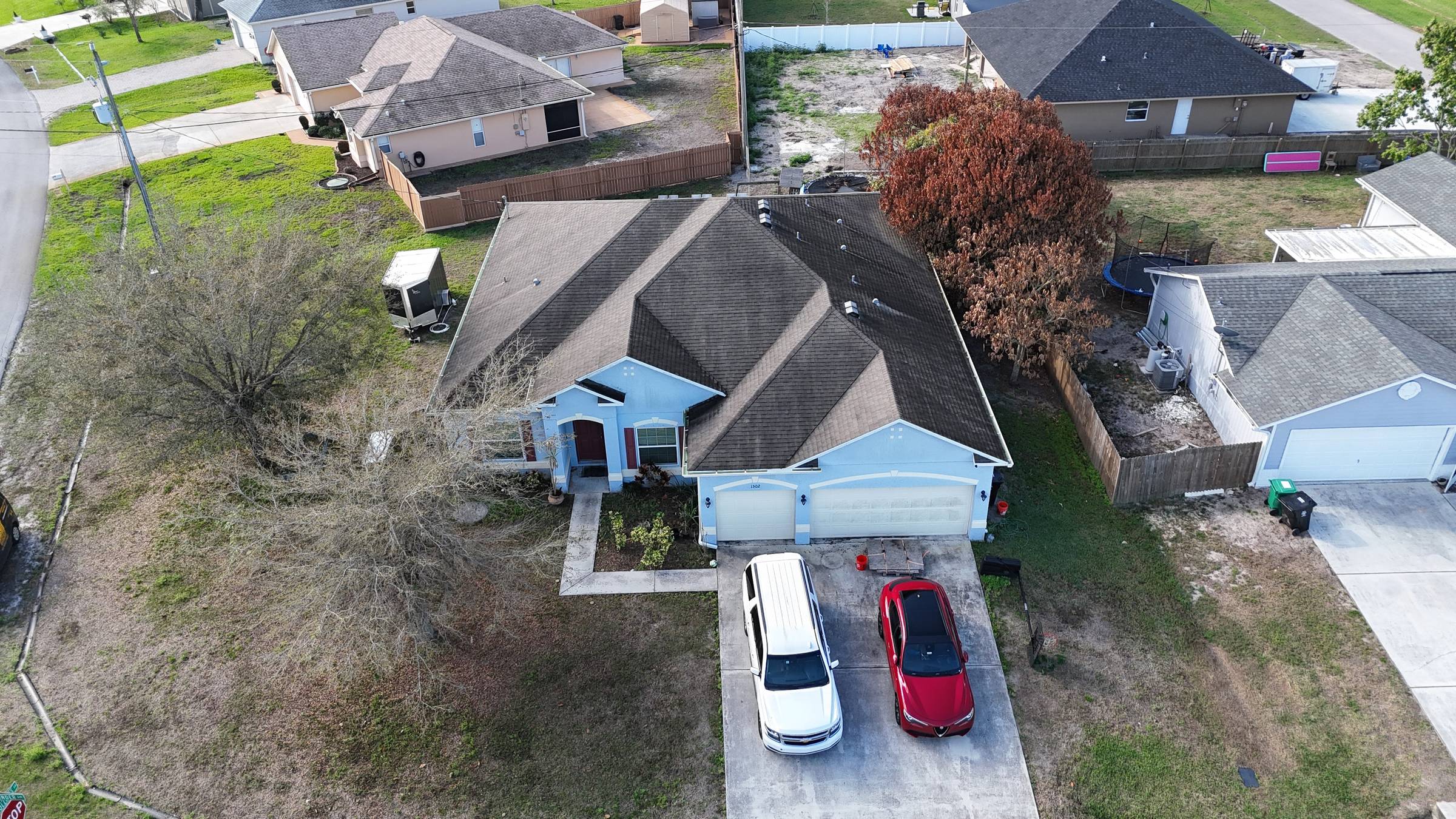
Aerial view of completed roof in Port St. Lucie by Bigfoot Windows and Roofing
Common South Florida repair situations
Each card separates what you can see from what is usually going on underneath. The symptom is real; the cause still has to be confirmed on the roof.
Slipped, cracked or broken tile
You see: a tile out of line, a crack, or a piece on the lawn.
Usually behind it: the tile is the weather shield, but the waterproofing is the underlayment beneath it. A broken tile matters most when the underlayment under it is aged, torn or exposed. See tile roofing.
Missing or damaged shingles
You see: bare patches, curled tabs, granules in the gutter.
Usually behind it: lost seal strips or nails that have backed out; wind lifts the tab and rain follows. The question is how far the lifting extends beyond what is visible. See shingle roofing.
Flashing and wall-to-roof transitions
You see: a stain near where a lower roof meets a taller stucco wall.
Usually behind it: step flashing or counter-flashing that has separated from the wall, or sealant that has dried out. Federal building-science guidance notes that when sidewall flashing is lacking or inadequate, “water can leak into the wall and cause serious water damage” (U.S. DOE Building America Solution Center).
Pipe boots and roof penetrations
You see: a leak near a bathroom or kitchen vent, or around an A/C line.
Usually behind it: the rubber collar around the pipe has cracked or shrunk under years of sun. It looks intact from the ground.
Valleys
You see: staining below the line where two roof slopes meet.
Usually behind it: debris damming the valley, or worn valley metal or underlayment letting water back up under the covering.
Flat-roof seams, blisters, punctures and drainage
You see: a drip that follows heavy rain, standing water that stays for days, or a bubble in the surface.
Usually behind it: an open seam or puncture in the membrane (the sheet or built-up layers that make a flat roof watertight), a blister where the layers have separated, or a clogged scupper or drain. See flat roofing.
Metal roof fasteners, clips, sealant and penetrations
You see: rust streaks, a drip at a screw line, or a leak at a vent.
Usually behind it: a fastener washer that has aged, a clip that has loosened, or sealant at a penetration that has failed. See metal roofing and metal-tile roofing.
Localized decking damage found after opening the roof
You see: nothing—until the covering comes up.
Usually behind it: a soft or delaminated area of the substrate (the deck or surface the roofing is attached to) where water sat for a long time. This is the most common reason a repair scope changes after it starts. Pricing for decking is owned by the roof decking replacement cost guide.
Storm debris or impact damage
You see: a branch on the roof, a dent, cracked tiles in a line.
Usually behind it: the visible damage plus, sometimes, cracked or displaced material around it that only shows up on close inspection.
What affects repair cost?
This guide does not publish prices. Bigfoot’s roof leak repair cost guide owns that topic. What is useful here is why two repairs that sound alike can be priced differently:
- Access, height, pitch and how complicated the roof is to move around on safely.
- The roof system, and whether matching material is available.
- How large an area has to be opened to reach the cause.
- Flashing, penetration, transition or drainage work in the scope.
- Concealed decking, lumber, insulation or structural damage found after opening.
- Permit and inspection requirements for that scope and jurisdiction.
- Temporary protection or mobilization.
- Discontinued materials that make a compatible repair harder.
From Bigfoot’s contract termsBigfoot’s contract does not include permit, architectural or engineering fees or additional insurance requirements unless they are noted in the Scope of Work—so ask whether a permit is part of your repair’s written scope.
Whether a repair needs a permit depends on the scope and where the house is. Miami-Dade and Broward are in the High-Velocity Hurricane Zone (HVHZ, the Florida Building Code’s stricter wind region for those two counties), and reroofing and roof repair are governed by the Florida Building Code, Existing Building volume (2023 FBC Existing Building, Chapter 7). Your building department is the authority: Miami-Dade, the Broward County Building Code Division, or Palm Beach County’s Building Division. The Miami-Dade roof permit guide on this site walks through the process.
Why can’t a South Florida roof repair be promised for an exact day?
Roof work here is scheduled around conditions, not just calendars. Several things have to line up:
- Safe working conditions. Crews come off the roof when lightning is near; the National Weather Service notes that lightning can strike several miles from the parent thunderstorm (National Weather Service Miami, lightning safety).
- A dry surface. Adhesives, sealants and self-adhering underlayments need a dry substrate to bond.
- The repair system and its cure time. Some materials need hours of dry weather after application; a flat-roof patch and a tile reset have different windows.
- Crew and material availability—especially a matching tile profile or a discontinued shingle.
- Forecast confidence. Afternoon storms are the normal pattern for much of the year, so a morning start on a small scope is often chosen over an all-day plan.
From Bigfoot’s contract termsBigfoot’s contract states that the contractor is not responsible for delays caused by manufacturing or delivery delays, sudden rain, storms, windstorms or other causes beyond the contractor’s control.
Before approval, confirm who will provide scheduling updates and whether the confirmation will arrive by call, email or text. Weather decisions are based on safe working conditions and product instructions; this guide does not promise a universal rain-probability cutoff.
What happens on repair day?
Not every repair needs the same crew size, permit, inspection or number of steps. This is the general shape, with Bigfoot’s written terms quoted where they apply.
Arrival and access
From Bigfoot’s contract termsBigfoot’s contract asks the customer to provide access to the property where the work is to be performed from 7 AM to 6 PM as requested by the contractor, and to schedule other work and contractors so they do not interfere.
Protection and staging
From Bigfoot’s contract termsBigfoot’s roofing terms ask the customer to protect interior furnishings from debris that can fall through the deck, to remove or relocate satellite dishes, solar equipment, signage and other rooftop items, and to keep children and pets away from the work until it is substantially complete. The written repair proposal or preparation instructions should identify which of these responsibilities apply to the specific repair and what the crew will protect.
Opening the affected area
The crew removes only the material needed to reach the cause—tiles lifted and set aside, shingles cut back to sound courses, a section of membrane opened at the seam.
Documenting concealed conditions and getting approval before extra paid work
From Bigfoot’s contract termsBigfoot’s terms state that where rotten, damaged or non-code deck, sheathing or framing is found it is replaced at the Carpentry Replacement Rates published in the proposal and documented by change order before the work proceeds, and that the customer is notified of the condition and the associated cost prior to replacement.
From Bigfoot’s contract termsUnder Bigfoot’s change-order clause, extra work is authorized only by a written change or additional-work order signed by both the owner and the contractor, and the customer may pre-purchase an estimated wood allowance at a 20% discount with any unused wood refunded at close-out.
Completing the repair with compatible materials
The replacement material should be compatible with the system already on the roof—the same membrane type on a flat roof, the same tile profile where it still exists, shingles that suit the existing installation. On tile roofs the Florida-specific installation standard is the FRSA/TRI Florida High Wind Concrete & Clay Tile Installation Manual (Tile Roofing Industry Alliance); on shingles the manufacturer’s published instructions govern.
Cleanup, photos and your update
The written repair scope should specify debris removal, any nail sweep that is appropriate to the work, and whether before, during and after photographs will be delivered.
From Bigfoot’s contract termsBigfoot’s agreement includes a photography and media release allowing Bigfoot to photograph the property and the completed work for promotional use, with a written opt-out available before the project begins.
For a repair, the signed proposal should name the project contact and state the applicable update and follow-up commitments. Do not assume commitments written for a permitted replacement project automatically apply to every repair.
Payment timing must follow the signed repair proposal or invoice. When no permit or final inspection is required, the written document should state the exact amount and due date rather than relying on replacement-project language.
Will the repair match?
Usually close. Rarely invisible. Say that out loud before the work starts and nobody is surprised afterwards.
- New shingles or tiles may not perfectly match material that has weathered for years. Sun, dirt, algae and biological growth, coating age and the plain difference between production lots all change appearance.
- Production-lot variation is a manufacturing reality, not a contractor’s excuse. A shingle manufacturer’s technical bulletin warns that different plants use raw materials, including coloured granules, from different supplier locations, and that this added variability “makes it very difficult for any materials to match” (Malarkey Roofing Products, Technical Bulletin: Mixing Run Dates on Shingles).
- A close match is not the same as an invisible repair.
- Tile availability and compatibility can constrain the approach. A profile or colour that is discontinued, or a product without a current Miami-Dade Notice of Acceptance (NOA, the county’s product approval), may mean sourcing salvaged tile or reworking the area so the new material sits where it is least visible.
- Metal panels and coatings can show age and colour variation, and a small area of minor waviness in metal is a known characteristic of the material.
From Bigfoot’s contract termsBigfoot’s terms note two appearance items that are not defects: minor waviness or “oil-canning,” particularly on metal systems, which pertains to aesthetics and not performance; and white mineral marks (efflorescence) on concrete tile, which are naturally occurring and not covered under warranty.
Keep the two questions separate: does it look the same and does it keep the water out. A repair can be fully functional and still visible from the street.
What warranty applies to a roof repair—and what are its limits?
Warranty language can differ between a full-roof proposal and a targeted repair. Do not assume a replacement warranty applies. The repair-specific language in the signed proposal controls and should identify the covered area, term, start date, exclusions and claim process.
Bigfoot’s general contract materials include different warranty durations for different contexts. Because those materials do not establish one universal repair warranty, obtain the applicable repair warranty or service policy in writing before authorization.
What any repair warranty should spell out, whatever its length:
- the exact area and work covered, if any;
- the duration and the date it starts;
- exclusions, including leaks at unrelated locations;
- any maintenance or access requirements;
- why a repair warranty is not the same thing as a full-roof workmanship warranty or a manufacturer system warranty—those cover a whole new system installed to the manufacturer’s specification, while a repair covers the work performed on a defined area of an existing roof; and
- how to report a concern.
From Bigfoot’s contract terms — “Claims”Bigfoot’s terms require that claims for non-fulfillment of the contract be made in writing to the contractor not later than fifteen (15) days after completion of the work, or they are waived—so put any concern in writing promptly, and keep a copy.
For how manufacturer and workmanship warranties differ in general, see this site’s guide to how roofing warranties work in Florida.
What should you do after the repair?
- Keep the paperwork together: the written scope, the invoice, any change order, and every photo you received.
- Watch the original spot after the next meaningful rain. A repair that holds through a real storm tells you more than a dry week does.
- Fix the inside last. Dry out and repair drywall, paint or ceiling texture only after the source is addressed and the material has dried; a fresh patch on a still-wet ceiling hides evidence you may need.
- Keep drains, gutters and scuppers clear when that can be done safely from the ground or a properly set ladder—standing water is the flat roof’s most common enemy.
- Do not walk on a tile roof and do not climb onto any roof to inspect it. Tile cracks underfoot, and a fall is a far worse outcome than a leak. Look from the ground, from a window, or ask for photographs.
- If the symptom returns, report it with the date, the weather, photos and the exact location—in writing, per the claims clause above.
- Follow any material-specific advice Bigfoot gives for your roof; this guide does not create a maintenance schedule.
Ask for repair-specific aftercare and follow-up instructions in writing, because the appropriate guidance depends on the roof system and materials used.
Repair or replace?
Age alone does not decide it. What matters is the scope of the failure, whether it keeps recurring, the condition of the deck underneath, whether compatible material still exists for the system you have, and how much serviceable life the rest of the roof realistically has. A single failed pipe boot on an otherwise sound roof is a repair. Three unrelated leaks in two years on a roof with soft decking is a different conversation. Bigfoot’s repair-versus-replacement guide walks through that decision in full; this article does not repeat it.
Questions to ask before authorizing a repair
Print this list or keep it on your phone. A contractor who welcomes these questions is telling you something.
- What do you believe is causing the leak, and what evidence supports that conclusion?
- What exact area and components will you repair?
- What is excluded?
- What could change after the roof is opened?
- How will additional work be documented, priced, and approved?
- Are permits or inspections required for this scope?
- Will replacement material visibly match?
- What written warranty or service policy applies to this exact repair?
- Will I receive before-and-after photos?
- What should I do if the same symptom returns?
A contractor’s license can be checked at the Florida Department of Business and Professional Regulation (MyFloridaLicense.com). Bigfoot’s licenses are listed at the end of this article.
Not sure where the water is getting in?
Schedule a roof evaluation. Bigfoot will explain what can be seen, what still needs investigation and whether a repair is a responsible option.
Frequently asked questions
Can a roof leak appear far from where water enters?
Yes. Water can travel along a truss or the underside of the deck before it drips, so the stain may be well away from the entry point. The diagnosis should trace that path rather than assume the stain marks the source.
Do I need to be home during a roof repair?
Not always. The contract requires access but does not automatically require you to remain at the property. Confirm whether anyone must be present to open a gate, provide attic access or approve a handoff.
Can new shingles or tiles match an older roof exactly?
Usually not exactly. Weathering, algae, coating age and production-lot differences mean new material can look different. A close match is reasonable; an invisible repair is not guaranteed.
What happens if damaged decking is discovered?
The condition should be documented and the additional scope and cost explained before replacement. Paid extra work should be approved through the written change-order process.
Does a roof repair come with the same warranty as a replacement?
Do not assume it does. The signed repair proposal should state the exact covered area, duration, start date, exclusions and claim procedure.
What records should I receive after a roof repair?
Keep the written scope and exclusions, change orders, invoice, supplied photos, repair warranty or service policy, and any required permit and inspection record.
Sources
- U.S. Environmental Protection Agency, Moisture Control Guidance for Building Design, Construction and Maintenance (EPA 402-F-13053, December 2013) — water travelling along framing before dripping. epa.gov (PDF)
- U.S. Department of Energy, Building America Solution Center, Step and Kick-out Flashing at Roof-Wall Intersections — roof-to-wall flashing and water intrusion. basc.pnnl.gov
- 2023 Florida Building Code, Existing Building, 8th Edition, Chapter 7 — reroofing and roof repair provisions. codes.iccsafe.org
- 2023 Florida Building Code, Building, 8th Edition, Chapter 15 — roof assemblies. codes.iccsafe.org
- Miami-Dade County Building Department — permit authority for Miami-Dade (Broward County’s Building Code Division and Palm Beach County’s Building Division are the other South Florida authorities; their sites block automated checks, so they are named, not linked). miamidade.gov
- Florida Department of Business and Professional Regulation — contractor license verification. myfloridalicense.com
- National Weather Service, Miami–South Florida forecast office — lightning safety. weather.gov/mfl
- Malarkey Roofing Products, Technical Bulletin: Mixing Run Dates on Shingles (rev. 08/26) — colour and lot variation. malarkeyroofing.com
- Tile Roofing Industry Alliance / FRSA, Florida High Wind Concrete & Clay Tile Installation Manual, 7th Edition. tileroofing.org
- Insurance Institute for Business & Home Safety, Roofing Roadmaps — roof component definitions. ibhs.org
- Bigfoot Construction, Inc. d/b/a Bigfoot Windows and Roofing — currently deployed roofing proposal Terms & Conditions (pages 1–3), warranty page, roofing process page and point-of-contact page. Quoted inline and labelled “From Bigfoot’s…”.
Written and reviewed by Darryl Rosenbaum, Founder & Owner, Bigfoot Construction, Inc. d/b/a Bigfoot Windows and Roofing. Florida licenses: CGC1531370 (Certified General Contractor), CCC1333168 (Certified Roofing Contractor), CRC1331693 (Certified Residential Contractor), SCC131153098 (Specialty Structure Contractor).
Reviewed September 2026. Update log: reviewed for publication; company-policy statements are drawn from current proposal materials, while project-specific points direct homeowners to confirm the applicable written scope. This article provides general information, not a diagnosis, insurance promise or legal advice.