
TPO vs Hot Mop Roofing in Miami-Dade: Full Comparison
Stand on almost any low-slope roof in Miami-Dade in August and you can feel the two forces that decide how long that roof lasts: surface heat that will cook a membrane, and the afternoon storm cell building over the Everglades that will test every seam and edge detail you installed. South Florida homeowners comparing TPO vs hot mop roofing in Miami usually start with price. That is the wrong first question. The first question is what the Florida Building Code’s High-Velocity Hurricane Zone (HVHZ) provisions will actually let you install on your building, and whether the exact assembly your contractor is quoting carries a valid Miami-Dade Notice of Acceptance (NOA).
Most national roofing blogs never mention NOA, wind-uplift pressure calculations, or fastening patterns, because inland roofers never have to. Here they are the whole job. What follows is how a licensed contractor (CGC1531370, CCC1333168, CRC1331693, SCC131153098) actually weighs these two systems on a Miami-Dade or Broward property.
Quotable stat: Miami-Dade and Broward Counties are the only two counties in the United States designated as the High-Velocity Hurricane Zone (HVHZ), where roofing products must carry an approved assembly-specific listing. Source: Florida Building Code, HVHZ provisions — floridabuilding.org; Miami-Dade Product Control — miamidade.gov.
Flat Roof Basics: What Low-Slope Roofing Means in Miami-Dade
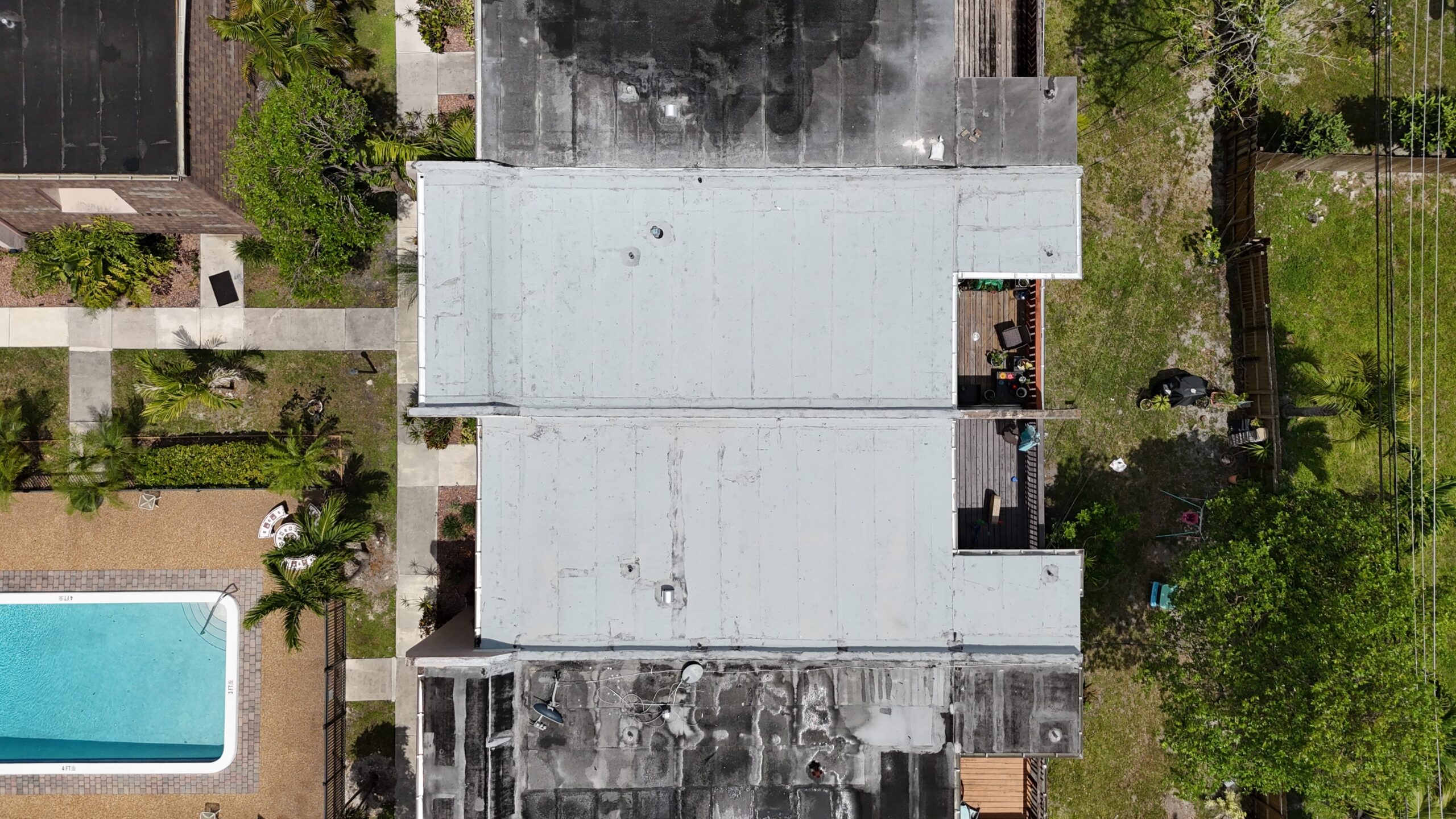
A “flat roof” is never truly flat. Any roof under 2:12 pitch is classified as low-slope, and code requires positive drainage toward scuppers, internal drains, or gutters. In practice, older Miami homes, mid-century additions, Florida rooms, carports, and most small commercial buildings sit at 1/4:12 or less — enough to move water off, not enough to forgive a clogged drain or a compressed insulation board.
That geometry drives everything. Water sits longer here than on a shingled slope, sun exposure is nearly perpendicular for hours a day, and the perimeter of a low-slope roof is where uplift pressure concentrates during a hurricane. Both a TPO membrane system and a hot mop built-up roof have to solve the same three problems: waterproofing the field, terminating properly at every wall and penetration, and staying mechanically attached when the wind tries to peel the corner up like a soda can lid.
How TPO and Hot Mop Systems Actually Work
TPO (thermoplastic polyolefin) is a single-ply sheet, typically 45, 60, or 80 mil thick, rolled out over insulation or a cover board. The sheets are mechanically fastened, induction-welded, or fully adhered, and adjacent sheets are joined with a hot-air weld that fuses the material into one continuous piece. A correct weld is not a glue joint — it is a molecular bond, and it is generally stronger than the sheet itself. Reflective white TPO also throws off a large share of solar energy, which matters more here than almost anywhere in the country.
Quotable stat: Reflective “cool roof” surfaces such as white single-ply membranes can stay roughly 50°F cooler than conventional dark roofs in peak summer sun, reducing the heat driven into the building below. Source: U.S. Department of Energy — energy.gov.
A hot mop roof — the traditional built-up roof, or BUR — is layered. Crews heat asphalt in a kettle to roughly 400 degrees and mop it between plies of fiberglass or organic felt, building three, four, or five plies into a monolithic mat, then finish with gravel, a mineral cap sheet, or a coating. Its close cousin, modified bitumen, uses factory-made rubberized asphalt sheets torched or cold-adhered in place, and many South Florida “hot mop” quotes are really a hybrid BUR base with a mod-bit cap.
The core difference: TPO relies on a handful of welded seams to be perfect. A hot mop tar and gravel roof relies on redundancy — multiple overlapping plies, so no single layer is the only thing between water and your ceiling.
Quick comparison at a glance
| Factor | TPO (single-ply) | Hot Mop / BUR (multi-ply) |
|---|---|---|
| Waterproofing model | Welded seams on one sheet | Redundant overlapping plies |
| Heat / reflectivity | Reflective white; lower cooling load | Dark surface runs hotter (unless coated) |
| Typical Miami service life | ~20 yrs at 60 mil+; less at 45 mil | Comparable with gravel/cap + recoating |
| Foot traffic tolerance | Moderate; scuffs and punctures | High; good for serviced equipment |
| Repairs | Clean weld-in patch | Messier, weather-dependent |
| Install disruption | Fast, smaller crew, low odor | Kettle smell/smoke; more crew & days |
| HVHZ / NOA status | Approved assemblies available | Approved assemblies available |
The HVHZ Factor: NOA Approval and Wind-Uplift Rules Neither System Escapes
Here is where South Florida diverges hard from generic advice. Miami-Dade and Broward sit inside the HVHZ, governed by the Miami-Dade 25-7 HVHZ wind-load standard and the corresponding FBC provisions. Under that framework, roofing products are not approved generically — a specific assembly is approved. The NOA names the membrane, the insulation, the fasteners and plates, the deck type, the adhesive, and the maximum design pressure the assembly is rated for.
Quotable stat: The HVHZ wind-load framework is built around design wind speeds of roughly 170–186 mph (ultimate) for much of coastal Miami-Dade and Broward, which is why perimeter and corner fastening is engineered rather than assumed. Sources: Florida Building Code / ASCE 7 wind maps referenced at floridabuilding.org; hurricane wind-load guidance at fema.gov.
What that means for you as an owner:
- Both systems can be code-compliant. Neither TPO nor hot mop is banned here. Both have current NOA listings from major manufacturers.
- Substitutions break approval. Swap the specified fastener, use a different insulation board, or change the attachment method, and the assembly no longer matches the NOA. An inspector can fail it, and an insurer can dispute it later.
- Perimeter and corner zones get tighter fastening. Uplift pressure at a roof corner can run two to three times the field pressure, so fastener spacing tightens dramatically in those zones. This is one of the most common shortcuts on cheap bids.
- Edge metal is a rated component. Drip edge, gravel stop, and coping are tested and approved assemblies here, not sheet-metal afterthoughts. Edge failure is a leading initiator of low-slope roof loss in hurricanes — once the edge lifts, wind gets under the membrane.
- Insulation attachment is inspected separately. On a mechanically attached system, the boards below the membrane carry load too.
A legitimate Miami-Dade contractor should be able to hand you the NOA number for the exact assembly on your permit. If a bid cannot produce one, that is your answer about the bid. You can verify any NOA yourself through the Miami-Dade Product Control Search at miamidade.gov.
Longevity: What Each System Realistically Delivers Under South Florida UV and Heat
Manufacturer life expectancy figures come from national testing. South Florida ages materials faster. Between year-round UV, surface temperatures that swing hard during afternoon thunderstorms, and salt air near the coast, both systems generally land at the lower end of their published ranges here.
A properly installed 60 mil or thicker TPO system, with clean welds and adequate slope, typically delivers a serviceable life in the 20-year neighborhood, with thinner 45 mil membranes running shorter. TPO roof lifespan in Miami is driven less by the sheet itself than by seam integrity and how much standing water sits on it.
A well-built four or five ply hot mop with a gravel surface or a granulated cap sheet is comparably durable, and often ages more gracefully — the gravel shields the asphalt from UV, and the redundancy means a single defect is rarely catastrophic. Where BUR loses ground is heat: dark surfaces run far hotter than reflective white membrane, and the asphalt eventually loses volatiles, gets brittle, and cracks. Coating a BUR periodically extends its life meaningfully; ignoring it shortens the roof by years.
Honest summary: on a good deck with real slope and honest workmanship, the two systems are closer in lifespan than either manufacturer’s sales sheet suggests. Installation quality outweighs material choice.
Maintenance: What Ongoing Upkeep Looks Like for TPO vs Hot Mop
Flat roof maintenance in South Florida is not optional on either system. Two inspections a year — before hurricane season and after it — plus a check after any major storm is the working standard.
On TPO, inspection focuses on the welds. A probe run along the seams finds voids before they open. You are also checking the sealant at pipe boots, the termination bar at parapet walls, and any spot where equipment or foot traffic has scuffed the sheet. Repairs are clean: cut a patch of matching membrane, weld it in, done. That is a genuine advantage.
On hot mop, you are looking for alligatoring of the surface, blisters, displaced gravel, and open laps at the flashing. Repairs are messier and more weather-dependent — you are working with hot asphalt or mastic, and matching an aged surface is imperfect. But BUR tolerates foot traffic far better, so if you have HVAC equipment up there being serviced monthly, that matters.
On both systems, roof flashing at walls, curbs, skylights, and penetrations is where the real risk lives. The field of a roof almost never fails first.
Cost: How Material, Labor, and Long-Term Ownership Costs Compare
Pricing on a Miami-Dade flat roof replacement moves with material markets, deck condition, tear-off depth, insulation R-value requirements, and HVHZ detailing, so any specific dollar figure quoted online is unreliable by the time you read it. What is stable is the shape of the comparison.
TPO roofing membrane cost is usually competitive per square on materials and installs faster with a smaller crew, which pulls labor down. Fully adhered systems cost more than mechanically attached ones; thicker membrane costs more than thin, and is worth it here.
Hot mop typically costs more in labor — kettles, more crew, more setup, more days on site — and gravel adds weight and material cost. It is also disruptive: the smell and smoke of a kettle is a real consideration on an occupied home in a tight Miami neighborhood, and some HOAs and buildings restrict it outright.
Over a full ownership cycle, the picture flips depending on the building. TPO’s cheaper repairs and reflective surface reduce cooling load and service cost. BUR’s redundancy reduces the chance of an emergency interior-damage event. Neither is universally cheaper.
Best Application: When TPO Makes Sense, When Hot Mop Makes Sense
TPO is generally the better call when: the roof is large and open with few penetrations; energy performance and interior cooling load matter; the deck is sound and the slope is adequate; you want a warranty that covers welded seams; or the property is a commercial flat roof in Miami-Dade where a fast, low-disruption installation has real value.
Hot mop or a BUR/mod-bit hybrid earns its place when: the roof is small, chopped up, and full of curbs and penetrations where multi-ply flashing is easier to detail reliably; the roof sees heavy regular foot traffic; you are recovering a tired existing BUR and want compatibility; or the owner explicitly values redundancy over efficiency.
One caution on the built-up roof vs TPO decision: a low-slope area with chronic drainage problems is not fixed by either membrane. It is fixed by tapered insulation, additional drains, or corrected framing — before the new roof goes on.
Common Problems and Failure Points: An Honest Look at Both Systems
TPO’s failure signature is roof seam failure. A weld run at the wrong temperature or speed looks perfect on day one and separates in year six. Other issues: punctures from dropped tools or debris, shrinkage pulling at terminations on mechanically attached systems, and fastener back-out telegraphing through the sheet. Older-generation TPO formulations had premature weathering problems; current products are substantially better, but that history is why membrane thickness and manufacturer choice matter.
Hot mop’s failure signature is blistering and cracking. Trapped moisture in the plies expands under Miami heat and lifts the layers. Asphalt embrittles with age and alligators. Gravel migrates and clogs drains. And installation is unforgiving — mop the asphalt too cool and the plies never fully bond.
Shared across both, and the honest headline: the majority of low-slope failures we open up are not membrane defects. They are flashing details, edge metal, drains, and penetrations — the parts a bidder trims to win a job on price. FEMA post-storm investigations of building performance repeatedly identify roof edge and flashing systems as leading initiators of roof-covering loss in high winds. Source: FEMA Building Science — fema.gov.
Ponding Water, Insurance, and Wind Mitigation: Local Questions Homeowners Actually Ask
Ponding water on a flat roof is the most common local complaint, and it is the single biggest warranty risk on either system. Most manufacturer warranties define ponding as water remaining more than 48 hours after rainfall stops and exclude damage attributable to it. TPO will not rot from standing water the way asphalt degrades, but ponding accelerates seam stress, collects debris, adds dead load, and gives a warranty carrier a clean reason to deny a claim. If your roof ponds, the correction belongs in the scope of work — not in a note on the invoice.
On insurance, what a Florida wind mitigation inspection rewards is roof deck attachment, roof-to-wall connections, secondary water resistance, and roof covering compliance with current code and product approval. Those are structural and documentation items. A compliant, permitted, NOA-listed roof of either type earns the same credits; an undocumented one earns nothing. Keep your permit, your final inspection, and your NOA paperwork together — that folder is worth money at renewal and at claim time.
Frequently Asked Questions
Does TPO or hot mop roofing perform better in a Miami hurricane?
Neither system wins on material alone. Hurricane performance is determined by the tested assembly — deck attachment, insulation fastening, membrane attachment method, perimeter and corner fastener spacing, and rated edge metal — all documented in the Miami-Dade NOA and sized to the wind-uplift pressures for your building’s height, exposure, and roof zones. A properly engineered TPO assembly and a properly engineered built-up assembly can both meet HVHZ requirements. The failures we see after storms trace to edge metal and flashing, not to the choice between single-ply and multi-ply.
Can hot mop roofing pass Miami-Dade NOA requirements the same way TPO does?
Yes. Built-up and modified bitumen systems have current Notice of Acceptance listings from major manufacturers, just as TPO does. The requirement is identical for both: the installed assembly must match an approved NOA or a Florida Product Approval that covers HVHZ use component-for-component, and the permit and inspection must reflect it. There is no code preference between the two — only approved assemblies and unapproved ones. You can confirm any listing through Miami-Dade Product Control at miamidade.gov.
Does ponding water void a TPO roof warranty in South Florida?
It commonly excludes coverage for damage caused by it. Most manufacturer warranties treat water standing longer than 48 hours after rain as a design and drainage defect rather than a product defect. TPO itself resists water well, but ponding stresses seams, loads the structure, and traps debris. The fix is drainage — tapered insulation, added drains or scuppers, cleared existing drains — addressed during the roof replacement, not after a claim is denied.
Does wind-mitigation insurance credit differ between TPO and hot mop roofs?
Membrane type is not itself a credited category. Florida’s wind mitigation inspection evaluates roof deck attachment, roof-to-wall connection, secondary water resistance, roof covering code compliance, and roof geometry. Both systems can satisfy the roof covering item when permitted and installed to an approved NOA. What actually changes your credit is documentation: a permitted, inspected, NOA-matched roof scores; an undocumented one does not.
How long does a hot mop or TPO roof actually last under intense Florida UV and heat?
Expect the lower end of published ranges. A 60 mil or thicker TPO with sound welds and real slope commonly serves around two decades here; thinner membranes fall short of that. A four to five ply hot mop with gravel or a granulated cap sheet is broadly comparable, and periodic recoating extends it. In both cases, drainage quality and installation workmanship move the number far more than the material itself does.
Is a white TPO roof actually cooler than a dark hot mop roof in Miami?
Yes, measurably. Reflective white membranes reject far more solar energy than dark asphalt surfaces. The U.S. Department of Energy notes that a reflective cool roof can run roughly 50°F cooler than a conventional dark roof under peak sun, which lowers the heat pushed into the space below and can reduce cooling load. A gravel-surfaced or coated BUR narrows that gap somewhat, but an uncoated dark built-up roof will run hotter than white TPO in Miami-Dade summer conditions.
Bigfoot Windows & Roofing is a licensed South Florida contractor — CGC1531370, CCC1333168, CRC1331693, SCC131153098 — serving Miami-Dade and Broward homeowners and building owners.
Ready for a free estimate? Call 786-886-2088 or fill out our contact form.
Related Articles
 Cash Discount Roof Replacement Miami-Dade | Pay in Full
 Elite Impact Windows & Doors in Miami-Dade | Bigfoot Windows & Roofing
 Miami-Dade Roofing & Construction Services | BigfootShingle Roofing For Florida Homes: Why A Professionally Installed Asphalt Shingle Roof With Bigfoot Is A Smart, Long-Term Investment