
Best Shingle Roofing Contractors in South Florida | Bigfoot Windows & Roofing
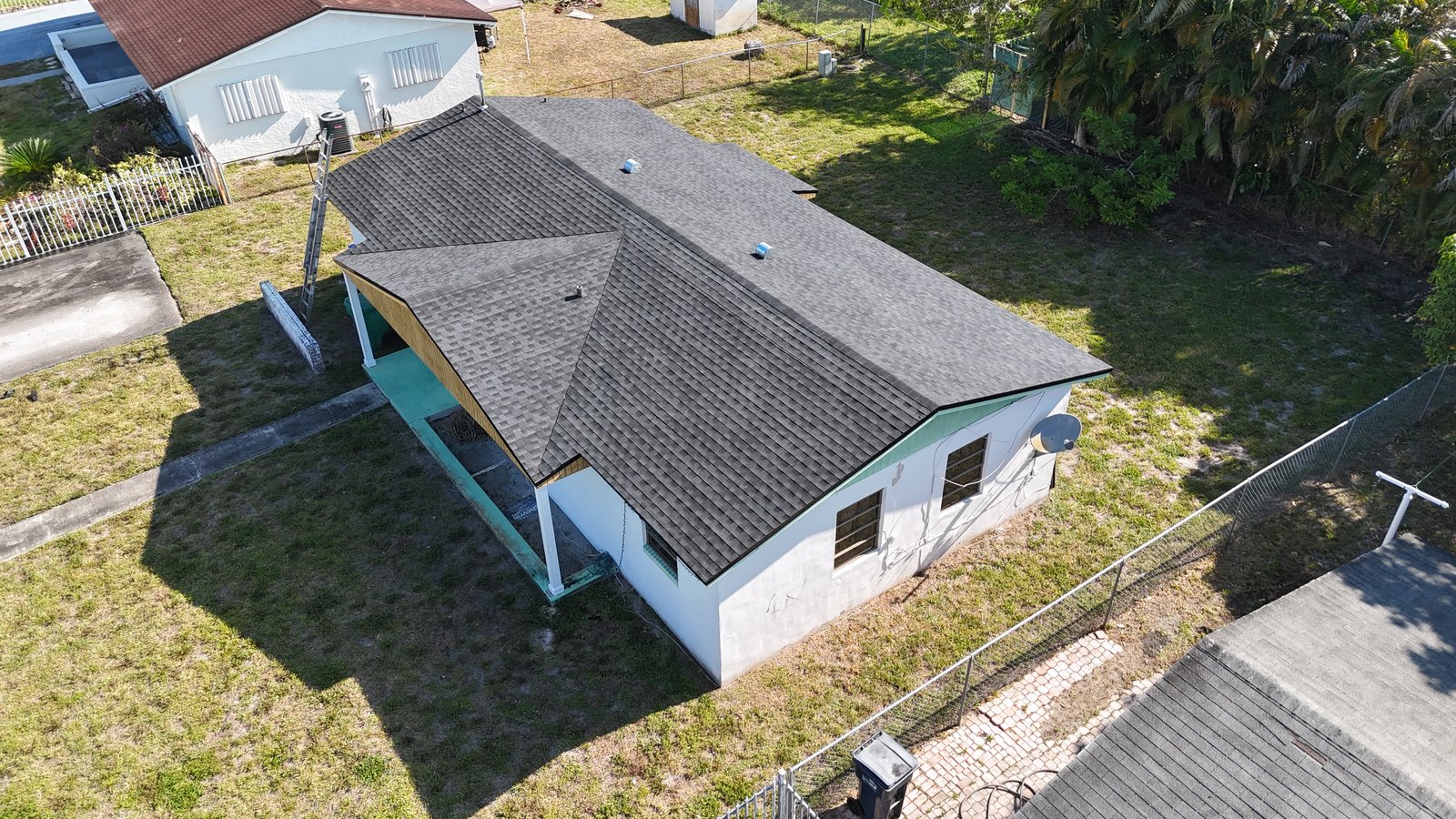
The best shingle roofing contractors in South Florida hold a Florida Certified Roofing Contractor license (CCC class), install only HVHZ-approved shingles (with a Miami-Dade NOA or a Florida Product Approval) that meet Miami-Dade or Broward HVHZ wind standards, pull permits on every job, and deliver an OIR-B1-1802 certification form your insurer will accept — without shortcuts.
Updated August 2026
Key Takeaways
- HVHZ (Miami-Dade and Broward) requires shingles with a Miami-Dade NOA or a Florida Product Approval that covers HVHZ use.
- Always verify a roofing contractor’s CCC license number at the Florida DBPR online lookup before signing anything.
- A new shingle roof in South Florida typically lasts 12–15 years due to intense heat, UV, and storm exposure.
- Post-installation, your contractor should provide a completed OIR-B1-1802 wind mitigation form to support an insurance premium review.
- A Certified General Contractor can handle structural scope — hurricane straps, decking damage, framing — that a roofing-only sub cannot.
The Problem
Why Hiring the Wrong Shingle Contractor in South Florida Costs You More
A low bid means nothing if the installation fails an inspection or voids your insurance coverage.
South Florida homeowners replacing a shingle roof face a market full of contractors who undercut on price by skipping code compliance. In Miami-Dade and Broward counties — the High-Velocity Hurricane Zone (HVHZ) — a shingle installation is not a routine job. The Florida Building Code Section 1504 imposes strict design-pressure requirements that most out-of-state or unlicensed contractors simply do not understand or follow.
The consequences are real: a roof installed with shingles that do not carry a Miami-Dade NOA or a Florida Product Approval that covers HVHZ use can fail inspection, leaving you with a stop-work order, forced tear-off, and a bill that dwarfs the original savings. Worse, an undocumented installation can trigger a claim denial when your insurer sends an adjuster after the next named storm.
This article explains exactly what standards to demand, how to verify a contractor’s license, and what questions to ask before you sign a contract — so you hire once and hire right.
South Florida Context
HVHZ Rules, NOA Requirements, and Why They Change Everything
Miami-Dade and Broward operate under the strictest residential wind code in the United States.
The High-Velocity Hurricane Zone encompasses all of Miami-Dade and Broward counties. A product with a current Florida Product Approval (FL number) that covers HVHZ use is legal to install in Miami-Dade and Broward. A Miami-Dade NOA is an additional certification some products also carry; it is not required for the permit. An NOA is issued by Miami-Dade’s Building Code Compliance Office and certifies that the product has passed the more rigorous TAS (Test Application Standard) protocols specific to HVHZ wind loading.
Palm Beach County sits outside the HVHZ boundary but is still subject to Florida Building Code wind provisions for coastal zones, meaning design-pressure compliance is still required — just through Florida Product Approval rather than an NOA. Contractors working across all three South Florida counties need to know which approval path applies to each job site.
| County | Wind Zone | Required Product Approval | Typical Design Pressure |
|---|---|---|---|
| Miami-Dade | HVHZ | Miami-Dade NOA (TAS tested) | 140+ mph / high DP |
| Broward | HVHZ | Miami-Dade NOA (TAS tested) | 140+ mph / high DP |
| Palm Beach | High-wind coastal | Florida Product Approval | 130–160 mph range |
Before any contractor presents a proposal, ask them to identify the specific NOA number for the shingle product they plan to install. A contractor who cannot produce that number is either planning to use a non-compliant product or does not know the code — both are disqualifying.
Education
How to Verify a Contractor’s License Before You Sign
Florida law requires a specific license class for roofing work — and verification takes less than two minutes.
In Florida, roofing replacement requires either a Certified Roofing Contractor (CCC license class) or a Certified General Contractor (CGC license class). The fastest way to confirm a contractor’s credentials is the Florida DBPR online license search at myfloridalicense.com. Enter the contractor’s name or license number and confirm the license type is active.
Handymen and unlicensed roofing crews operate throughout South Florida — often advertising on social media with prices that seem too good to pass up. They cannot legally pull a permit, and work performed without a permit in Miami-Dade or Broward triggers significant liability for the homeowner when the property is sold or when an insurance claim is filed.
Here is a five-question checklist to run through before signing any roofing contract in South Florida:
- What is your Florida license number, and which class is it? (Acceptable: CCC or CGC. Unacceptable: no license or an expired one.)
- What is the NOA number for the shingle product you’re proposing? (Verify it on the Miami-Dade BCCO website if the job is in HVHZ.)
- Will you pull the permit, or will I need to? (The contractor must pull and manage the permit — if they ask you to pull it, that is a red flag.)
- Do you carry general liability and workers’ compensation insurance? (Request certificates before work begins — do not accept verbal assurances.)
- Will you provide a completed OIR-B1-1802 wind mitigation form after installation? (This form is what your insurer uses to assess your premium after a new roof.)
If a contractor hesitates or deflects on any of these five questions, that is your answer.
Comparison
Shingle vs. Metal Roofing in South Florida — Which Is Right for You?
Both can meet HVHZ code. The decision comes down to budget, longevity goals, and insurance strategy.
| Factor | Architectural Shingles | Standing Seam Metal |
|---|---|---|
| Typical lifespan (South Florida) | 12–15 years | 40–50+ years |
| Installed cost range (per square) — typical directional range; actual pricing varies by project scope, deck condition, and permit complexity | $750–$850 | $1,050–$1,300 |
| HVHZ compliance path | NOA or a Florida Product Approval that covers HVHZ use required (TAS tested) | NOA or a Florida Product Approval that covers HVHZ use required (clip-system tested) |
| Wind Proven warranty available? | Yes (GAF System Plus) | Yes (Englert or Metal Alliance standing seam) |
| Insurance wind mitigation credit | Moderate (with peel-and-stick deck) | Stronger (metal + SWR combo) |
| HOA restrictions | Rarely restricted | Florida SB 293 protects metal |
Cost ranges above are typical directional estimates — actual pricing varies by project scope, deck condition, and permit complexity. Contact Bigfoot for a project-specific estimate.
When shingles are the better fit: Your budget is constrained, your HOA does not permit metal, or you are planning to sell the home within five to ten years and want a code-compliant roof at a lower upfront cost. GAF architectural shingles with a peel-and-stick full-deck underlayment can still qualify as a secondary water barrier on the OIR-B1-1802 form, which may help with your insurance premium.
When metal is the better fit: You plan to stay in the home long-term, you want to minimize future replacement cycles, or your wind mitigation strategy calls for the strongest available product. For a deeper look at roofing costs across material types, our online estimator walks through the full range.
Why It Matters Who Holds the License
A Certified General Contractor Can Do What a Sub Cannot
Licensed contractor, not a lead aggregator or a roofing-only crew.
Most roofing contractors carry only a CCC license. That is perfectly legal for a straightforward shingle replacement on a structurally sound roof. But South Florida homes — especially those built before 2002 — frequently reveal surprises once the old shingles come off: rotted decking, missing hurricane straps, corroded fasteners, or framing members that need repair before a new roof can be installed to code.
A contractor who holds only a roofing license must stop work and refer those structural issues to a separate general contractor, adding cost, delay, and a coordination gap that can leave your home open to weather. A Certified General Contractor (CGC1531370) can address structural modifications, hurricane strap upgrades, and decking repairs in the same scope of work — without a handoff. That structural capability is grounded in license authority, not a marketing claim.
“We pull the permit, we install to the NOA, and we hand you the OIR-B1-1802 at the end. That paperwork is part of the job — not an add-on you have to chase.”
Darryl Rosenbaum
President, Bigfoot Windows & Roofing
Product Guidance
What to Look for in an HVHZ-Approved Shingle System
The product and the installation method must both comply — the NOA covers both.
Not every architectural shingle that passes ASTM D3161 Class F (110 mph) qualifies for the HVHZ. For Miami-Dade and Broward, the shingle must carry a Miami-Dade NOA or a Florida Product Approval for HVHZ use that covers the specific installation fastener pattern and nail spacing you will be using. A contractor who changes the nail spacing to save time — even slightly — can void the NOA compliance, which voids the warranty and potentially voids your insurance claim.
GAF architectural shingles with the Layer Lock technology use a 19-dimple shingle-to-shingle engagement and a 1.81-inch nail line — significantly wider than older shingle designs — which contributes to the Wind Proven warranty’s no-maximum-mph coverage. Per GAF product documentation, the Wind Proven warranty covers qualifying installations for 15 years without a named-storm exclusion — confirm current terms with your GAF contractor at time of installation, as warranty details are subject to change.
For the underlayment layer, the 2024 Florida Building Code update permits direct-to-deck peel-and-stick application. A full-deck peel-and-stick system qualifies as a Secondary Water Resistance (SWR) feature on the OIR-B1-1802 wind mitigation inspection form, which insurers may credit as a wind mitigation discount. The 30-lb felt underlayment does not qualify as a secondary water barrier — confirm with your contractor which underlayment system they are proposing and why.
The Process
What a Code-Compliant Shingle Roof Replacement Looks Like in South Florida
Understanding the steps keeps you from being misled by contractors who skip critical stages.
- Free estimate and product selection: Contractor identifies the correct NOA for the proposed shingle system and the required underlayment path for your county.
- Permit application: The contractor — not the homeowner — submits permit documents to the local building department. Miami-Dade and Broward require plan review for HVHZ replacements.
- Tear-off and deck inspection: Old shingles and underlayment are removed. Decking is inspected for rot, delamination, and structural integrity. Any defects are documented before new material goes down.
- Hurricane strap / structural scope (if needed): If the inspection reveals missing or undersized hurricane straps, or structural framing issues, a Certified General Contractor can address these within the same permitted scope — no separate contractor required.
- Installation to NOA spec: Underlayment, starter strip, shingles, and ridge cap are installed per the NOA fastener schedule. Inspectors verify nail pattern and lap dimensions.
- Final inspection and documentation: The building department issues a certificate of completion. Your contractor provides the OIR-B1-1802 wind mitigation certification form for submission to your insurer.
If a contractor cannot describe this sequence clearly — especially the permit step and the OIR form delivery — treat that as a warning sign. You can also explore financing options for the full replacement cost, including PACE programs that work through your property tax bill rather than a traditional bank loan.
Ready to get a straight answer on your shingle roof?
Or call Bigfoot Windows & Roofing directly at 786-886-2088
Related Reading
More South Florida Roofing Guides
Related Articles
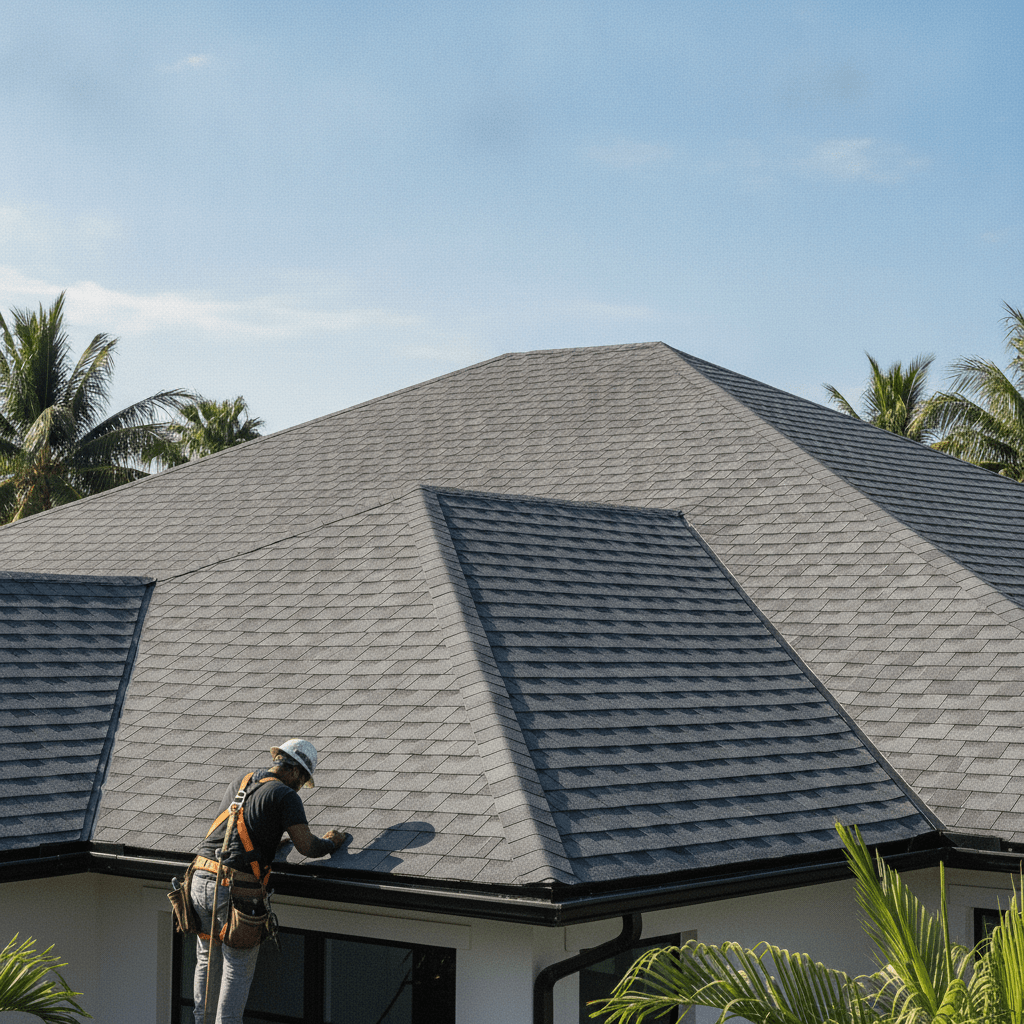
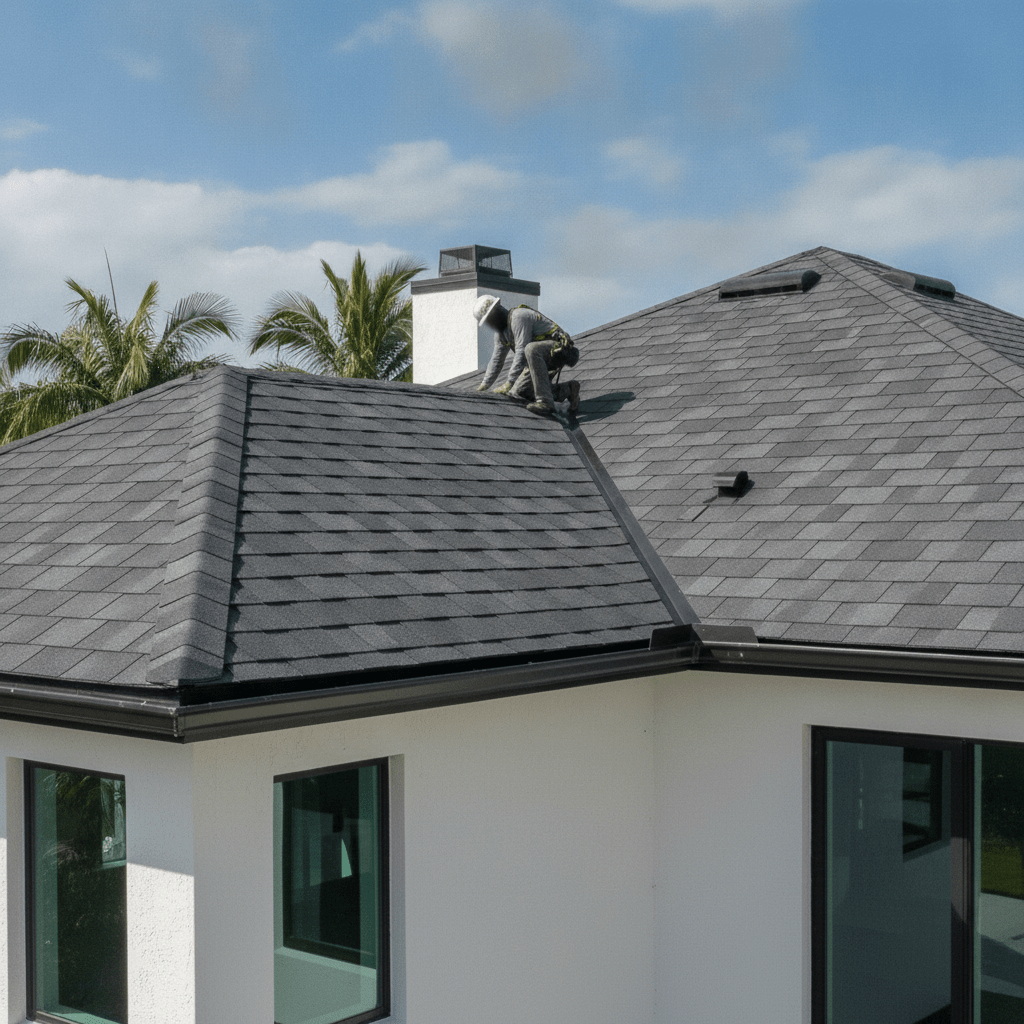
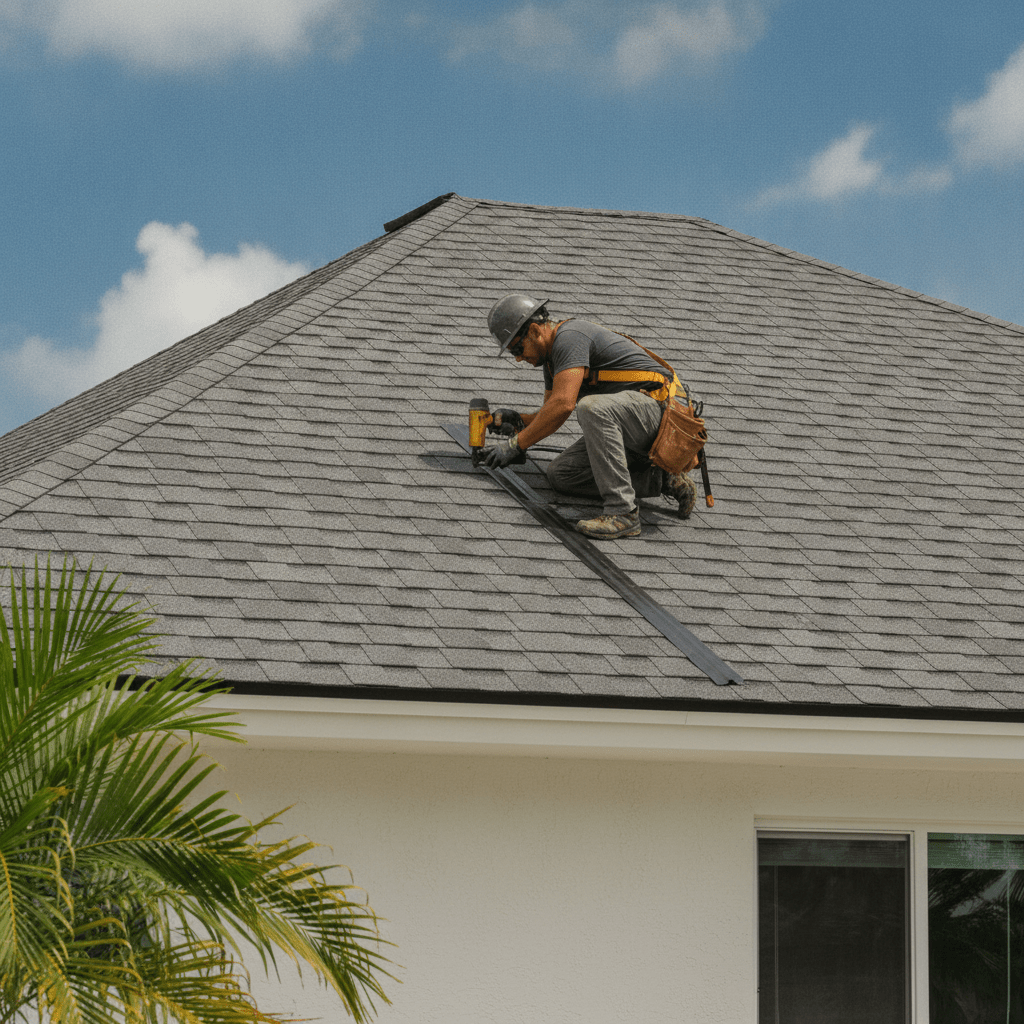
Who We’re Not the Right Fit For
- Multi-unit commercial buildings: We focus on residential homes and small multi-family properties. A large commercial roofing project — big-box or mid-rise — calls for a contractor with dedicated commercial crews and bonding levels we do not carry for those scopes.
- Buyers who want the lowest possible bid regardless of compliance: We pull permits on every job and install only materials with a Miami-Dade NOA or a Florida Product Approval that covers HVHZ use. If your decision is driven purely by price and you are willing to accept an unpermitted installation, we are not the right contractor — and we would encourage you not to go that route with anyone.
- Emergency same-day patching only: We can assess storm damage and advise on an emergency basis, but we are not a 24-hour tarping or patch crew. If you need immediate emergency tarp service after a storm event, your best first call is a licensed public adjuster or your insurer’s emergency service line.
- Homeowners outside Miami-Dade, Broward, and Palm Beach: Our current service area is South Florida. If your property is in a different region of Florida, we are not the right geographic fit.
Frequently Asked Questions
What shingle roofing standards must contractors meet in Miami-Dade County’s High-Velocity Hurricane Zone?
A product with a current Florida Product Approval (FL number) that covers HVHZ use is legal to install in Miami-Dade and Broward. A Miami-Dade NOA is an additional certification some products also carry; it is not required for the permit. The NOA certifies the product has passed TAS (Test Application Standard) wind protocols specific to Miami-Dade and Broward. The contractor must also install using the exact fastener pattern specified in the NOA; deviating from that pattern voids compliance even if the product itself is approved.
How do I verify a roofing contractor’s license in Florida before signing a contract?
Go to myfloridalicense.com and use the DBPR license search tool. Enter the contractor’s name or license number and confirm it is active and in the CCC (Certified Roofing Contractor) or CGC (Certified General Contractor) class. This search is free and takes under two minutes. Never rely on a contractor’s verbal assurance — look it up yourself before you sign.
Ready to get started? Get a free, no-pressure estimate from a licensed South Florida contractor.
Do you need a permit for best shingle roofing contractors in south florida in Miami-Dade or Broward?
Yes. Miami-Dade and Broward require a permit for re-roofing and most roof repairs. A licensed roofing contractor pulls the permit and schedules the required inspections as part of the project.
Does financing typically cover best shingle roofing contractors in south florida?
Financing options may be available depending on the scope and your lender. Ask your contractor what programs apply to your specific project before you sign anything.
How long does a roofing project like this take?
Most single-family roof replacements in South Florida are completed in 1-3 days once materials are on site and permits are pulled, though structural or deck repair work can extend that timeline.
Schedule Your Free Estimate
Ready to get started? Request a free estimate — no phone call required.