Cost of a New Roof in Florida | Bigfoot Windows & Roofing
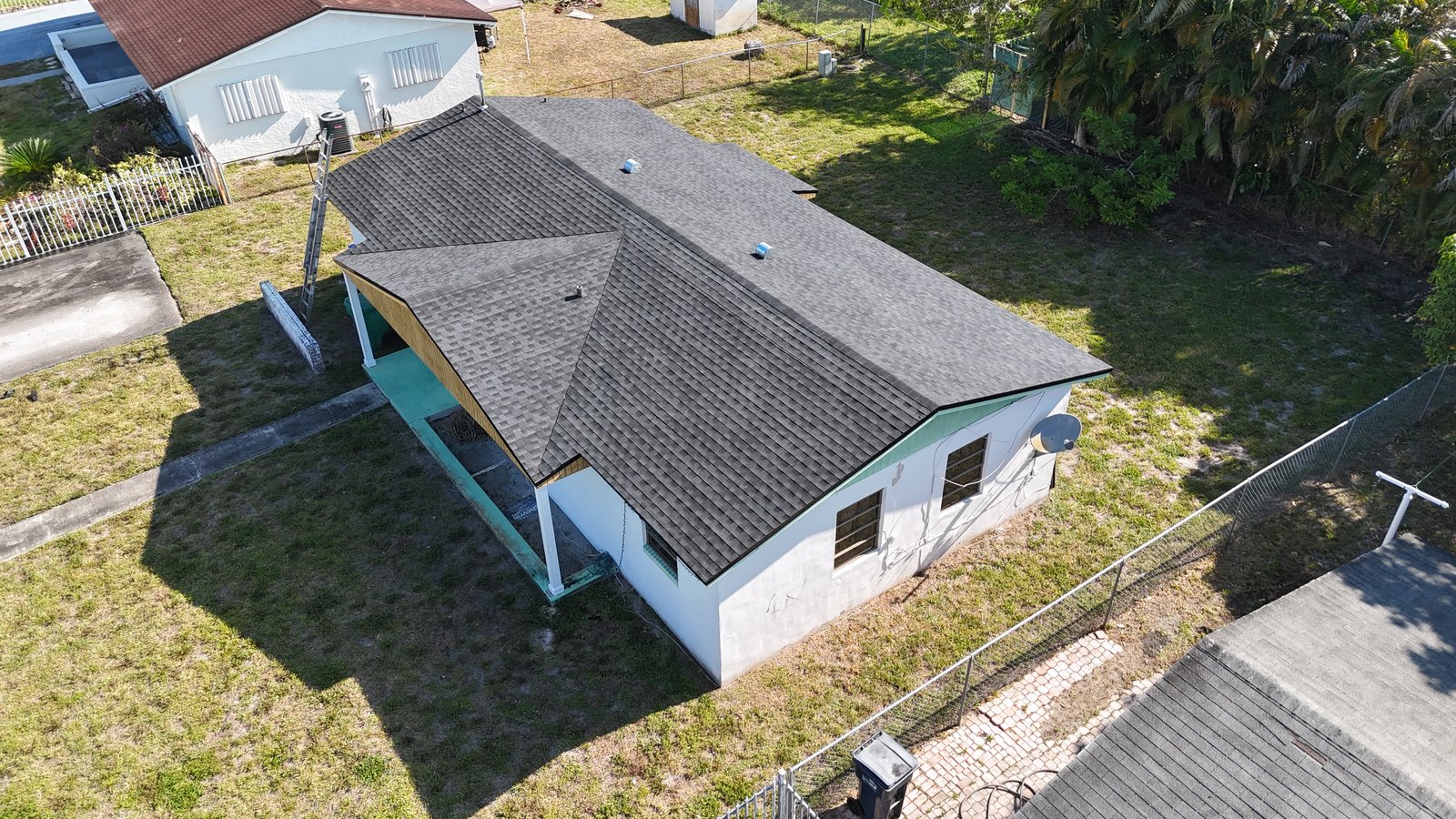
A new roof in Florida typically costs between $750 and $1,400 per square (per 100 sq ft installed), depending on material, roof complexity, and county. In Miami-Dade and Broward — the High Velocity Hurricane Zone (HVHZ) — stricter code requirements, mandatory product approvals, and additional inspections routinely push costs above the state average.
Updated September 2026
Key Takeaways
- Installed roofing costs in South Florida range from about $750 (architectural shingles) to $1,400+ per square (metal tile) — material and HVHZ compliance drive the range.
- Miami-Dade and Broward require Miami-Dade Notice of Acceptance (NOA) or Florida Product Approval on every roofing material — not all national brands qualify.
- Mandatory deck-attachment inspections, secondary water barriers, and roof-to-wall connection requirements add measurable cost that most national cost guides ignore.
- A new qualifying roof combined with a wind mitigation inspection can meaningfully reduce your homeowners insurance premium — actual savings vary by insurer and policy.
- Permit fees, third-party inspections, and product-approval documentation extend timelines and budgets; factor 3–8 weeks for a typical Miami-Dade permitted project.
- Bigfoot holds a Certified Roofing Contractor license (CCC1333168) and a Certified General Contractor license (CGC1531370), covering structural scope like hurricane strap upgrades in a single contract.
Why Florida Roof Pricing Is Different
National Cost Guides Undercount What South Florida Homeowners Actually Pay
The HVHZ adds code layers — and cost layers — that no generic estimate accounts for.
If you plugged your zip code into a national roofing cost calculator, you likely saw a number that feels suspiciously low. That is because national guides are built on nationwide averages. They do not account for Florida Building Code (FBC) requirements specific to the High Velocity Hurricane Zone, the HVHZ product-approval documentation process (Miami-Dade NOA or Florida Product Approval), mandatory third-party inspections, or the secondary water barrier requirements that are standard — not optional — in Miami-Dade and Broward counties.
Here is what actually drives price in South Florida:
- HVHZ product approval: Every roofing material installed in Miami-Dade or Broward must carry either a Miami-Dade NOA or a Florida Product Approval that specifically covers the HVHZ. Products without it cannot be installed legally — and some popular national brands simply do not qualify.
- Deck attachment inspection: Before a new roof goes on, an inspector must verify that the existing deck is nailed to the FBC-required pattern. If it fails, re-nailing or partial decking replacement is required. That adds cost that no initial quote can fully predict without opening the roof.
- Secondary water barrier: The FBC requires a secondary water resistance layer in the HVHZ. A full-deck peel-and-stick underlayment satisfies this requirement and can qualify for a secondary water barrier credit on your wind mitigation inspection form — but it costs more than the 30-lb felt used in other states.
- Roof-to-wall connections: Hurricane straps or clips connecting the roof structure to the wall below are inspected as part of every permitted replacement. If your home has toenail connections, upgrading to code-compliant straps is often required or strongly recommended. Because Bigfoot holds a Certified General Contractor license (CGC1531370) in addition to its Certified Roofing Contractor license (CCC1333168), structural scope like hurricane strap upgrades can be handled under one contractor and one contract — homeowners do not need to hire a separate structural contractor for that work.
- Citizens Property Insurance documentation: If you carry Citizens Insurance, your new roof must comply with Citizens’ policy requirements or risk non-renewal. Material choice and inspection documentation directly affect insurability.
South Florida Cost Context
How Miami-Dade Roof Costs Compare to the Rest of Florida
Palm Beach County projects typically run somewhat less than full HVHZ work because Miami-Dade and Broward carry the most stringent inspection and documentation requirements in the state. That said, even Palm Beach properties near the coast face elevated wind-load design requirements that push costs above the national average.
The table below shows typical installed cost ranges by material for South Florida as of mid-2026. These are directional ranges — actual quotes depend on roof size, pitch, deck condition, tear-off layers, permit fees, and site-specific conditions. Get a written itemized quote before committing to any number.
| Roofing Material | Typical Installed Range (per square) | HVHZ NOA/FPA Required? | Lifespan (South FL) |
|---|---|---|---|
| Architectural Asphalt Shingles (GAF) | $750 – $850 | Yes — Miami-Dade NOA | 12–15 years |
| Standing Seam Metal (Englert or Metal Alliance) | $1,050 – $1,300 | Yes — manufacturer-approved clips with NOA | 40–50+ years |
| Concrete Tile (Westlake) | $1,000 – $1,350 | Yes — Florida Product Approval | 25–40 years |
| Metal Tile (Stone-Coated Steel) | $1,175 – $1,400 | Yes — Florida Product Approval | Lifetime warranty |
| TPO Flat Roofing | $800 – $1,400 | Yes — system-specific FPA | 15–25 years |
Source: Bigfoot Windows & Roofing published pricing guide, July 2026. Verify current market rates with an itemized written quote.
Cost Drivers Explained
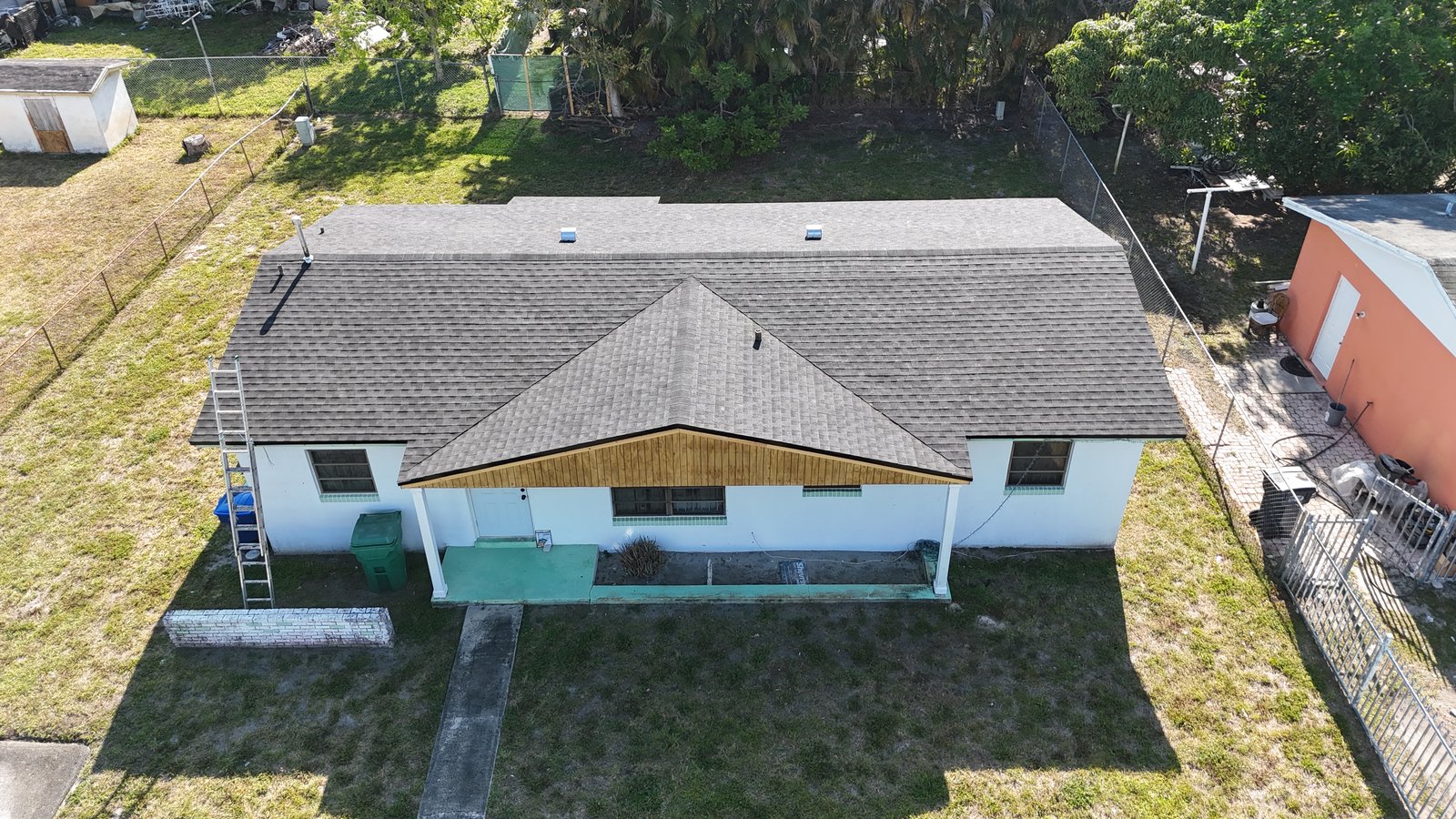
What Actually Changes the Total Price of Your Florida Roof Replacement
Understanding these variables helps you evaluate quotes — not just compare bottom-line numbers.
| Cost Factor | Impact on Price | Notes |
|---|---|---|
| Roof size and pitch | High | Steep slopes require more labor and safety equipment; measured in squares (100 sq ft each) |
| Tear-off (single vs. double layer) | Moderate–High | A second layer of existing roofing adds disposal cost and labor; directional estimate: +$60–$90 per square for additional tear-off |
| Deck replacement | Variable | Sheets failing the nail-pattern inspection must be replaced; directional estimate: +$80–$150 per sheet |
| HVHZ permit fees | Moderate | Miami-Dade permit fees vary by project value; third-party inspection fees typically add a few hundred dollars |
| Secondary water barrier (peel-and-stick) | Moderate | Required in HVHZ; full-deck application supports secondary water barrier credit on wind mit form |
| Hurricane strap upgrades | Moderate–High | Required if existing connections do not meet current FBC; can be handled under Bigfoot’s CGC license without a separate contractor |
| NOA/FPA documentation | Low (time cost) | Product approval verification adds pre-job time but is non-negotiable in Miami-Dade and Broward |
Tear-off and decking cost ranges above are directional market estimates, not Bigfoot-authorized pricing. Your written quote will itemize these separately. Ask for it line by line.
The Permit and Inspection Timeline in Miami-Dade
Pulling a roofing permit in Miami-Dade County is not a one-afternoon errand. The typical sequence includes submitting permit documents with the product’s NOA or Florida Product Approval on file, waiting for permit issuance (timelines vary by queue), scheduling a pre-installation deck inspection, the installation itself, a final inspection, and — for insurance purposes — a post-installation wind mitigation inspection. For a typical permitted residential project, allow 3–8 weeks from contract signing to final sign-off. Projects requiring structural work, such as hurricane strap upgrades, may run longer.
Working with a contractor who holds both a Certified Roofing Contractor (CCC1333168) and a Certified General Contractor (CGC1531370) license means the structural and roofing scopes can be permitted and inspected under one contractor of record rather than splitting responsibilities across two licensed parties — a practical simplification for homeowners navigating the Miami-Dade permitting process. You can explore your roofing financing options while permits are in process to reduce the cash-flow impact of the project.
Material Comparison
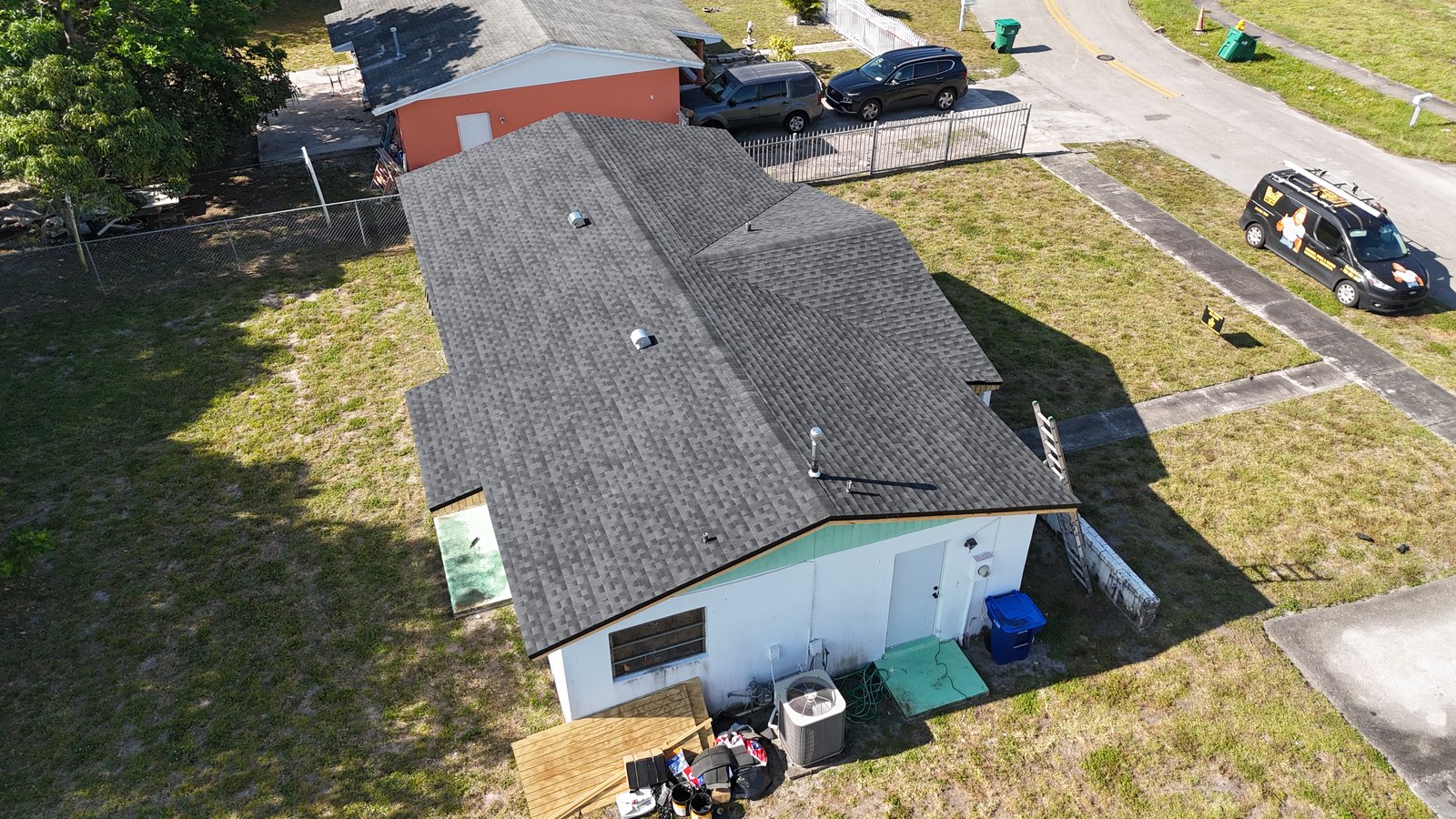
Shingles vs. Metal vs. Tile — Which Is the Right Fit for South Florida?
| Attribute | GAF Architectural Shingles | Englert or Metal Alliance Standing Seam Metal | Westlake Concrete Tile |
|---|---|---|---|
| Installed cost range | $750–$850/sq | $1,050–$1,300/sq | $1,000–$1,350/sq |
| Lifespan (South FL) | 12–15 years | 40–50+ years | 25–40 years |
| HVHZ approval path | Miami-Dade NOA | Manufacturer-approved clips + NOA | Florida Product Approval |
| Wind rating | Wind Proven (no max mph cap with LayerLock + 4 accessories) | Manufacturer-approved clip system rated for HVHZ | Poly Set foam: ~180 mph; mechanical: ~160 mph |
| Insurance wind-mit benefit | Moderate | High (metal + peel-and-stick SWR) | High (tile + foam set SWR) |
| HOA restrictions | Rarely restricted | Florida SB 293 protects metal roofing from HOA bans | Rarely restricted |
| Best for | Budget-conscious replacement; shorter-horizon ownership | Long-term ownership; coastal exposure; insurance premium reduction | Mediterranean aesthetics; mid-range lifespan |
When shingles are the better fit: If you plan to sell within 10 years and your current roof is at end of life, architectural shingles at $750–$850 per square deliver a code-compliant, insurable roof at the lowest initial cost. GAF’s Wind Proven Limited Wind Warranty — no maximum wind speed, 15-year term, requires Timberline shingles with LayerLock Technology plus four qualifying GAF accessories — provides meaningful storm coverage without the metal premium.
When metal is the better fit: If you plan to stay long-term, live within two miles of saltwater, or want the strongest shot at lowering your insurance premium after a wind mitigation inspection, standing seam metal is the most durable option available in South Florida. Bigfoot’s Englert or Metal Alliance panels are roll-formed on-site from 24-gauge Galvalume or aluminum. In our experience, many South Florida homeowners see meaningful homeowners-insurance premium reductions after installing a qualifying new roof and obtaining a wind mitigation inspection. Actual reductions vary by insurer, policy, location, and home construction, and no specific figure can be guaranteed.
You can get a detailed estimate for either material using our online pricing estimator or by calling us directly at 786-886-2088.
Why License Breadth Matters for Roofing Scope
A Licensed Roofing and General Contractor — Not Just a Roofer
One licensed contractor, one contract, one point of accountability for structural and roofing scope.
Florida licensed: CGC1531370 · CRC1331693 · CCC1333168 · SCC131153098
“When a Miami-Dade inspector finds that hurricane straps need upgrading mid-project, most roofing-only contractors have to stop work and tell the homeowner to find a separate GC. We can keep the job moving under the same contract.”
President, Bigfoot Windows & Roofing
Roofing Products We Install
HVHZ-Approved Materials Bigfoot Installs in South Florida
Every product Bigfoot installs in Miami-Dade and Broward carries the required Miami-Dade NOA or Florida Product Approval for the HVHZ. Here is a brief overview of the main systems:
- GAF Timberline Architectural Shingles: Installed with the LayerLock Technology and four required GAF accessories to qualify for the GAF WindProven Limited Wind Warranty (15-year term, no maximum wind speed, no named-storm exclusion within its wind-speed coverage). Bigfoot holds GAF Certified Plus certification, making the GAF System Plus Limited Warranty (50-year non-prorated on eligible single-family homes) available on qualifying installations.
- Englert or Metal Alliance Standing Seam Metal: Panels roll-formed on-site from 24-gauge Galvalume or aluminum. Installed with the manufacturer’s approved clips, at the spacing its product approval specifies — carrying a current Miami-Dade NOA. Panels run one continuous piece bottom-to-top with no horizontal seams. A full-deck peel-and-stick underlayment under the metal qualifies as a Secondary Water Resistance feature on the Florida wind mitigation inspection form (OIR-B1-1802), which insurers may credit as a wind mitigation discount on the hurricane portion of your homeowners premium. Actual credit varies by insurer and requires a licensed wind mitigation inspection.
- Westlake Concrete and Stone-Coated Tile: Concrete tile (Saxony 900 flat; Barcelona barrel) with poly-set foam installation achieves approximately 180 mph wind rating vs. approximately 160 mph for mechanical fasteners. Stone-coated steel carries a Lifetime warranty with no named-storm or saltwater exclusion clauses.
- TPO Flat Roofing: System-specific Florida Product Approval required; typically paired with tapered ISO insulation and a cover board for drainage and energy performance.
Florida law requires insurers to offer wind-mitigation credits for approved opening protection and roof improvements. Actual premium reductions vary and are not guaranteed. We recommend a licensed wind mitigation inspector evaluate your home after any new roof installation to document eligible credits for your carrier. Learn more about pricing for South Florida home improvement projects.
How the Project Works
The Roof Replacement Process in Miami-Dade and Broward
- Free estimate and scope review: We measure the roof, evaluate the existing deck condition (visually and, where accessible, structurally), confirm the applicable product approval path, and provide a written itemized quote.
- Material and permit selection: We confirm the product’s Miami-Dade NOA or Florida Product Approval is current, pull the building permit with the county, and schedule the pre-installation deck inspection.
- Deck inspection and tear-off: The county inspector verifies deck nail pattern before new material goes on. If deck panels fail, we replace them. Tear-off of old material and disposal follows.
- Secondary water barrier installation: Full-deck peel-and-stick underlayment applied per FBC and HVHZ requirements.
- Roof-to-wall connection inspection: Hurricane straps or clips are inspected. If upgrades are required, our Certified General Contractor (CGC1531370) authority allows us to perform that structural work without a separate contractor.
- Roofing material installation: Shingles, metal panels, tile, or TPO installed per the approved product’s specifications and the manufacturer’s NOA/FPA requirements.
- Final permit inspection and close-out: County inspector signs off. We provide all documentation for your insurance carrier.
- Wind mitigation inspection: We recommend scheduling a licensed wind mitigation inspector post-completion to document your new roof’s features for potential insurance premium credits.
Get a Written, Itemized Roof Estimate
No national-average guesswork. We scope your specific roof, confirm your HVHZ product approval path, and give you line-item pricing before any commitment.
Related Articles
Who We’re Not the Right Fit For
We believe in being upfront about when we are probably not your best option:
- You need emergency same-day patch work only. Bigfoot focuses on permitted, code-compliant full replacements and repairs. If you need an emergency blue-tarp patch after a storm and nothing more, a local storm-response crew may mobilize faster for that narrow scope.
- Your budget is strictly the lowest number on any quote, regardless of HVHZ compliance. In Miami-Dade and Broward, the lowest quote often means a contractor skipping required product approvals, deck inspections, or secondary water barrier installation. We will not cut those corners — if that disqualifies us on price, that is honest.
- You want a roofing-only contractor and have already separately hired a structural contractor for strap upgrades. Our license breadth is an advantage when scope overlaps, but if that coordination is already handled, you may not need it.
- You are outside our service area. We serve Miami-Dade, Broward, and Palm Beach counties. Projects further north or outside South Florida are outside our typical range.
Common Questions
Frequently Asked Questions
How much does a new roof cost in Miami-Dade County compared to the rest of Florida?
Miami-Dade roof replacements typically cost more than the Florida state average because of HVHZ requirements: every material must carry a Miami-Dade NOA or HVHZ-qualified Florida Product Approval, deck inspections are mandatory before installation, and secondary water barriers are required by code. Expect installed costs ranging from about $750 per square for architectural shingles to $1,300+ per square for standing seam metal — meaningfully above national averages.
What roofing materials are approved for the High Velocity Hurricane Zone and how do they affect price?
In the HVHZ (Miami-Dade and Broward), approved materials include GAF Timberline shingles with a Miami-Dade NOA, Englert or Metal Alliance standing seam metal with manufacturer-approved NOA clips, Westlake concrete and stone-coated tile with Florida Product Approval, and system-specific TPO membranes. HVHZ approval paths add documentation cost and limit material choices compared to the rest of Florida, which contributes to higher per-square prices than non-HVHZ counties.
Does replacing my roof in South Florida lower my homeowners insurance premium?
It can. Florida law requires insurers to offer wind-mitigation credits for eligible roof improvements. In our experience, many South Florida homeowners see meaningful premium reductions after installing a qualifying new roof and completing a wind mitigation inspection. Actual reductions vary by insurer, policy, location, and home construction — no specific figure can be guaranteed. A licensed wind mitigation inspector documents the credits; your carrier determines the discount.
How long does the roofing permit and inspection process take in Miami-Dade County?
For a typical permitted residential roof replacement in Miami-Dade, allow 3–8 weeks from contract signing to final inspection sign-off. That includes permit submittal and issuance, the pre-installation deck inspection, the installation itself, and the final county inspection. Projects involving structural work — such as hurricane strap upgrades — may take longer depending on county queue times and scope complexity.
What is the difference between a roof repair and a full roof replacement under Florida Building Code?
The Florida Building Code triggers a full replacement requirement when a repair involves 25% or more of the roof area — a threshold that also applies to Citizens Property Insurance non-renewal rules for older roofs. Repairs under that threshold can often be permitted as repairs. If your roof is 20–25 years old and has significant damage, a full replacement may be required by code and by your insurer regardless of your preference for a repair.
Is there a Florida grant or financing program that can help cover roof replacement costs?
Yes. The My Safe Florida Home program offers matching grants of up to $10,000 (a $2-for-$1 match, reimbursing up to 2/3 of eligible mitigation costs) for qualifying wind-mitigation improvements, subject to program funding and eligibility. PACE financing — repaid through your property tax bill — is also available for qualifying homeowners without a personal credit score requirement. You can explore both through our financing page. Consult your CPA regarding any potential tax considerations.
Can my HOA block me from installing a metal roof in Florida?
Generally, no. Florida Senate Bill 293 restricts HOA authority to prohibit metal roofing and impact-resistant materials that meet Florida Building Code. If your HOA objects, the law generally prevents a flat prohibition — though HOAs may still have some say over color and style within limits. Confirm the specifics of your HOA rules and Florida SB 293 applicability with a Florida attorney before signing a contract.
Schedule Your Free Estimate
Ready to get started? Request a free estimate — no phone call required.
Sources
- Bigfoot Windows & Roofing — Metal Roof Cost Florida Pricing Guide (July 2026): bigfootwindowsandroofing.com/metal-roof-cost-florida-pricing-guide/
- GAF WindProven Limited Wind Warranty: gaf.com/en-us/resources/warranties/windproven
- Florida Division of Emergency Management — Wind Mitigation Booklet: floridadisaster.org
- My Safe Florida Home — Maximum Grant Amount: mysafeflhome.com
- Florida Building Code — Energy Conservation 8th Edition (2023): floridabuilding.org
- Florida Senate Bill 293 (HOA/metal roofing): flsenate.gov
Ready to Get a Real Number for Your South Florida Roof?
We pull permits, handle HVHZ product approvals, and can scope structural work like hurricane strap upgrades under one contract. No national-average estimates — just an itemized written quote for your specific home.