
10 Flat Roof Myths Miami Homeowners Should Stop Believing
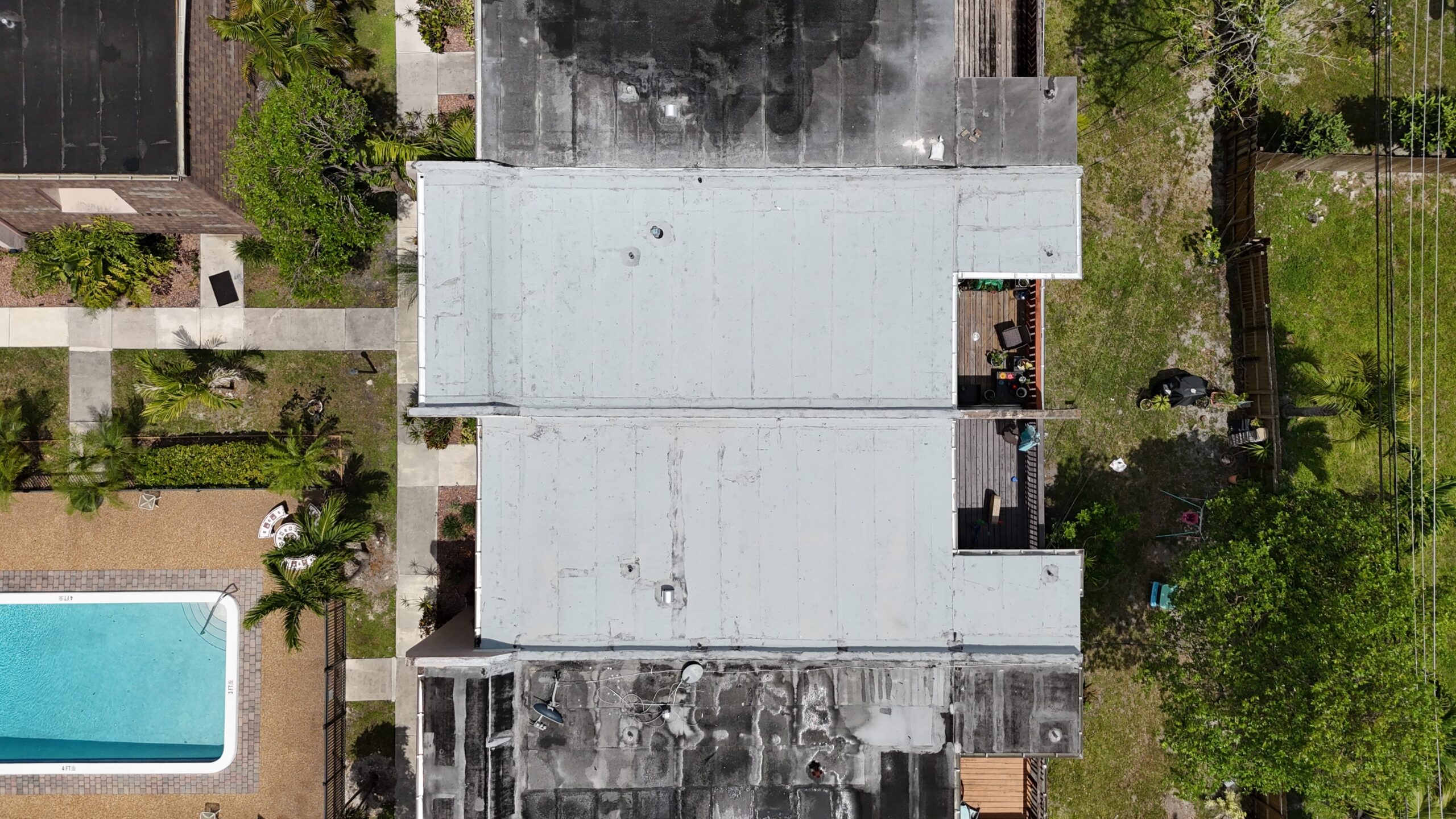
Drive any street in Coral Gables, Kendall, or Hollywood and half the houses show the same thing: a low-slope deck over the addition, the carport, or the whole back half of the home. South Florida builds flat roofs because they are cheap to frame and hidden from the curb. Then August rain sits on them, the seams open, and the homeowner learns that the rules for a low-slope assembly in Miami-Dade are nothing like the rules for the barrel tile out front.
Most of the bad information behind the flat roof myths Miami homeowners repeat comes from national blog content written for Ohio, and it does not survive contact with the High-Velocity Hurricane Zone. In HVHZ jurisdictions — all of Miami-Dade and Broward — every roofing product has to carry a current Miami-Dade Notice of Acceptance (NOA) or Florida Product Approval, and the inspector signing your permit reads it line by line. Here are ten myths, each answered with what the code sheet says.
The Numbers Behind Miami’s Flat Roof Rules
A few verifiable facts frame everything below:
- Florida runs its own code. The Florida Building Code, 8th Edition (2023), is the governing document; roofing is covered in FBC Chapter 15 and the High-Velocity Hurricane Zone provisions, published at floridabuilding.org.
- HVHZ is defined by law. The Florida Building Code defines the High-Velocity Hurricane Zone as Miami-Dade and Broward Counties — the only two counties held to that standard (source: Florida Building Code, Section 1620).
- Product approval is mandatory. Miami-Dade County requires a current Notice of Acceptance (NOA) or a Florida Product Approval that covers HVHZ use for roofing products used in the HVHZ; NOAs are searchable through the county’s Product Control database at miamidade.gov.
- Low-slope is defined by pitch. The FBC classifies “low-slope” roofs as those with a slope of less than 2:12 (source: Florida Building Code, Chapter 15).
- Cool roofs matter here. The U.S. Department of Energy notes that reflective “cool roof” surfaces can stay up to about 50 °F cooler than conventional dark roofs in peak sun (source: energy.gov) — relevant to the TPO-versus-modified-bitumen choice in Myth 10.
Why Flat Roof Myths Cost Miami-Dade Homeowners Real Money
A myth on a sloped tile roof costs you a repair. A myth on a low-slope roof costs you a failed inspection, a stalled permit, a denied claim, or a tear-off you already paid for once. The reason is structural to how the county works: NOAs are jurisdiction-specific documents that name a product, a substrate, a fastening pattern, and a design pressure. Change any one of those variables and the acceptance no longer covers your assembly.
Generic advice fails here. An out-of-state franchise can call a membrane “hurricane rated,” but cannot tell you whether its NOA covers your deck type at your building’s calculated uplift pressure under the Miami-Dade HVHZ wind-load provisions. Bigfoot Windows & Roofing holds CGC1531370, CCC1333168, CRC1331693, and SCC131153098 — we pull the acceptance before we quote, because the acceptance is the job. On a recent Kendall re-roof we replaced a “hurricane rated” single-ply that a prior crew had fastened at field spacing straight through the high-uplift corner zone; the NOA it was sold under never covered that pattern, and the corners were the first thing to lift.
Myth 1: Flat Roofs Are Actually Flat (No Slope Required)
There is no such thing as a flat roof in the code. The Florida Building Code requires positive drainage on low-slope assemblies, and the working minimum enforced across South Florida is a quarter inch of fall per foot of run — one inch of drop for every four feet toward the drain, scupper, or gutter line. Anything under that is a design deficiency, not a style choice.
Homeowners get burned when a re-roof buries the original taper. Proper flat roof drainage slope is built with tapered insulation or a sloped deck, verified before the membrane comes off the truck. If your roofer is not talking about slope on day one, they are selling you a bathtub liner.
Myth 2: Ponding Water Is Always Normal on a Flat Roof
Standing water forty-eight hours after the rain stops is not normal, and it is not “just how flat roofs are.” The distinction that matters is positive drainage versus ponding tolerance. Some membrane systems are tested and accepted for incidental standing water; that acceptance is not permission to design a roof that holds it.
Ponding water flat roof conditions do three things at once: they load the structure, they cook the membrane under UV while it sits in a warm pool, and they turn every seam and penetration into a submerged joint instead of a shed surface. In Miami’s rainy season that cycle repeats weekly. Ponding is a symptom of a slope defect, a crushed insulation board, or a blocked scupper — all fixable, none normal.
Myth 3: Flat Roofs Don’t Last as Long as Sloped Roofs
Service life on a low-slope roof is driven by the assembly and the maintenance, not by the geometry. The honest comparison for flat roof vs sloped roof South Florida is this: tile lasts a long time because the tile itself is inert, but its underlayment and fasteners age on their own schedule. A correctly detailed low-slope system — proper slope, correct TPO membrane or modified bitumen selection, welded or torched seams, terminations tied into sound roof flashing and a code-compliant drip edge — performs for a long, useful run.
What actually shortens flat roof lifespan Miami-Dade homeowners see is neglect at the details: an unsealed plumbing boot, a scupper packed with leaves, an A/C stand screwed through the membrane. Geometry did not do that.
How the Two Systems Compare
| Factor | TPO (single-ply) | Modified Bitumen (multi-ply) |
|---|---|---|
| Construction | Single heat-welded sheet | Multiple asphaltic plies |
| Surface | Reflective (cool roof — see DOE) | Darker unless coated |
| Seams | Heat-welded; weld quality is critical | Torch-, mop-, or self-adhered |
| Field repair | Requires welding equipment/skill | Easier, more redundancy |
| Selection driver | Deck type, uplift pressure, foot traffic | Deck type, uplift pressure, foot traffic |
Myth 4: Any Roofer Can Install a Flat Roof to Code
Low-slope work in the HVHZ is its own discipline. The installer has to work to the specific NOA for the system — the exact insulation, the exact adhesive or fastener, the exact spacing at field, perimeter, and corner zones, because uplift pressure is not uniform across a roof. Corners see the highest loads, and that is where an untrained crew short-fastens.
Under HVHZ low-slope roofing code, a mismatched component voids the acceptance for the whole assembly. A licensed roofing contractor is not a formality; the license is what makes someone accountable to the acceptance document. Ask any bidder for the NOA number they intend to install under, and watch what happens.
Myth 5: Leaks Are Easy to Spot and Trace on a Flat Roof
On a pitched roof, water enters high and shows up more or less below. On a low-slope deck, water enters at a seam, travels laterally between the membrane and the insulation, finds the low point in the deck, and stains a ceiling twenty feet from the actual breach. Chasing the stain is how homeowners pay for three “repairs” that fix nothing.
Real low-slope roof leak detection tests the assembly instead of guessing at the drywall: flood testing where appropriate, infrared scanning for wet insulation after sundown, and inspection of every penetration, drain bowl, wall transition, and termination bar. The membrane field is rarely the culprit. Details are.
Myth 6: Your NOA Automatically Transfers When You Switch Materials
It does not, and this one is expensive. A Miami-Dade NOA flat roof acceptance is written for a named product in a named assembly. If you tear off a modified bitumen roof Miami-Dade system and install a single-ply membrane, you are installing under a different acceptance entirely — different substrate requirements, different attachment, different design pressures, different fire and wind ratings.
Changing deck type, insulation, or attachment method mid-project has the same effect even when the membrane brand stays the same. The permit documents have to reflect the system that is actually going on the building, or the final inspection is a correction notice waiting to be written.
Myth 7: A Patch Repair Never Needs a New NOA
Small, in-kind repairs to an existing system generally continue under the original acceptance — that is true. The myth is that the exemption is unlimited. Once the work crosses into replacing a meaningful percentage of the roof area, or once you change the system rather than repair it, the county treats it as a re-roof: permit, product approval on file, and inspections.
The practical trap is the serial patch: five “small” repairs with five different materials produce a roof no single acceptance covers, and the next buyer’s inspector will say so. Repair within the system and keep the paperwork with the house.
Myth 8: Permitting Won’t Flag Ponding Water on a Reroof Inspection
It absolutely can. Drainage is a code requirement, not a cosmetic preference, and an inspector who sees standing water or a dead-flat field on a re-roof can cite the drainage provision and withhold the final. That is a stop-work moment on a job you thought was done.
The fix belongs in the estimate, not in the argument at inspection. If the deck does not drain, the scope needs tapered insulation, added crickets, or a re-worked scupper and gutter detail before the membrane goes down. Any contractor who bids a TPO flat roof Miami job over a known ponding condition without addressing slope is handing you their problem.
Myth 9: Insurance Treats Flat Roof Age the Same as Sloped Roofs Post-Storm
Carriers writing in HVHZ counties have tightened underwriting on roof age and type, and low-slope assemblies are often scrutinized on a shorter clock than tile or metal. Homeowners renewing in Miami-Dade and Broward find the age threshold, inspection requirement, or settlement basis — replacement cost versus actual cash value — differs for the flat section.
What protects you is documentation: a permitted re-roof, the NOA on file, a dated inspection history, and photographs. An undocumented flat roof of unknown age is the single easiest thing for an underwriter to price against you or decline outright. This is the part of flat roof myths Miami homeowners believe that shows up on a renewal notice rather than a leak.
Myth 10: TPO and Modified Bitumen Are Interchangeable Choices
They are different systems with different failure modes and different acceptances. A TPO membrane is a single-ply sheet, heat-welded at the seams and highly reflective — the U.S. Department of Energy notes reflective roof surfaces can run up to roughly 50 °F cooler than dark ones in peak sun (energy.gov) — but weld quality is everything. Modified bitumen is a multi-ply asphaltic system, torch-, mop-, or self-adhered, with more redundancy and easier field repair at the cost of a darker surface unless coated.
The right pick depends on your deck, your rooftop equipment, how often people walk it, and the uplift pressures calculated for your building. Neither one is universally better. Anyone who leads with a brand before asking about your deck is selling inventory.
Frequently Asked Questions About Flat Roofs in Miami-Dade
Does my flat roof NOA transfer if I switch roofing materials?
No. A Notice of Acceptance covers a specific product in a specific assembly — substrate, insulation, attachment, and design pressure all named. Switching from modified bitumen to a single-ply membrane, or changing the deck or fastening method, means you are building under a different acceptance and the permit documents must reflect it. You can verify any product’s NOA through the Miami-Dade Product Control database at miamidade.gov.
Will Miami-Dade permitting flag ponding water on a reroof inspection?
Yes, it can. Positive drainage is a code requirement under the Florida Building Code (floridabuilding.org). An inspector who finds standing water or a dead-flat field on a re-roof can cite the drainage provision and hold the final until slope is corrected with tapered insulation, crickets, or reworked scuppers.
Do I need a new NOA after a patch repair or only a full replacement?
Genuine in-kind repairs generally continue under the existing system’s acceptance. Once you replace a significant portion of the roof area or change the system rather than repair it, the work is treated as a re-roof and requires a permit with current product approval on file.
How does insurance underwriting treat flat-roof age differently in HVHZ zones post-storm?
Low-slope sections are often held to shorter age thresholds, extra inspection requirements, or actual-cash-value settlement while the sloped portion still qualifies for replacement cost. Permitted work, a filed NOA, and dated inspection records are what keep a flat roof insurable.
What’s the actual code-minimum slope versus what passes inspection in practice?
The working minimum for low-slope roofs is a quarter inch of fall per foot toward the drainage point. In practice, inspectors look for positive drainage across the whole field — a roof that meets the number on paper but holds water in a dished area still fails the intent of the requirement.
What counts as a “low-slope” roof under the Florida Building Code?
The Florida Building Code classifies a low-slope roof as one with a slope of less than 2:12 (Chapter 15, floridabuilding.org). That classification — not the everyday word “flat” — is what determines which drainage, membrane, and attachment provisions apply.
How often should a flat roof be inspected in South Florida’s climate?
Twice a year is the standard for flat roof maintenance South Florida conditions demand: once before hurricane season and once after. Add an inspection after any named storm, and any time another trade works on rooftop equipment.
Get the NOA Checked Before It Costs You
The damage these flat roof myths Miami property owners repeat is preventable with one thing: knowing what system is on your roof and whether the paperwork behind it is current. We inspect your low-slope roof, verify slope and drainage, check terminations, flashing, and drip edge, and tell you plainly what acceptance your assembly falls under — before a claim or a closing forces the question.
Ready for a free estimate? Call 786-886-2088 or fill out our contact form.