
Key Takeaways
- Impact windows use a PVB laminated interlayer that keeps glass bonded even when cracked — standard glass shatters and enters the home.
- Thicker glass alone does NOT make a window impact-rated; it must pass a Florida Building Code large-missile and cyclic pressure test.
- A Miami-Dade NOA is a separate, stricter approval beyond a standard Florida Product Approval — required for HVHZ installations.
- Shutters over non-impact windows are not equivalent to impact windows; the window frame and wall anchor still fail under sustained pressure.
- Impact windows provide continuous protection; shutters require manual deployment before every storm.
The Real Problem
Most homeowners compare the glass — but the glass is only half the story
Understanding what makes an impact window strong starts below the surface.
Impact windows are stronger than non-impact windows because they use a laminated PVB interlayer that keeps the glass bonded after a strike — standard glass shatters and immediately exposes the opening. That difference in construction is the core of hurricane resistance, and it explains why glass thickness alone is not the right comparison point. A window’s full hurricane resistance comes from three engineered layers working together: the laminated glass unit, the aluminum frame, and the structural anchoring into your wall assembly. Remove any one of those layers and the system fails — no matter how thick the pane looks.
Non-impact windows are glazed with annealed or tempered glass. Tempered glass is stronger than annealed in normal use, but under hurricane-force debris impact it still shatters into fragments. Once the glass is gone, wind pressure enters the building envelope, and that pressure differential can lift roofs and collapse interior walls. That is the physical mechanism the Florida Building Code was designed to interrupt.
Learn how impact-rated windows work and why frame construction matters as much as glass selection.
South Florida Context
Miami-Dade and Broward sit inside the HVHZ — the strictest wind zone in the United States
The High-Velocity Hurricane Zone (HVHZ) covers Miami-Dade and Broward counties. Products installed here must carry a Miami-Dade Notice of Acceptance (NOA) — a product-level approval issued by the Miami-Dade Product Control Division after independent laboratory testing. A standard Florida Product Approval (issued statewide) does not satisfy HVHZ requirements on its own.
This distinction matters when you are comparing quotes. A window with a Florida Product Approval number but no Miami-Dade NOA cannot legally be installed as hurricane protection in Miami-Dade or Broward without supplemental protection such as shutters. If a contractor quotes you a window for HVHZ use, ask for the NOA number — not just the state approval number.
Palm Beach County sits just north of the HVHZ boundary and follows standard Florida Building Code wind requirements, which are still among the most rigorous in the country. Impact windows with a valid Florida Product Approval satisfy Palm Beach requirements.
How Impact Windows Are Built
The laminated interlayer is what separates impact glass from every other type
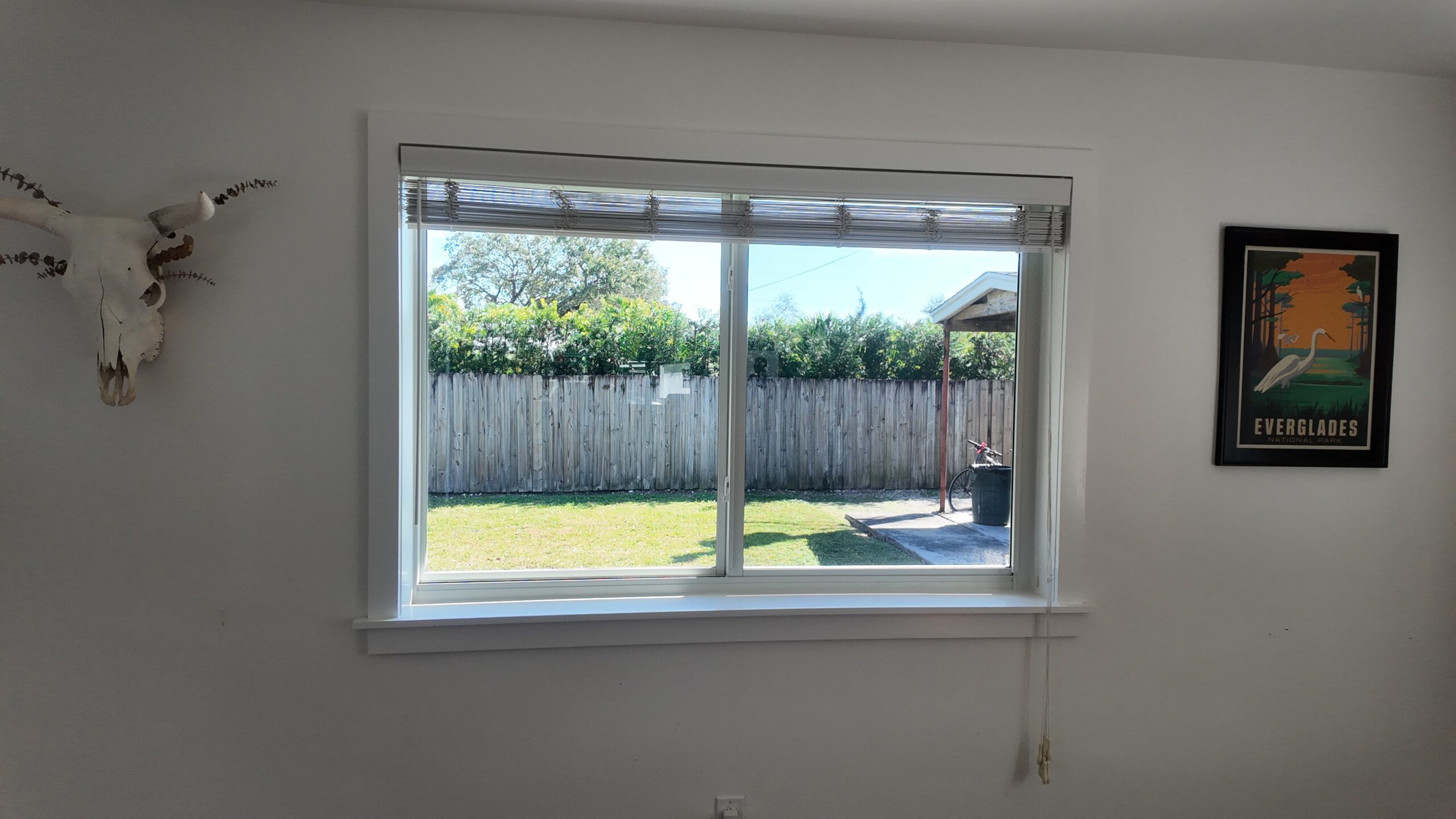
An impact-rated window uses laminated glass — two glass lites bonded together by a polyvinyl butyral (PVB) interlayer. When struck, the glass may crack, but the PVB holds the fragments in place. The opening stays sealed. Wind, rain, and flying debris cannot enter the home.
Standard glass — even tempered — has no interlayer. When it breaks, the opening is exposed immediately. The pressure difference between the exterior and interior of the home can then act on the roof assembly, walls, and doors. Studies by the Insurance Institute for Business & Home Safety (IBHS) and post-storm damage assessments indicate that homes with breached openings suffer disproportionately larger structural losses than homes with intact openings.
Beyond the glass unit, impact windows are tested as a complete system: glass + frame + anchoring hardware. The Florida Building Code large-missile impact test fires a 9-lb 2×4 at the window at 50 feet per second. The cyclic pressure test then applies thousands of positive and negative pressure cycles to simulate sustained hurricane-force wind. A window passes only if it maintains the seal through both tests. Thicker glass without a tested frame assembly does not earn an impact rating.
| Feature | Non-Impact Window | Impact Window |
|---|---|---|
| Glass construction | Single annealed or tempered pane | Two lites + PVB laminated interlayer |
| When glass breaks | Shatters; opening exposed | Cracks but stays bonded; opening sealed |
| Frame tested as system | No | Yes — frame, glass, and hardware tested together |
| Florida Product Approval | Not required for glazing only | Required; NOA required in HVHZ |
| Storm prep required | Yes — shutters or panels must be deployed | No action required before storm |
| UV and noise reduction | Minimal | Significant (laminate blocks UV; mass reduces sound) |
Side-by-Side Comparison
Impact windows vs. shutters over non-impact windows: what the numbers look like
Shutters are a legitimate code-compliant option in many situations — but they are not the same as impact windows in daily use or long-term cost.
| Factor | Non-Impact + Shutters | Impact Windows (No Shutters) |
|---|---|---|
| Storm deployment | Manual — must close before each storm | Always active; no action needed |
| Frame protection | Window frame still exposed to cyclic pressure | Frame tested to full hurricane load |
| Daily light & ventilation | Normal when shutters are open | Normal — no shutters to manage |
| Insurance credit | Partial wind-mit credit (opening protection only) | Full wind-mit credit — often larger premium reduction |
| Upfront cost | Lower (windows) + shutter cost added | Higher upfront; lower combined long-term |
| HOA restrictions | Some HOAs restrict shutter appearance | Florida SB 293 — HOAs cannot prohibit impact windows |
| Resale value signal | Moderate | Strong — buyers expect impact in South Florida |
One scenario where shutters remain the practical choice: historic or architecturally protected homes where existing window frames cannot be modified, or rental properties where the owner wants to keep window replacement costs deferred. In those cases, code-compliant shutters are a legitimate protective measure — just not a permanent set-and-forget solution.
Why It Matters Who Installs
Installation determines whether the rating is real in the field
A licensed contractor, not a lead aggregator — your permit is pulled under our license.
An impact window installed with incorrect anchoring depth, wrong fastener spacing, or missing perimeter sealant will fail before it reaches the rated load — even if the product itself is NOA-approved. The tested performance lives in the product and the installation assembly. Both must be correct.
When window replacement involves structural modifications — such as widening an opening, adding a structural header, or correcting out-of-plumb rough openings — a contractor authorized to handle structural scope can manage that work in-house without requiring a separate structural contractor. That coordination happens under our Certified General Contractor license (CGC1531370), which covers structural modifications that window-only installers are not licensed to perform.
“The NOA number on the box means nothing if the buck stops at the wrong anchor depth. We pull the permit, we do the inspection, and the license is ours.”
President, Bigfoot Windows & Roofing
Product Guidance
What we install — and why we recommend aluminum frames for South Florida
We install Mr. Glass impact windows as our primary line. Aluminum frames are our recommendation for South Florida conditions — aluminum is more time-tested in the HVHZ heat, humidity, UV exposure, and salt-air environment than vinyl alternatives. For energy efficiency, thermally broken aluminum frames (sometimes called thermal-barrier frames) are available and reduce heat transfer significantly without sacrificing structural performance.
Mr. Glass series numbering is counterintuitive: the Series 350 is the builder/residential-grade product — it is not recommended for condos, high-rises, or commercial buildings. The Series 200 (single hung flagship) and Series 300 (horizontal roller flagship) are the high-performance lines. The Series 1000 sliding glass door comes standard with 9/16" glass.
All Mr. Glass lines carry Florida Product Approval. The Series 2500T door carries a Miami-Dade NOA. We back our installations with a 10-year workmanship warranty; Mr. Glass carries a 10-year product warranty (effective October 2025).
Explore our full impact window installation services or impact door options for complete opening protection.
Our Process
From measurement to final inspection — what to expect
- In-home measurement and scope review. We measure every opening, check rough-opening condition, and identify any structural or anchoring concerns before quoting.
- Permit application. We pull the permit under our license. You do not need to manage the permitting process.
- Factory order and lead-time window. Custom aluminum frames are ordered to the measured dimensions. We communicate the lead time at the quote stage.
- Installation. Frame anchoring follows the NOA or Florida Product Approval installation instructions precisely — fastener type, spacing, and embedment depth are specified in the approval documents.
- City or county inspection. A building inspector verifies the installation against the permit and approval documents. This is the independent quality check that protects you.
- Closeout and warranty documentation. You receive permit closeout confirmation and warranty paperwork before we leave the job.
Ready to replace non-impact windows before the next hurricane season?
Or request a free estimate online — no pressure, no obligation.
Related Reading
You might also find these useful
Related Articles
Who We’re Not the Right Fit For
- Budget-first shoppers comparing lowest installed price only. We do not cut corners on anchoring, permitting, or frame quality to win on price. If the lowest number on the page is the deciding factor, we are probably not your contractor.
- Projects requiring vinyl frame windows. We recommend aluminum frames for South Florida conditions. If your HOA or architect requires vinyl for aesthetic reasons and that is non-negotiable, we may not be the right installer.
- Homeowners who want the permit pulled in their name to manage directly. We pull permits under our license. If you want to owner-build and self-manage subcontractors, that is a different engagement than what we offer.
- Commercial high-rise glazing projects. Our primary focus is residential and light-commercial. Large-scale commercial curtain wall or storefront glazing scopes are outside our typical project profile.

Written by Darryl Henry Rosenbaum, Founder of Bigfoot Windows & Roofing.
Darryl Henry Rosenbaum, doing business as Bigfoot Windows and Roofing, holds four active Florida licenses recognized by the Florida Department of Business and Professional Regulation (DBPR): Certified General Contractor (CGC1531370), Certified Residential Contractor (CRC1331693), Certified Roofing Contractor (CCC1333168), and Certified Specialty Contractor with a Glass & Glazing Specialty (SCC131153098).
Common Questions
Frequently Asked Questions
What is the difference between impact and non-impact windows?
Impact windows use laminated glass — two glass lites bonded by a PVB interlayer — inside a frame and anchoring system tested to Florida Building Code hurricane standards. Non-impact windows use a single annealed or tempered pane with no interlayer. When non-impact glass breaks, the opening is immediately exposed to wind and debris. Impact glass cracks but stays bonded, keeping the opening sealed through the storm.
Are impact windows really stronger than regular windows?
Yes — by design, not just by thickness. Impact windows must pass Florida Building Code large-missile impact testing (a 9-lb 2×4 at 50 fps) and thousands of cyclic pressure cycles as a complete system. Regular windows are not tested to this standard. Thicker glass alone does not confer an impact rating; the laminated interlayer, frame, and anchoring must all be part of the tested assembly.
Do impact windows break at all?
The glass can crack under a severe impact, but the PVB laminated interlayer holds the fragments in place. The window continues to seal the opening. Think of it like a car windshield — it may spider-crack but it does not shatter inward. After a storm, a cracked impact window is inspected and replaced if needed, but during the event it continues to protect the building envelope.
Is laminated glass the same as impact glass?
Not automatically. Laminated glass uses a PVB or SGP interlayer, but it must be tested as part of a complete window system — frame, hardware, and anchoring — to earn a Florida Product Approval or Miami-Dade NOA. Laminated glass sold as a glazing upgrade in a non-tested frame assembly is not impact-rated. Always ask for the approval number, not just the glass spec sheet.
Do I still need shutters with impact windows?
No. Properly installed impact windows with a valid Florida Product Approval (or Miami-Dade NOA in HVHZ) satisfy the Florida Building Code opening-protection requirement on their own. Shutters are not required and no pre-storm action is needed. This is one of the primary practical advantages: your home is protected even if a storm strengthens unexpectedly overnight.
How are impact windows tested for strength?
Florida Building Code requires two main tests: a large-missile impact test (a 9-lb 2×4 fired at 50 feet per second) and a cyclic pressure test applying positive and negative pressure loads thousands of times to simulate sustained hurricane winds. Both must be passed by the window as a complete system — glass, frame, hardware, and fasteners. Products passing both tests earn a Florida Product Approval; HVHZ products also require a Miami-Dade NOA.
Can I finance impact window replacement in South Florida?
Yes. PACE financing (Property Assessed Clean Energy) is a common option in Florida — payments are added to your property tax bill, not a bank loan. Rates