
BIGFOOT HOMEOWNER DECISION CENTER
Impact Windows & Doors Buyer’s Guide
From first estimate to final walkthrough
Download the printable guide (PDF)
A plain-language guide for homeowners replacing impact windows and doors: how an installation runs, what drives the price, what is and is not included, and how the warranty works.

Contents
The Buyer's Guide
- 1What happens after you buy: the 15-step process
- 2How long will the job take?
- 3The whole timeline at a glance
- 4What does it cost, and what drives the price?
- 5When do you pay?
- 6Financing, grants and insurance
- 7What is included and what is not
- 8Warranty
- 9About Bigfoot
- 10Inspections and your final walkthrough
- 11Getting your home ready for installation
- 12Your proposal in plain English
- 13Questions to ask every contractor
- 14Red flags when comparing proposals
- 15Ready to plan your windows and doors?
More from Bigfoot
- 16Product approvals in plain terms
- 17Wind zones and design pressure, explained
- 18Impact windows: styles and series
- 19Impact doors
- 20Choosing glass
- 21Window & Door Planning Worksheet
- 22What to compare between two impact window quotes
- 23Can a window opening become a door opening?
- 24Common questions
- 25More answers: permits and approvals
- 26More answers: products and doors
- 27More answers: glass
- 28More answers: cost and financing
- 29More answers: installation and timeline
- 30More answers: warranty and insurance
- 31About this guide
What happens after you buy: the 15-step process
Your project moves through 15 steps. The first three take you from your first call to a signed proposal. The rest begin once your proposal is accepted and fall into three phases: approvals and ordering, installation, and inspections and completion.
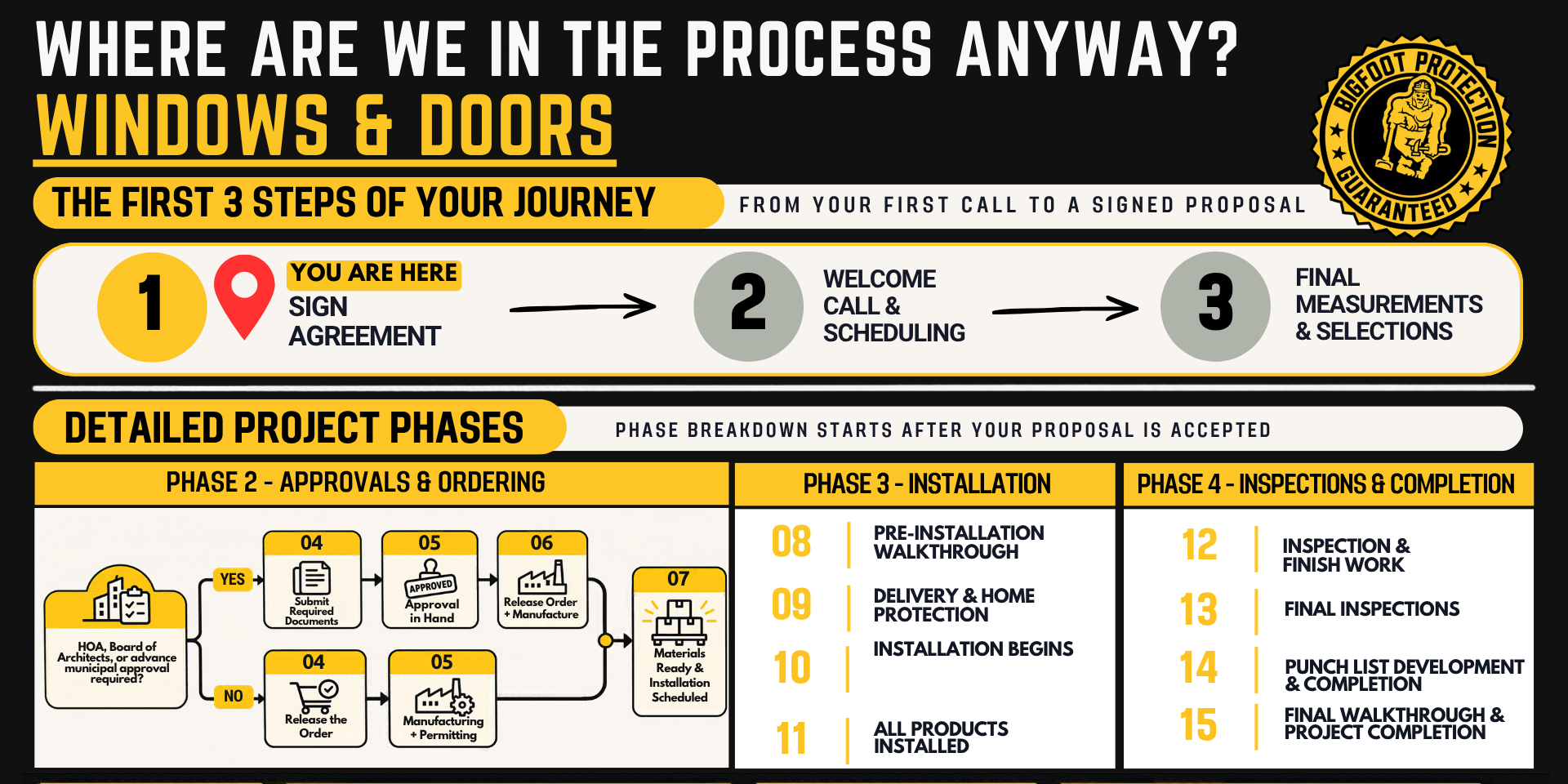
Sign Agreement
You are here. Your proposal is signed and the project begins.
Welcome Call & Scheduling
Bigfoot calls you to welcome you to the project and talk through scheduling.
Final Measurements & Selections
Every opening is measured again and you confirm your selections: series or style, glass, frame color and finish, and hardware.
Approval Check, Then Documents Or Order
Is an HOA, Board of Architects, or advance municipal approval required? If yes, Bigfoot submits the required documents. If no, Bigfoot releases the order.
Approval In Hand, Or Manufacturing And Permitting
If approval was required, you wait for it to come in. If not, your order goes into manufacturing while the permit is handled.
Release Order And Manufacture
On the approval path, the order is released and your products are made once approval is in hand.
Materials Ready & Installation Scheduled
Your products are ready and the install is scheduled with you.
Pre-Installation Walkthrough
Before work starts, Bigfoot walks the home with you.
Delivery & Home Protection
Products are delivered and your furniture and floors are protected.
Installation Begins
Bigfoot's own in-house crews start the install.
All Products Installed
Every specified window and door is in place.
Inspection & Finish Work
The inspection takes place and finish work is completed.
Final Inspections
The required final inspections pass and the permit is closed.
Punch List Development & Completion
A list of anything you want corrected is made, and then corrected.
Final Walkthrough & Project Completion
Bigfoot walks the job with you to confirm everything is installed correctly.
Your first appointment
The estimate appointment takes 60 to 90 minutes. Your advisor walks the house, photographs the openings, then measures them. Bring your questions, photos of your openings and any other proposal you have.
An estimate is not a contract until it is signed and either a deposit is received or a financing agreement is signed. The proposal and its attached Terms & Conditions are the complete agreement.
Measuring twice
Measurements happen twice: once at the estimate, where an inch or two off is fine, and again as final measurements after you sign. Your advisor attends the final measurements, which are your last chance to change anything. A later change means an updated contract, signed again.
The contract price does not change between the first appointment and final measurements. If Bigfoot makes a mistake, Bigfoot owns it.
Choosing glass and finish
Your selections cover the series or style, the glass (impact only or insulated; clear, gray or white interlayer; Low-E), the frame color and finish, and the hardware. Coatings and tints should match across each side of the house. Insulated glass can be mixed without a visible difference.
Permits and paperwork
Bigfoot records and submits the permit paperwork, including the Notice of Commencement, which you sign. You can sign in person or by DocuSign, or with a virtual notary if you are out of state.
This page describes the process and is not part of your contract.
How long will the job take?
Most of the wait is before the crew arrives, not on your walls. From signed contract to install usually takes 5 to 12 weeks, depending on the manufacturer, and your estimate shows the lead time for your order.
Nothing about a start date is real until the contract is signed, the permit and any approvals are in hand, and the materials are ready.
Before the crew arrives
Signed contract
With a deposit or a signed financing agreement.
Final measurements
Taken after you sign.
HOA approval, if any
Where an HOA applies, its approval comes first.
Permit and materials order
Handled by Bigfoot.
Waiting for materials
Made-to-order products have to arrive.
Install scheduled with you
You and Bigfoot agree on the date.
Permits
City permit approval typically takes 15 to 45 days, depending on the city and the submittal. In some cities Bigfoot does not place the order until the permit is approved.
HOA approval
Where an HOA applies, its approval adds 2 to 4 weeks on top, depending on how long the HOA takes to approve.
Busy season
From March to September, lead times can run longer than stated.
Factory closures
Manufacturers close for about three weeks around Thanksgiving, Christmas and New Year's. The last-order cutoff is usually around October.
On install days
- Bigfoot's own in-house crews install your windows and doors.
- A whole-home install for a standard home typically takes 2 to 5 days on site.
- Crews work Monday to Friday, sometimes Saturday. Sundays are off.
- On scheduled days crews are on site from 7:00 AM to 6:00 PM, and visits are confirmed ahead of time.
- Dates can be moved for illness, family or vacation. There is no pressure to install the moment materials land.
Structural changes to an opening add time: engineering, permit review, concrete curing and inspections.
Staying informed
You will hear from Bigfoot every two to four weeks and whenever something material changes. You can call the office at any time. If something unexpected is found, you get a photo and a straight explanation of whether the scope covers it and what the fix takes, before anyone touches it.
The whole timeline at a glance
From signed contract to finished job, four stages set your schedule. Most of the time passes before the crew arrives.
| Stage | Typical time |
|---|---|
| Order lead time (signed contract to install) | 5 to 12 weeks, depending on the manufacturer |
| City permit approval | 15 to 45 days, depending on the city |
| HOA approval, where one applies | Adds 2 to 4 weeks, depending on the HOA |
| On site for a standard whole home | 2 to 5 days |
Your estimate shows the lead time for your order, and the manufacturer's production schedule and material supply are what set it, along with factory closures around the year-end holidays. Permit time depends on your city and the submittal, and on an HOA, Board of Architects or strict-municipality job Bigfoot waits for the required approval before ordering, which stretches the wait. On site, structural changes to an opening add engineering, permit review, concrete curing and inspections, and install dates can move for illness, family or vacation.
Ask for your own dates: contract signed, order placed, permit approved, install and final inspection.
What does it cost, and what drives the price?
Your price is built from the products you choose, their sizes, the glass, the finish, any structural work, and your city's permit fee. Your written proposal shows the exact price for your openings.
Structural changes to an opening are priced separately, at $4,000 to $35,000 per opening, with an engineer's review before the final price.
Products and sizes
Series, style and the size of each opening.
Glass
Insulated glass and Low-E are separate choices with separate prices.
Finish
Frame color and finish.
Structural work
Changing an opening is priced on its own, apart from the window or door.
Permit fee
Permit fees differ by city. Bigfoot's estimator carries each city's fee.
Will there be surprise fees?
Bigfoot aims to include in the price all the fees it controls, so there are no surprises.
How are doors with sidelites or a transom priced?
Each part of the opening is measured and listed separately.
Does the price change after the first appointment?
The contract price does not change between the first appointment and final measurements.
When do you pay?
You pay in four parts, tied to the work.
To place the order
Your first payment releases your order.
When installation begins
Due when the crew starts.
When installation is complete
Due when every product is installed.
When the permit is closed and the walkthrough is done
The final payment.
Ways to pay
- Visa, Mastercard, American Express and Discover carry a 4% card convenience fee.
- Cash, ACH, check and Zelle carry no card fee.
- Checks and ACH are payable to Bigfoot Windows and Roofing.
If you finance
On a financed job, Bigfoot can proceed with no deposit and no payments along the way once the financing company approves the agreement. The lender pays 100% at the last milestone, subject to lender approval, program terms and disbursement procedures.
Financing, grants and insurance
Bigfoot offers zero-down options through three lenders, and shows two programs that are not lenders. Every option is subject to lender approval and terms.
Lenders
- Renew Financial
- GreenSky
- Service Finance Company
Rates are usually between 8% and 12% on average. Your own rate depends on the lender and your application, and terms may vary. The financing company can ask for bank statements, pay stubs or W-2s at any point. You can try your own numbers in Bigfoot's financing calculator on bigfootwindowsandroofing.com.
Partial or extra payments are allowed. PACE and Renew re-amortize once a year, so your payment drops after a large extra payment.
Programs that are not lenders
Florida PACE
PACE is repaid through your yearly property tax bill, not a monthly bank payment. More than one PACE program is offered.
Financing starts at job completion, not signing. Interest builds from the day the work is finished until the first tax bill and is added to the amount financed. The first payment is usually about 12 to 20 months after the job, depending on funding.
If your mortgage company pays your property taxes, your monthly mortgage payment may go up sooner.
PACE conditions
Under Florida statute, a PACE agreement creates a lien from the recording date that lasts until it is paid off.
To be eligible, your taxes must be current and not late in the past 3 years (or the length of ownership if shorter), you must be current on your mortgage, and you must have no involuntary liens such as construction liens.
A roof and windows must be submitted as separate applications.
My Safe Florida Home
A state grant, not a lender. It offers up to $10,000 for qualifying impact window and door upgrades, for low- and moderate-income homeowners.
The state pays $2 for every $1 the owner pays; low-income homeowners are exempt from the match. The home must be a homestead built before 2008 and insured for $700,000 or less, and a program inspection comes first.
PACE can be combined with My Safe Florida Home. Confirm current program requirements and approval before work starts.
Insurance
Florida Statute 627.0629 requires insurers' rate filings to include windstorm-mitigation discounts or credits. The amount varies. A separate inspector does the wind-mitigation inspection and fills out the form.
Bigfoot cannot promise an insurance credit. For an opening-protection credit, every opening must be protected: every window and door, the garage door and any side door. Glass block does not count unless it is shuttered or changed to impact.
What is included and what is not
Your proposal lists your scope in writing. Here is what Bigfoot's proposal includes, and what it leaves out.
Included
- Protection of furniture and floors during the install
- Removal and disposal of existing windows and doors
- Installation of all specified impact windows and doors
- Door casing where applicable
- New wood bucks where applicable
- Minor repairs within the immediate window or door reveal
- Project management from permit to final inspection
- Permit processing and submission (when included)
- Coordination of all material deliveries
- Professional installation by Bigfoot crews
- Scheduling and attendance at all required inspections
- Caulking, sealant and weatherstripping at all openings
- Screw covers and trim as applicable
- Daily cleanup during the install
Not included
- Any painting or priming
- Window treatments, blinds and shades
- Electrical or alarm work on removed openings
- HOA application fees, where applicable (the homeowner's responsibility)
- Structural work not explicitly listed in the proposal
- Repairs to pre-existing or concealed conditions
Structural opening work is separate from the window and door price.
What you receive at the end
- Copies of the final inspection
- A copy of the paid invoice
- The manufacturer warranty, registered where applicable
- Job photos on request
Do not add aftermarket tint or film unless the manufacturer allows it in writing. Many warranties exclude glass damage that follows.
Warranty
Bigfoot warrants its installation labor for 10 years. If a workmanship issue appears in that period, Bigfoot returns and corrects it. This applies to installation by Bigfoot crews.
When it starts
At final inspection and permit closeout. If closeout is held up by something unrelated to Bigfoot's work, coverage begins at substantial completion.
Who it covers
Windows and exterior doors installed by Bigfoot. It transfers once to the next owner, subject to the written warranty terms.
Manufacturer warranty
Separate and limited. It covers frames, glass and hardware against defects. Duration and coverage vary by product line, and the documents are provided at installation. Bigfoot handles any manufacturer registration required.
Glass
The glass warranty term depends on the glass makeup and interlayer.
Not covered
- Storm or event damage
- Accidental glass breakage
- Outside impact, such as golf balls, BB guns or landscaping rocks
- Vandalism
A warranty is not homeowners insurance.
Who do I call?
Contact Bigfoot first, not the manufacturer. Your signed contract and written warranty control.
About Bigfoot
Bigfoot Windows and Roofing is a family-owned, licensed Florida contractor founded in 2016. It serves Miami-Dade, Broward and Palm Beach counties and additional Florida locations. One company handles windows, doors and roofing, with in-house installation crews.
| License | Number |
|---|---|
| General Contractor | CGC1531370 |
| Roofing | CCC1333168 |
| Residential | CRC1331693 |
| Certified Specialty (Glass & Glazing) | SCC131153098 |
Reviews
5.0 on Google with 180+ reviews.
Insurance
Products
The main window and door maker is Mr. Glass.
Office
7250 SW 39th Terrace, Miami, FL 33155. Phone (786) 886-2088.
Inspections and your final walkthrough
Your permit closes when the required inspections pass. Bigfoot schedules and attends every required inspection.
In Miami-Dade there is currently one inspection for windows: the buck and fastener inspection, which also closes the permit. A door-only permit has one inspection, called the final, at the same stage.
- The buck and fastener inspection happens after the units are set and fastened, before stucco or trim covers the fasteners. Permit closeout follows.
- Some other cities add inspections, including a final where repairs must also be complete.
- For a door or window conversion, the reinforcement and door anchoring are inspected before the wall is closed.
- New wood bucks go in where applicable, and each unit is fastened with screws or anchors and caulked in.
Punch list and final walkthrough
Before work starts there is a pre-installation walkthrough. After installation, a punch list of anything you want corrected is developed and completed.
After the inspection passes, Bigfoot walks the job with you to confirm everything is installed correctly. The final 10% payment is due when the permit is closed and this walkthrough is done.
Wind-mitigation inspection
The wind-mitigation inspection for insurance is done by a separate inspector.
Getting your home ready for installation
A little preparation makes install day faster and cleaner. Here is what to do before the crew arrives, what to expect while they work, and what to do afterward. Bigfoot protects your furniture and floors and cleans up daily, but the crew can only work around what it can reach.
Bigfoot's promise on your home: dust-protected spaces, protection for your furniture and belongings, and thoughtful cleanup.
Before install day
- Clear and cover the space. Remove or cover furniture, decorations and fragile items that block access to the windows and doors, both inside and outside. That includes exterior decorations such as holiday wreaths.
- Provide adequate access. Keep pathways to rooms and windows clear of obstacles, and move anything that could cause an accident or get in the installers' way.
- Take things off the walls and ceilings near the work. Pictures, wall hangings and similar items should come down before the job starts.
- Remove your window treatments. Your new windows and doors will look great, but old blinds and curtains might not fit the new spaces. Take them down beforehand to avoid damage. Issues with removing or installing treatments are not part of the proposal.
- Know the shutter notice. If exterior shutters block an opening and you want to keep them, the crew may need to remove them when there is not enough space, and cannot reinstall them.
- Have your hardware ready. New doors do not come with new locks. If you plan to replace them, have them ready on installation day and the crew will install them for you.
- Contact your alarm company 24 to 48 hours before the install date. Tell them about the replacement so they can remove the alarm and put it back after the installation is complete. Alarm wires need to be removed before the install, and alarm wiring and function are not part of Bigfoot's scope.
- Keep pets and children away from the work area. Make plans for them before the crew arrives.
- Arrange water and electricity. You provide both for the length of the job.
- Plan your other contractors around this job. If you have other work scheduled, set it so it does not get in the way of the install.
On install day
- Be ready to give access. Crews work on scheduled days from 7:00 AM to 6:00 PM, and Bigfoot confirms the visit with you ahead of time.
- Expect some dust. Removing old windows and installing new ones involves scraping, sanding and possibly drywall work. Expect some dust and dry paint on floors and exterior areas. Installers are as careful as possible and use floor coverings, and dust walls of plastic go up where applicable.
- Expect the crew to protect your home. Furniture is covered with plastic, and the crew does daily cleanup and trash removal during the install.
- Keep pets and children clear of the work. Old units come out and new ones go in throughout the day.
- Stay reachable. If something unexpected turns up behind an old window, you will get a photo and a straight explanation before anyone touches it.
After the install
- Plan the finish work that is yours. Painting and priming are not included in the proposal. After the final inspection passes, the crew adds screw covers and trim and takes the stickers off the windows.
- Walk the job with Bigfoot. After the inspection passes, you go through the work together. Tell the crew about anything you want corrected and it goes on your punch list.
- Keep your paperwork. You receive copies of the final inspection and the paid invoice, and the manufacturer warranty, registered where applicable.
Not sure about something on this list? Ask at your pre-installation walkthrough. Bigfoot walks the home with you before work starts.
Your proposal in plain English
Your proposal comes with Terms & Conditions. Here is what the main terms mean for you, in everyday words. This page explains the idea. Your signed proposal and its attached terms are the actual agreement, and they control.
The basics
When is it a binding contract?
Only when two things have happened: you have signed it, and either Bigfoot has received your deposit or your financing agreement has been signed. There is no separate agreement to sign later, and nothing has to be acknowledged at a home office.
Who am I contracting with?
Your contractor is Bigfoot Construction, Inc., doing business as Bigfoot Windows & Roofing. Formal notices go in writing to 7250 SW 39th Terrace, Miami, Florida 33155.
Does everyone on the deed have to sign?
One owner's signature is enough. By signing, you confirm you are authorized to sign for the other owners and occupants.
Do verbal promises count?
No. Bigfoot is not bound by anything promised verbally. The contract changes only through a written change order or amendment that you and Bigfoot both sign.
Price and timing
The price is fixed
Once you sign, the price is fixed for the scope described in the proposal. It is not an estimate that can be revised later. Bigfoot cannot add to it for items it left out of its own estimate, higher labor or material costs, engineering changes, permit expenses, market increases or items it later decides were not included. The permit and inspection fees shown in your scope are already in the price.
The price is good for 30 days
The proposal and its price are good for 30 days from the date on the proposal. If you have not signed within 30 days, ask for an updated proposal. The new price may be different. Thirty days is the only expiration period in the contract.
Final measurements
Final measurements are taken after you sign and before anything is ordered. That is your last chance to change a selection, and a later change means an updated, re-signed contract. The price does not change between the first appointment and final measurements.
When the lead-time clock starts
The estimated manufacturing lead time begins after final measurements, after any required approvals, and after the order is submitted to the manufacturer. Lead time depends on the manufacturer, and your estimate shows it. Bigfoot is responsible for its own avoidable ordering, approval and scheduling mistakes. Delays outside its control, such as manufacturer shutdowns, material shortages, strikes, hurricanes and major storms, can extend the schedule.
Changes and change orders
No added work that raises the price starts until you and Bigfoot both sign a written change order. Each one states the condition or the change you asked for, the work being added, removed or changed, the increase or credit, and any effect on the schedule, products, approvals or warranties. One signature from each side is enough, and it can be signed electronically.
Nothing is ever added to your price automatically. You never owe a design, estimating, coordination, drafting or research fee just for asking about a change you did not approve. If a request needs paid design or engineering work, Bigfoot tells you the cost and gets your agreement first.
Window sills
When the old windows come out, existing window sills can break, scratch or be damaged. If that happens, Bigfoot notifies you right away.
You then choose one of two options. Either you provide replacement sills and Bigfoot installs them at an additional labor cost, or you authorize Bigfoot to supply and install replacement sills, which carries an additional charge. Both options are documented and approved through a change order.
Minor repairs and major repairs
Minor repairs
Minor repairs are ordinary, nonstructural repairs within the immediate window or door reveal, including limited repairs needed to complete the installation. New wood bucks are included where applicable. They are covered where your scope says they are.
Major repairs
Examples include large areas of stucco or drywall coming loose, repairs needing corner beads, repairs outside the immediate reveal, structural reinforcement, steel headers or columns, concrete cutting, excessive deterioration and special engineering.
Major repairs need a written change order signed before the work begins, unless your scope already includes them.
Cosmetic issues
An issue that is only cosmetic and does not prevent safe installation should not stop your project. You can repair it yourself or through another contractor, as long as that does not unreasonably delay the final inspection or final payment.
Hidden conditions
Some problems cannot be seen until the old unit is out. Who is responsible depends on what caused them. Bigfoot is responsible for direct damage caused by its negligence, improper removal, improper installation or failure to use reasonable care. You are responsible for conditions that were already there, such as stucco or drywall that was not properly supported, earlier work installed incorrectly, or conditions hidden behind existing windows, doors, trim or walls.
When Bigfoot finds one, it photographs it, explains what it found, tells you whether your scope covers it, tells you whether it affects safety, and gives you a written price if extra work is needed. Please respond within 2 business days if the opening is exposed or security, safety or weather protection is involved, and within 5 business days for a non-urgent condition. Bigfoot will not do corrective work you have not approved, though it may take reasonable temporary steps to protect the home, such as securing an exposed opening with plywood. Work on your other openings continues.
If Bigfoot reasonably believes an opening is not structurally sound or does not meet code, it may decline to install a product in it until the opening is made safe and code-compliant.
HOA and BOA approvals, permits and fees
- On a project with a homeowners association, Board of Architects, strict municipality or other higher risk, Bigfoot waits for the required approval before ordering when its experience says approval is necessary.
- On a standard-risk project, Bigfoot may submit the manufacturer order after final measurements, even if the permit has not been issued yet. That judgment is Bigfoot's, and so is the cost if it makes an ordering or approval mistake.
- Bigfoot includes permit processing, standard municipal permit fees, required inspections and its own permit closeout where your scope reflects them.
- HOA and BOA fees are yours unless your scope expressly lists them as included.
- Not included unless your scope says so or you sign a change order: special or structural engineering, structural reinforcement, steel headers or columns, concrete cutting, permits caused by concealed structural conditions, unrelated property violations, and work required because of another contractor.
If a product is not approved
If a size, style or configuration you want is not approved, Bigfoot works with you to find an approved alternative, and you must approve it. If it costs more, you both sign a change order first. If it costs less, you get a credit or refund of the difference.
Delivery and storage
If materials are delivered to your property, please provide a reasonably secure place to keep them. Bigfoot is responsible for damage caused by it or its crews. You are responsible for theft, weather damage, or damage caused by you, other occupants, visitors or another contractor after delivery. Bigfoot works around reasonable scheduling needs, including illness, family needs and vacations, and does not pressure you to install the moment materials are ready.
Storage charges begin only after all three of these have happened: Bigfoot has told you in writing that your materials are ready, it has made documented scheduling attempts, and 60 days have passed since that notice.
The final 10%
The last 10% is due after the work is finished, not before.
It becomes due after Bigfoot's scope is complete; after the inspection for its work has passed, or Bigfoot has made the required inspection request and a good-faith effort to get it; after its permit is closed where closure is within its control; after the final walkthrough takes place; and after the agreed punch-list items are completed.
If something unrelated to Bigfoot's work keeps the permit from closing, such as an existing violation or another contractor's unfinished renovation, that issue cannot indefinitely delay the final payment. Bigfoot still returns to finish or obtain the final inspection on its own work once the matter is resolved. If you decline to sign the final walkthrough, Bigfoot may send written notice that the work is complete. You then have 5 business days to identify in writing the specific items you believe are incomplete or defective.
Questions to ask every contractor
Use this list with every company you talk to, including Bigfoot. Each question comes with what a good answer from Bigfoot looks like, so you can hold the others to the same standard. Check each one off as you get a clear answer in writing.
- Are you licensed, and can I see your insurance? Good answer: Bigfoot holds a General Contractor licence (CGC1531370), a Roofing licence (CCC1333168), a Residential licence (CRC1331693) and a Certified Specialty licence for Glass & Glazing (SCC131153098), and posts its certificate of insurance on its website.
- Who will install my windows and doors? Good answer: Bigfoot's own in-house crews.
- Who pulls the permit? Good answer: Bigfoot processes and submits the permit paperwork where your proposal includes it, including the Notice of Commencement that you sign. Impact windows and exterior doors need a permit every time.
- Is the whole scope in writing? Good answer: Yes. The proposal lists the inclusions, the exclusions and the product details for each opening, and the proposal with its attached terms is the complete agreement.
- What is not included? Good answer: Painting and priming, window treatments, electrical or alarm work on removed openings, HOA application fees, structural work not listed in the proposal, and repairs to pre-existing or concealed conditions.
- How long is the warranty, and what are its layers? Good answer: Bigfoot warrants its installation labor for 10 years, and the manufacturer's own limited warranty covers frames, glass and hardware separately.
- When does the warranty start, and does it transfer? Good answer: It starts at final inspection and permit closeout, and it transfers once to the next owner under the written warranty terms.
- How do you price changes? Good answer: The price is fixed once you sign, and it changes only through a written change order that you sign before the added work begins.
- What are the payment milestones? Good answer: 50% to place the order, 20% when installation begins, 20% when installation is complete, and 10% when the permit is closed and the walkthrough is done.
- Will you measure again before ordering? Good answer: Yes. Final measurements happen after you sign, with your advisor present, and the contract price does not change between the first appointment and final measurements. If Bigfoot makes a mistake, Bigfoot owns it.
- Can I have the approval number for every line? Good answer: Bigfoot puts the approval numbers in the permit package, and you can ask your rep for each line's number in writing. The approval documents are available any time you ask.
- Is each line approved for the High-Velocity Hurricane Zone, and what is its design pressure? Good answer: Bigfoot does not send a homeowner a quote with a line flagged as not compliant with the High-Velocity Hurricane Zone, and you can ask for the design pressure of each line in writing.
- How long will it take, and what could stretch it? Good answer: Lead time runs 5 to 12 weeks depending on the manufacturer, city permit approval takes 15 to 45 days depending on the city, and an HOA adds 2 to 4 weeks. A standard whole home takes 2 to 5 days on site.
- Will you order before the approvals are in? Good answer: Where an HOA, Board of Architects or strict municipality is involved, Bigfoot waits for approval before ordering. In some cities it does not order until the permit is approved.
- What happens if you find a hidden problem? Good answer: You get a photo and a straight explanation of whether the scope covers it and what the fix takes, and nothing is done until you approve it.
Bigfoot will also look over another contractor's proposal with you, to make sure the two are comparable.
Red flags when comparing proposals
Asking you to buy is normal. Pressure starts when urgency, fatigue, fear or hidden information is used to push you to decide before you are ready. No single item below proves a company is bad. Two or three together are a pattern worth noticing.
Pressure on the day
- A price that is only good while the salesperson is in your home, with no written reason or end date.
- A salesperson who steps out again and again to call a manager and comes back with a better number.
- No written proposal left behind, so you cannot read it slowly or compare it.
- A long presentation before any number appears, so that saying no feels like wasting the evening.
Fear and big claims
- Worst-case warnings about your home with no photo, measurement or document you can check.
- A claim that your insurer will drop you. Only your carrier and your agent can confirm that, so ask them in writing.
- Grant deadlines quoted from memory. The state program publishes its own dates.
- A product described as rated for a hurricane category. Impact products are tested to design pressures and impact standards, and no product is completely hurricane proof.
Price and scope games
- A big first number cut in steps until a special price appears.
- Financing described only as a small monthly payment, with no cash price or total repaid.
- A request to sign to lock the price before the product series, product approval and written scope are named.
- A low price that leaves out permits, wood bucks, finish work or engineering.
Closing the door on comparison
- Being told other companies will waste your time, or that every other quote is apples to oranges.
- A refusal to give you a price unless every decision-maker is in the room right now.
- A vague one-line price with no inclusions or exclusions.
Before you compare totals, compare scope: permits and fees, inspections and closeout, wood bucks and opening preparation, removal and disposal, finish work, concealed conditions, protection and cleanup, and when the warranty starts.
Bigfoot's own approach is a defined scope, a clear explanation of permits, inspections and product approvals, and no promise to skip any of them. If you want a one-line price without knowing what it includes, another contractor may suit you better.
Ready to plan your windows and doors?
- Impact window and door proposal checklist
- Financing calculator
- Warranty details
- Read our Google reviews
Bring your questions, photos of your openings and any other proposal to the appointment. The appointment includes measuring.
Bigfoot Windows and Roofing, 7250 SW 39th Terrace, Miami, FL 33155.
Product approvals in plain terms
Short answer: every impact window and door needs a product approval, and the approval has to match the part of Florida where you live. Think of the approval as the spec sheet that proves a product passed its tests. It is not the building permit. You need both.
Bigfoot's main window and door maker is Mr. Glass. In Miami-Dade and Broward, which sit inside Florida's High-Velocity Hurricane Zone (HVHZ), the approval for the window or door has to cover that zone. Mr. Glass marks the HVHZ status of each line on its own quote, so the status is checked line by line. A line can read "No compliance with HVHZ." Bigfoot does not send a homeowner a quote that has a flagged line.
No window or door is completely storm-proof. Bigfoot does not describe any product that way. Impact glass can break in one spot while the rest of the glass still holds together.
The two kinds of approval
Miami-Dade NOA
A Miami-Dade Notice of Acceptance names the approved product and its limits. It covers the High-Velocity Hurricane Zone.
Florida Product Approval
Shown as an "FL" number. It also names the approved product and its limits. One that carries the HVHZ endorsement is also accepted in Miami-Dade and Broward.
Which one Bigfoot uses
Mr. Glass uses Florida Product Approvals rather than Miami-Dade NOAs. Both kinds of document are available from Bigfoot on request.
What to check on an approval
- It names the exact product you are buying, not a similar one.
- Your opening is within the sizes and limits the product was tested to.
- The design pressure is listed (see below).
- The approval is current.
Bigfoot puts the approval numbers in the permit package. The numbers are not printed on the proposal today, so ask your rep for each line's approval number in writing. Bigfoot also keeps approval, NOA and warranty documents available any time you ask.
Design pressure (DP)
Design pressure is the wind-pressure rating a tested window or door is built to resist. It is written as two numbers, in pounds per square foot. Each series has its own rating, and the "small missile" versions of a series reach higher pressure.
The pressure each opening needs depends on your home and your city. The product also has to be anchored the way its approval says. Ask for the design pressure of each line in writing.
Approval versus permit
An approval (NOA or Florida Product Approval) is not a permit, and a permit does not replace an approval. You need both. Impact windows and exterior doors need a permit every time. Bigfoot records and submits all of the permit paperwork.
In some cities Bigfoot waits for the permit before ordering.
Your proposal's product pages show the manufacturer, series, type, dimensions, configuration and design-pressure information. They are the authority on what is being ordered.
Wind zones and design pressure, explained
Short answer: the wind your windows and doors must resist depends on two things. One is where your house sits on the map. The other is where each opening sits on the wall. Think of it like sizing a beam on a job site. The span and the load both matter, and you cannot size it from the address alone.
What "wind zone" means
People use the phrase in two different ways, and mixing them up causes most of the confusion.
Where the house sits
The building code assigns every address a design wind speed. It comes from a map, not from a weather report. It tells you how hard the wind is expected to blow at your location.
Where the opening sits
An opening in the calm middle of a wall sees less pull than one near a corner of the house. Corners are where wind separates and speeds up, so they get the harder number.
Put together
The address and the opening position together set the pressure that one window or door has to be built for. Two windows on the same house can need different ratings.
Why two addresses in one county can differ
The wind map does not follow county lines. Distance from open water matters, because wind that crosses open water or flat ground hits a building harder than wind that has to push through trees and neighbouring homes. The height of the building matters too, since upper floors see more pressure. Do not assume one county means one wind number.
Why Miami-Dade and Broward are the High-Velocity Hurricane Zone
Florida's building code carves out the High-Velocity Hurricane Zone (HVHZ) and applies it to all of Miami-Dade and Broward. These two counties get the strictest product rules in the state. The reason is exposure to hurricanes. The code answers it with tougher design wind speeds and a tougher testing and approval process for anything that goes in an exterior opening.
Products sold into the zone are tested as a complete assembly, meaning the glass, the frame and the hardware together, not each part alone. The tests cover impact from flying debris and the steady and repeated pressure of a storm. A window that passes is a tested system. It is not just a thick piece of glass in an ordinary frame.
Why impact glass protects the whole house. If one window breaks in a storm and wind rushes inside, pressure inside the house jumps and every other opening is loaded harder. Keeping the glass intact on every opening protects more than the opening that gets hit.
What design pressure means for choosing a series
Design pressure is the push and pull, in pounds per square foot, that a window or door must resist without failing. A product rated below what your opening demands can blow in or blow out. So the required number comes first, and the series is chosen to meet it.
- The opening's position, middle of the wall or corner, sets which pressure applies.
- The worst case for that opening is the number the product has to meet.
- If a series falls short for a given opening, the options are a stronger series or glass build-up, or splitting a large opening into smaller units.
This is also why prices move. Corner openings, taller walls, large openings and coastal locations push the required pressure up. A higher requirement can mean a stronger series, heavier glass or a stronger frame and anchoring, and those cost more.
What the approval has to cover
An approval is only useful if it matches your job. Check these four things:
- The zone. In Miami-Dade and Broward the approval has to cover the High-Velocity Hurricane Zone. Mr. Glass marks that status on each quote line.
- The exact product. The approval must name the series and type you are buying.
- The size and configuration. Each approval lists the sizes and layouts it was tested for. You cannot go beyond them.
- The pressure. The rating listed on the approval has to meet or beat the pressure your opening requires, and the product has to be installed and anchored the way the approval says.
Your engineer, permit reviewer and the building code decide the final number for your address, and no online page can. Ask for the required and proposed pressure for each opening in writing.
Impact windows: styles and series
Short answer: pick the window style that fits how you want each opening to work, then pick the series for the strength and finish you need. Here is what Bigfoot sells.
Window styles
Single hung
The style used in South Florida. Bigfoot does not currently offer double hung.
Horizontal roller (sliding)
A window that slides sideways.
Casement
Casements come as swing-out, awning and fixed versions. Mr. Glass casements come with stainless steel hardware as standard.
Picture window
A fixed window. It lets in light and the view but does not open.
Shaped windows
Arches, half circles and tombstones. These are fixed only.
Frames and finishes
Window frames on Mr. Glass orders are aluminum. Colours include white, black, bronze and clear anodized, plus a powder-coat finish or a wood-grain finish. Write the frame colour you want next to each opening so it can be checked on the quote.
How the Mr. Glass series are numbered
The 350 series is the builder-grade line. The 200, 300 and 400 series are the higher lines. Each series carries its own approval and its own design-pressure rating, which is why the series name on a quote matters more than the word "impact."
A series name alone does not tell you what you are getting. Ask for the series, the type, the size in inches, the frame colour, the glass makeup and the approval number for every line.
Questions to settle for each opening
- Does it need to open? If not, a fixed picture window is an option.
- Which style (single hung, horizontal roller, casement, picture or shaped) suits the opening?
- Which series, and does it have the approval and design pressure your opening needs?
- Which frame colour or finish?
- Which glass? See "Choosing glass" below.
Impact doors
Short answer: Bigfoot works with five impact door types: front entry doors, sliding glass doors, French (swing) doors, bifold doors and pivot doors. The table covers each one.
| Door type | What it is | Good to know |
|---|---|---|
| Entry door | The front door of the home. It can have sidelites (glass panels beside it) and a transom (glass above it). | Doors are measured concrete to concrete. Final measurements are taken again after the contract is signed. |
| Sliding glass (patio) door | A patio-style door whose panels slide. | Choose the glass, finish and hardware. For a patio opening, ask about both a sliding glass door and a French (swing) door. |
| French door | In the Mr. Glass line this is the 3000 series swing door, single or double, with 7/16 laminated glass and insulated options. | Choose the glass, finish, swing direction and hardware: 3-point locks or ladder handles. Doors taller than 98 inches must use Mr. Glass hardware. |
| Bifold door | A door whose panels fold. | Availability depends on the opening size, your design goals, the design pressure the opening needs and the product approval. Ask your project advisor which options fit your opening. |
| Pivot door | A door that turns on a pivot instead of side hinges. | The Mr. Glass pivot door goes up to 72 by 144 inches in one panel, with 9/16 glass standard and a wood-insert option. |
Door choices to make
For any door you will choose the glass, the finish, the swing direction and the hardware. Write your choices in the Notes column of the planning worksheet below so they are on the quote.
Door warranties come in layers
Bigfoot's 10-year workmanship warranty covers how Bigfoot installed the door. The maker's written warranty covers the product. A door may also carry separate glass, frame, finish, hardware or screen terms. Read each layer on its own.
Choosing glass
Short answer: impact glass is the storm layer. Insulated glass and Low-E are separate choices you can add, and each one is priced on its own.
Impact (laminated) glass
Two sheets of glass with a plastic layer between them, like a car windshield but thicker. The plastic layer helps the glass resist breaking, cracking and chipping. It is not unbreakable. When hit hard, impact glass can break in one spot while the rest of the glass still holds together.
Insulated glass
An extra on top of impact glass: the impact glass, a gap filled with argon gas, and one more single sheet of ordinary glass. That makes three layers. The impact glass goes on the outside. If any one layer breaks, the whole unit is replaced.
Low-E
A coating, and a separate choice from insulated glass. It is usually on one sheet only. The coating can be seen, so the sides of the house should match.
Impact, laminated and insulated are three different labels, not one. Laminated glass on Mr. Glass orders is two heat-strengthened sheets with a 0.090-inch PVB plastic layer between them. The exact makeup is printed on each order line, so ask which one is on your line.
When insulated glass matters most
- Sun heat coming through the glass.
- Outside noise such as traffic or trains. For noise, insulated glass is the option to consider.
- Condensation on pool-facing or yard-facing glass.
Insulated glass adds no privacy. It is also hard to tell from outside whether a window has it. Insulated glass can be mixed across a house without a visible difference, but Low-E coatings and tints can be seen, so keep them matching on each side of the house.
Interlayer and thickness
The plastic layer between the sheets can be clear, gray or white for privacy. Thicker glass does not make the frame deeper. Only the glass unit changes.
Waterfront homes and "turtle" glass
Turtle glass is common on waterfront homes. Mr. Glass has no special turtle layer. With 5/16 glass, both sheets need to be gray. With 9/16 glass, gray meets the requirement automatically.
When your city's glass rules are unknown
Bigfoot waits for permit approval before ordering when a city's glass requirements are unknown.
Window & Door Planning Worksheet
Print this page and fill in one row for each opening. Bring it to your appointment with photos of your openings and any other proposals you have collected.
How to fill it in
- Opening: give each opening a letter (A, B, C and so on).
- Room: write the room the opening is in.
- Width and Height: write every size in inches, width first and then height. Measure a door from concrete to concrete.
- Window or door type: write the style (for example single hung, casement, sliding glass door) and the series if you know it.
- Glass: write impact only or insulated, and any Low-E coating or interlayer colour you want.
- Notes: frame colour, swing direction, hardware, or anything you want checked.
Your measurements are preliminary. They help you plan and compare proposals, but they are not order sizes. Bigfoot takes its own final measurements on a separate visit after the contract is signed, before anything is ordered.
| Opening | Room | Width (in) | Height (in) | Window or door type | Glass | Notes |
|---|---|---|---|---|---|---|
| | ||||||
| | ||||||
| | ||||||
| | ||||||
| | ||||||
| | ||||||
| | ||||||
| | ||||||
| | ||||||
| | ||||||
| | ||||||
| |
What to compare between two impact window quotes
Short answer: compare line by line, not total by total. Two prices only mean something when each line describes the same product.
Each line of a quote should show five things: the series, the size in inches, the frame colour, the glass makeup and the approval number. Then check the rest of this list.
- The five basics on every line. Series, size in inches, frame colour, glass makeup and approval number. A missing item is a question to ask, not something to assume.
- HVHZ status of each line. Ask whether each line complies with the High-Velocity Hurricane Zone requirement.
- The unit count. Match the number of units on the quote to the order. The order is what counts.
- Glass type. Impact-only and insulated (three layers) are different, and Low-E is its own choice. These are separate choices with separate prices.
- Strength rating per line. Each series has its own rating, and the "small missile" versions are higher.
- Warranty layers, one at a time. Bigfoot's 10-year workmanship warranty starts at final inspection or permit closeout. The maker's layers are separate. Compare each layer on its own.
Bigfoot will review another contractor's proposal with the owner to make sure the proposals are comparable. Bring it to your appointment.
Can a window opening become a door opening?
Short answer: yes. Bigfoot converts a window opening to a door opening for sliding, French, bifold, pivot or multi-panel doors. It is a wall job, not a product swap.
The six steps
- Site review. Bigfoot looks at the opening, the wall type and any load-bearing conditions.
- Engineering. A Florida-licensed engineer details the jambs, sill, header and reinforcement.
- Permit. The changed opening gets its own permit path, separate from the door permit.
- Opening work. The block is cut and reinforced with rebar, concrete and a header where required.
- Inspection. The reinforcement and the door anchoring are inspected before the wall is closed.
- Door and finish. The impact door is installed, then the stucco, drywall and trim are finished and the permit is closed out.
What it costs
Structural opening work runs from $4,000 to $35,000 per opening. That is separate from the door itself. The range is a general one, because the scope changes from wall to wall. An engineer reviews the opening before a final price is given.
Structural work that is not listed in a proposal is excluded, so make sure it appears on the page if you want it done.
Why it takes longer
A conversion usually takes longer than a standard replacement. A standard replacement fits a new unit into an opening that already exists. A conversion has an engineer's design, its own permit path, wall work, and an inspection before the wall is closed, and the door goes in after those steps.
Common questions
Do I need a permit for impact windows and doors?
Yes, every time. Bigfoot records and submits all of the permit paperwork.
What is the difference between a Miami-Dade NOA and a Florida Product Approval?
They are two kinds of product approval, and each one names the approved product and its limits. A Miami-Dade Notice of Acceptance (NOA) covers the High-Velocity Hurricane Zone. A Florida Product Approval carries an "FL" number, and one with the HVHZ endorsement is also accepted in Miami-Dade and Broward. Mr. Glass uses Florida Product Approvals. Neither one is a permit. Ask your rep for each line's approval number in writing.
Does Bigfoot install doors?
Yes. Bigfoot installs front entry doors, sliding glass doors, French (swing) doors, bifold doors and pivot doors. Which products are available depends on the opening size, your design goals, the design pressure the opening needs and the product approval. For a patio opening, ask about both a sliding glass door and a French (swing) door.
Are impact windows and doors hurricane-proof?
No. No window or door is completely storm-proof, and Bigfoot does not describe any product that way. Impact glass is not impenetrable. It can break in one spot while the rest of the glass still holds together.
How do I compare two quotes?
Go line by line. Each line should show the series, size in inches, frame colour, glass makeup and approval number. Also compare HVHZ status, unit count, glass type, strength rating and each warranty layer. Bigfoot will review another contractor's proposal with you to make sure the proposals are comparable.
Can a window opening become a door opening?
Yes. It is a wall job with an engineer, its own permit path and an inspection before the wall is closed. Structural opening work runs from $4,000 to $35,000 per opening, separate from the door, and an engineer reviews before the final price.
Is a warranty the same as homeowners insurance?
No. Bigfoot's workmanship warranty covers defects in how Bigfoot installed the product. It does not automatically cover storm or event damage, accidental glass breakage, or outside impact such as golf balls, BB guns, landscaping rocks or vandalism. If something happens, contact Bigfoot first and Bigfoot will review the cause. For an insurance credit, every opening has to be protected: every window and door, the garage door and any side door. Glass block does not count as impact.
How long does installation take?
The number of days depends on the size of the project and on the city's inspections. Ask your project advisor to give you the schedule in writing. Some cities add inspections, and in some cities Bigfoot waits for permit approval before ordering.
How does the warranty work?
Warranties come in layers. Bigfoot's 10-year workmanship warranty covers how Bigfoot installed the window or door, and it starts at final inspection or permit closeout. The maker's written warranty covers the product. A product can also carry separate glass, frame, finish, hardware or screen terms. Compare each layer separately.
Are there financing or grant options?
Yes. Bigfoot offers financing through Renew Financial, GreenSky and Service Finance Company, including zero-down options, subject to lender approval and terms. Florida PACE, repaid through your property tax bill, is a property-assessed financing program, not a lender. Separately, My Safe Florida Home is a state grant program that may pay part of the cost of qualifying impact window and door upgrades. Confirm the current requirements and approval before work starts.
More answers: permits and approvals
Who handles the permit paperwork?
Bigfoot does. The team coordinates permits and provides documentation support for HOA requirements and inspections where your project needs them. You will be asked to sign what the city or association requires, but you do not have to run the process yourself. Ask your project advisor who files each item and get the answer in writing.
How long does city permit approval take?
Plan on 15 to 45 days, depending on the city. Permit time depends on both the city and the submittal. In some cities Bigfoot does not place the order until the permit is approved, so ask your advisor which way your city works.
Does HOA approval add time?
Yes. HOA approval adds 2 to 4 weeks on top of the city timeline, depending on how long your HOA takes to approve. Associations often review details such as frame colour, glass tint and grid pattern. Bigfoot helps with the documents, but the HOA application fee, where one applies, is the homeowner's cost. Confirm your specific HOA rules and consult an attorney.
Does "permit included" mean every permit cost is included?
Not necessarily. Ask the proposal to say whether the price covers city fees, engineering, recording charges, reinspections, corrections and any HOA or condominium requirements. If a line is not written down, treat it as a question to ask before you sign, not something to assume.
What does the inspector actually check?
The inspector verifies the product approval, the fastener schedule and the installation against the permit drawings. In Miami-Dade today, a window job has a buck and fastener inspection after the units are set and fastened and before stucco or trim covers them. That inspection also closes the permit. Some other cities add more inspections.
What makes a window "impact rated"?
The whole assembly is tested, not just the glass. In the High-Velocity Hurricane Zone, products are tested for flying-debris impact, steady air pressure and repeated wind-pressure cycles, under protocols known as TAS 201, 202 and 203. The product must then be installed the way its approval documents say. A thick pane in an ordinary frame is not an impact window.
Should my proposal name the exact model?
Yes. Without the maker and the exact series or system, you cannot compare one proposal with another. The final approved size and configuration still depend on your project and the permit, so the product pages in your signed proposal are the authority on what is being ordered.
What licence should a window contractor hold?
Impact window work needs an active Florida licence for the work, at minimum a certified specialty contractor in glass and glazing. If the job also changes the structure, such as resizing a header, a certified residential or general contractor classification is needed as well. Look any contractor up at myfloridalicense.com before you sign.
Why is a structural engineer involved in some jobs?
When an opening gets bigger or changes into a door, a Florida-licensed engineer determines whether the wall is load-bearing, sizes the reinforcement, confirms the header and prepares signed and sealed drawings for the building department. A plain like-for-like replacement does not usually need this step.
More answers: products and doors
Are impact windows required in Florida?
It depends on your location, your project and the code that applies. In hurricane-prone areas, impact-rated products are commonly used for storm protection and code compliance. In Miami-Dade and Broward the rules are the strictest in the state. Bigfoot confirms what your address needs and recommends products to match.
What is the difference between impact and non-impact windows?
Impact windows use reinforced laminated glass and frames designed to resist wind and flying debris. Standard windows do not give the same protection. An impact product is also a tested, approved assembly, so the frame, hardware and anchoring matter along with the glass.
What are impact doors, and are they worth it?
Impact doors are exterior doors built with reinforced frames, impact-rated glass or panels, and hardware meant to help protect a home from hurricane conditions and forced entry. For many South Florida homes they are worth it. They can also remove the need to put shutters over that opening before a storm, once the opening has an approved product.
Are impact sliding glass doors a good upgrade?
For large openings, often yes. A big sliding door is a large area of glass, and covering it with an approved impact product improves storm protection, security, light and everyday comfort. Compare it against a French swing door for the same opening, since the two have different looks and different hardware.
Aluminum or vinyl: which is better?
Neither wins on material alone, so compare the whole product. Aluminum can offer rigidity and narrower frame profiles in some designs. Vinyl can offer thermal advantages. Bigfoot generally prefers aluminum impact systems for South Florida based on market history, rigidity and service experience, and window frames on Mr. Glass orders are aluminum.
Which window style gives the most airflow?
Casement windows are usually worth comparing first, because most of the opening can be open and the sash can catch a breeze. Awning windows suit smaller or higher openings. Horizontal rollers and single hung windows open about half of their area. Picture windows do not open at all.
Which style gives the clearest view?
A picture or fixed window gives the most uninterrupted view. A fixed centre unit with a casement on each side can keep much of the view and still add ventilation. A fixed window cannot give airflow, so decide opening by opening which ones really need to open.
Do impact windows come with screens?
Most windows that open can include screens. Fixed picture windows generally do not use them, since they do not open. Whether a screen is available depends on the series and configuration you choose, so write it in the Notes column of your worksheet.
What should I ask before I order?
Ask for the exact product approval, the required and proposed design pressure, the glass makeup, the frame material and the installation method. Ask who is responsible for structural conditions, and ask for written inclusions for wood bucks, permits, engineering and inspections. A clear written answer to each of these is what makes two proposals comparable.
More answers: glass
Do impact windows help with energy bills and comfort?
They can. Glass type, Low-E coatings, frame construction, sealing and installation all affect energy performance. Do not rely on the word "impact." Compare the product's NFRC U-factor and solar heat gain coefficient (SHGC), which are printed on the label, between the options you are considering.
What is the difference between SHGC, U-factor and visible transmittance?
SHGC measures how much of the sun's heat gets through the whole window, and lower lets in less. U-factor measures how easily heat passes through in either direction, and lower insulates better. Visible transmittance is how much daylight comes through, and higher is brighter. Darker glass is not automatically better at blocking heat, so compare the ratings, not the colour.
Will impact windows reduce outside noise?
They can. Laminated impact glass often helps with noise from traffic, airports or busy streets, and insulated glass is the option to consider when noise is your main reason. No window is soundproof, though. Sound also gets in through walls, roofs, doors, vents and gaps. Ask for the complete product's sound ratings for your size and configuration.
Do I need Low-E on every side of the house?
Not necessarily. Low-E does the most where direct sun reaches the glass. A shaded side may gain little from a strong solar-control package. A room that stays hot in the shade usually needs attention to air leakage, the frame and the building itself. Compare each side's exposure and decide whether matching or selective packages matter more to you.
Can I use different glass on different sides of the house?
Often yes, especially where the sides cannot be seen together. Availability, approvals, warranty terms and HOA or condominium rules can limit mixing, so ask for those in writing before ordering. Insulated glass is hard to tell from outside, but Low-E coatings and tints can be seen, so keep them matching where the openings are viewed together.
Will Low-E glass look mismatched from one window to the next?
It can. Coatings differ in colour, brightness and reflection, and the difference shows most where openings are seen side by side. Judge it from samples of the exact glass makeups, viewed from both inside and outside, rather than from a picture on a screen.
Does thicker glass mean a stronger window?
No. Strength belongs to the complete tested and approved product: glass, frame, hardware, anchoring and installation method. Do not judge by thickness. Ask for the product approval and the rated design pressure for your exact size and configuration, and compare those numbers between proposals instead of comparing glass thickness.
Can thicker glass stop golf balls or flying rocks?
Thickness alone is not a guarantee. Glass type, heat treatment, the plastic layer, the edge condition and how an object strikes all matter. Impact glass is not unbreakable. If damage from this kind of event is a worry, ask whether the product has relevant testing or written warranty coverage for it.
Will insulated glass stop condensation?
No product can promise that. Better insulation may reduce condensation on the room side under some conditions, but indoor humidity still matters. Moisture between the panes, or around the frame, points to a seal or installation problem that should be inspected, so send photos to Bigfoot.
Why do large windows sometimes look wavy or reflective?
Laminated layers, heat treatment, coatings, large panel size, screens, lighting and viewing angle can all make reflection, subtle colour or waviness more noticeable. These are not automatically defects. Look at real samples against the manufacturer's quality standards before you decide.
More answers: cost and financing
How do I get a quote?
Request a free quote on the Bigfoot website, call (786) 886-2088, or start with the online estimator on the site. The team reviews your goals and your property, then walks through next steps. Bring your worksheet from this guide, photos of your openings and any other proposals you have.
What decides the price of impact windows and doors?
Window or door size, product type and series, glass package, frame material, the installation conditions at your home, and permitting. Hardware, configuration and finish matter for doors. The online estimator gives you a range before an appointment, and the project-specific price comes after the team has looked at your openings.
Why do two quotes for the same house differ so much?
The usual reason is missing scope. One quote may leave out permits, engineering, approved products, trim and finish, disposal or inspection coordination that another one prices. A quote that looks much cheaper can leave you paying for those items separately. Ask for a written, itemized scope and compare line by line.
What is usually not included in a window price?
Typical exclusions are painting or priming, window treatments and blinds, electrical or alarm work on removed openings, HOA application fees, structural work not listed in the proposal, and repairs to pre-existing or concealed conditions. Furniture and floor protection, removal and disposal of old units and daily cleanup are normally part of the job. Check your own proposal.
Why can two homes of the same size cost very different amounts?
Square footage does not set the price. Two homes of equal size can have different numbers and sizes of openings, different structural conditions, different code zones and different product needs. The scope drives the price, so a number quoted per square foot of floor area tells you very little. Ask for the opening count and the written scope instead.
Is the structural work included in the price of the window or door?
No. Opening-change work, such as the engineering, the extra permit, cutting the wall, reinforcement, inspections and patch-back, is separate from the impact product and its installation. If structural work is not listed in your proposal, it is excluded, so make sure it appears on the page if you want it done.
Which lenders can I ask about?
Ask Bigfoot about Renew Financial, GreenSky and Service Finance Company. Zero-down options are available, subject to lender approval and terms. The financing company may also ask for documents such as bank statements, pay stubs or W-2s. Florida PACE and My Safe Florida Home are separate programs and are not lenders.
How is PACE repaid?
PACE is generally repaid through an assessment on your property tax bill, not a monthly bank payment. Read the assessment agreement for the schedule, the costs and the first payment date, and ask your mortgage servicer whether your escrow will change. Terms discussed for PACE should not be assumed to apply to the other lenders.
Is My Safe Florida Home a loan, and how much can it pay?
It is a state home-hardening grant, not a loan. For qualifying impact window and door upgrades, the state contribution is up to $10,000 for low- and moderate-income homeowners, but the amount depends on the grant type, approved costs, program rules and available funds. Approval and the maximum are not guaranteed. A program inspection comes first, and the inspection must recommend opening protection before it can be covered.
Can work start while my grant application is pending?
No. Wait for formal approval through the program before starting the work, because starting early can make the project ineligible for reimbursement. You are the applicant and manage the state portal. Bigfoot can review the inspection report, prepare the scope and do the contracted work, but the state controls approval. After the work, request the final inspection.
More answers: installation and timeline
How long from signing the contract to installation?
Plan on 5 to 12 weeks from the signed contract to install, depending on the manufacturer. Windows and doors are made to your openings, so the maker's production schedule sets most of the wait. Your estimate shows the lead time for your manufacturer. If your HOA needs to approve first, add 2 to 4 weeks.
How many days will the crew be at my home?
For a standard whole-home job, typically 2 to 5 days on site. Structural changes to an opening and city inspections can add time. Crews work Monday to Friday, sometimes Saturday, and Sundays are off. Your advisor confirms each visit ahead of time.
Why can't the windows just be picked up off the shelf?
Impact windows are almost always made to your exact opening sizes and specifications. That is why Bigfoot takes final measurements on a separate visit after the contract is signed, before anything is ordered. Specialty finishes or oversized units can take longer.
What happens before the crew arrives?
In order: the contract is signed and the deposit or financing agreement is in place, final measurements are taken, HOA approval is obtained if needed, the permit is filed and the materials are ordered. Then you wait for materials, and the install is scheduled with you. On some jobs Bigfoot orders right after final measurements. In some cities it waits for the permit first.
Can I move the install date?
Yes. Dates can be moved for things like illness, family needs or vacation. There is no pressure to install the moment your materials land. Tell your project advisor as early as you can so the crew can be rescheduled, and ask for the new date in writing.
Does Bigfoot use its own installers?
Yes. Bigfoot installs with its own in-house crews. A crew works on scheduled days from 7:00 AM to 6:00 PM, and the install includes new wood bucks where they apply, fastening, caulking and daily cleanup. Ask your advisor to confirm who will be your contact for each visit.
What if something unexpected is found when old windows come out?
Rot or other hidden damage can turn up once old units are removed. The crew should show you a photo and give you a straight explanation, including whether your scope covers it and what the fix involves, before anyone touches it. Repairs to pre-existing or concealed conditions are not part of a standard proposal, so ask how they would be priced.
What happens at the end of the job?
After the units are set, the inspection takes place and the permit closes out. Bigfoot then walks the job with you to confirm the install is right. You receive a copy of the final inspection and your paid invoice, with the maker's warranty registered where applicable. Job photos are available on request.
More answers: warranty and insurance
What does "workmanship" mean?
Workmanship is the installation itself: how the product was fitted, fastened, flashed, sealed and finished. A workmanship problem comes from the install. A product defect comes from how the unit was made, and the maker's written warranty covers it. Bigfoot reviews which one applies, so you do not have to guess.
Who do I call if something goes wrong?
Call Bigfoot first, not the manufacturer, at (786) 886-2088. Bigfoot works out whether it looks like workmanship, a product defect, maintenance or event damage, and coordinates the maker's claim where it applies. Send a close-up of the problem, a wider shot, a short video if it moves or leaks, your address, the approximate install date and when you first noticed it.
Is a stress crack or fogging between panes covered?
It may be, depending on the manufacturer and product. A crack that starts in the glass itself with no impact point can be treated as a manufacturing defect under some written warranties, but a crack that starts at an impact point generally is not. Fogging between panes is a seal failure, which many warranties cover for a stated term. Send photos and Bigfoot will review it.
Are screens covered?
That depends on the maker. Bigfoot's workmanship warranty does not cover damaged or torn screens, and many manufacturers limit or exclude screen coverage. Check the written warranty for your brand, or ask Bigfoot to check it for you. If a screen is damaged, send Bigfoot a photo and the team will tell you whether any warranty applies.
Can window tint or film affect my warranty?
Yes. Many manufacturer warranties exclude glass damage, such as thermal stress cracks or seal failure, that follows aftermarket film, tint or coatings. Do not add anything to the glass unless the manufacturer allows it in writing. Ask Bigfoot first, and ask the manufacturer's terms for your product before you hire anyone to treat the glass.
Is the warranty transferable if I sell?
Bigfoot's workmanship warranty may be transferred once to the next homeowner, subject to the written warranty terms and transfer requirements. The maker's warranty transfers only as far as its own terms allow, and you should not assume it matches Bigfoot's. Contact Bigfoot before the sale and the team will explain the steps.
Is a "lifetime warranty" always better?
Not automatically. "Lifetime" means whatever the written warranty says it means. It often has a defined period when coverage is full, followed by reduced coverage, plus conditions and exclusions. Read what it covers, how long it stays at full value and what is left out before you compare it with a plainly stated term.
Does the manufacturer's warranty pay for labor?
Often it covers replacement parts but not on-site labor, and an installer is responsible for the install itself. That is why Bigfoot gives its own 10-year workmanship warranty, separate from the maker's. If the maker approves a covered product defect, Bigfoot coordinates the claim and reviews the labor needed. Final responsibility depends on the warranty, the cause and the circumstances.
Will impact windows lower my insurance premium?
Possibly. Florida law requires insurers' rate filings to include wind-mitigation credits, but the amount varies by insurer, policy, location and home, and Bigfoot cannot promise a credit. After the install, a separate inspector completes the wind-mitigation form that your insurer uses. For the opening-protection credit every opening needs protection, so confirm the rules with your insurer.
How do I take care of my windows, and how long will they last?
There is no single lifespan. Many systems are designed for decades, but it depends on the manufacturer, materials, coastal exposure, maintenance, seal condition and installation quality. Keep tracks and weep holes clear, rinse with fresh water near salt air, use only approved cleaners and follow the maker's care instructions. Failing to maintain a product can affect its coverage.
About this guide
This guide is meant to help you plan and compare. It is not a quote, a contract or an engineering document. Your signed proposal is the authority on what is ordered, and the product pages in it show the manufacturer, series, type, dimensions, configuration and design-pressure information. Your own measurements are preliminary, and Bigfoot takes final measurements after the contract is signed. No window or door is completely storm-proof. For approval, NOA and warranty documents, or for any question in this guide, call Bigfoot Windows & Roofing at (786) 886-2088.