Impact Windows Melbourne FL: Hurricane Protection Guide
Last updated: July 2026
Key Takeaways
- Melbourne FL homes do not require HVHZ-rated impact windows; a Florida Statewide Product Approval (FL#) satisfies Brevard County permit requirements, provided the product’s tested design-pressure rating meets the calculated DP for each opening.
- Melbourne FL is in Brevard County — outside Miami-Dade HVHZ; standard Florida Product Approval (FL#) satisfies local permit requirements. HVHZ under the Florida Building Code applies only to Miami-Dade and Broward (source: floridabuilding.org).
- Coastal areas of Melbourne fall inside the wind-borne debris region under ASCE 7-22; minimum design-pressure ratings apply.
- Both Miami-Dade NOA-labeled and FL#-only windows are legal in Brevard — what matters is the correct design pressure for your specific opening.
- Proper impact-window documentation unlocks Florida wind-mitigation credits — required by Section 627.0629, Florida Statutes. Fabricated savings figures are not permitted here, but credits can be significant.
- Permits are never optional for impact window replacement in Brevard County; inspections are required at rough-in and final.
The Problem
Melbourne Is Not HVHZ — But Brevard Coastal Homes Still Face Real Hurricane Exposure
Getting the code wrong in either direction wastes money or leaves your home under-protected.
Melbourne FL homes do not require HVHZ-rated impact windows; a Florida Statewide Product Approval (FL#) satisfies Brevard County permit requirements, provided the product’s tested design-pressure rating meets the calculated DP for each opening. A lot of Melbourne homeowners are told they need Miami-Dade-rated windows because they live near the coast. That is not quite right — and the overcorrection in the other direction (buying inadequately rated windows because “we’re not Miami”) is worse. Brevard County operates under the Florida Building Code (FBC) 8th Edition (2023), which adopts ASCE 7-22 wind load standards (source: floridabuilding.org). Your required design pressure depends on your address, your roof height, and your window opening size — not a one-size label.
Melbourne sits along the Atlantic coast. According to the National Hurricane Center, Florida has been struck by more hurricanes than any other U.S. state, and NOAA data shows the Atlantic coast of Central Florida remains within the region where the design wind speed under ASCE 7-22 exceeds 130 mph for risk-category II buildings. Homes within the mapped wind-borne debris region — generally those in areas where the design wind speed is 140 mph or greater, or within one mile of the coast where the wind speed is at least 130 mph — must have windows that are rated impact-resistant or protected by an approved storm shutter system (source: FBC / ASCE 7-22). The exact design pressure (DP) rating required for each opening is calculated by your contractor or engineer at permit time — it is not a marketing number on a product brochure.
Local Context
Brevard County Code, Wind Zones, and the Coastal Construction Line
Melbourne’s Brevard County Building Department reviews impact-window permits against Florida Product Approval (FL#) documentation and the project-specific engineering load calculations. Brevard is not inside the High-Velocity Hurricane Zone (HVHZ), which the Florida Building Code defines as covering only Miami-Dade and Broward counties (source: floridabuilding.org). That distinction matters for two reasons:
- Approval pathway: Statewide FL# approval (administered by the Florida Building Commission) is fully sufficient. You do not need a Miami-Dade Notice of Acceptance (NOA) to pass inspection in Brevard. Products that carry an NOA will also pass — but the NOA is not required.
- Testing standards: HVHZ requires large-missile impact testing under the more stringent TAS 201/202/203 protocols. Non-HVHZ Brevard requires ASTM E1886/E1996 or equivalent — still a rigorous standard, but a different one. Most quality impact windows are tested to both, so this is rarely a practical limitation.
Brevard coastal construction also intersects with Florida’s Coastal Construction Control Line (CCCL), administered by the Florida Department of Environmental Protection. If your Melbourne property sits seaward of the CCCL, you may need a separate DEP permit in addition to the county building permit (source: floridadep.gov). Your contractor should identify this before pulling the building permit — not after.
Education
NOA vs. FL# Approval: What Melbourne Homeowners Actually Need to Know
Both are legitimate. Which one is required depends on your county, not your preference.
| Approval Type | Issuing Authority | Required in Brevard? | Required in HVHZ? |
|---|---|---|---|
| Florida Product Approval (FL#) | Florida Building Commission | Yes — sufficient on its own | Yes — sufficient if it covers HVHZ use |
| Miami-Dade NOA | Miami-Dade PHRD | Accepted but not required | Accepted, not required |
| ASTM E1886/E1996 Test Report | Accredited test lab | Underlying basis for FL# approval | Also required (large-missile) |
When you receive a product quote, ask the contractor to provide the FL# number for each window model. You can verify it yourself for free at the Florida Building Commission’s product approval search tool (floridabuilding.org). The FL# listing will show the approved sizes, tested DP ratings, and installation requirements. If the window you are buying is not listed in a size or configuration that matches your opening, it does not pass inspection — regardless of what the salesperson says.
Design pressure ratings explained: DP ratings are expressed in pounds per square foot (psf). A window rated DP+50/-50 can withstand 50 psf of positive (inward) and negative (outward) wind pressure. For Melbourne coastal homes, required DP ratings for a typical two-story residence near the shore can reach DP+40 to DP+60 on larger openings. Your contractor’s permit drawings will show the required DP for each opening, and the installed product must meet or exceed it.
Homeowners considering impact window replacement should request a copy of the FL# Product Approval sheet before signing a contract. A contractor who cannot produce it for the specific product they are selling is a red flag.
Comparison
Impact Windows vs. Storm Shutters in Brevard County
Both can satisfy the wind-borne debris region requirement in Melbourne. Here is how they compare on the practical factors homeowners ask about most:
| Factor | Impact Windows | Storm Shutters |
|---|---|---|
| Code compliance (Brevard WBD region) | Yes — permanent solution | Yes — if rated and deployed |
| Wind-mitigation insurance credit | Yes — openings protected 24/7 | Partial — only when deployed |
| Noise & UV reduction (year-round) | Yes — continuous Low-E glass benefit | None when open |
| HOA restriction risk (Florida law) | HOAs cannot prohibit impact windows | HOAs may regulate appearance |
| Preparation time before a storm | Zero — always deployed | Hours of labor per storm |
| Upfront cost | Higher | Lower initial outlay |
Note on HOAs: Section 163.055 and related Florida statutes limit the ability of homeowners’ associations to prohibit hurricane-protection products that comply with the Florida Building Code, though associations may still adopt reasonable specifications governing appearance. Confirm your specific association’s governing documents.
When shutters are the better fit: If your budget is limited right now and you need code compliance quickly, rated accordion or panel shutters on a few key openings are a legitimate near-term solution. They can be deployed before a named storm and satisfy Brevard Building Department requirements when properly installed with an FL# or NOA. Impact windows deliver more year-round benefit, but the right answer depends on your timeline and budget — not a sales pitch.
Why It Matters Who Pulls the Permit
License Breadth Means Fewer Surprises at Inspection
A licensed contractor, not a lead aggregator or a subcontractor chain.
When a window replacement project surfaces a structural issue — a rotted buck, a header that was improperly sized, or a lintel that needs reinforcement before the new window can be installed — a contractor authorized for general contracting scope can address it in the same project without stopping work to hire a separate trade. That structural coordination capability is grounded in holding a Certified General Contractor license in addition to the Glass & Glazing Specialty license. All four DBPR license numbers above can be independently verified at the Florida DBPR license search (myfloridalicense.com). On our own South Florida installs, we routinely open a wall during window replacement and find a buck that has taken on water over decades — being able to replace it and re-anchor to sound framing in the same permit is the difference between a job that passes rough-in the first time and one that stalls.
“I tell Melbourne homeowners the same thing I tell everyone in South Florida: the product is only half the job. The installation, the permit drawings, the DP calculations for your specific openings — that’s where most problems happen. Get the paperwork right the first time.”
President, Bigfoot Windows & Roofing
Product Guidance
What to Look for in an Impact Window for Melbourne FL
Melbourne’s coastal climate — salt air, high UV index, afternoon thunderstorms, and occasional direct hurricane tracks — puts real demands on window frames and glazing. In Bigfoot’s field experience installing impact windows along Florida’s coast, aluminum frames hold up better than vinyl in coastal salt-air conditions. Aluminum is more dimensionally stable under heat cycling, more resistant to UV degradation over time, and more commonly tested and specified in coastal construction zones.
Glass specifications for Melbourne coastal homes:
- 7/16" laminated glass is the standard mid-grade for most residential openings. It satisfies ASTM E1886/E1996 requirements at typical Brevard residential DP ratings.
- 9/16" laminated glass provides additional protection for larger openings, high-rise-capable installations, or openings with higher calculated DP requirements.
- Low-E coatings reduce solar heat gain significantly — important for Melbourne’s climate zone. The U.S. Department of Energy notes that Low-E coatings can reduce energy loss through windows by as much as 30–50% compared with uncoated glass (source: energy.gov). This also supports Florida Energy Code compliance, which can matter when window replacement exceeds the alteration thresholds in the FBC.
- Coastal finish requirement: If your Melbourne home is close to open water, ask about the appropriate architectural-grade coating (such as AAMA 2605 vs. 2604) on aluminum frames. Many manufacturers limit warranty coverage on lower-grade finishes in coastal salt-air environments — confirm the specific warranty terms with the manufacturer’s published documentation.
For impact-rated windows and doors, always request the FL# approval sheet and confirm the tested DP rating covers the size of opening you are installing. A window that is FL#-approved at DP+40 but is being installed in an opening that requires DP+55 fails inspection.
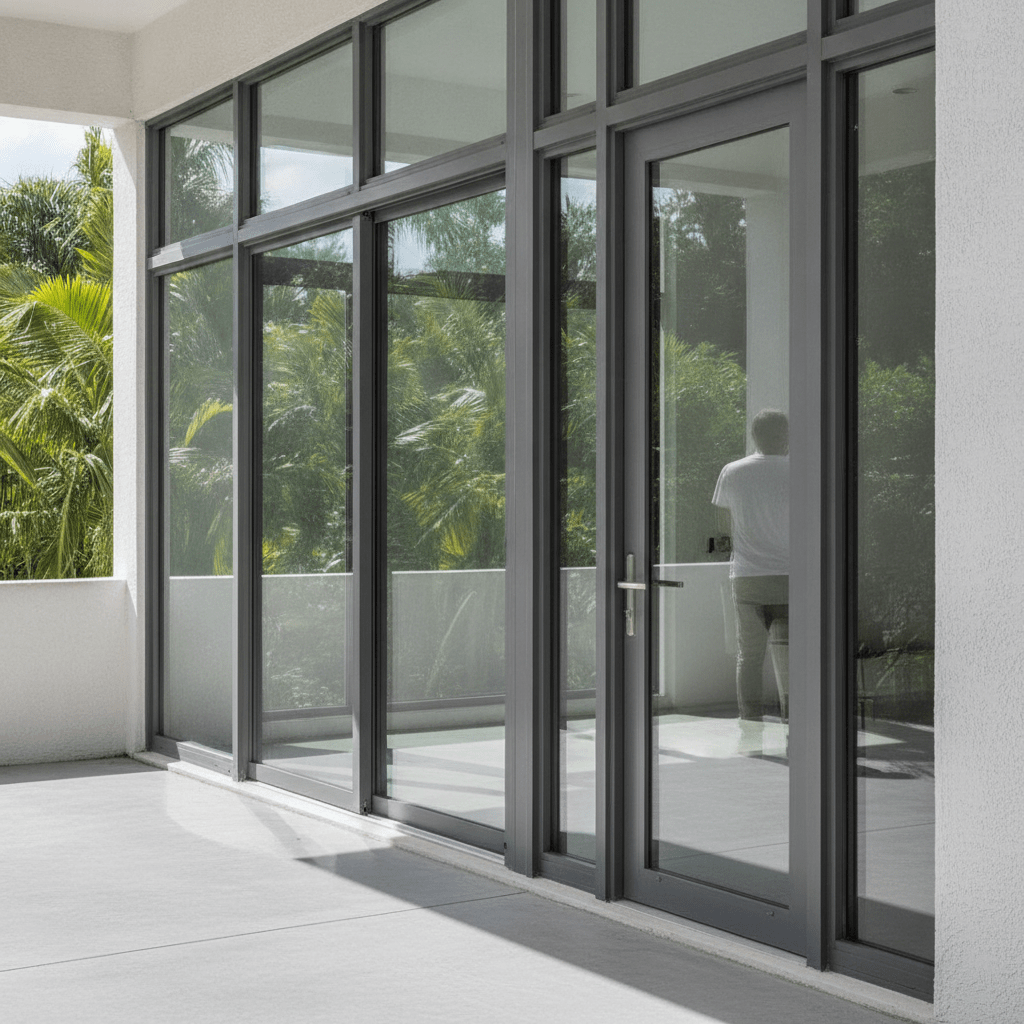
Homeowners who are also considering impact-rated entry or sliding doors should note that the same FL# and DP verification process applies — door openings often carry higher required DP ratings than adjacent windows due to their larger area.
The Process
How Impact Window Permitting Works in Brevard County
Permits are never optional for impact window replacement in Melbourne. Here is what the process looks like:
- Pre-construction measurement and DP calculation: The contractor measures every opening and calculates the required design pressure based on your home’s location, height, and exposure category. This drives product selection — not the other way around.
- Product selection and FL# verification: The specific window model is confirmed against its FL# approval for the tested size and DP rating matching your openings.
- Permit application to Brevard County Building Department: The contractor submits permit drawings, the FL# product approval documentation, and installation details (anchor spacing, buck preparation, sealant spec). The Brevard County Building Department reviews and issues the permit.
- Installation: Windows are installed per the FL# approval’s installation requirements — anchor type, spacing, and embedment depth are not optional. Deviating from the approval document voids the product approval for that installation.
- Inspection: Brevard requires at minimum a rough-in inspection (before drywall or interior finish covers the framing) and a final inspection. The inspector verifies the installed product matches the permitted product and that the installation matches the approved drawings.
- Wind mitigation inspection (optional but recommended): After passing final inspection, schedule a licensed wind-mitigation inspector to document your opening protections. This documentation is what you submit to your insurance carrier to request mitigation credits, which Florida insurers are required to offer under Section 627.0629, Florida Statutes.
If you want to explore financing for your project, Bigfoot offers PACE financing options that are paid through your property tax bill — no traditional bank qualification required.
Questions about Brevard County permits, DP ratings, or product approval for your Melbourne home?
Who We’re Not the Right Fit For
- Homeowners who need a Brevard County-only local contractor: Bigfoot’s primary service area is Miami-Dade, Broward, and Palm Beach counties. Melbourne and Brevard County are outside our standard service zone. For a Melbourne installation, we recommend contacting the Brevard County Building Department’s contractor lookup to find a locally licensed installer — this article is education, not a sales pitch for a project we are not positioned to serve.
- Projects requiring DEP CCCL permits only: If your primary need is navigating a Coastal Construction Control Line permit without a window replacement component, a coastal engineering firm is the right resource — not a window contractor.
- Budget-first buyers comparing builder-grade products: If lowest upfront cost is the primary driver and long-term coastal performance is secondary, Bigfoot may not be the right fit. We install aluminum-frame, FL#-approved products selected for durability in coastal conditions — not the cheapest available option.
- Commercial or high-rise projects requiring NOA-only specifications: If your project specification sheets require Miami-Dade NOA on every product (common in some commercial specs), confirm with us before proceeding — not all products in our line carry an NOA, only Florida Product Approval.
Frequently Asked Questions
Do Melbourne FL homes need HVHZ-rated impact windows, or is standard Florida Product Approval sufficient?
Melbourne is in Brevard County, which is outside the High-Velocity Hurricane Zone (HVHZ). Under the Florida Building Code, HVHZ requirements apply only to Miami-Dade and Broward counties (source: floridabuilding.org). For Melbourne, a Florida Statewide Product Approval (FL#) is sufficient to pass the Brevard County building permit inspection. Products with a Miami-Dade NOA are also accepted, but the NOA is not required. What is required is that the installed product’s tested design-pressure rating meets or exceeds the calculated DP for your specific opening.
What design-pressure rating do impact windows need to meet Brevard County building code?
There is no single universal DP requirement — it depends on your home’s location, building height, and the size of each opening. Under ASCE 7-22 and the FBC 8th Edition (2023), a typical two-story Melbourne coastal residence may require DP ratings between DP+40 and DP+60 psf on larger openings. Your contractor’s permit drawings will calculate the required DP for each opening individually. The installed product must be FL#-approved at a tested DP rating that equals or exceeds the calculated requirement for that opening.
Will installing impact windows in Melbourne FL lower my homeowners insurance premium?
Often, yes, though no specific dollar amount can be promised. Florida law (Section 627.0629, Florida Statutes) requires insurers to provide premium discounts or credits for construction techniques that reduce hurricane loss, including impact-rated opening protection. To claim the credit, you need a licensed wind-mitigation inspection documenting your opening protections, which you then submit to your carrier. The actual savings depend on your insurer, your home, and your policy — beware of any contractor who guarantees a specific dollar figure.
Do you need a permit for hurricane impact windows in Miami-Dade or Broward?
Yes. Miami-Dade and Broward require permits and product approval documentation (a Miami-Dade NOA or a Florida Product Approval that covers HVHZ use) for impact window and door installations (source: miamidade.gov). A licensed contractor pulls the permit and schedules inspections at rough-in and final.
Does financing typically cover hurricane impact windows?
Financing options may be available depending on scope and lender. Bigfoot offers PACE financing paid through your property tax bill. Ask your contractor what programs apply to your specific project before you sign anything.
How long does an installation like this take?
Most residential impact window or door installations in South Florida are completed in 1-3 days once product is on site and permits are pulled, though whole-house projects can take longer.
Ready to get started? Get a free, no-pressure estimate from a licensed South Florida contractor.
Sources
- Florida Building Commission — Florida Building Code & Product Approval search: floridabuilding.org
- Miami-Dade County — Product Control (NOA) & permitting: miamidade.gov
- U.S. Department of Energy — Energy-efficient windows & Low-E coatings: energy.gov
- Florida Department of Environmental Protection — Coastal Construction Control Line program: floridadep.gov
- Section 627.0629, Florida Statutes — Windstorm mitigation insurance credits.
- ASCE 7-22 — Minimum Design Loads and Associated Criteria for Buildings and Other Structures (as adopted by the FBC).