
Impact Windows & Roofing SW Florida Gulf Coast | Bigfoot Windows & Roofing
Last updated: July 2026 by the Bigfoot Windows & Roofing editorial team.
Key Takeaways
- Gulf Coast counties (Lee, Collier, Charlotte) are NOT in Miami-Dade’s HVHZ — product approvals follow Florida Product Approval, not Miami-Dade NOA.
- FBC 2023 sets minimum design wind speeds for each county; impact windows must carry a matching or higher design-pressure rating to pass inspection.
- Bundling a new roof and impact windows under one permit pull can reduce coordination friction and total project time.
- Post-Hurricane Ian permitting in Lee and Collier counties has evolved — lead times vary; plan 4–10 weeks for permit approval.
- New impact windows and a qualifying roof system can support a wind-mitigation inspection that may reduce homeowner insurance premiums.
- Bigfoot holds a Certified General Contractor license, meaning structural modifications (hurricane straps, roof-to-wall connections) can be handled in-house.
The Problem
Gulf Coast Homeowners Are Getting Conflicting Advice About Code Compliance
What applies in Miami-Dade does not automatically apply in Fort Myers or Naples — and the difference matters.
After Hurricane Ian reshaped the Southwest Florida coastline in 2022, homeowners across Lee, Collier, and Charlotte counties rushed to upgrade windows and roofs. Many were told by salespeople that they needed Miami-Dade-approved products. Some were told the opposite. Both sides were oversimplifying.
The truth is more precise: the Gulf Coast is subject to the Florida Building Code and its wind-speed maps, but it is not part of the High-Velocity Hurricane Zone (HVHZ). Miami-Dade and Broward counties form the HVHZ, a materially stricter code path that requires a Miami-Dade NOA or a Florida Product Approval that covers HVHZ use. Outside that zone — including all of Southwest Florida — products must carry Florida Product Approval (FPA) to a design pressure that matches or exceeds the calculated wind load for that specific site. That is a meaningful distinction, not a technicality.
This article explains exactly what impact window and roofing code compliance looks like on the Gulf Coast, how the two scopes interact, and what to expect from the permitting process in Lee and Collier counties today.
Southwest Florida Context
Lee, Collier & Charlotte Counties: Wind Zones, Post-Ian Realities, and Permit Timelines
Southwest Florida sits in Wind Speed Design zones that typically fall between 140 and 170 mph (3-second gust) depending on proximity to the coast, per the FBC 2023 wind speed maps. Coastal parcels within one mile of the shoreline in Lee and Collier counties can be exposed to calculated design pressures that exceed 60 psf on openings — which means not every budget impact window will pass plan review.
Post-Hurricane Ian, both Lee County Building & Flood and Collier County Growth Management absorbed a substantial backlog of rebuild and repair permits. As of mid-2026, permit review timelines for impact windows in those counties typically run four to ten weeks from submission, depending on project complexity and whether structural drawings are required. Projects that involve structural modifications — such as enlarging an opening or addressing compromised framing — require signed-and-sealed engineering drawings, which adds time and scope. A contractor holding a Certified General Contractor (CGC1531370) license can coordinate that structural scope in-house rather than requiring the homeowner to hire a separate structural engineer and coordinate independently.
Collier County, which covers Naples and Marco Island, tends to run more consistently on permit timelines. Lee County’s Fort Myers Beach and Cape Coral area remains more variable due to ongoing post-Ian rebuild volume. Charlotte County (Port Charlotte, Punta Gorda) has a lighter permit backlog and typically moves faster.
Code & Product Approval
FBC 2023, Florida Product Approval, and the NOA Question
Here is the cleanest way to understand the regulatory landscape for Gulf Coast homeowners:
| Requirement | Miami-Dade / Broward (HVHZ) | SW Florida Gulf Coast (Lee, Collier, Charlotte) |
|---|---|---|
| Code path | FBC + HVHZ Chapter 16 | FBC 2023 standard wind provisions |
| Product approval required | Miami-Dade NOA (local product approval) | Florida Product Approval (FPA) via DBPR/floridabuilding.org |
| Impact required by code | Yes — openings must be protected | Yes — impact or shutter in wind-borne debris region (130+ mph) |
| Design pressure standard | Minimum 40 psf + HVHZ uplift | Site-specific per FBC wind map; coastal parcels often 50–70 psf |
| Permit authority | Miami-Dade or Broward Building | Lee, Collier, or Charlotte County Building |
The practical implication: a product that holds Florida Product Approval to the required design pressure is code-compliant in Lee, Collier, or Charlotte county. An NOA is not required — and some products that hold NOA also hold FPA, so they are approved in both zones. What matters is that the specific product’s tested and labeled design pressure (positive and negative) equals or exceeds what the project’s engineering documents call for.
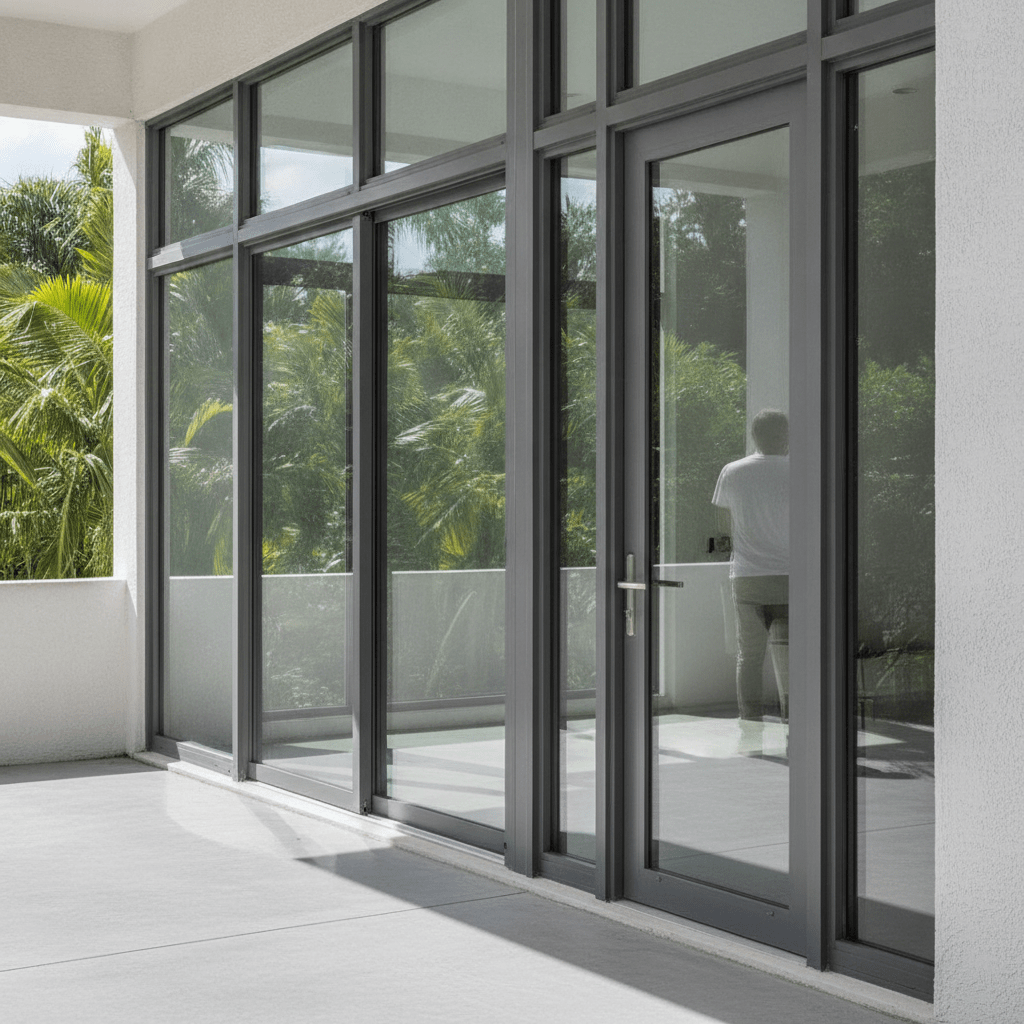
For impact windows installed on the Gulf Coast, Bigfoot uses aluminum-frame products — aluminum is more time-tested in South Florida’s heat, humidity, UV exposure, and hurricane conditions than vinyl, which can warp and deform over decades in these climate conditions. All products carry Florida Product Approval, and the design pressure is confirmed against the project’s permit drawings before ordering.
Options Compared
Impact Windows vs. Hurricane Shutters on the Gulf Coast
Florida law does not require impact windows specifically — it requires that openings be protected in the wind-borne debris region. Hurricane shutters are still a code-acceptable alternative. Here is how the two options compare in a Southwest Florida context:
| Factor | Hurricane Shutters | Impact Windows (Aluminum) |
|---|---|---|
| FBC compliance | Yes, if rated to site DP | Yes, if rated to site DP |
| Day-to-day usability | Shutters must be deployed; often left open | Always on; no deployment required |
| Insurance credit potential | Partial (opening protection only) | Stronger (combined opening + glass rating) |
| Energy efficiency | None when open | Low-E glass reduces solar heat gain year-round |
| Long-term maintenance | Hinges, tracks, panels rust in salt air | Aluminum frames require minimal maintenance |
| Upfront cost | Lower | Higher upfront, lower over 20-year horizon |
When shutters may still be the right call
If a homeowner is on a tight budget, is planning to sell within two to three years, or is dealing with a historic-designation property with strict exterior appearance rules, shutters can be the pragmatic choice. Bigfoot focuses on impact window and roofing installations — we are not the right contractor if shutters-only is the goal.
License & Authority
A Licensed Contractor, Not a Lead Aggregator
Bigfoot pulls permits in your name under verified DBPR licenses — not a subcontract chain.
Certified Residential Contractor CRC1331693
Certified Roofing Contractor CCC1333168
Certified Specialty Contractor — Glass & Glazing SCC131153098
Service Area: Lee · Collier · Charlotte · Miami-Dade · Broward · Palm Beach
Darryl Rosenbaum — President
“On the Gulf Coast, the code path is different from Miami-Dade, but the stakes in a major storm are identical. We treat product selection and permit documentation the same way we do in HVHZ — by the numbers, not by what’s easiest to sell.”
Darryl Henry Rosenbaum — Founder, Bigfoot Windows & Roofing
Product Guidance
What Impact Window Products Work for Southwest Florida?
Because Gulf Coast installations follow Florida Product Approval rather than NOA, the product pool is broad. The key spec to verify is design pressure (DP) rating — positive and negative — on the specific product and size being ordered. Larger openings experience higher design pressures. A window that passes at 48 psf may not be rated at the required 62 psf for a large coastal opening.
Bigfoot installs aluminum-frame impact windows. The aluminum frames we use hold Florida Product Approval across the relevant pressure ranges for Lee, Collier, and Charlotte county sites. Glass options include Low-E coatings (our primary recommendation: SB 70 or equivalent, which provides the strongest heat block — important on a west-facing Gulf Coast elevation). For coastal parcels within two miles of saltwater, we specify the 2605 coastal finish — a different coating than the standard 2604 finish, required to maintain the product’s 10-year warranty in salt-air environments.
For homeowners combining impact window replacement with a full roof replacement, there are coordination benefits: both scopes can often be permitted together under a single contractor of record, reducing the number of separate inspections and the risk of one trade’s work being held up waiting for another trade’s permit sign-off. Because Bigfoot holds both a Certified Roofing Contractor license and a Certified Specialty Contractor with a Glass & Glazing Specialty license, both scopes are pulled under the same contractor number — no subcontract handoff on either side of the permit.
How It Works
The Process: Estimate Through Final Inspection
- Site Assessment: We measure every opening, note structural conditions, and flag any framing concerns that would affect permit drawings or product selection.
- Product Selection & Design Pressure Confirmation: We confirm the site’s required design pressure per FBC 2023 wind maps and select products with FPA ratings that meet or exceed that threshold.
- Permit Submission: We prepare and submit permit documentation to the applicable county building department (Lee, Collier, or Charlotte). We account for the current permit review backlog and advise on realistic timelines before you commit.
- Fabrication & Scheduling: Custom aluminum frames are fabricated to the measured opening sizes. Lead times vary by manufacturer and season; we build the current lead time into the project schedule at the time of agreement.
- Installation: Our crew installs the windows and any roofing scope. Structural scope — including hurricane strap upgrades or roof-to-wall connection improvements where required — is handled under the Certified General Contractor (CGC1531370) license, so no separate GC is needed.
- Final Inspection: We coordinate the county inspection, provide all required product approval documentation, and obtain the final sign-off. You receive a copy of the closed permit for your records and for any future wind-mitigation inspection.
A wind-mitigation inspection after installation documents the new opening protection and roof covering. Homeowners in Lee and Collier counties have seen meaningful insurance premium adjustments after this inspection — we do not quote specific dollar savings because results depend on the individual carrier, policy structure, and coverage level, but the documentation is worth having.
Serving Lee, Collier, Charlotte & all of South Florida
Get a no-pressure estimate for impact windows, roofing, or both.
Or call Bigfoot Windows & Roofing at 786-886-2088
Related Reading
More Guides for Gulf Coast & South Florida Homeowners
Related Articles
Who We’re Not the Right Fit For
- Shutters-only projects: If you need accordion shutters or panels installed and no window or door replacement, Bigfoot is not the right contractor. We focus on permanent opening protection — impact windows and doors.
- Extremely tight timelines with no permit flexibility: If you need windows installed in two weeks with no permit pulled, we cannot help. Every Bigfoot installation is permitted and inspected. There are no shortcuts on this.
- Projects requiring licensed electrical or plumbing scope: Our four licenses cover general contracting, residential contracting, roofing, and glass & glazing. If your project is primarily electrical or plumbing, you need a contractor licensed in those trades.
- Commercial high-rise projects in Lee or Collier county: We work on residential structures and low-rise commercial. Large-scale commercial or high-rise projects are outside our current scope.
Frequently Asked Questions
Do impact windows on the Gulf Coast of Southwest Florida have to meet Miami-Dade NOA standards?
No. Lee, Collier, and Charlotte counties are not part of the High-Velocity Hurricane Zone (HVHZ). Miami-Dade NOA is a local product approval, and it is not required even within Miami-Dade and Broward counties. In Southwest Florida, impact windows must carry Florida Product Approval (FPA) rated to the site-specific design pressure under FBC 2023. A product with FPA to the required design pressure is code-compliant on the Gulf Coast without an NOA.
What design wind speed do impact windows need to meet in Lee and Collier counties?
FBC 2023 wind-speed maps place most coastal parcels in Lee and Collier counties in the 140–170 mph (3-second gust) range. The design pressure for a specific opening depends on building height, exposure category, and location. Coastal parcels within one mile of the shoreline frequently require design pressures of 50–70 psf or higher on openings. Your permit drawings will specify the exact DP required; the window product must match or exceed that rating.
Can I install impact windows and a new roof at the same time and save on permitting costs?
Yes, combining both scopes under one contractor of record can reduce coordination friction and sometimes total permit fees. When the same licensed contractor holds both the roofing and glazing license — as Bigfoot does — both scopes are pulled under a single contractor number. You avoid the scenario where one trade’s inspection hold delays the other. Actual permit fee savings vary by county and scope; we can provide a project-specific breakdown when preparing your estimate.
How long does it take to get an impact window permit approved in Collier or Lee County?
As of mid-2026, typical review timelines are four to ten weeks from submission in Lee and Collier counties, depending on project complexity and backlog. Standard window replacements in existing openings move faster than projects requiring structural drawings. Collier County tends to be more consistent; Lee County (especially Fort Myers Beach and Cape Coral) still carries elevated post-Ian rebuild volume. We factor current permit timelines into every project schedule before you commit.
Are impact windows legally required in Southwest Florida, or are hurricane shutters still allowed?
Florida law requires opening protection in the wind-borne debris region — not specifically impact windows. Hurricane shutters rated to the site’s design pressure remain a code-acceptable alternative. That said, impact windows provide continuous protection without deployment, and typically support stronger wind-mitigation inspection results. The choice between impact windows and shutters is a budget and lifestyle decision, not a strictly legal one, as long as both options are properly rated and permitted.
Will new impact windows and a qualifying roof help lower my homeowner’s insurance premium in Southwest Florida?
A wind-mitigation inspection after installation documents your home’s opening protection and roof system. This report is submitted to your carrier and can support a premium reduction under both Citizens and many private insurers. The actual reduction depends on your carrier, policy structure, coverage levels, and the specific credits triggered. We do not quote specific savings figures because results vary — but the wind-mit report is yours to keep and submit to any carrier, including when shopping policies.
Can I finance impact windows and a new roof together in Southwest Florida?
Financing is available through PACE programs (Property Assessed Clean Energy), which are repaid through your property tax bill rather than a bank loan. Important: roofing and window scopes must be submitted as separate PACE applications — they cannot be combined into one. Rates are typically around 9.49%; a 20-year term produces the lowest monthly payment. Bigfoot can walk you through the financing options at the estimate stage. For qualifying property owners, there may also be tax benefits — consult your CPA.
Sources
- Florida Building Code 2023 (7th Edition), Chapter 16 — Structural Design (Wind Loads); Florida Department of Business and Professional Regulation (floridabuilding.org)
- Florida Product Approval system — DBPR/floridabuilding.org product approval search
- Lee County Building & Flood Division — permit application and inspection procedures (leegov.com)
- Collier County Growth Management Department — permit timelines and building department guidance (colliercountyfl.gov)
- NOAA National Hurricane Center — Hurricane Ian post-event assessments (nhc.noaa.gov)
Ready to protect your Gulf Coast home?
Bigfoot Windows & Roofing serves Lee, Collier, Charlotte, and all of South Florida. Get a straight answer on what your home needs and what it will cost.
Request a Free Estimate Online
Prefer to talk? Call 786-886-2088