Pivot Doors Miami: Impact Standards & HVHZ Requirements
Last updated: July 2026 by the Bigfoot Windows & Roofing editorial team.
Key Takeaways
- Pivot doors in Miami-Dade must hold a current Notice of Acceptance (NOA) or Florida Product Approval to pass inspection.
- HVHZ wind-load testing under TAS 201/202/203 is mandatory — not optional — for oversized pivot systems.
- Aluminum is the most proven pivot door frame material for South Florida’s heat, humidity, and salt air.
- Structural rough-opening reinforcement is almost always required; a Certified General Contractor handles it in one scope.
- Installed cost for a custom impact pivot door in South Florida typically ranges from roughly $8,000 to $25,000+ depending on size, glass, and structural prep.
The Real Challenge
Pivot Doors Look Simple — Getting Them Approved in Miami Is Not
Most homeowners fall in love with the look first and discover the code reality second.
Pivot doors in Miami-Dade must hold a current Miami-Dade Notice of Acceptance (NOA) or a Florida Product Approval that covers HVHZ use — tested to TAS 201, 202, and 203 in the HVHZ configuration — before they can pass a building inspection; without that approval, no pivot door will receive a final certificate of occupancy in Miami-Dade or Broward.
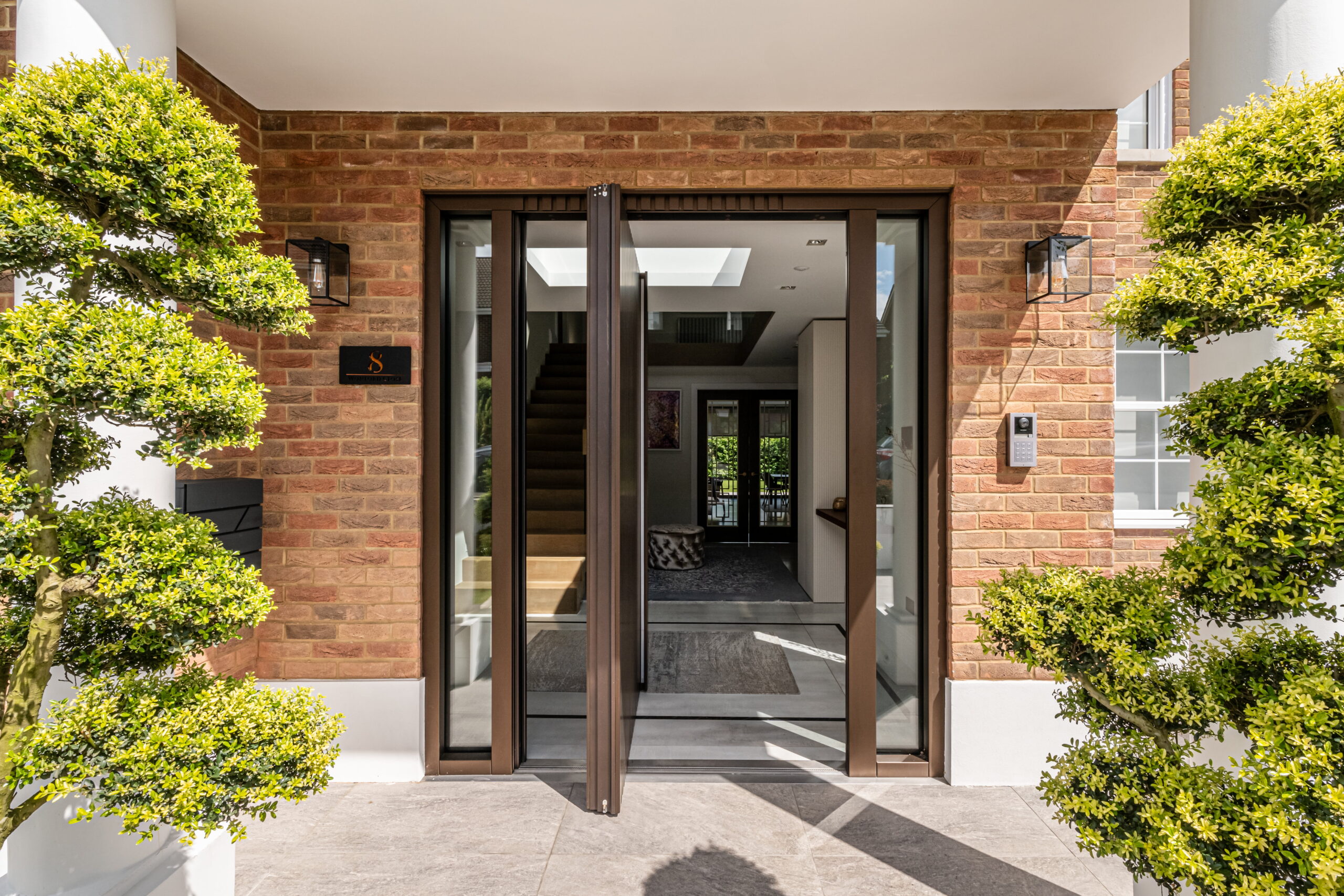
A pivot door rotates on a vertical axis at the top and bottom — not on hinges at the side. That single design choice creates a sweeping, floor-to-ceiling statement that has become one of the most requested upgrades in South Florida luxury construction. It also creates a set of code challenges that standard swinging doors never face.
Miami-Dade and Broward counties sit inside the High-Velocity Hurricane Zone (HVHZ) — the strictest residential building code environment in the United States. Per the Florida Building Code, most of Miami-Dade carries an ultimate design wind speed in the range of 170 to 186 mph, the highest in Florida (floridabuilding.org). Every exterior door in that zone must be tested to TAS 201 (large-missile impact), TAS 202 (cyclic wind pressure), and TAS 203 (uniform static air pressure) before it can receive a Notice of Acceptance (NOA) from Miami-Dade Product Control (miamidade.gov). Pivot doors are large, heavy, and structurally different from conventional doors, which means many off-the-shelf impact door products simply do not cover them. If the door you want does not have a current Miami-Dade NOA or a Florida Product Approval that includes the pivot configuration at your intended size, the county will not issue a final inspection certificate.
This code environment did not appear by accident. Hurricane Andrew — a Category 5 at peak that struck near Homestead in August 1992 — exposed catastrophic failures in building envelopes when windows and doors blew out and pressurized homes from the inside (NOAA National Hurricane Center). The HVHZ opening-protection requirements are the direct legacy of that storm.
That is the core problem this guide addresses: how to get the pivot door you want while meeting every HVHZ requirement — and who should be coordinating that process for you.
South Florida Code Context
HVHZ, NOA, and the Florida Building Code — What Pivot Doors Trigger
The Florida Building Code (FBC) Chapter 14 governs exterior openings, including doors. Inside Miami-Dade and Broward counties, the HVHZ provisions layer additional requirements on top of the statewide code. Here is what that means in practice for a pivot door project:
- Notice of Acceptance (NOA): Miami-Dade Product Control issues NOAs for products that pass HVHZ testing (miamidade.gov). Your pivot door system — frame, glass, hardware, and pivot hardware — must appear on a current NOA or a Florida Product Approval that covers HVHZ use. The NOA lists the maximum tested size and the specific installation requirements (embedment, anchoring pattern, substrate). If your door is larger than the tested size on the NOA, the product is not approved for that opening.
- TAS 201/202/203 testing: These are the three-part test protocols administered at approved Florida testing labs. A product that passes all three in the HVHZ configuration can receive an NOA. Pivot systems must be tested as a system — you cannot mix a pivot door frame with glass from a different tested assembly.
- Permits in Miami-Dade: You will need a building permit. The permit application requires product approval documentation (NOA number or Florida Product Approval number), shop drawings showing the rough opening and anchorage, and — for most pivot doors — a signed-and-sealed structural drawing from a licensed Florida engineer. The permit-pull process typically takes 4 to 10 weeks in Miami-Dade depending on project complexity and current backlog.
- Structural rough opening: A pivot door does not load the frame the way a hinged door does. The top pivot typically transfers load to a header differently, and the rough opening often needs reinforcement — sometimes a steel lintel, sometimes an engineered header. This is a structural modification that falls under impact door installation scope and requires a contractor authorized for structural work.
From Our Own Jobs
What We Learned Installing Oversized Pivot Doors in Coral Gables and Pinecrest
On a recent Coral Gables project, we installed a 10-foot thermally broken aluminum pivot door on a west-facing entry. The homeowner had already selected a product before calling us — and the frame profile they liked did not have a Miami-Dade NOA covering the size they wanted. We had to walk that back and re-select a system whose NOA actually listed the 10-foot configuration at the design pressure for that exposure. That single step saved a failed final inspection down the road.
The lesson we have seen repeat on nearly every oversized pivot project: the rough opening almost never comes ready. On that Coral Gables entry we set an engineered steel lintel and re-poured the sill anchorage to match the NOA’s embedment table before the door ever arrived. When we handle the structural prep, permitting, and the door installation as one scope, there is no seam between trades where anchorage detail gets lost — which is exactly where inspections tend to fail. On a Pinecrest install we caught undersized pivot hardware that a door-only supplier had spec’d; it would not have carried the door weight at the NOA-rated design pressure.
Frame Materials
Aluminum vs. Steel vs. Fiberglass: Which Frame Wins in South Florida?
Frame material is one of the most consequential decisions for a Miami pivot door. Here is how the three common options compare in the HVHZ coastal environment:
| Material | Coastal Durability | Structural Rigidity | Weight | South Florida Track Record |
|---|---|---|---|---|
| Aluminum (thermally broken) | Excellent — 2605 anodized finish resists salt air | High — handles large pivot spans | Moderate | Most tested; most NOA-covered pivot systems |
| Steel | Fair — requires marine-grade coating; prone to rust at welds | Very high | Heavy — pivot hardware must be rated accordingly | Limited NOA coverage in HVHZ pivot configurations |
| Fiberglass | Good — not susceptible to rust | Lower than aluminum at large spans | Light | Rare in HVHZ-approved pivot systems; limited NOA availability |
Aluminum is our recommendation for pivot doors in South Florida. It is the most time-tested frame material in HVHZ heat, humidity, and UV exposure, and the overwhelming majority of NOA-approved pivot door systems use aluminum construction. For energy efficiency, look specifically for thermally broken aluminum frames — a thermal barrier inside the frame profile significantly reduces heat transfer. The U.S. Department of Energy notes that in warm climates, windows and doors with a low solar heat gain coefficient (SHGC) reduce cooling loads, which matters when your door is 8 or 10 feet tall and faces a west-facing facade (energy.gov).
If you are within two miles of the water, the finish specification matters: the AAMA 2605 coating provides significantly better salt-air resistance than the 2604 wood-grain finish and is required to maintain the 10-year product warranty on most aluminum door lines.
Cost Overview
What Does a Pivot Door Cost Installed in Miami?
Pivot door pricing varies widely because these are almost always custom or semi-custom systems. The table below reflects typical South Florida installed ranges — not guaranteed quotes.
| Scope | Typical Installed Range | Key Cost Drivers |
|---|---|---|
| Standard residential aluminum pivot (up to 8 ft tall) | $8,000 – $13,000 | Glass thickness, finish, existing rough opening condition |
| Oversized aluminum pivot (8–12 ft tall, impact glazed) | $13,000 – $20,000 | Custom fabrication, 9/16" glass, structural header work |
| Full-height architectural pivot (12 ft+, custom system) | $20,000 – $35,000+ | Engineer drawings, steel lintel, premium finish, site logistics |
Structural prep work — header reinforcement, rough opening modification, hurricane straps — adds cost that is often not quoted upfront by door-only installers. When a Certified General Contractor (CGC1531370) handles the full scope, structural modifications, permitting, and door installation are coordinated in a single project rather than handed off between separate trades. That structural work is handled in-house rather than subcontracted to an unknown third party, which simplifies accountability at the permit inspection stage.
Learn more about financing options for impact door projects — including PACE financing available through property tax billing with no credit score impact.
Why Licensing Matters Here
One Contractor. Four Licenses. No Handoffs on Structural Work.
A licensed contractor, not a lead aggregator.
“A pivot door project in Miami-Dade is a structural project with a beautiful door on the end of it. If your contractor can’t pull a structural permit, they’re handing that piece off to someone else — and you’re the one managing the seam.”
President, Bigfoot Windows & Roofing
Product Guidance
What to Ask About Impact Glazing for Your Pivot Door
The glass inside your pivot door is not a separate decision from the frame — in an HVHZ-approved system, the glass, interlayer, frame, and hardware are tested and approved as a single assembly. Ask your contractor these questions before you commit:
- Is the door-and-glass combination covered by a single NOA? The NOA must list the exact glass specification (thickness, interlayer, Low-E coating) that will be installed. Swapping to a different glass type after the fact can invalidate the approval.
- What glass thickness does the NOA cover? For most oversized HVHZ pivot applications, 9/16" laminated glass is the standard. Thinner glass may be permitted for smaller openings at lower design pressures — verify against the tested configuration, not just the product brochure.
- Does the Low-E coating affect turtle code compliance? Within Miami-Dade coastal areas, lighting ordinances require glass that does not emit light visible to nesting sea turtles. A 9/16" gray laminate is generally auto-compliant; other glass types require a double-gray or equivalent specification. Confirm compliance before ordering.
- What is the pivot hardware rated to? Pivot hardware must be rated for the door weight and the design pressure listed on the NOA. Undersized pivot hardware is a common failure point on inspections.
For impact door installation in South Florida, the product approval documentation must travel with the permit set. If a contractor cannot show you the NOA number before the door is ordered, that is a significant red flag.
Installation Process
How a Pivot Door Project Moves From Permit to Final Inspection
- Site assessment: Measure the opening, assess the existing header and structural condition, confirm design pressure requirements for your specific location within Miami-Dade or Broward.
- Product selection and NOA verification: Select a door system with a current Miami-Dade NOA or Florida Product Approval that covers your intended configuration — size, glass spec, pivot hardware.
- Engineering drawings (if required): For openings larger than what is covered by standard NOA installation details, a Florida-licensed structural engineer prepares signed-and-sealed drawings. This is not optional for most oversized pivot door projects.
- Permit application: Submit to Miami-Dade Building Department with NOA documentation, product approval number, shop drawings, and engineer letter if required. Budget 4–10 weeks for approval.
- Structural prep: Modify the rough opening as needed — header reinforcement, lintel installation, hurricane strap integration. This is the stage where Miami-Dade structural work requires a contractor licensed to perform structural modifications.
- Door installation: Set the pivot hardware, hang the door, install glass per the NOA-specified assembly, seal and flash the perimeter.
- Inspections: Rough inspection (structural), product approval inspection (door unit), and final inspection. All three must pass before the permit closes.
Have a pivot door project in Miami-Dade or Broward? Talk through the NOA requirements and structural scope before you order anything.
Who We’re Not the Right Fit For
- Projects requiring non-impact decorative pivot doors: If you want a pivot door that is purely decorative and not hurricane-rated — perhaps for an interior application or a climate-controlled lobby outside HVHZ — we are set up for impact-rated work and HVHZ compliance. A millwork or specialty door dealer may serve that scope better.
- Buyers with an already-ordered door lacking a Miami-Dade NOA: If you have purchased a pivot door system that does not hold a current Miami-Dade NOA or Florida Product Approval covering your configuration, we cannot install it in an HVHZ opening and get it through final inspection. Product selection must happen before purchase, not after.
- Projects outside Miami-Dade, Broward, and Palm Beach counties: Our team and permit relationships are built around South Florida. If your project is in Central or North Florida, a local contractor with relationships in your county’s building department will serve you more efficiently.
- Ultra-budget timelines: Custom pivot door fabrication, permit processing, and structural prep take time. If you need a door installed in two weeks, a standard in-stock hinged impact door is almost certainly the right answer — and we are happy to do that work instead.
Frequently Asked Questions
Do pivot doors qualify as impact doors under Miami-Dade building code?
A pivot door can qualify as an impact door if it holds a current Miami-Dade Notice of Acceptance (NOA) covering the specific pivot configuration, glass specification, and door size you are installing. The NOA must be issued by Miami-Dade Product Control and must cover the TAS 201/202/203 test series. Not all pivot door systems have this approval — confirm the NOA number and the tested configuration before ordering any product.
How much does a custom pivot door cost installed in Miami?
Installed cost for a residential aluminum impact pivot door in South Florida typically ranges from roughly $8,000 to $20,000 for standard and oversized units, and $20,000 to $35,000 or more for full-height architectural systems requiring custom fabrication and engineering. Key cost drivers include door height and width, glass thickness, finish specification, and the extent of structural rough-opening work required.
Can a pivot door meet HVHZ requirements in Miami-Dade County?
Yes — but only if the specific product has been tested to TAS 201, 202, and 203 in the HVHZ configuration and holds a current Miami-Dade NOA or a Florida Product Approval that covers HVHZ use at your intended door size and design pressure. The door, frame, glass, and pivot hardware must all be part of the same tested assembly. Products approved under Florida Product Approval (statewide) do not automatically satisfy HVHZ requirements unless the approval covers HVHZ use or the product also has a Miami-Dade NOA.
What permits are required to install a pivot door in Miami-Dade?
You need a building permit from Miami-Dade Building Department. The permit set typically includes NOA documentation or Florida Product Approval number, shop drawings showing the rough opening and anchoring pattern, and — for most oversized pivot doors — signed-and-sealed structural drawings from a licensed Florida engineer. Your contractor pulls the permit; it is not optional and cannot be waived. Budget 4 to 10 weeks for permit processing in Miami-Dade depending on current backlog and project complexity.
What wind speeds must a pivot door in Miami-Dade be designed to withstand?
Under the Florida Building Code, most of Miami-Dade County falls within an ultimate design wind speed zone of roughly 170 to 186 mph (Risk Category II), the highest in the state (floridabuilding.org). Every exterior opening, including a pivot door, must be engineered to the design pressures derived from those wind speeds for its specific location and exposure. Your engineer or contractor determines the exact design pressure the door must meet, and the product’s NOA must confirm the door was tested to or above that pressure.
Does a Florida-licensed engineer need to sign off on a pivot door installation?
For most oversized pivot doors, yes. When the opening is larger than the standard installation details published in the product’s NOA, a Florida-licensed structural engineer must prepare signed-and-sealed drawings showing the anchorage, header reinforcement, and load path. Smaller pivot doors that fall within the NOA’s pre-approved installation table may not require separate engineering, but the contractor must verify this against the specific NOA before pulling the permit.
Sources
- Florida Building Commission — Florida Building Code & Product Approval: floridabuilding.org
- Miami-Dade County — Building Product Control (NOA / TAS 201-202-203): miamidade.gov
- NOAA National Hurricane Center — Hurricane Andrew Tropical Cyclone Report (1992): nhc.noaa.gov
- U.S. Department of Energy — Energy Efficient Windows: energy.gov

Ready to get started? Get a free, no-pressure estimate from a licensed South Florida contractor.
Schedule Your Free Estimate
Ready to get started? Request a free estimate — no phone call required.