Extra Plywood Sheets Cost in Roofing | Bigfoot Windows & Roofing
In South Florida, each additional plywood sheet beyond the standard 5-sheet allowance typically costs between $80 and $150 per sheet installed — covering materials, labor, disposal, and permit compliance. The exact number depends on sheet size, decking spec required by the Florida Building Code for your wind zone, and how many damaged boards your roofer uncovers during tear-off.
Updated August 2026
Key Takeaways
- Most South Florida roofing quotes include a 5-sheet plywood allowance; additional sheets typically run $80–$150 each installed (materials + labor + disposal).
- Miami-Dade and Broward HVHZ code requires specific decking thickness — 7/16" OSB minimum, but 15/32" or 19/32" CDX may be required depending on rafter spacing and wind-uplift design.
- The roofer cannot know how many sheets need replacement until the old roofing is torn off — hidden rot, delamination, and undersized sheathing are only visible mid-job.
- Miami-Dade Building Department requires a sheathing nail-pattern inspection before underlayment goes down — extra decking adds at least one inspection day to the timeline.
- Lumber commodity prices fluctuate; get your per-sheet unit price in writing before signing a roofing contract.
The Problem
Why “5 Sheets Included” Is Almost Never Enough
Here is what homeowners in Miami-Dade and Broward discover only after tear-off begins.
Nearly every South Florida roofing proposal you receive will include a line item that reads something like: “Up to 5 sheets of plywood decking included.” It sounds generous — until your roofer pulls back the first layer of old shingles and finds soft spots, delaminated OSB, or wood that crumbles at the edges. Suddenly five sheets covers almost nothing.
This is not a bait-and-switch. It is a structural reality of roofing in a high-humidity, hurricane-prone climate. Roof decking sits directly beneath roofing material, absorbing decades of heat cycling, condensation, and any water that crept past a failed fastener, a cracked hip cap, or a rusted pipe boot. By the time you are replacing a 20-year-old South Florida roof, the decking has usually taken a hit — the question is how much of it.
The “5 sheets” convention exists because roofers cannot price an unknown. A square (100 sq ft) of roof may need zero additional sheets or it may need eight. The allowance gives both parties a shared starting point. What matters is what happens when that number is exceeded — and whether you understood the per-sheet cost before signing the contract.
South Florida Context
Miami-Dade, Broward, and the HVHZ Decking Rules That Drive Cost
The High-Velocity Hurricane Zone is not a marketing label — it is a code path with real material and inspection requirements.
Miami-Dade and Broward counties sit entirely within Florida’s High-Velocity Hurricane Zone (HVHZ), the most stringent residential building code zone in the United States. Under the Florida Building Code (currently the 8th Edition, 2023), roof decking in the HVHZ must meet minimum thickness and fastening requirements set out in FBC Section 1518 and applicable Miami-Dade product approvals.
What that means practically:
- Minimum decking thickness: 7/16” structural panels (OSB or plywood) are the floor, not the target. Where rafter spacing exceeds 24 inches on center, 15/32” or 19/32” CDX plywood may be required to achieve the design-pressure ratings mandated by the applicable Miami-Dade NOA or Florida Product Approval for the roofing system being installed.
- Nail pattern and ring-shank fasteners: HVHZ sheathing nails must be ring-shank, and the nail schedule (spacing at panel edges and field) is inspected — not assumed. Every new or replaced sheet gets nailed to the required pattern.
- Inspection sequencing: Miami-Dade Building Department requires a sheathing nail-pattern inspection to pass before the underlayment phase begins. If extra sheets are added mid-job, that inspection must cover all new decking. An extra inspection call adds at least one business day — sometimes two in summer when inspector availability tightens.
This code sequencing is why additional decking is not just a materials cost. It is a labor, disposal, and schedule cost, and in Miami-Dade it is also a permit-process cost.
For homeowners in Miami-Dade seeking roofing contractors, understanding HVHZ rules upfront prevents the sticker shock that hits mid-project when a roofer calls to report 15 rotted sheets instead of 5.
Cost Education
What Actually Drives the Per-Sheet Price in South Florida
Four cost factors every homeowner should understand before signing a decking allowance line item.
The $80–$150 per-sheet range is directional — a typical market range for South Florida conditions as of mid-2026. Here is what pushes a job toward the low or high end of that range:
| Cost Driver | Low-End Pressure | High-End Pressure |
|---|---|---|
| Material spec | 7/16” OSB (standard rafter spacing) | 19/32” CDX plywood (wide rafter spacing or NOA requirement) |
| Lumber commodity market | Stable framing lumber prices | Post-storm demand spike or supply disruption |
| Sheet type (full vs. cut-in) | Full 4×8 sheet replacement | Cut-in partial panels around hips, valleys, edges |
| Disposal and haul-away | Single layer of old roofing | Two-layer tear-off; heavy saturated OSB adds weight |
| Labor timing | Morning hours in spring | Afternoon Miami summer heat; crew speed drops |
| Permit complexity | Palm Beach County standard permit | Miami-Dade HVHZ permit with mid-job inspection call |
Full-Sheet vs. Cut-In Replacement: Why Partial Panels Cost More Per Square Foot
A full 4×8 sheet is the most efficient unit to replace. The roofer sets it, nails the required pattern, moves on. Cut-in work — fitting irregular panels around dormers, hips, skylights, or rake edges — requires measuring, cutting, and often fitting twice to get a tight seam. That labor adds up quickly when you are billing by the sheet rather than by the square foot. If your roofer quotes a flat per-sheet price, confirm whether that price applies to cut-in work or only to full replacements.
How Much Does Additional Plywood Replacement Cost If More Than 5 Sheets Are Needed?
Here is a simple way to think through the math before your project starts. If your roofer quotes $100 per sheet and your tear-off uncovers 18 damaged sheets, the overage is 13 sheets × $100 = $1,300 above the contract allowance. On a 2,000-square-foot roof — roughly 20 squares — finding 18 damaged sheets is not unusual if the roof is 20+ years old and has had any history of slow leaks.
| Scenario | Sheets Needed | Sheets in Allowance | Overage Sheets | Directional Cost at $100/sheet |
|---|---|---|---|---|
| Light damage (newer roof) | 3–6 | 5 | 0–1 | $0–$100 |
| Moderate damage (15–20 yr roof) | 10–18 | 5 | 5–13 | $500–$1,300 |
| Heavy damage / chronic leak history | 20–40+ | 5 | 15–35+ | $1,500–$3,500+ |
| Full deck replacement | All panels | 5 | Negotiated separately | Price as a separate scope line |
Note: These are directional estimates for South Florida market conditions as of August 2026. Actual per-sheet pricing varies by contractor, material spec, and lumber market at the time of your project. Always get your unit price in writing before work begins.
Material Comparison
7/16” OSB vs. 15/32” or 19/32” CDX Plywood — Which Does Your Miami-Dade Roof Need?
The spec your roofer uses affects both the per-sheet cost and HVHZ code compliance.
Not all decking is equal in the HVHZ. The Florida Building Code and applicable Miami-Dade product approvals specify minimum panel thickness based on rafter or truss spacing and the design-pressure requirements of the roofing system being installed. Here is a practical comparison:
| Decking Type | Typical Thickness | When It Applies | Relative Cost | HVHZ Compliance |
|---|---|---|---|---|
| OSB (Oriented Strand Board) | 7/16” | Rafter/truss spacing ≤ 24” OC; standard residential | Lower | Meets minimum — confirm against NOA/FPA for your system |
| CDX Plywood | 15/32” | 24” OC spacing; preferred for longevity in HVHZ humidity | Moderate premium | Preferred for HVHZ shingle and metal systems |
| CDX Plywood | 19/32” | Wide rafter spacing; NOA-specified systems; high-wind zones | Higher | Required for some standing seam metal and tile NOA paths |
OSB is less expensive per sheet but absorbs moisture more readily than CDX plywood in South Florida’s humidity — a factor that matters for long-term deck integrity between re-roofing cycles. Your roofer should confirm which spec is required under the applicable Florida Product Approval or Miami-Dade NOA for the system being installed, not just use whichever is cheapest at the lumberyard that week.
Why It Matters Who You Hire
Pre-Sale Clarity on Decking Costs Is a Scope Problem, Not Just a Pricing Problem
A contractor authorized to coordinate structural and permit scope handles mid-job discoveries differently than one who only lays roofing.
When a roofer finds 30 rotted sheets mid-job on a Miami-Dade permit, someone has to call the building department, schedule the additional sheathing inspection, manage the material order, and keep the rest of the crew productive while the deck dries and the inspector arrives. That sequencing takes coordination — and it is exactly the kind of in-project visibility that separates a well-run job from one that stalls for days with your house open to the sky.
“The homeowners who get surprised by extra decking costs are almost always the ones whose contracts didn’t spell out the per-sheet rate upfront. We put that number in writing before we start — so if we find 20 bad sheets instead of 5, nobody is shocked by the call.”
President, Bigfoot Windows & Roofing
Because Bigfoot holds a Certified General Contractor license (CGC1531370) in addition to the Certified Roofing Contractor license (CCC1333168), we can handle structural modifications, hurricane strap upgrades, and other code-driven structural scope that sometimes surfaces during a decking inspection — without subcontracting that work to a second company or stalling the permit while a GC gets added to the job. That multi-trade accountability is grounded in license breadth, not a marketing badge: when the Miami-Dade inspector finds a rafter damaged by longstanding rot alongside the bad decking, we have the authority to address it in the same permit scope. Homeowners do not need to hire a separate contractor to resolve structural issues uncovered mid-job.
For homeowners evaluating roofing pricing options in South Florida, understanding what scope your contractor can handle in-house is part of comparing proposals accurately.
Roofing Systems & Decking
How Roofing System Choice Affects Decking Requirements
The roofing product you choose determines the decking spec — and the decking spec determines extra-sheet cost.
Different roofing systems carry different Miami-Dade NOA or Florida Product Approval requirements for the decking beneath them. Here is how the most common South Florida systems align:
- GAF architectural shingles with peel-and-stick underlayment: The 2024 Florida Building Code update permits direct-to-deck peel-and-stick systems, which qualify as a secondary water barrier on the wind mitigation inspection (OIR-B1-1802). These systems generally work over 7/16” OSB at standard rafter spacing, but the sheathing nail schedule still requires a Miami-Dade inspection pass. GAF’s Wind Proven warranty — which carries no maximum mph cap and remains in force for 15 years — requires that the full shingle system, including underlayment and accessories, is installed per the GAF System Plus specifications. That means new or replaced decking must be properly fastened to the required nail pattern before the warranty-eligible system goes down.
- Englert or Metal Alliance standing seam metal: Roll-formed on-site from 24-gauge Galvalume or aluminum with manufacturer-approved concealed clips, standing seam metal panels run continuously from eave to ridge with no horizontal seams. The clip system requires a solid, properly fastened deck. The manufacturer’s HVHZ clip spec (clips installed at the spacing its product approval specifies) transmits wind-uplift loads directly into the decking — which means soft or delaminated panels beneath a metal roof are a structural failure point, not just a cosmetic one. Decking spec for standing seam often runs to 15/32” CDX or better.
- Concrete tile (Westlake Saxony 900 / Barcelona): Tile is the heaviest common roofing system in South Florida. The dead load of concrete tile requires that the deck structure — rafters, sheathing, and fastening — is sound. Rotten decking beneath tile is particularly common because tile’s weight can mask a slow sag for years until tear-off reveals the damage. Decking replacement scope on tile jobs often runs higher than on shingle re-roofs for this reason.
If you are financing your South Florida roofing project, knowing the decking spec upfront helps you size the financing correctly — because extra sheets found mid-job add to the final invoice, and that overage needs to fit within your approved amount.
How the Process Works
What Happens When the Roofer Finds More Than 5 Bad Sheets
The sequence from tear-off to inspection to underlayment — and where extra decking fits in.
Here is the typical job flow on a Miami-Dade roof replacement when additional decking surfaces mid-job:
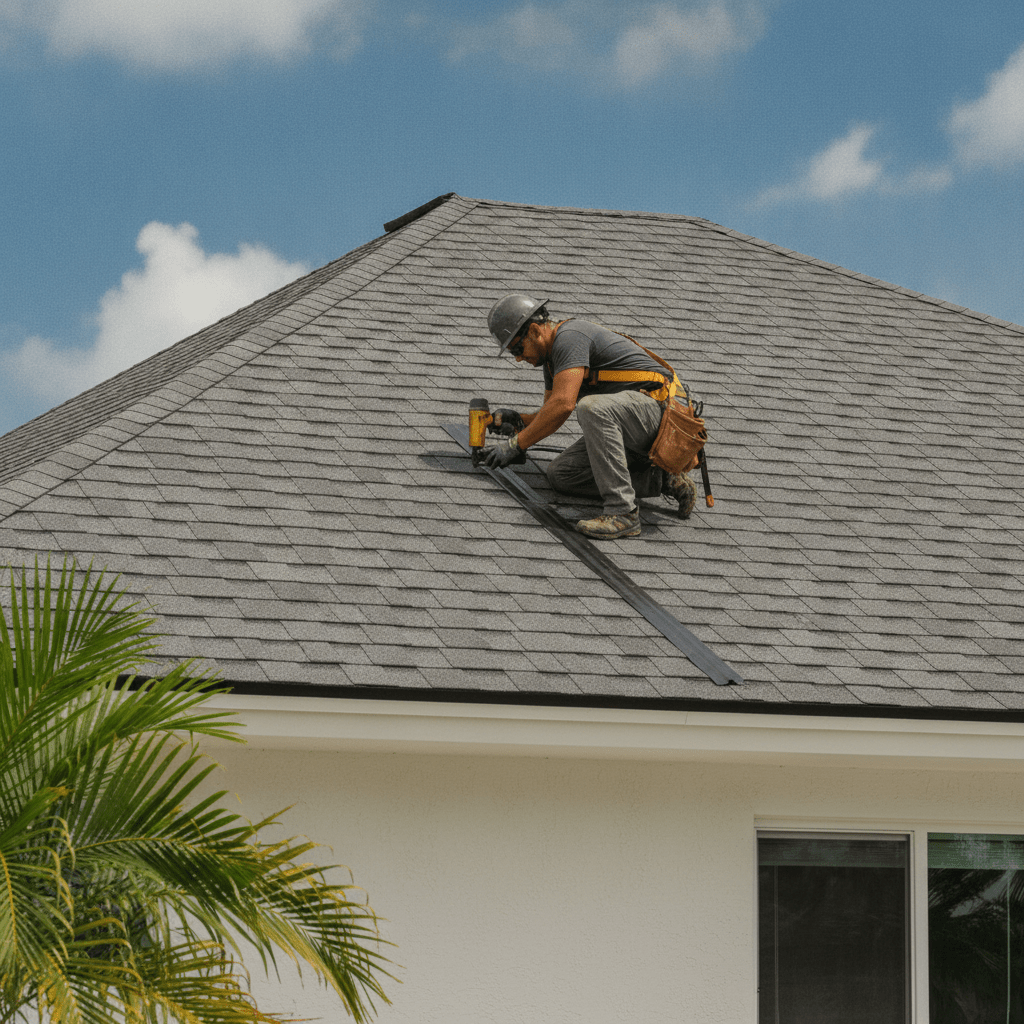
- Tear-off and assessment: Old roofing is removed and the bare deck is visible for the first time. The roofer walks the entire deck, marking soft spots, delaminated panels, and boards with structural damage. This is when the “5-sheet allowance” number becomes real.
- Homeowner notification: A responsible roofer calls or texts with the actual count, the per-sheet rate from your contract, and the revised cost before any new material is ordered. You confirm and authorize the additional scope in writing.
- Material order: Plywood or OSB is ordered or pulled from the contractor’s supplier. In Miami-Dade during active roofing season, same-day delivery is not guaranteed — plan for a possible half-day wait if the count is large.
- Removal and replacement: Damaged panels are removed, disposed of, and new panels are cut in and nailed to the HVHZ fastening schedule.
- Sheathing nail-pattern inspection: Miami-Dade Building Department must inspect the sheathing nail pattern before underlayment begins. This inspection covers both original decking and all replaced panels. The inspector checks nail type (ring-shank), nail spacing at panel edges, and field nailing. Scheduling this inspection mid-job adds at least one business day to the timeline — sometimes two in peak summer.
- Underlayment and roofing proceed: Once the inspection passes, the crew continues with underlayment, cap sheet or peel-and-stick, and the roofing system.
The sheathing inspection requirement is not optional and cannot be skipped to save time. Any roofer who suggests going straight to underlayment to avoid the inspection delay is proposing a code violation that will surface at final inspection — or worse, during the next storm.
Not sure how many decking sheets your roof might need? Get a straight-talking estimate before you commit.
Related Reading
More South Florida Roofing Guides
Related Articles
Who We’re Not the Right Fit For
We believe the most useful thing we can do is tell you honestly when we are not your best option. Here are situations where Bigfoot Windows & Roofing may not be the right call:
- You need the absolute lowest price on paper. If your only decision criterion is the cheapest per-sheet quote you can find, we are probably not your contractor. Our pricing reflects HVHZ-compliant materials, permitted work, and mid-job communication — not the fastest number to get a signature.
- Your project is outside South Florida. We operate in Miami-Dade, Broward, and Palm Beach. If your property is in Orlando, Tampa, or elsewhere in Florida, we are not the right geographic fit and you should work with a contractor who knows your local building department and code path.
- You want the decking cost locked in regardless of what tear-off reveals. We cannot guarantee a fixed decking cost when we have not seen the deck. Any contractor who guarantees “no extra decking charges no matter what” is either guessing or building a very large contingency into the base price. We would rather give you an honest per-sheet rate and a realistic expectation range.
- You are planning a partial or patch repair only. If you want to patch a section of decking without pulling permits or doing a full tear-off assessment, that is not a scope we take on in the HVHZ — Miami-Dade code and our standard of care both require that replacements are permitted and inspected.
Frequently Asked Questions
How much does each additional plywood sheet cost after the first 5 on a roof replacement in Miami?
In South Florida, each additional sheet beyond the standard 5-sheet allowance typically runs $80–$150 installed — covering the material, labor to remove the damaged panel, cut and set the new one, nail it to the HVHZ schedule, and haul away the debris. The exact rate depends on sheet thickness required by your Miami-Dade NOA or Florida Product Approval, lumber prices at the time of your job, and whether the replacement is a full 4×8 panel or a cut-in piece around a hip, valley, or edge. Get this rate in writing before your contract is signed.
Why does my roofing contract only include 5 plywood sheets and what happens if more are needed?
The 5-sheet allowance is a South Florida industry convention — a shared starting point because no roofer can see through existing roofing material to assess deck condition before tear-off. When more are needed, your roofer should call you before ordering materials, give you the per-sheet rate from your contract, and get written authorization for the additional scope. The overage is invoiced on top of the contract base price. Never let a roofer replace extra sheets without notifying you first — that is a red flag regardless of how many they find.
Does Miami-Dade code require a specific plywood thickness for roof decking in the HVHZ?
Yes. The Florida Building Code (8th Edition, 2023) and Miami-Dade’s HVHZ requirements set minimum panel thickness based on rafter or truss spacing and the design-pressure requirements of the roofing system installed. The minimum is 7/16” structural panels, but 15/32” or 19/32” CDX plywood is often required — particularly for standing seam metal or tile systems, or where rafter spacing exceeds 24 inches on center. Your roofer should confirm the required spec against the applicable Miami-Dade NOA or Florida Product Approval before ordering replacement material.
Will my homeowners insurance cover the cost of extra roof decking found rotten during replacement?
It depends on your policy and the cause of the damage. Most standard homeowners policies cover sudden and accidental damage — a tree branch through the roof, for example — but exclude gradual deterioration, which is how most South Florida decking rot is classified. Slow leaks, long-term condensation, and age-related delamination are typically maintenance issues under most policies. Your best move is to photograph the damage before it is removed, ask your roofer to document it in writing, and submit a claim if you believe storm activity contributed to the damage. Do not assume coverage — verify with your adjuster.
How do I know if my roofer is charging a fair price for additional plywood sheets in South Florida?
The simplest check is whether the per-sheet rate is spelled out in your contract before work begins. A fair South Florida rate for HVHZ-compliant decking replacement runs roughly $80–$150 per sheet installed as of mid-2026, depending on material spec and job complexity. If a contractor’s mid-job rate is significantly higher than what was quoted, ask for an itemized breakdown of material cost, labor, and disposal. Rates that balloon after tear-off — with no contractual basis — are a warning sign. Get three quotes and compare the decking unit rate, not just the base price.
How does extra decking affect the project timeline and permits in Miami-Dade?
Extra decking adds at least one business day — often two — to a Miami-Dade roof replacement. Miami-Dade Building Department requires a sheathing nail-pattern inspection to pass before underlayment can begin. When additional sheets are replaced mid-job, those panels must be included in the inspection. In peak summer months, inspector availability can stretch the wait. Budget for this: a roof opened mid-job in South Florida summer is exposed to afternoon thunderstorms. A good roofer has a temporary weatherproofing plan and communicates the revised timeline before the inspection is called in.
Can I finance extra decking costs if they go above my original budget?
Yes, in most cases. If your roofing project is financed through PACE (Property Assessed Clean Energy), talk to your program administrator about whether the overage can be added to the approved amount before work resumes — PACE applications for roofing and windows must be separate. If you are using a personal or home improvement loan, the overage may need to come out of pocket or require a supplemental draw. The My Safe Florida Home grant program offers up to $10,000 in matching funding for qualifying wind-mitigation improvements — confirm eligibility at mysafeflhome.com. Plan your financing with a buffer for decking overages before signing any roofing contract.
Schedule Your Free Estimate
Ready to get started? Request a free estimate — no phone call required.
Sources
- Florida Building Code, 8th Edition (2023), Section 1518 — Roof Decking. floridabuilding.org
- My Safe Florida Home Program — grant eligibility and matching funds. mysafeflhome.com
- Florida Department of Business and Professional Regulation (DBPR) — license verification. myfloridalicense.com
Know your decking cost before you sign anything.
Bigfoot Windows & Roofing puts the per-sheet rate in your contract upfront. No mid-job surprises, no pressure calls from the roof.