Last updated: July 2026
Key Takeaways
- Firefighters can breach impact windows — it takes longer, requires carbide-tipped tools, and produces different results than standard glass.
- Impact glass is laminated, not tempered — it cracks but stays in the frame, meaning the frame and mullion are the real entry target.
- The weak point of an impact window installation is typically the frame anchor or the mullion, not the glass pane itself.
- That same resistance that slows a firefighter by seconds also slows a burglar by minutes — a meaningful deterrent difference.
- Miami-Dade NOA approval means the window system (glass + frame + anchor) has been tested as a unit under HVHZ standards.
The Real Question
Why Homeowners Are Asking This
A common concern when upgrading windows in Miami-Dade and Broward.
Yes — trained firefighters can breach impact windows, but it requires carbide-tipped tools and takes meaningfully longer than breaching standard glass. A homeowner in Miami Shores called us with a related worry: “What happens if there’s a fire and the firefighters can’t get in through the windows?” It is a completely fair question, and it comes up more than you might expect — especially after a neighbor upgrades to impact-resistant windows.
Impact glass behaves very differently from the standard single-pane glass most South Florida homes had before the Florida Building Code required impact-rated glazing in High-Velocity Hurricane Zones (HVHZ). Understanding that difference matters whether you are a homeowner weighing a window upgrade, a renter in a new condo, or simply curious after watching a fire rescue demonstration.
South Florida Context
Why HVHZ Impact Requirements Change the Equation
Miami-Dade and Broward counties sit inside the High-Velocity Hurricane Zone — the most demanding residential building code in the United States. Every window installed in new construction or as a permitted replacement must carry a Miami-Dade NOA (Notice of Acceptance) or Florida Product Approval. That approval covers the entire window system: the laminated glass unit, the aluminum frame, the anchorage pattern, and the installation method.
That system-level approval is also why the glass alone is not the whole story when you ask how firefighters — or burglars — interact with an impact window. The window passed a large-missile impact test, a cyclic pressure test, and a water-infiltration test as a complete assembly. Any forced-entry scenario is testing the same assembly.
How Impact Glass Actually Breaks
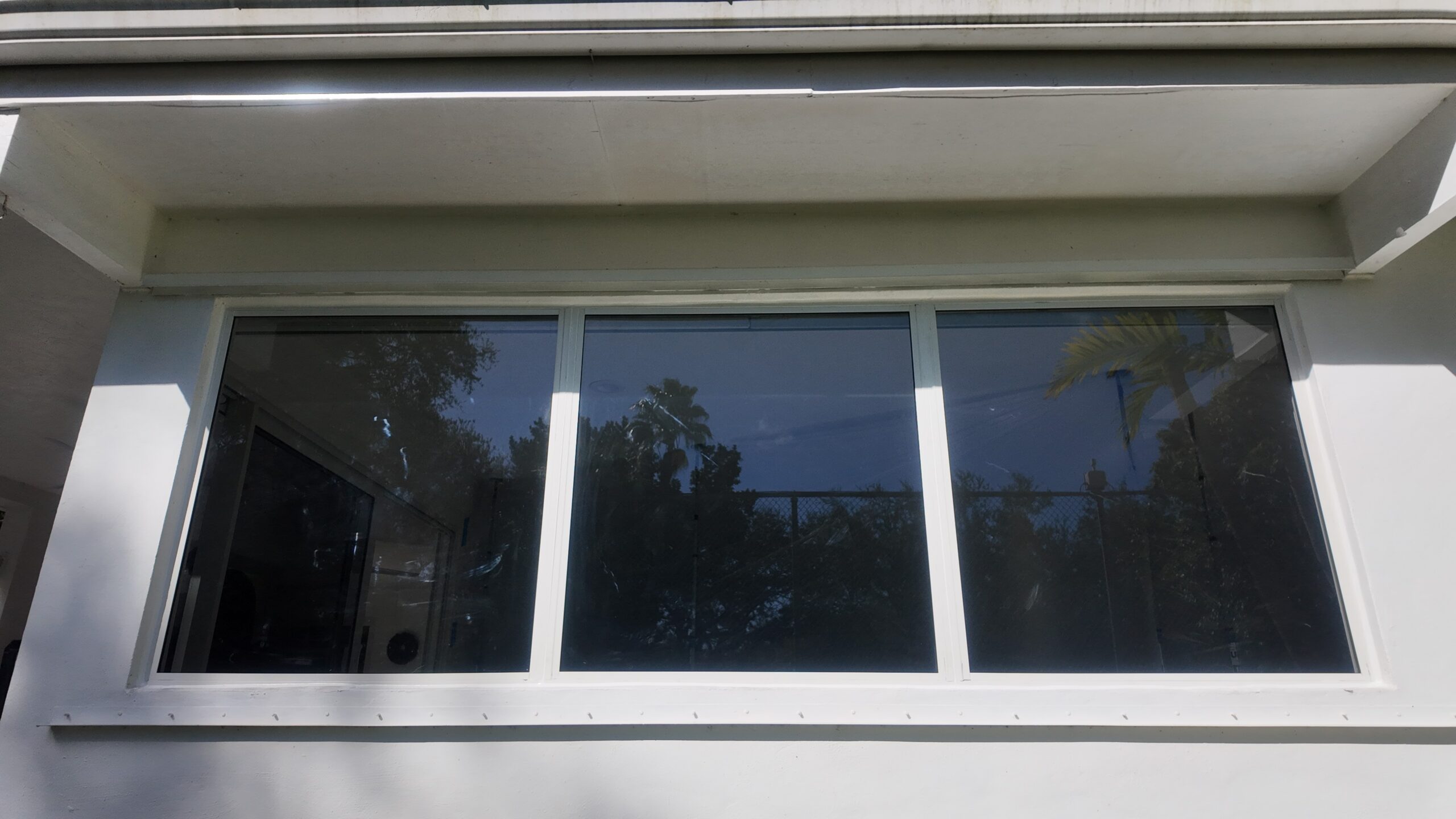
Laminated vs. Tempered: The Critical Difference
Most people confuse impact glass with tempered glass. Tempered glass is found in car side windows, shower doors, and older sliding doors — it shatters into small, relatively harmless cubes when struck hard enough. That is intentional for safety.
Impact glass is laminated. Two or more lites of glass sandwich a polyvinyl butyral (PVB) or ionoplast interlayer. When struck, the glass lites crack — sometimes severely — but the interlayer holds the broken pieces together, much like a car windshield. The pane stays in the frame. There is no “breakthrough” moment where the glass suddenly disappears and creates an opening.
This is the core fact that surprises most people: after a baseball bat, a hurricane-speed missile, or a firefighter’s Halligan bar strikes an impact window, the glass looks destroyed but the opening is still blocked by a sheet of cracked laminate bonded to the frame.
| Property | Standard Float Glass | Tempered Glass | Laminated Impact Glass |
|---|---|---|---|
| How it breaks | Large, sharp shards | Tiny cubes | Cracks but stays in frame |
| Opening created on strike? | Yes — immediately | Often yes | No — interlayer holds |
| Entry tool needed | Any hard object | Any hard object | Carbide blade or sustained force |
| Time to breach (approximate) | Seconds | Seconds | Minutes, with correct tools |
| Burglar deterrent level | Low | Low-medium | High |
Forced Entry Reality
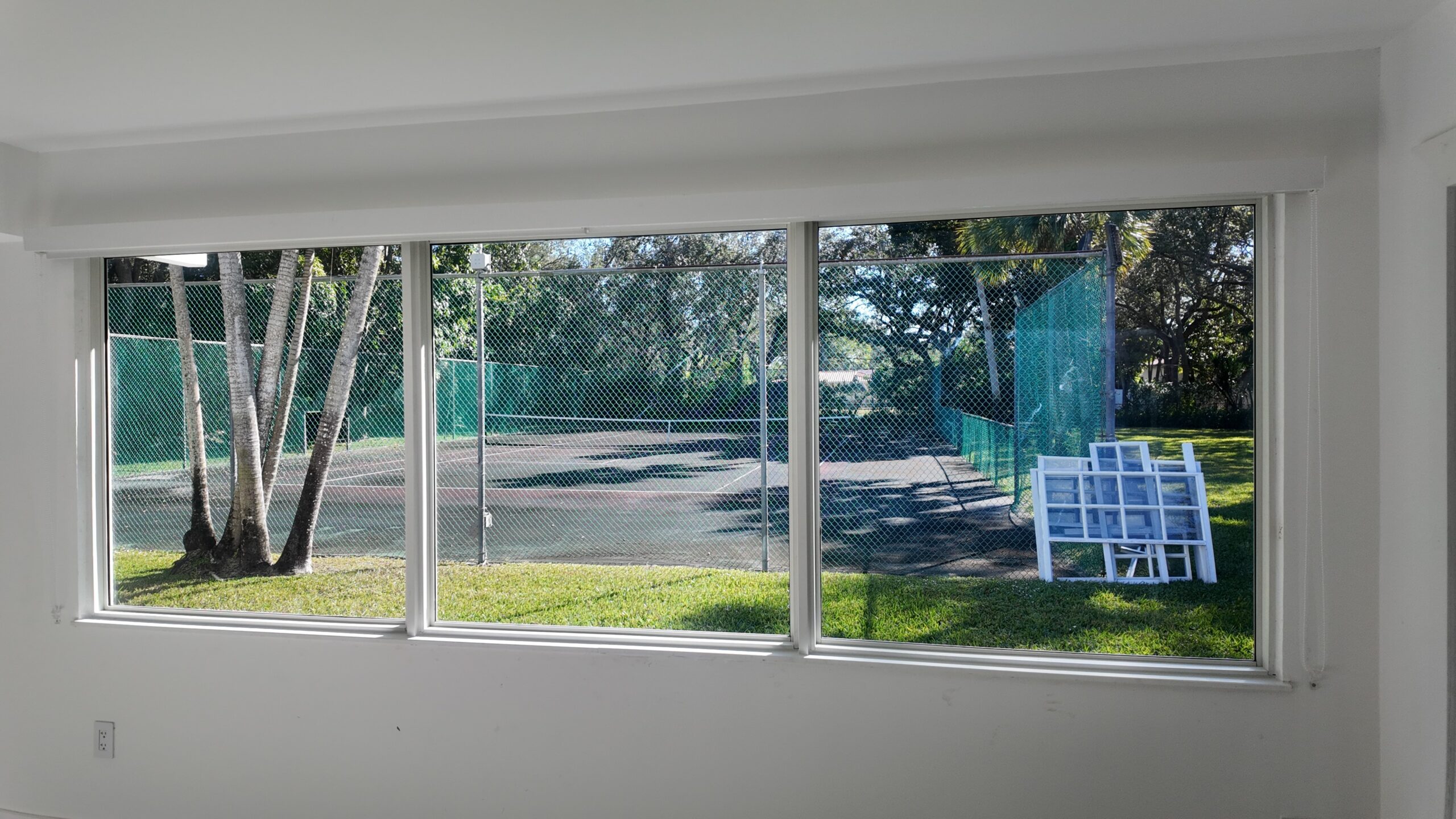
What Actually Works — and What the Weak Points Are
Fire departments that regularly respond to homes with impact windows — and in Miami-Dade that is nearly every newer home — use carbide-tipped reciprocating saw blades or oscillating multi-tool blades to cut through the laminated interlayer after cracking the glass. A standard wood-cutting or metal-cutting blade will skate across the interlayer without cutting through it. This is not a widely publicized fact, but it is standard knowledge in fire-rescue training.
The other common technique is to target the frame anchor or the mullion rather than the glass center. The aluminum frame is mechanically fastened to the rough opening with screws or bolts into the substrate. A Halligan bar driven between the frame and the wall can sometimes lever the entire unit out of the opening faster than cutting through glass. The glass wins; the attachment point is the variable.
This matters for homeowners too. A properly installed impact window — with correct anchorage per the Miami-Dade NOA installation diagram — is meaningfully harder to lever out than a window installed with fewer fasteners than specified. Installation quality is not a cosmetic issue; it is a structural one.
| Entry Method | Works on Standard Glass? | Works on Impact Glass? | Notes |
|---|---|---|---|
| Rock / blunt object | Yes | Cracks glass, no opening | Interlayer holds |
| Standard saw blade | Yes | No — skates on interlayer | Wrong tool |
| Carbide-tipped blade | Yes | Yes — cuts interlayer | Takes minutes, not seconds |
| Halligan / pry bar at frame | Yes | Depends on anchor quality | Installation matters |
| Sustained striking at mullion | Yes | Possible with enough force | Most energy-intensive method |
Why Installation Matters
The Structural Argument for Permitted, Inspected Work
A licensed contractor, not a lead aggregator.
When a window passes a Miami-Dade NOA test, it passed as an assembly — glass, frame, and installation method together. If the window is installed with fewer fasteners than the NOA requires, or into a substrate that was not properly reinforced, the tested performance does not transfer to your home. This is especially relevant in older South Florida homes where the rough opening framing may need remediation before a new window system performs as rated.
Because Darryl holds a Certified General Contractor license (CGC1531370) in addition to the Glass & Glazing specialty, structural framing issues, subsill rot, or header repairs can be addressed as part of the same permitted scope — without routing you to a separate contractor. That is a scope coordination advantage that matters when installation quality is the variable that determines whether your window performs to its rated specifications.
“The glass is only as good as the anchor. We pull the NOA sheet on every job and count fasteners. That is not optional — it is what the approval requires.”
President, Bigfoot Windows & Roofing
What We Install
Mr. Glass Impact Windows: Frame, Glass, and Burglar-Deterrent Reality
Bigfoot Windows & Roofing primarily installs Mr. Glass impact windows. The Mr. Glass lineup uses aluminum frames — not vinyl — which hold up better in South Florida’s heat, UV exposure, and salt-air coastal conditions. For homes within two miles of the water, the 2605 marine-grade finish is the correct spec; the 2604 wood-grain finish loses its 10-year warranty in coastal environments, per Mr. Glass manufacturer specification — confirm current warranty terms with the manufacturer before specifying.
Glass thickness options run from 5/16″ builder grade to 7/16″ standard mid-grade to 9/16″ for high-rise and heavy-duty applications. The 9/16″ glass is standard on the Mr. Glass Series 1000 sliding glass door — there is no equivalent in thinner glass options. Thicker laminated glass takes longer to breach with any tool, which compounds the burglar-deterrent benefit.
For energy efficiency, we recommend SB 70 Low-E glass (or the equivalent Climate Guard 6227 available as a complimentary upgrade on whole-house replacements) — it provides the strongest heat block with a characteristic dark green hue. Thermally broken aluminum frames are available for homeowners prioritizing condensation control and energy performance.
All Mr. Glass windows carry Florida Product Approval. Miami-Dade NOA is available on the 2500T impact door series. Explore our impact window installation options for South Florida homes or explore impact door systems for complete opening protection.
Our Process
From Estimate to Permitted Inspection
Every impact window job Bigfoot installs goes through a permitted process: permit application, NOA documentation submitted to the jurisdiction, inspection by the building department after installation, and final sign-off. In Miami-Dade and Broward, this is not optional — it is what HVHZ compliance requires.
- Estimate and product selection — We walk the openings, identify substrate conditions, and match the right Mr. Glass series to each opening size and use case.
- Permit application — We pull the permit. Homeowner does not need to manage this.
- Installation with NOA compliance — Fastener counts and patterns per the NOA installation diagram.
- Building department inspection — Inspector verifies the installation before we close out the permit.
- Wind mitigation documentation — We can provide the documentation your insurance company needs for a wind mitigation inspection, which may reduce your premium.
If you are considering financing your window project, PACE financing options are available — paid through the property tax bill with no prepayment penalty. Roofing and window projects must be submitted as separate PACE applications.
Ready to protect your South Florida home with properly installed, NOA-compliant impact windows?
Who We’re Not the Right Fit For
- Homeowners who want the lowest possible price with no permit. We pull permits on every job. If unpermitted work is the goal, we are not the right contractor.
- Projects that only need one window replaced and price-per-unit is the only metric. Our process — permit, NOA compliance, inspection — has overhead that makes single-window jobs less cost-competitive against smaller operators.
- Buyers who have already committed to a vinyl-frame window brand. We install aluminum-frame impact windows. We believe aluminum performs better in South Florida’s climate and HVHZ conditions. If vinyl is a firm preference, we may not be the right fit.
- Homeowners who need a same-week turnaround with no lead time. Permitted work takes time. If speed without permits is the priority, we are not that contractor.

Written by Darryl Henry Rosenbaum, Founder of Bigfoot Windows & Roofing.
Darryl Henry Rosenbaum, doing business as Bigfoot Windows and Roofing, holds four active Florida licenses recognized by the Florida Department of Business and Professional Regulation (DBPR): Certified General Contractor (CGC1531370), Certified Residential Contractor (CRC1331693), Certified Roofing Contractor (CCC1333168), and Certified Specialty Contractor with a Glass & Glazing Specialty (SCC131153098).
Frequently Asked Questions
Can firefighters break through impact hurricane windows?
Yes. Trained firefighters can breach impact windows, but it takes longer and requires specific tools — primarily carbide-tipped saw blades or oscillating multi-tools. Standard blades skate off the PVB interlayer without cutting through. Fire departments serving Miami-Dade and Broward communities train specifically for this because nearly every newer home in the HVHZ has impact glazing.
What is the weak point of an impact window?
The frame anchor and mullion — not the glass center — are typically the easier forced-entry targets. A Halligan bar driven between the frame and the rough opening can lever a window out if the anchorage does not match the NOA installation requirements. Properly permitted and inspected installations with correct fastener counts are meaningfully more resistant to this technique.
Are impact windows also burglar proof?
Not literally burglar proof, but a strong deterrent. A casual intruder expecting glass to shatter is immediately stopped — the crazed laminate stays in the frame. Breaching it requires specific tools and several minutes of visible, noisy work. Industry research and law enforcement guidance consistently describe most residential burglaries as opportunistic; that time and noise barrier is the deterrent value. Impact windows are not a replacement for a monitored alarm system.
How do firefighters get into a home with hurricane windows?
They use carbide-tipped reciprocating or oscillating saw blades to cut through the laminated interlayer after cracking the glass, or they target the frame attachment point with a Halligan bar. Doors — especially garage doors and entry doors — are often the faster entry route. Firefighters in South Florida are trained and equipped for impact-glazed buildings because the HVHZ building code makes impact windows the standard.
What tools break impact-resistant glass the fastest?
Carbide-tipped reciprocating saw blades are the most effective tool for cutting through the PVB or ionoplast interlayer in laminated impact glass. An oscillating multi-tool with a carbide blade also works. Standard wood- or metal-cutting toothed blades do not cut the interlayer — they skate across it. A Halligan bar at the frame anchor can be faster than cutting through the glass itself if the anchorage is the weak point.
Do impact windows make it harder for first responders to get in?
They add seconds to minutes compared to standard glass, but trained first responders account for this. Miami-Dade and Broward fire departments regularly encounter impact-glazed homes. The delay is measured; it is not an insurmountable barrier for equipped crews. If you are concerned, the best practice is to ensure your home address is clearly visible and your entry doors are accessible — doors are usually the faster entry point regardless of glazing type.
Does the glass thickness affect how hard an impact window is to breach?
Yes. Thicker laminated glass — 9/16″ versus the builder-grade 5/16″ — takes longer to crack through and puts more material between the interlayer and any tool. For South Florida homes in HVHZ, the glass thickness specified in the Miami-Dade NOA is the minimum; choosing a thicker option increases both impact resistance and the time required for forced entry.
Sources
- Florida Building Code — High-Velocity Hurricane Zone (HVHZ) glazing requirements
- Miami-Dade County Notice of Acceptance (NOA) program — product approval and installation specifications
- Florida Product Approval system — impact-resistant glazing standards
Questions about impact windows for your South Florida home? Talk to a contractor who pulls permits and counts fasteners.
<a class="bf-cta-btn