
TPO Flat Roof in South Florida: Cost, Lifespan, and What to Expect
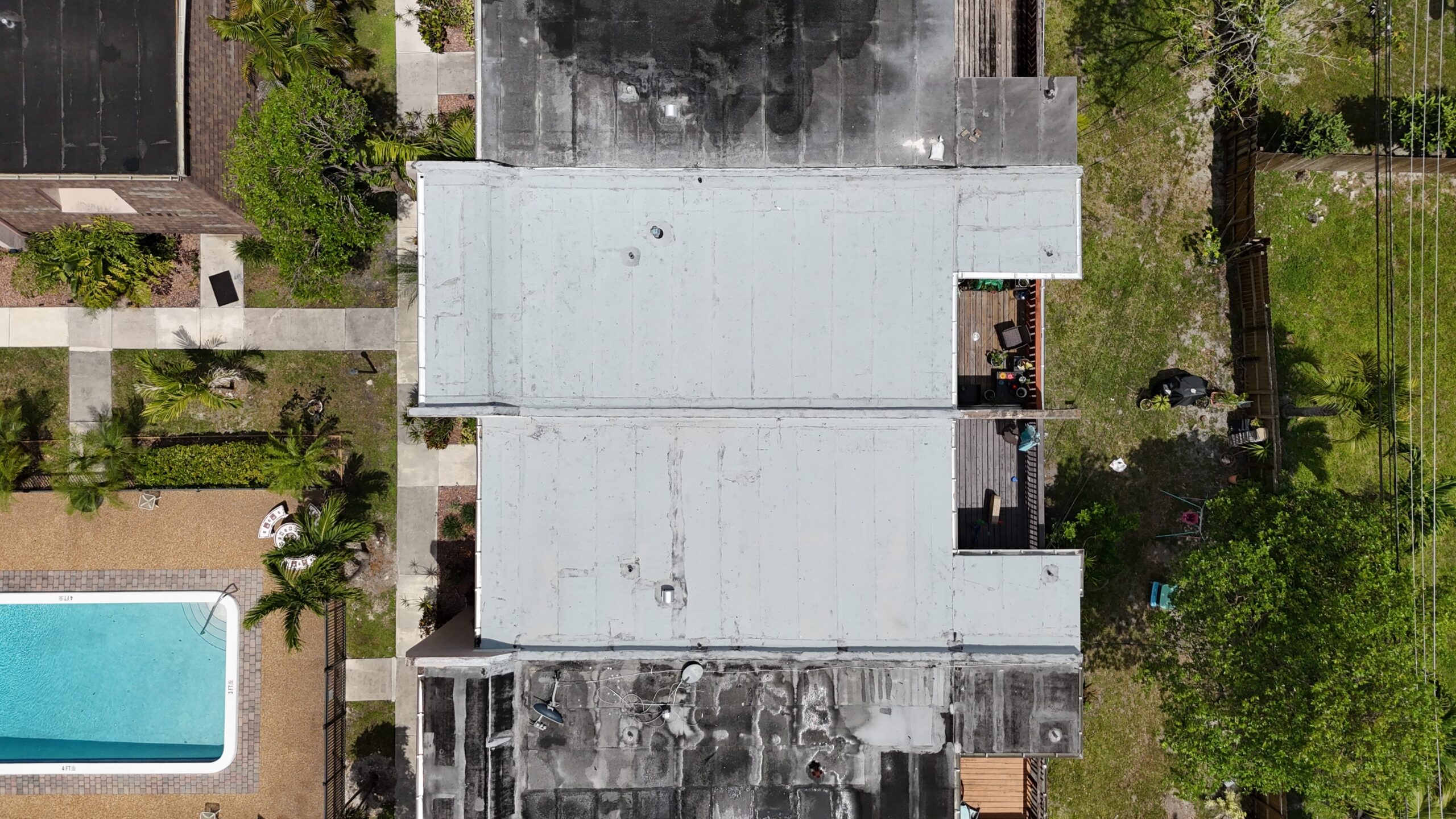
Updated June 2026
Key Takeaways
- TPO flat roofs typically last 15–25 years in South Florida with proper upkeep.
- Reflective white TPO membrane reduces cooling loads — important in Miami-Dade heat.
- Installed cost runs roughly $5–$10 per square foot depending on roof size, access, and substrate condition.
- TPO outperforms modified bitumen on energy efficiency; modified bitumen may edge out TPO on puncture resistance in high-traffic applications.
- Florida Building Code and HVHZ (High-Velocity Hurricane Zone) requirements add permit and testing steps — plan for them upfront.
- A Certified Roofing Contractor familiar with Miami-Dade NOA requirements should pull the permit, not a sub-trade or handyman.
The South Florida Flat Roof Problem
Why Flat Roofs Fail Faster Here Than Almost Anywhere Else
UV intensity, standing water, and hurricane uplift are a brutal combination.
South Florida homeowners and commercial property owners face a flat-roof environment unlike most of the country. Miami-Dade, Broward, and Palm Beach sit at roughly 25–26° latitude — meaning UV radiation is near-vertical for most of the year. Flat roof membranes that test well in Ohio or the Pacific Northwest degrade significantly faster here under constant UV exposure, extreme heat cycling, and seasonal hurricane-force winds.
The three most common failure points on South Florida flat roofs are: (1) seam separation from thermal expansion and contraction, (2) flashing failure at penetrations (drains, HVAC curbs, parapet walls), and (3) ponding water where drains are undersized or clogged. TPO, when installed correctly with heat-welded seams and properly sloped drainage, addresses all three better than older cold-applied or torch-applied systems.
Local Context
HVHZ, Florida Building Code, and NOA Requirements
Miami-Dade and Broward are High-Velocity Hurricane Zone counties — the strictest flat-roof jurisdiction in the US.
The Florida Building Code (FBC) Chapter 15 governs roofing statewide, but properties inside the High-Velocity Hurricane Zone (HVHZ) — which includes all of Miami-Dade and Broward counties — face additional requirements. A product with a current Florida Product Approval (FL number) that covers HVHZ use is legal to install in Miami-Dade and Broward. A Miami-Dade NOA is an additional certification some products also carry; it is not required for the permit. Palm Beach County follows the standard FBC Broward High Wind zone requirements, which are rigorous but distinct from HVHZ.
What this means in practice: not every TPO product on the national market is NOA-approved. Your contractor must specify a system with documented Miami-Dade Product Approval, pull a permit, and schedule a final inspection. Skipping this step creates insurance and resale problems — South Florida insurers routinely require proof of permitted work before issuing or renewing a policy on a re-roofed structure.
Bigfoot Windows & Roofing holds a Certified Roofing Contractor (CCC1333168) license, which is the Florida license classification required to pull roofing permits under the FBC. Work pulled under this license means a licensed contractor — not a subcontractor with a different trade license — is the responsible party of record for your roof installation.
What You Need to Know
TPO Flat Roof: How It Works, What It Costs, and How Long It Lasts
What is TPO?
TPO stands for Thermoplastic Polyolefin. It is a single-ply roofing membrane — typically white or light gray — factory-manufactured in rolls 10 to 20 feet wide. Sheets are mechanically fastened or adhered to the roof deck, then heat-welded at every seam using hot-air welding equipment. The result is a continuous, watertight thermoplastic surface. White TPO is classified as a cool roof by ENERGY STAR and the Florida Green Building Coalition because its solar reflectance index (SRI) significantly reduces heat absorbed through the roof deck.
How Long Does TPO Last in South Florida?
With correct installation and annual maintenance, TPO flat roofs in South Florida typically last 15–25 years. The lower end of that range reflects systems installed without proper drain slope, systems that were never recoated or inspected, or systems installed over a deteriorated substrate. The upper end reflects proactively maintained systems on well-drained decks. Manufacturer warranties for TPO systems generally run 15–20 years for labor-and-material coverage, though warranty terms vary — ask your contractor for the specific warranty document before signing.
TPO Cost in South Florida: What to Budget
Installed TPO roofing in South Florida typically ranges from $5 to $10 per square foot, depending on: roof size (larger roofs cost less per square foot), substrate condition (tear-off of existing layers adds cost), roof complexity (penetrations, drains, HVAC curbs, parapets), and permit and inspection fees required by the local municipality. A 1,500-square-foot flat roof might run $7,500–$15,000 fully installed and permitted. These are directional ranges — an accurate number requires a measured estimate of your specific roof.
For a preliminary estimate on your roofing project, you can use the Bigfoot roofing estimator online before calling.
| Cost Factor | Lower Cost | Higher Cost |
|---|---|---|
| Roof size | 2,000+ sq ft | Under 800 sq ft |
| Existing layers | Single layer, good substrate | Multiple layers, rotted decking |
| Penetrations | Few (2–3 drains) | Many HVAC curbs, pipes, skylights |
| Permit complexity | Standard FBC (Palm Beach) | HVHZ NOA or a Florida Product Approval that covers HVHZ use required (Miami-Dade / Broward) |
| Access | Ground-level flat section | Multi-story or restricted access |
Material Comparison
TPO vs. Modified Bitumen: Which Is Better for South Florida?
Two legitimate flat-roof systems — with different trade-offs.
| Criteria | TPO (recommended for most) | Modified Bitumen |
|---|---|---|
| Energy efficiency | High (white reflective surface, cool-roof rated) | Low–moderate (dark surface absorbs heat) |
| Seam strength | Heat-welded — very strong when done correctly | Torch-applied or self-adhering — seam quality variable |
| UV resistance | Good with quality membrane; reflectivity slows degradation | Requires surface coating or granules for UV protection |
| Puncture resistance | Moderate (heavier mil = better) | Good — SBS-modified bitumen is tough underfoot |
| HVHZ / NOA availability | Many NOA-approved systems available | NOA-approved systems available; confirm product approval |
| Installed cost range | ~$5–$10/sq ft | ~$4–$9/sq ft |
| Typical lifespan (South Florida) | 15–25 years | 10–20 years |
When Modified Bitumen Is the Better Fit
If your flat roof sees heavy foot traffic from HVAC technicians or maintenance workers, a multi-ply modified bitumen system may hold up better to repeated abrasion and puncture. Modified bitumen is also sometimes preferred on roofs with complex geometry where heat-welding equipment is difficult to maneuver. If energy efficiency is not a top priority and you prefer a time-tested torch-applied system, modified bitumen is a reasonable choice — just factor in higher long-term cooling costs.
When energy bills are a concern or the structure is in Miami-Dade’s HVHZ, TPO is generally our recommendation for most residential and light-commercial flat roofs in South Florida.
Why It Matters Who Pulls the Permit
A Licensed Roofing Contractor — Not a Lead Aggregator
Florida law requires a Certified Roofing Contractor to hold the permit. Verify the license before anyone steps on your roof.
Certified Residential Contractor · CRC1331693
Certified Roofing Contractor · CCC1333168
Certified Specialty Contractor – Glass & Glazing · SCC131153098
Miami-Dade · Broward · Palm Beach
When a flat roof project also involves structural repairs — rotted decking, parapet wall damage, or hurricane strap upgrades required during re-roofing — having a contractor who also holds a Certified General Contractor (CGC1531370) license means that structural scope can be handled under one contract and one permit set, rather than coordinating a separate general contractor for structural work and a separate roofing contractor for the membrane. That structural scope includes hurricane strap installation and code-driven structural modifications that inspectors may flag during a roofing permit inspection. You should not need to manage two separate licensed trades to complete one re-roof.
“The permit is not a formality in South Florida. It is the document that protects your insurance claim and your resale value. If your contractor skips it, you own that problem.”
President, Bigfoot Windows & Roofing
What to Expect
The TPO Flat Roof Installation Process in South Florida
- Inspection and estimate. A contractor walks the roof, measures square footage, documents existing layers, drain locations, penetrations, and substrate condition. This is the only way to produce an accurate number — no honest contractor quotes TPO without physically seeing the roof.
- Permit application. In Miami-Dade and Broward HVHZ, the permit application includes the NOA number for the specific TPO system being installed and the roofing contractor’s license number. Plan for 2–6 weeks for permit approval depending on municipality backlog.
- Tear-off (if required). Florida Building Code limits the number of roof layers permitted. If tear-off is needed, decking is inspected for rot or damage before the new system is applied.
- Deck preparation and insulation. Tapered insulation is commonly added to improve drainage slope — critical for South Florida’s heavy afternoon rain events.
- Membrane installation. TPO rolls are mechanically fastened or adhered, then all seams are heat-welded and tested. Penetrations and flashing details are completed.
- Final inspection. The building inspector reviews the installation against the permit and NOA requirements. You receive a closed permit — keep this document.
Want to see approximate numbers before calling? Explore our roofing services page or use the online estimator to get a preliminary range.
Ready to get a real number on your South Florida flat roof?
We pull the permit, handle the NOA, and close it out. No subcontracted surprises.
TPO Maintenance
How to Maintain a TPO Flat Roof in South Florida
Annual or semi-annual maintenance is the single biggest factor in hitting the upper end of a TPO membrane’s lifespan. In South Florida’s wet-dry seasonal climate, the practical maintenance checklist is:
- Clear drains twice a year — before and after hurricane season. Clogged drains create ponding water that accelerates seam stress.
- Inspect seams and flashing after every named storm — wind uplift concentrates at edges, parapets, and penetration flashings first.
- Keep HVAC technicians off the membrane surface — foot traffic on unprotected TPO eventually causes punctures. Install walk pads at HVAC access routes.
- Re-coat or reseal flashing tape at penetrations every 5–7 years as caulk and lap sealant degrade in UV exposure.
- Document inspections — if you ever file an insurance claim, a maintenance log showing regular inspections strengthens your position significantly.
If your roof is approaching the 15-year mark, ask for a professional membrane assessment before your next insurance renewal. Many South Florida insurers now request a roof inspection report as a condition of continued coverage on roofs over 15 years old.
Bigfoot holds flexible financing options that can help spread the cost of a planned re-roof rather than facing an emergency replacement after a storm event.
Who We’re Not the Right Fit For
We believe in being direct about where we are — and are not — the best match.
- Buyers seeking the absolute lowest bid with no permit. If the primary goal is the cheapest number and a permit feels optional, we are not the right contractor. Every flat roof we install in Miami-Dade and Broward is permitted and inspected. That process costs time and money — it also protects your insurance coverage and your home’s resale value.
- Projects outside South Florida. We operate in Miami-Dade, Broward, and Palm Beach counties. If your property is outside that service area, you need a local contractor familiar with your county’s specific permit office and inspection process.
- Emergency same-week installations. Flat roof replacements in the HVHZ require a permit, which takes time. If you need a roof installed tomorrow with no permit, that is not a service we provide.
- Homeowners committed to a specific non-NOA-approved product. If you have already selected a TPO brand that does not carry current Miami-Dade Product Approval, we cannot legally install it in Miami-Dade or Broward under a valid permit. We can help you find a comparable NOA-approved alternative.
Common Questions
Frequently Asked Questions
What is a TPO flat roof and is it right for South Florida?
TPO (Thermoplastic Polyolefin) is a single-ply flat roof membrane heat-welded at seams. Its white reflective surface makes it well-suited for South Florida’s intense UV and heat. Many TPO systems carry Miami-Dade NOA approval for HVHZ installation, making it a code-compliant choice for Miami-Dade and Broward county properties. It is among the most common flat-roof systems installed in South Florida today for both residential and light-commercial applications.
How long does a TPO flat roof last in Florida’s heat?
With proper installation and maintenance, TPO flat roofs in South Florida typically last 15–25 years. Lifespan depends on membrane thickness, installation quality, drainage design, and how consistently the roof is maintained. Roofs with adequate slope, clear drains, and annual inspections consistently outperform neglected systems by 5–10 years. UV intensity in South Florida is higher than national averages, which is why reflective white TPO performs better here than dark-surface alternatives.
How much does TPO roofing cost per square foot in South Florida?
Installed TPO roofing in South Florida typically runs $5–$10 per square foot, including tear-off (if needed), permitting, insulation, and labor. Larger roofs cost less per square foot. High penetration counts, decking repairs, and HVHZ permit requirements add cost. A 1,500-square-foot flat roof might run $7,500–$15,000 fully permitted. These ranges are directional — accurate pricing requires a physical measurement and assessment of your specific roof conditions.
What is the difference between TPO and modified bitumen for flat roofs?
TPO is a single-ply thermoplastic membrane with a reflective white surface — better for energy efficiency. Modified bitumen is an asphalt-based system applied in multiple plies — better for puncture resistance under heavy foot traffic. TPO seams are heat-welded; modified bitumen seams are torch-applied or self-adhering. For most South Florida residential flat roofs, TPO is preferred for energy savings and lifespan. Modified bitumen remains a viable choice for high-traffic rooftops or complex geometries.
Does a TPO flat roof require a permit in Miami-Dade?
Yes. Any flat roof replacement in Miami-Dade requires a building permit and must use a product with current Miami-Dade NOA (Notice of Acceptance) approval or a Florida Product Approval that covers HVHZ use. The permit must be pulled by a Certified Roofing Contractor — not a handyman or an unlicensed sub. Unpermitted roofing work in Miami-Dade creates insurance coverage gaps and can require removal and re-installation at the homeowner’s expense if discovered during a resale inspection.
How do I maintain a TPO flat roof in South Florida?
Clear all drains twice yearly (before and after hurricane season), inspect seams and flashing after major storms, install walk pads at HVAC access routes to prevent punctures, and reseal penetration flashings every 5–7 years. Annual professional inspections — documented in writing — also support insurance claims if storm damage occurs. Consistent maintenance is the primary variable that separates a 15-year TPO system from a 25-year one in South Florida’s climate.
Sources
- Florida Building Code (FBC), 7th Edition — Chapter 15 Roof Assemblies and Rooftop Structures
- Miami-Dade County Product Control — Notice of Acceptance (NOA) database: miamidade.gov/building
- ENERGY STAR Roofing Products Program — Cool Roof Rating Council (CRRC) certified reflectance values
- Florida Department of Business and Professional Regulation (DBPR) — Contractor License Verification: myfloridalicense.com
- National Roofing Contractors Association (NRCA) — Low-Slope Roofing Manual, Single-Ply Membranes section
Get a straight answer on your South Florida flat roof.
Permitted, inspected, and backed by four active Florida licenses.