Last updated: July 2026 by the Bigfoot Windows & Roofing editorial team.
Key Takeaways
- Impact windows must survive a 9-lb 2×4 fired at 34 mph — the large-missile impact test — without the frame being breached.
- After impact, the glass endures thousands of wind-pressure cycles simulating an entire hurricane’s duration.
- Design pressure (DP) ratings tell you how much wind load a specific unit is tested and approved for.
- In Miami-Dade and Broward’s HVHZ, the required DP ratings are the strictest in the United States.
- Glass may crack during a hurricane — that is by design; the laminated interlayer keeps the opening sealed.
The Real Question
Why the Word “Impact” Doesn’t Tell You Everything
Not all impact-rated products meet the same bar.
Homeowners shopping for impact windows in South Florida frequently see the word “impact-rated” on every product sheet and assume they are all equivalent. They are not. The strength of an impact window is determined by what test standard the unit passed, what Design Pressure it earned, and whether the installation method — anchoring pattern, buck type, sealant — is done to match the approval. A window with a Miami-Dade Notice of Acceptance (NOA) is not automatically stronger than one with a Florida Product Approval; the testing protocols are different, and for most residential openings the Florida Product Approval pathway is valid. What matters is whether the product and its installation are appropriate for your specific opening, wall type, and exposure category.
South Florida Context
HVHZ: The Strictest Hurricane Code in the United States
Miami-Dade and Broward County operate under a separate, stricter standard.
The High-Velocity Hurricane Zone (HVHZ) covers Miami-Dade and Broward counties. After Hurricane Andrew devastated the region in 1992, Florida rewrote its building code and placed these two counties under testing requirements that remain the most demanding in the country. Products installed in the HVHZ must hold a Miami-Dade Notice of Acceptance (NOA), a Florida Product Approval that covers HVHZ use, or meet the equivalent testing track under the Florida Building Code. The rest of Florida — Palm Beach, Sarasota, the Gulf Coast — follows the Florida Building Code without the HVHZ overlay, which still requires impact-rated products in wind-borne debris regions but at slightly less aggressive test pressures for certain opening sizes.
If you live in Miami-Dade or Broward, every window and door product installed on your home — including the specific glass build-up, frame profile, and anchor pattern — must be covered by an active NOA or approved product approval issued for HVHZ use. Your permit inspector will verify this. A contractor who cannot provide the product approval number at permit submission is not yet ready to install.
How the Testing Works
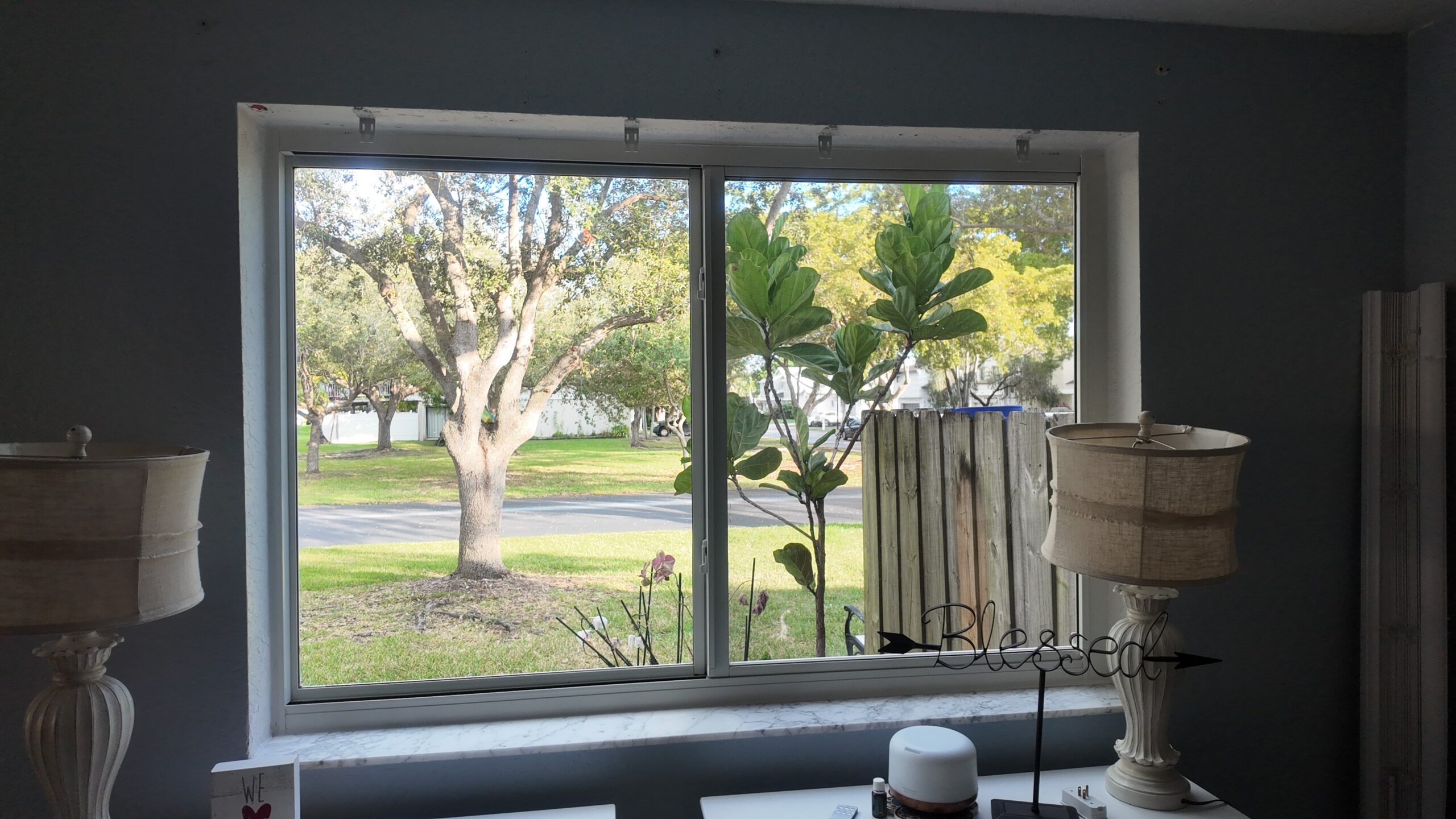
What Impact Windows Actually Have to Survive
The Florida Building Code (TAS 201, TAS 202, TAS 203 for HVHZ; ASTM E1886/E1996 for the rest of Florida) defines a two-part test sequence every impact unit must pass before approval.
Part 1 — Large-Missile Impact Test
A 9-pound 2×4 stud is fired at the test specimen at approximately 34 miles per hour. The missile must strike the unit twice at the most vulnerable locations — typically the corner and the center of a panel. After impact, the glazing may crack (that is expected), but the glass must not separate from the frame and the opening must not be breached. This simulates roof tiles, lumber, and large debris carried by a Category 4 or 5 storm.
Small-missile test: For some opening types and locations, steel ball bearings are also fired at the glass at higher velocities to test resistance to smaller, faster debris.
Part 2 — Cyclic Wind-Pressure Loading
After the missile strikes, the same unit is subjected to thousands of positive and negative pressure cycles that simulate the wind-load fluctuations a window endures throughout a full hurricane event. The unit must maintain structural integrity across the entire cycle sequence without failure of the frame, sash, glazing bead, or anchor points. This is the part of the test that eliminates products with weak frame extrusions or inadequate glass-to-frame retention systems.
| Test Phase | What It Simulates | Pass Criterion |
|---|---|---|
| Large-missile impact (9-lb 2×4 @ ~34 mph) | Roof tile, lumber, large debris | No breach of opening; glass stays in frame |
| Small-missile impact (steel balls at higher velocity) | Gravel, small debris | No penetration through glazing |
| Cyclic pressure loading (thousands of cycles) | Sustained hurricane wind pressure fluctuations | Frame, sash, and anchors remain structurally intact |
Design Pressure (DP) Ratings — What They Mean for Your Opening
Every approved impact window carries a Design Pressure rating expressed in pounds per square foot (psf). A DP +50/-50 rating means the unit was tested and approved to withstand 50 psf of positive (inward) and negative (outward) wind pressure. Higher DP values indicate approval for higher wind-load exposures.
For a given home, your structural engineer or architect of record determines the required DP for each opening based on the home’s mean roof height, its distance from the coast, the exposure category, and the building’s wind speed map value. In Miami-Dade, most single-story residential openings require a minimum DP of approximately +40/-50 psf, but corner openings, upper-floor openings, and homes near the water often require +60/-70 or higher. The product you install must equal or exceed the required DP for every opening — not just on average.
Material & Glass Comparison
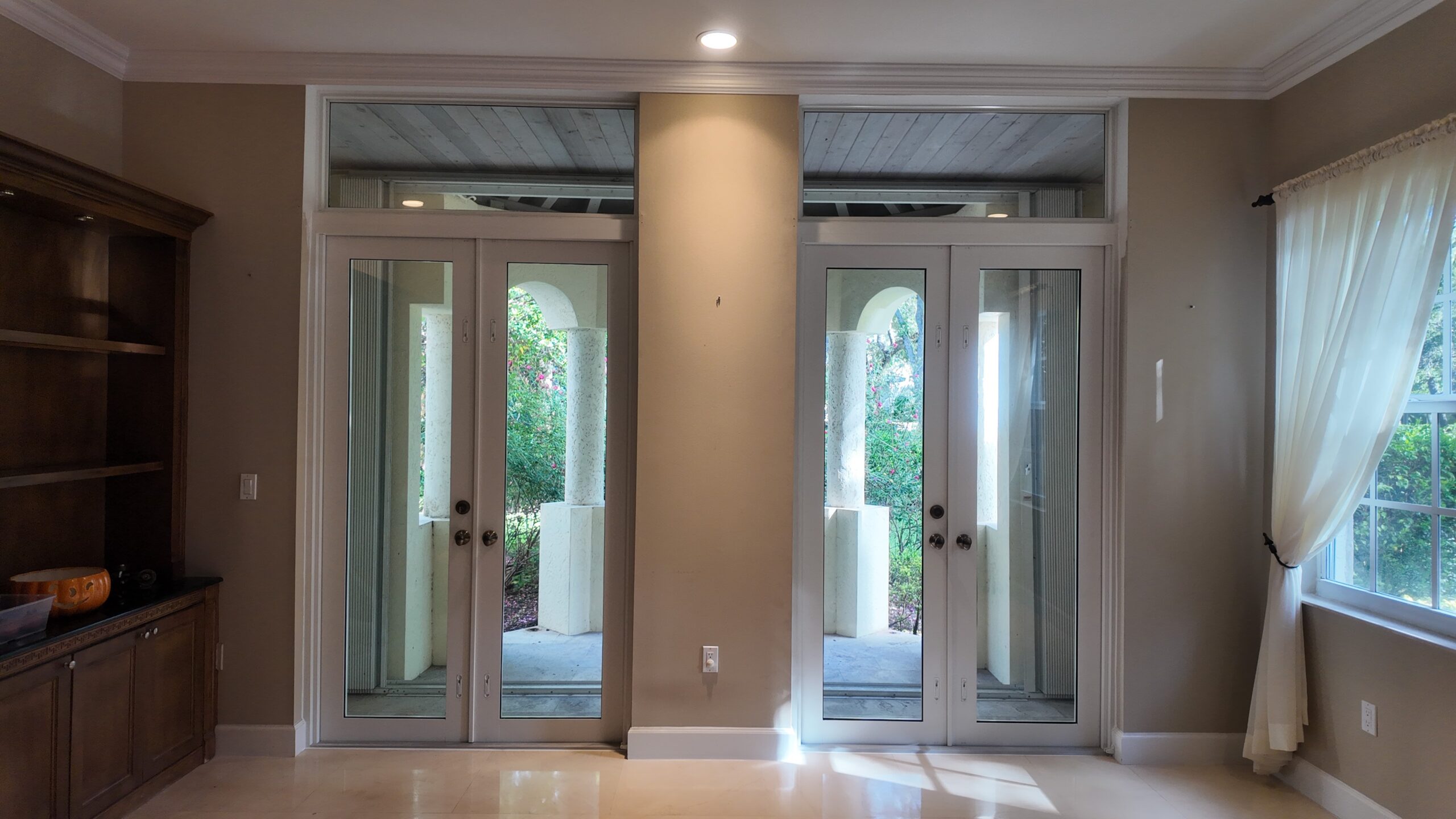
How Frame Material and Glass Build-Up Affect Real-World Strength
| Factor | What to Look For | Why It Matters in South Florida |
|---|---|---|
| Frame material | Aluminum (recommended for HVHZ) | More dimensionally stable in heat, humidity, and UV than vinyl; time-tested in coastal salt-air environments |
| Glass build-up | Laminated interlayer (PVB or SGP) | Keeps cracked glass bonded in frame; SGP interlayer is stiffer and used in higher-DP applications |
| Glass thickness | 5/16" (builder), 7/16" (standard mid), 9/16" (high-rise / heavy-duty) | Thicker glass increases impact resistance and DP ceiling; 9/16" is standard for high-rise and large openings |
| Anchor pattern | Must match NOA / product approval exactly | Spacing, embedment depth, and fastener type are all tested parameters — deviation voids the approval |
| Frame depth | Does not change when you upgrade glass thickness | A common homeowner misconception — upgrading from 7/16" to 9/16" glass does not require a new frame profile |
We recommend aluminum frames for all South Florida impact-window installations. Aluminum has a longer performance track record in the HVHZ’s combination of heat, UV, salt air, and hurricane pressure cycling than vinyl alternatives. When energy efficiency is a priority, thermally broken aluminum frames — which include a polyamide thermal barrier within the extrusion — significantly reduce heat transfer without sacrificing structural rigidity.
For projects that also involve structural wall modifications to accommodate new or enlarged openings, having a contractor authorized to coordinate multi-trade scope under a Certified General Contractor license means the structural lintel, rough opening preparation, and window installation are handled under a single scope of accountability — rather than splitting the work between a general contractor and a separate window company. You can explore our full impact window installation services to see how we handle structural scope in-house.
Why It Matters Who Installs
A Tested Product Only Performs When Installed to the Approval
Licensed contractor — not a lead aggregator or subcontract chain.
“A window with a Miami-Dade NOA is only as strong as the installation it sits in. If the anchor spacing deviates from the tested pattern, the approval is void — and so is your wind-mitigation credit.”
President, Bigfoot Windows & Roofing
What We Install
Mr. Glass Impact Windows — HVHZ-Approved Aluminum Frames
Our primary impact-window line is Mr. Glass, manufactured with aluminum frames and Florida Product Approval on all series. Key series for South Florida homeowners:
- Series 200 (flagship single-hung): 2-7/8" frame depth, spiral adjustable balances, high-rise capable. Suitable for multi-story and condo applications.
- Series 300 (horizontal roller): Rated to 80/80 psf; available up to 127-5/8" wide in three-panel configuration — covers large coastal openings.
- Series 350 (residential): Builder-grade entry point — residential use only; not appropriate for condos, high-rise, or commercial buildings.
- Series 2500T (impact door): Thermally broken door tested in both in-swing and out-swing configurations — most competitors test only one direction.
All Mr. Glass casement units include stainless steel hardware as a standard feature, not an upgrade. For coastal installations within two miles of open water, we specify the 2605 marine-grade frame finish — the 2604 wood-grain finish loses its 10-year warranty in salt-air environments. We also carry ES Windows as a secondary aluminum impact-window line for projects where Mr. Glass sizing falls outside the required range.
We pair every window project with a roofing evaluation at no additional cost for whole-house replacement projects, because a new roof and new windows installed under a coordinated permit reduce both project complexity and the likelihood of sequencing conflicts at inspection.
Our Process
From Design Pressure Calculation to Final Inspection
- Opening survey & DP calculation: We measure every opening, document wall construction, and determine the required DP for each unit based on exposure category and mean roof height.
- Product selection & permit submittal: We select the approved product, prepare drawings, and submit for permit with the NOA or product approval number on file.
- Structural rough-opening prep (when needed): If an opening requires a new lintel or structural modification, that work is coordinated in-house under our general contractor license — no separate GC contract required.
- Installation to tested anchor pattern: Every fastener type, spacing, and embedment depth follows the product approval exactly. No field substitutions.
- Final inspection & wind-mitigation report: We support your wind-mitigation inspector with the product approvals and installation documentation needed to maximize your insurance premium reduction.
Financing is available through the PACE program, paid through your property tax bill rather than a separate bank loan. For qualifying property owners, there may be tax benefits available — please consult your CPA. Visit our financing options page to see current program details.
Ready to confirm the right DP rating and product for your South Florida home?
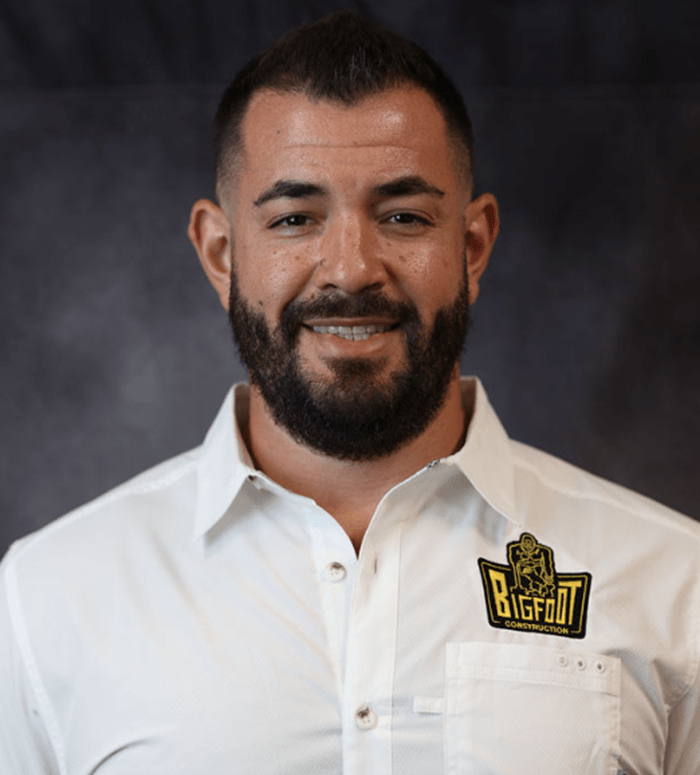
Written by Darryl Henry Rosenbaum, Founder of Bigfoot Windows & Roofing.
Darryl Henry Rosenbaum, doing business as Bigfoot Windows and Roofing, holds four active Florida licenses recognized by the Florida Department of Business and Professional Regulation (DBPR): Certified General Contractor (CGC1531370), Certified Residential Contractor (CRC1331693), Certified Roofing Contractor (CCC1333168), and Certified Specialty Contractor with a Glass & Glazing Specialty (SCC131153098).
Who We’re Not the Right Fit For
- Budget-first buyers comparing builder-grade bids: We do not install the lowest-cost window available. If the goal is the cheapest square-foot price without regard to frame material or DP adequacy, a volume installer focused on tract-home turnover will be a better match.
- Single-window replacements where permitting feels like overkill: Every impact-window installation in Miami-Dade and Broward requires a permit by law. If you want an unpermitted swap, we are not the right contractor.
- Homeowners who have already selected a brand we do not carry: We do not install PGT as a primary line. If you have a strong preference for a brand outside our approved product list, we will tell you honestly — and you should find a dealer who specializes in that product.
- Projects outside South Florida: We serve Miami-Dade, Broward, and Palm Beach counties. If your home is in a different region of Florida, we are not set up to permit and inspect your project.
Common Questions
Frequently Asked Questions
How strong are impact windows and doors?
Impact windows approved for Florida’s HVHZ must survive a 9-lb 2×4 fired at roughly 34 mph, followed by thousands of wind-pressure cycles. The Design Pressure (DP) rating on the approval tells you the maximum wind load the unit is tested for. Higher DP ratings indicate approval for more severe wind-load conditions. The specific DP required for your home depends on your opening location, mean roof height, and distance from the coast.
What is the large-missile impact test?
A 9-pound 2×4 stud is fired at the window or door specimen at approximately 34 miles per hour, striking it twice at the most vulnerable points. The glazing may crack — that is acceptable — but the glass must not separate from the frame and the opening must not be breached. This simulates large hurricane debris such as roof tiles and framing lumber.
Do impact windows break in a hurricane?
The glass can crack during a severe hurricane. That is by design. Impact windows use laminated glass — two panes bonded by a PVB or SGP interlayer. When the outer pane cracks, the interlayer holds the broken pieces in place. The opening remains sealed, which preserves the building’s structural envelope and prevents catastrophic interior pressure that can lift a roof.
What happens when impact glass breaks?
The laminated interlayer keeps cracked glass bonded to itself and to the frame. You will see a spider-web crack pattern, but wind and rain cannot enter. The opening stays protected until the glass is replaced after the storm. This is the fundamental difference between impact glass and a standard insulated unit, which would shatter and leave the opening exposed.
What design pressure do I need in Miami-Dade?
The required Design Pressure varies by opening. Most single-story residential openings in Miami-Dade require at least approximately +40/-50 psf. Corner openings, upper-floor openings, and homes near the water typically require +60/-70 psf or higher. Your permit set must document the required DP for every opening, and the installed product must meet or exceed that value. A contractor who cannot show the DP calculation at permit submission is missing a required document.
How are impact windows tested for hurricanes?
In Florida’s HVHZ, testing follows TAS 201, TAS 202, and TAS 203 standards. Outside the HVHZ, the equivalent is ASTM E1886 and E1996. Both sequences include the large-missile or small-missile impact phase followed by cyclic wind-pressure loading. A product earns a Florida Product Approval or Miami-Dade NOA only after the complete test sequence passes at an accredited laboratory.
Can my HOA block me from installing impact windows?
No. Florida Senate Bill 293 prohibits homeowner associations from blocking the installation of impact-resistant windows or doors. An HOA may regulate aesthetic details such as frame color within reasonable bounds, but it cannot deny you the right to install a code-compliant impact product. If your HOA issues a denial letter, consult a Florida real estate attorney — the statute is clear.
Sources referenced in this article:
- Florida Building Code, Section 1609 & TAS 201/202/203 (HVHZ testing standards)
- ASTM E1886 / E1996 — Standard Test Method for Performance of Exterior Windows, Curtain Walls, Doors, and Impact Protective Systems
- Miami-Dade County Building Code Compliance Office — Notice of Acceptance (NOA) requirements
- Florida Senate Bill 293 (2023) — HOA restrictions on impact windows and metal roofing
Get your Design Pressure requirements confirmed before you buy.
Call Bigfoot Windows & Roofing at 786-886-2088 or request an estimate online.