
Plywood Replacement During Re-Roofing | Bigfoot Windows & Roofing
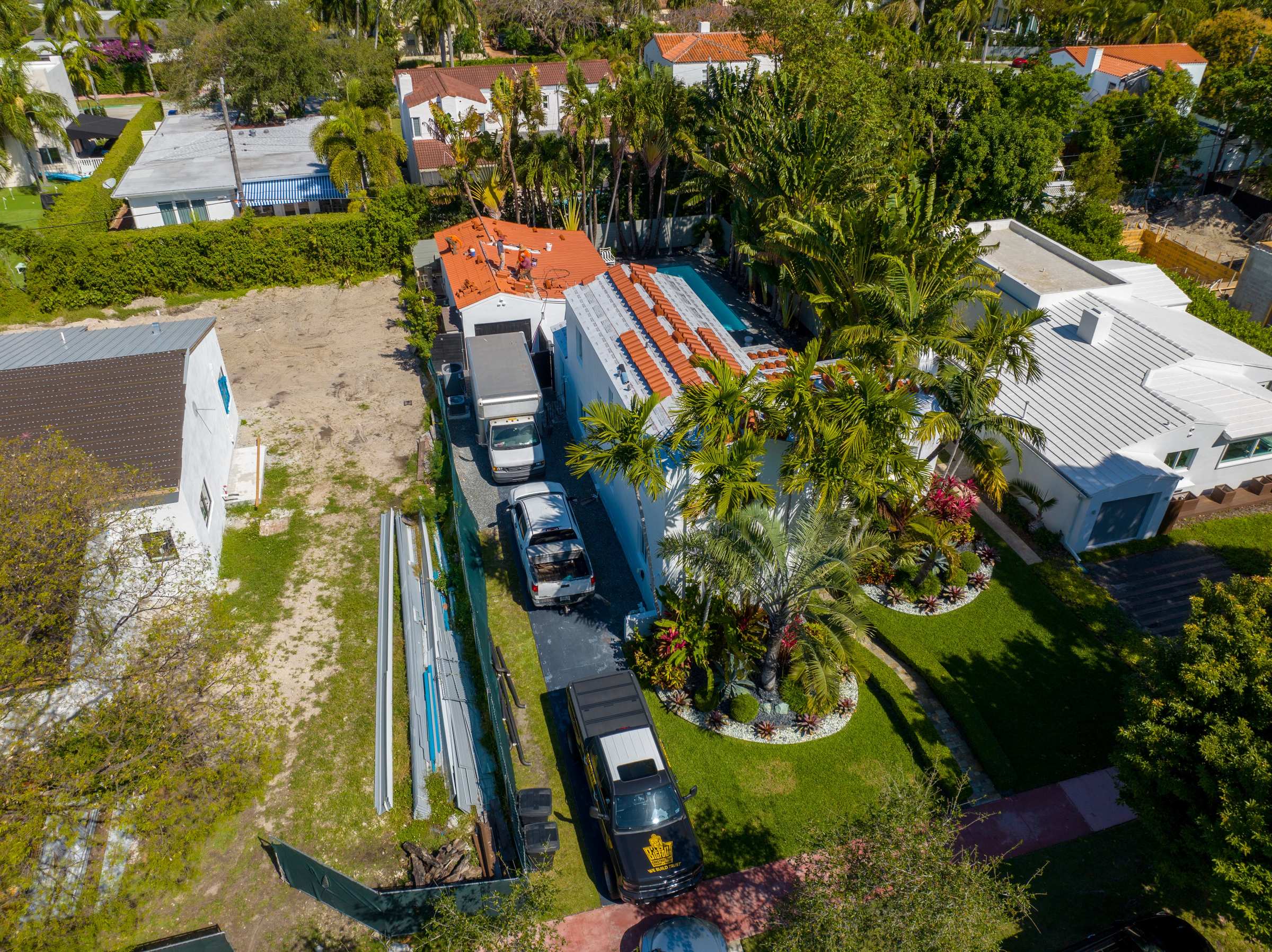
When re-roofing a South Florida home, contractors typically replace between 5% and 30% of the roof deck due to water damage — but in Miami-Dade and Broward, where hurricanes and humidity accelerate hidden rot, 15–25% replacement is common on roofs older than 15 years. Flat roofs with A/C penetrations and older tile roofs frequently exceed that range.
Updated August 2026
Key Takeaways
- Expect 5–30% plywood replacement as a planning range; HVHZ roofs older than 15 years often land at 15–25%.
- Hidden rot only becomes visible after old shingles or tile are removed — budget a per-sheet allowance, not a fixed number.
- Miami-Dade HVHZ code requires specific decking thickness and ring-shank nailing patterns before any new roofing can be inspected.
- Flat roofs with A/C curbs, vent penetrations, and ponding water zones are the highest-risk areas for concentrated deck damage.
- Decking replacement is typically a line-item allowance in South Florida re-roofing bids — understand how your contract handles change orders.
Why This Matters
The Plywood Problem No Contractor Can Predict Until Tear-Off
Hidden rot is the number-one source of mid-project surprises on South Florida re-roofs.
Here is what happens on almost every re-roofing job in Miami-Dade: the crew pulls off the old shingles or lifts the tile, and instead of a solid plywood deck underneath, they find dark, spongy sections that crumble when pressed. Sometimes it is a few sheets in the corner near the A/C curb. Sometimes it runs along an entire valley or eave line. The homeowner had no idea.
This is not negligence — it is physics. South Florida’s combination of intense UV, high humidity, frequent afternoon thunderstorms, and hurricane-season driving rain creates conditions where water infiltration works silently for years behind intact-looking roofing materials. By the time the exterior surface signals a problem, the structural damage underneath can be substantial.
The question is not whether you will have some decking replacement — it is how much, why, and how your contractor’s bid handles it. Understanding the answer before work starts keeps your project on budget and avoids the shock of a mid-job change order conversation.
South Florida & HVHZ Context
Why Miami-Dade and Broward Are Different From the Rest of Florida
The High-Velocity Hurricane Zone sets stricter rules — and your roof deck is where those rules start.
Miami-Dade and Broward counties sit within Florida’s High-Velocity Hurricane Zone (HVHZ), the most stringent building-code jurisdiction in the United States for residential construction. Under the Florida Building Code (FBC) as adopted locally, roof sheathing is not just a substrate — it is a structural component that must meet specific thickness minimums, fastener schedules, and span requirements before a new roof system can be installed and inspected.
When the Miami-Dade Building Department issues a roofing permit, the inspector does not just look at the finished roof. They verify that the deck itself meets current HVHZ standards. If your original plywood was installed under an older code cycle — or if it has been compromised by moisture — it may need to be brought up to current standards before the new roofing system goes on. That process can trigger additional deck replacement beyond whatever rot removal was already planned.
Palm Beach County follows the standard Florida Building Code rather than HVHZ, which means slightly different nailing schedules and inspection thresholds — but the moisture damage dynamics are identical given the shared climate. Regardless of which county your home is in, the South Florida climate means you should plan for some level of decking work on any re-roof.
What Drives the Numbers
How Much Additional Plywood Replacement Is Actually Needed?
The honest answer depends on your roof’s age, material, slope, and penetration count — here is how to think through it.
There is no universal percentage that applies to every re-roof. What experienced South Florida roofing contractors use instead is a damage-probability framework based on the characteristics of your specific roof. Here are the primary drivers:
Roof Age and Material Type
A concrete tile roof installed in the 1990s has had 25+ years of water cycling through thousands of small crack points, fastener holes, and mortar joints. The deck underneath has almost certainly absorbed moisture in multiple locations. Shingle roofs shed water faster but can still develop concentrated rot at valleys, eaves, and anywhere a flashing has failed. As a general planning reference:
| Roof Age & Type | Typical Deck Replacement Range | Risk Factor |
|---|---|---|
| Under 10 years, shingle | 2–8% of deck area | Low |
| 10–20 years, shingle (HVHZ) | 8–18% of deck area | Moderate |
| 15–25 years, tile (Miami-Dade) | 15–30% of deck area | High |
| 20+ years, flat/low-slope with penetrations | 20–40%+ of deck area | Very High |
| Any roof after a named hurricane | Add 5–15% to above ranges | Variable |
These are directional planning ranges based on field experience in Miami-Dade, Broward, and Palm Beach — not guaranteed project quantities. Actual replacement is confirmed at tear-off.
Penetrations: A/C Curbs, Vents, and Solar Mounts
Every penetration through a roof deck is a potential water entry point, and in South Florida, flat and low-slope roofs commonly have five to ten or more penetrations for A/C curbs, exhaust vents, plumbing stacks, and — increasingly — solar racking anchors. Each penetration creates a moisture-concentration zone. The plywood immediately surrounding an A/C curb that has had any flashing gap is almost always compromised. Budget for at least one to two sheets of replacement per major penetration as a conservative planning assumption.
What the Code Requires for HVHZ Decking
Under HVHZ requirements incorporated into the Florida Building Code, roof sheathing must meet specific minimums. As a general reference:
- Minimum thickness: 19/32" (5/8") plywood or equivalent structural panel is commonly required for most residential rafter spans in HVHZ applications — verify the applicable span table for your specific framing.
- Fastener type: Ring-shank nails are required (smooth-shank nails do not meet HVHZ uplift requirements).
- Nailing schedule: The Miami-Dade Building Department inspector verifies fastener spacing at the field and panel edges — typically 6" on center at edges and 12" in the field, though the applicable NOA or approval document for the specific roof system governs.
If your existing deck was nailed with smooth-shank nails — common on pre-2000 construction — the inspector may require re-nailing even on structurally sound panels. Re-nailing adds labor cost but is far less expensive than full replacement.
How to Read Your Contractor’s Bid
Most South Florida re-roofing bids handle decking in one of three ways:
- Included allowance: The bid includes a fixed number of sheets (often 5–10) as part of the base price. Anything beyond that triggers a per-sheet change order.
- Excluded entirely: Decking replacement is listed as "not included — charged at cost per sheet at time of installation." This is technically transparent but gives you zero budget certainty.
- Line-item estimate: The contractor estimates a probable quantity based on roof age and visible damage signs, lists a per-sheet unit price, and explains the change-order trigger. This is the most homeowner-friendly approach.
When comparing roofing estimates for South Florida projects, ask every contractor explicitly: "How many sheets of decking are included in this price, and what is your per-sheet rate if more are needed?" A contractor who cannot answer that question clearly has not thought through your project scope.
Cost Breakdown
Plywood Replacement Cost Factors: What Moves the Number
Per-sheet pricing varies — here is what to expect in Miami-Dade and Broward versus Palm Beach.
| Cost Factor | Lower End | Higher End (HVHZ / Complex) | Notes |
|---|---|---|---|
| Materials — 19/32" structural plywood, per sheet | ~$40–$55 | ~$70–$90 | Lumber pricing fluctuates; verify at time of bid |
| Labor — cut, fit, nail per sheet (HVHZ ring-shank schedule) | ~$40–$60 | ~$70–$100 | Higher on steep slopes or difficult access |
| Per-sheet total (installed) | ~$80–$115 | ~$140–$190 | Directional market range — not a Bigfoot fixed price |
| Re-nailing only (no replacement) | ~$15–$25/sheet | ~$30–$50/sheet | When panel is structurally sound but fasteners fail HVHZ spec |
| Disposal / two-layer tear-off adder | ~$300–$500 total | ~$600–$900 total | Applies when two existing layers must be stripped |
All figures are directional market-range estimates for planning purposes only. Actual pricing varies by material availability, project complexity, slope, and access. Bigfoot provides firm per-sheet pricing in writing before any decking work begins.
Palm Beach County projects typically run toward the lower end of the HVHZ range on labor because the HVHZ fastener schedule does not apply — but material costs are similar given the same South Florida lumber market. The biggest single variable is roof slope: a low-slope or flat roof costs less per sheet to deck than a steep residential roof where crews must use safety lines and scaffolding.
Why Contractor Structure Matters Here
One License That Changes Your Decking Conversation
A licensed contractor, not a lead aggregator — this is structural accountability, not a marketing badge.
Most roofing subcontractors hold a Certified Roofing Contractor license, which is appropriate for the roof system itself. But decking replacement can involve more than swapping plywood: it can uncover rotted rafters, compromised hurricane straps, undersized blocking at structural connections, or framing that does not meet current FBC span requirements. When that happens mid-job, a roofing-only contractor has to stop work and bring in a separate party — adding time, cost, and a coordination gap.
Darryl Henry Rosenbaum, doing business as Bigfoot Windows and Roofing, holds four active Florida licenses recognized by the Florida Department of Business and Professional Regulation (DBPR): Certified General Contractor (CGC1531370), Certified Residential Contractor (CRC1331693), Certified Roofing Contractor (CCC1333168), and Certified Specialty Contractor with a Glass & Glazing Specialty (SCC131153098).
That Certified General Contractor license is relevant to a decking conversation because it means structural modifications — rafter repair, hurricane strap upgrades, blocking corrections — can be assessed and addressed within the same scope of work, under one contractor’s permit, without the homeowner having to manage a handoff between trades. This is a structural advantage grounded in license breadth, not a claim about project outcomes.
“Every deck we replace gets documented with photos before the new roofing goes on. You know exactly what was replaced, where it was, and why — before the inspector shows up.”
Founder & President
Material Guidance
What Goes Back On: Roofing Systems Over a Repaired Deck
The decking is the foundation — the roofing system on top has to be matched to it correctly.
Once damaged decking is replaced and the HVHZ nailing schedule is satisfied, the new roofing system gets installed over a full-deck underlayment. For shingle roofing in South Florida, Bigfoot installs GAF architectural shingles with a full-deck peel-and-stick underlayment. Under the 2024 Florida Building Code update, a full-deck peel-and-stick system is now permitted as a direct-to-deck application and can qualify as a Secondary Water Resistance (SWR) feature on the Florida wind mitigation inspection form (OIR-B1-1802) — which may qualify for an insurance discount, depending on your carrier and wind mitigation inspection results.
For standing seam metal roofing, Bigfoot installs Englert or Metal Alliance panels roll-formed on-site from 24-gauge Galvalume or aluminum, using manufacturer-approved clips at the specified schedule. Metal roofing over a properly decked and re-nailed HVHZ deck gives the full structural assembly the best chance of performing as designed through hurricane season.
For tile roofing, the deck repair is especially important because tile is heavy — an undersized or moisture-compromised deck can deflect under tile weight, cracking the substrate and restarting the moisture cycle within a few years. Bigfoot uses Westlake concrete and barrel tile products, verified for the applicable wind-speed ratings for your county.
If you are considering financing your roof replacement, PACE programs allow you to spread both the base installation cost and the decking replacement allowance over time — and the decking line item is eligible as part of the same qualifying improvement.
What to Expect
The Decking Replacement Process: Step by Step
Knowing the sequence reduces mid-project anxiety.
- Pre-job estimate: At the estimate stage, we assess visible signs of moisture damage — staining on soffits, sagging field areas, cracked or lifted tile — and note penetration count. We provide a probable decking allowance in writing as part of the bid.
- Tear-off and inspection: Once old roofing is removed, we walk the entire deck and mark every compromised panel with chalk. We document each area with photos before any replacement begins.
- Replacement and re-nailing: Damaged panels are removed and replaced with code-compliant structural plywood at the correct thickness, fastened with ring-shank nails at the HVHZ-required schedule. Sound panels that were previously under-fastened are re-nailed in place.
- Inspector verification: The Miami-Dade Building Department inspector (or the applicable county inspector) verifies the deck before underlayment goes down. This is a mandatory hold point — the roof cannot proceed until the deck passes.
- Change-order documentation: Any decking replacement beyond the bid allowance is documented by sheet count and location before billing. You see the evidence before you see the invoice.
- Underlayment and finish roofing: Once the deck passes inspection, the full underlayment system and chosen roofing material are installed in sequence per the applicable Miami-Dade NOA or Florida Product Approval.
Want to know what your South Florida re-roof deck allowance should realistically be?
Who We’re Not the Right Fit For
We believe in being direct about where we are and are not the best match. Here are situations where another contractor may serve you better:
- You need the absolute lowest bid and want to sort out scope differences later. We include a written decking allowance, a per-sheet change-order rate, and photo documentation in our proposals. That process adds a few days to scoping. If speed-to-lowest-number is the priority, a contractor who excludes decking entirely will look cheaper on paper — and may be more expensive once the job is open.
- Your project is in a county or municipality we do not currently serve. We operate in Miami-Dade, Broward, and Palm Beach counties. If your property is outside that area, we are not set up to pull permits or manage inspections for your project effectively.
- You need roofing only — no decking assessment, no code compliance review. If your roof deck was recently replaced and independently inspected, and you simply need a new surface system installed, a roofing-only contractor may be a faster fit. Our approach is thorough; that thoroughness has value when the stakes are high, but it is more process than some straightforward re-roofs require.
- Your project requires licensing classes we do not hold. We do not hold electrical, plumbing, mechanical, pool, or HVAC licenses. If your re-roofing project requires those trades under a single GC umbrella, you will need a contractor with that full licensing portfolio or separate licensed subcontractors coordinated by your GC.
Homeowner Questions
Frequently Asked Questions
How much extra plywood replacement should I budget for when re-roofing my South Florida home?
Budget a per-sheet allowance rather than a fixed total. A practical planning range for Miami-Dade and Broward re-roofs is 10–20% of total deck area for shingle roofs over 12 years old, and 15–30% for tile roofs over 15 years. Ask your contractor for a written per-sheet unit price and a stated allowance in the base bid so you know exactly when a change order is triggered.
Why does my roofer find rotted decking after removing my old tile or shingles in Miami?
South Florida’s heat, humidity, and hurricane-season rain infiltration work on the underside of your roof deck for years before any visible exterior sign appears. Old tile and shingle systems can mask significant moisture damage. Rot becomes visible only after tear-off — which is why experienced contractors estimate a probable allowance rather than guaranteeing zero additional decking work.
Does Miami-Dade building code require full plywood replacement or just damaged sections during a re-roof?
Miami-Dade HVHZ rules require that all installed decking — whether new or existing — meet current thickness minimums and ring-shank nailing schedules before a new roof system is approved. Structurally sound panels that were under-fastened can be re-nailed rather than replaced. Damaged, delaminated, or moisture-compromised panels must be replaced. The building department inspector verifies the deck before underlayment proceeds.
How does water damage around A/C penetrations and vents affect my roof deck in South Florida?
Every penetration is a potential water entry point. A/C curbs with any flashing gap concentrate moisture in the surrounding plywood, and in South Florida’s high-humidity environment that damage spreads faster than in drier climates. Flat and low-slope roofs with multiple penetrations — common in Miami-Dade — often show the highest per-penetration damage zones. Budget at least one to two sheets of replacement per major penetration as a conservative planning figure.
What thickness and nailing pattern does Miami-Dade require for roof sheathing under HVHZ rules?
HVHZ residential applications commonly require 19/32" (5/8") structural plywood or equivalent, fastened with ring-shank nails at a schedule that the Miami-Dade Building Department inspector verifies before the new roof system proceeds. Exact requirements depend on your rafter span and the specific NOA or Florida Product Approval for the roofing system being installed — confirm the applicable spec with your licensed contractor and the issued permit documents.
How much does additional plywood decking cost per sheet if more than the allowance is needed?
As a directional market reference, installed plywood replacement in South Florida typically runs approximately $80–$190 per sheet depending on material costs at the time of the project, slope, access difficulty, and HVHZ fastener requirements. Re-nailing without replacement runs less. Ask your contractor for a firm per-sheet rate in writing before work begins — that number should be in your contract, not negotiated after the deck is open.
Can I finance the plywood replacement cost as part of my overall roofing project?
Yes. PACE financing treats decking replacement as part of the qualifying roofing improvement — it does not need to be a separate application. If your contractor structures the decking as a change order, confirm with your PACE administrator how mid-project scope additions are handled. The My Safe Florida Home program offers matching grants up to $10,000 for qualifying wind-mitigation improvements that may include decking upgrades. Always verify current program funding and eligibility before counting on grant availability.
Sources & References
- Florida Building Code — Residential (current adopted edition): floridabuilding.org
- My Safe Florida Home grant program: mysafeflhome.com
- Florida Department of Financial Services — Wind Mitigation Inspection Form OIR-B1-1802: referenced for SWR discount context
- Bigfoot Windows & Roofing — Roofing Pricing Guide: metal-roof-cost-florida-pricing-guide
- Renew Financial PACE eligibility: renewfinancial.com
Schedule Your Free Estimate
Ready to get started? Request a free estimate — no phone call required.
Get a written decking allowance and per-sheet rate before your South Florida re-roof begins.
Bigfoot Windows & Roofing serves Miami-Dade, Broward, and Palm Beach. We document every sheet replaced — before the invoice, not after.