
What the Roof Replacement Process Looks Like Start to Finish in South Florida
Updated June 2026
Key Takeaways
- South Florida roof replacements require a permit before any tear-off begins — no exceptions under the Florida Building Code.
- The full process runs roughly 5–10 business days from signed contract to final inspection, depending on permit turnaround.
- Miami-Dade and Broward HVHZ requirements add specific fastener, underlayment, and tie-down standards not used elsewhere in the U.S.
- Your old roofing materials are hauled away the same day as tear-off in a standard full-replacement project.
- A Certified General Contractor (CGC1531370) can handle structural issues discovered mid-project — no separate contractor needed.
The Homeowner Problem
Most Homeowners Have No Idea What Happens After They Sign
Post-sale anxiety is real — and it is mostly caused by a lack of visibility into what comes next.
You signed a contract for a new roof. Now what? For most South Florida homeowners, the gap between signing and the crew showing up feels like a black box. Calls go unanswered. Timelines are vague. You do not know whether a permit was pulled or whether your next call will be from an inspector who showed up unannounced.
This guide maps every stage of a roof replacement in South Florida — from the initial measurement and permit application all the way through final inspection and your warranty packet — so you know exactly what to expect and when to ask questions.
South Florida Context
Why the Process Here Is Different From the Rest of the Country
Miami-Dade, Broward, and Palm Beach are not standard roofing markets.
South Florida sits inside the High Velocity Hurricane Zone (HVHZ) as defined by the Florida Building Code. That designation changes almost every step of a roof replacement. Fasteners, underlayment, decking attachment, and drip edge specifications are all governed by HVHZ standards that are stricter than the rest of Florida — and far stricter than most of the United States.
In Miami-Dade County specifically, roofing products must carry a Miami-Dade NOA or a Florida Product Approval that covers HVHZ use to be installed legally. The NOA confirms that a product has been tested to Miami-Dade’s wind-load and impact standards. If a contractor tries to install a product without a Miami-Dade NOA or a Florida Product Approval that covers HVHZ use in Miami-Dade, the project will fail inspection — and the homeowner bears the cost of correction.
Permits are not optional here. The Florida Building Code Section 1511 governs roof replacements, and local jurisdictions enforce it strictly. Any contractor who suggests skipping the permit to save time or money is creating serious liability for you as the homeowner — including potential issues with insurance claims, future sales, and code compliance.
The Full Process
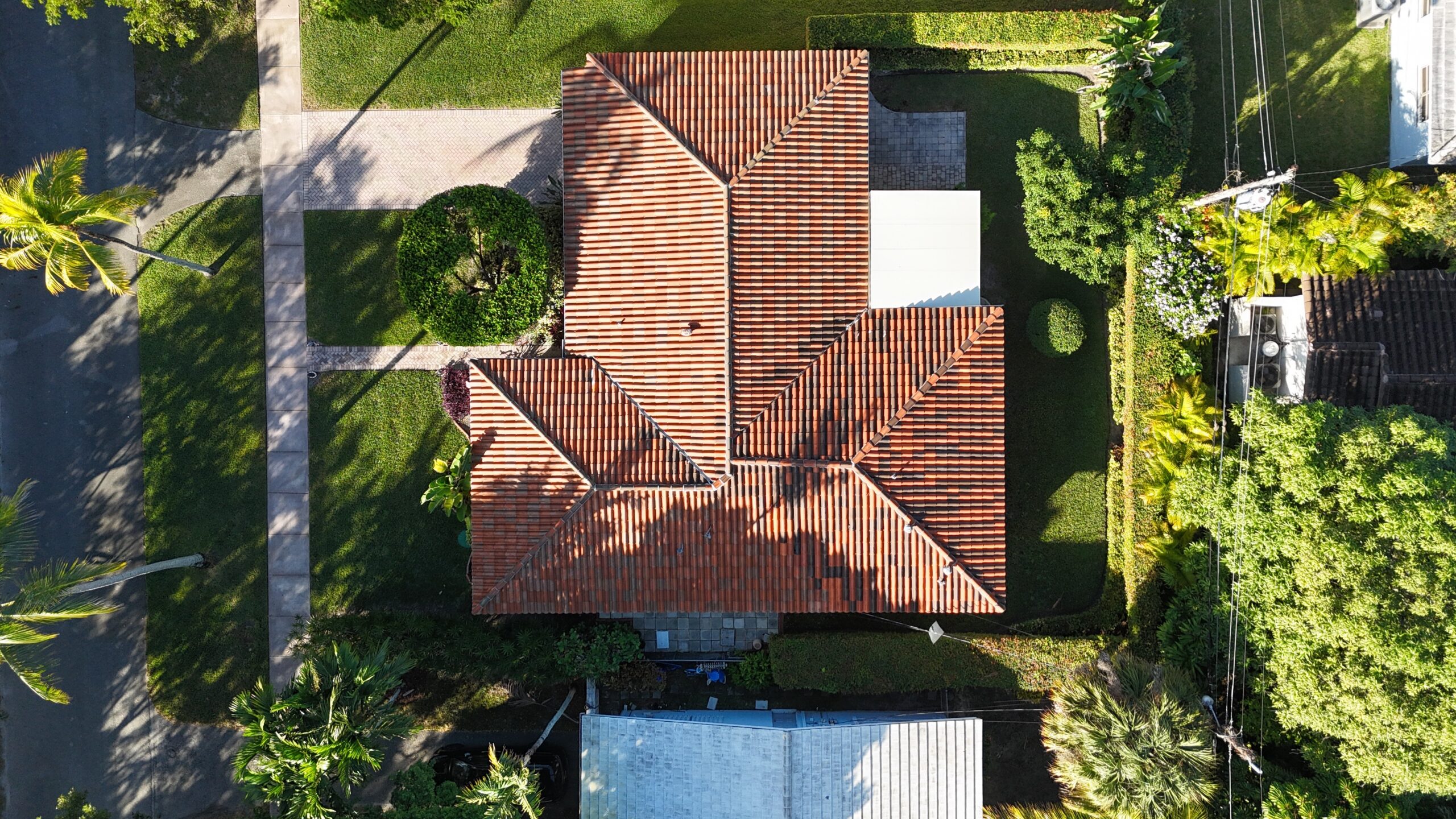
Stage-by-Stage: What a South Florida Roof Replacement Actually Looks Like
From first measurement to the warranty packet in your hand.
Stage 1 — Scope and Measurement. Before anything is ordered or permitted, the roof is measured and the full scope is documented. This includes the square footage, the pitch, the number of penetrations (vents, pipe boots, skylights), the condition of the existing decking, and whether any structural repairs — such as rafter repairs or hurricane strap upgrades — are needed. Because Bigfoot holds a Certified General Contractor license (CGC1531370) alongside the Certified Roofing Contractor license (CCC1333168), structural scope discovered during this stage does not require a separate contractor. One company can handle decking replacement, rafter repairs, and code-required hurricane strap installation under a single permit set.
Stage 2 — Contract and Material Selection. Once scope is defined, you choose your system — tile, shingle, flat/low-slope membrane, or metal. Every product used on a South Florida job should have an active Florida Product Approval and, for Miami-Dade, a valid NOA. Ask for these documents before you sign. They are public record.
Stage 3 — Permit Application. The permit application is submitted to the local building department — Miami-Dade, Broward, or Palm Beach depending on your address. This is the step that creates the most scheduling uncertainty. Permit turnaround varies by jurisdiction: some offices process in 3–5 business days; others run 7–14 days during peak season. A contractor who cannot tell you which jurisdiction your property falls under is not organized enough to manage your permit correctly.
Stage 4 — Material Order and Delivery. Materials are ordered once the permit is approved or imminent. Delivery to the job site is scheduled to align with the install date — you do not want materials sitting on your lawn or roof for an extended period in South Florida heat.
Stage 5 — Tear-Off Day. The crew arrives, the old roofing system is removed, and the decking is inspected. If damaged or soft decking is found, replacement is documented and added to the work order. All debris — old shingles, tiles, underlayment, nails — is loaded and hauled away the same day. Your property should be clean by the time the crew leaves for the day.
Stage 6 — Installation. Underlayment, drip edge, and the new roof system are installed to the approved permit drawings and HVHZ specifications. For tile or shingle work, fastener patterns and attachment methods are dictated by the product’s NOA and the Florida Building Code — not by installer preference. For flat roofs, membrane seams and termination details must meet the approved system specs.
Stage 7 — Inspections. Most jurisdictions require at least two inspections: a dry-in inspection (underlayment in place, before the finish surface is installed) and a final inspection. The inspector verifies fastener patterns, product approval compliance, flashing details, and decking attachment. Do not let a contractor skip the dry-in inspection by asking the inspector to come only at the end — that is how code deficiencies get buried.
Stage 8 — Punch-Out and Cleanup. After final inspection approval, the crew performs a final walkthrough — checking all pipe boots and penetration seals, clearing valleys and gutters of debris, and doing a magnet sweep of the driveway and yard for stray nails.
Stage 9 — Warranty Packet. You should receive a manufacturer’s warranty (covering the roofing material) and a workmanship warranty (covering the installation). Keep both. Your insurance carrier may request them, and a future buyer will want to see them.
| Stage | Who Is Responsible | Typical Timeline | What to Watch For |
|---|---|---|---|
| Scope & Measure | Contractor | Day 1 | Structural issues documented upfront |
| Permit Application | Contractor | 1–14 business days | Jurisdiction and turnaround vary |
| Material Order | Contractor | Concurrent with permit | Confirm NOA-approved products |
| Tear-Off | Roofing crew | Day 1 of install | Same-day debris removal expected |
| Installation | Roofing crew | 1–3 days depending on size | Dry-in inspection required |
| Final Inspection | Building dept. inspector | 1–3 days after request | Do not close permit without it |
| Warranty Packet | Contractor | Within 2 weeks of final | Manufacturer + workmanship both |
What the Work Actually Involves
Our Replacement Products and Methods
Bigfoot Windows & Roofing uses only Florida Product Approved materials on every replacement. Every project starts with a permit — no exceptions. Our standard replacement includes tear-off of existing materials, inspection of the decking, installation of a Florida-compliant underlayment system, and installation of the new roofing material with manufacturer-specified fastener patterns for hurricane resistance.
- Shingle replacements — GAF Timberline HDZ or UHDZ series with LayerLock technology, eligible for Golden Pledge warranty through our Master Elite certification
- Metal roofing — Standing seam or exposed-fastener panels with wind uplift ratings exceeding Miami-Dade requirements
- Flat/low-slope systems — TPO or modified bitumen with a heat-welded seam system and 10-year workmanship warranty
- Permit and inspection — We pull all permits, schedule inspections, and provide you the final Certificate of Completion
Comparing Approaches
Permitted vs. Unpermitted Roof Replacement: What Is Actually at Stake
| Factor | Permitted Replacement | Unpermitted Replacement |
|---|---|---|
| Insurance claim eligibility | Generally supported | Often denied or disputed |
| Home sale disclosure | Clean permit record | Must disclose; can kill sale |
| Code compliance | Inspector-verified | Unknown — no verification |
| Wind mitigation credit | Eligible after inspection | Usually ineligible |
| Cost if caught | None beyond permit fee | Re-roof at homeowner expense |
The permit is not bureaucratic friction — it is the mechanism that lets your insurer, your future buyer, and a future storm adjuster confirm your roof was installed correctly. In South Florida’s HVHZ, that confirmation is not a nice-to-have; it is the difference between a paid claim and a denied one. Learn more about our roofing services and process standards or explore what working in Miami-Dade specifically requires.
Why the License Set Matters
A Licensed Roofing Contractor — Not a Lead Aggregator
The person holding the license is the person responsible for your project.
“A permit is not paperwork — it is proof. It is what stands between your roof and a denied insurance claim after a hurricane.”
President, Bigfoot Windows & Roofing
How to Prepare
What to Do Before Install Day
A few straightforward steps on your end make install day faster and reduce the chance of delays:
- Clear driveway access. The crew will need to park a truck and often a dumpster or trailer near the structure. Move vehicles the night before.
- Protect attic contents. Vibration from tear-off dislodges dust and small debris through attic vents. Move valuables, electronics, or stored items away from the attic floor.
- Secure or remove wall art. Hammering transmits through the structure. Pictures and mirrors on interior walls can shift or fall.
- Notify neighbors. A courtesy heads-up about noise and early crew arrival goes a long way in tight neighborhoods.
- Confirm the permit is posted. Florida law requires the permit to be conspicuously posted at the job site. If it is not visible before work starts, ask.
If your project touches impact window or door openings at the roofline — dormers, skylights, or structural header changes — those can sometimes be coordinated in the same permit cycle. Ask your contractor at scope review, not after tear-off has already started.
Ready to understand exactly what your roof replacement will involve?
Call Bigfoot Windows & Roofing at Call 786-886-2088
Or use our roofing estimator to get a preliminary scope online.
Sources
- Florida Building Code, Building Volume — Section 1511: Reroofing. State of Florida. floridabuilding.org
- Miami-Dade County Product Control Division — Notice of Acceptance (NOA) Search. miamidade.gov/building
- Florida Department of Business and Professional Regulation — Licensee Search. myfloridalicense.com
- National Roofing Contractors Association (NRCA) — Roofing Manual: Residential Low-Slope Systems. nrca.net
Who We’re Not the Right Fit For
- Homeowners who need work done without a permit. We pull permits on every South Florida roof replacement. If a contractor has offered to skip the permit to move faster or charge less, we are not the right comparison — and that offer creates real liability for you.
- Projects outside South Florida. We serve Miami-Dade, Broward, and Palm Beach. If your property is outside those counties, we are not the right contractor for the job.
- Homeowners looking for the lowest possible bid. We price to the Florida Building Code, HVHZ standards, and proper permit coverage. If the lowest number on the table is the only decision factor, we will not be that number.
- Emergency same-day replacements with no planning window. A proper South Florida roof replacement requires a permit cycle. If you need a roof installed today with no permit, we cannot responsibly do that work.
Frequently Asked Questions
What does the roof replacement process look like from start to finish in South Florida?
It runs in nine stages: scope and measurement, contract and material selection, permit application, material order, tear-off, installation, inspections (dry-in and final), punch-out and cleanup, and warranty packet delivery. In South Florida the permit and HVHZ compliance steps add time compared to other markets — typically 5–10 business days total from signed contract to final inspection, depending on jurisdiction permit turnaround.
Who will actually be doing the work — employees or subcontractors?
This is one of the most important questions to ask any roofing contractor before signing. Ask directly: are the installers on your payroll or are they subcontractors? Both models exist; neither is automatically wrong. What matters is whether the license holder is accountable for the quality and code compliance of the work. The Certified Roofing Contractor on the permit is legally responsible regardless of crew structure.
How do I prepare my home before install day?
Clear driveway access the night before. Move vehicles, secure or remove interior wall art (vibration can dislodge pictures), and protect attic contents from dust and debris. Notify neighbors about early crew arrival and noise. Confirm the permit is visibly posted at the job site before tear-off begins — Florida law requires it.
Will there be a project manager on site during my roof replacement?
Ask this question directly when you are comparing bids. The answer varies by company. What you should confirm at minimum: who is the named point of contact during install, how do you reach them if something comes up, and who calls you after the final inspection passes? A contractor who cannot answer those questions clearly before you sign is a risk signal.
Do you haul away all the old roofing materials?
Yes. On a full roof replacement, all tear-off debris — old shingles, tiles, underlayment, and nails — should be removed from your property the same day as tear-off. A magnet sweep of the driveway and yard for stray nails is standard practice before the crew leaves. If a contractor leaves debris overnight without a clear reason, ask why.
Does a South Florida roof replacement require a permit, and what happens if one is not pulled?
Yes — the Florida Building Code Section 1511 requires a permit for roof replacements, and Miami-Dade enforces this strictly. An unpermitted roof can result in a denied insurance claim after a storm, a required re-roof at your expense if discovered during a home sale, and loss of wind mitigation credits that reduce your insurance premium. Never let a contractor talk you out of a permit.
What is the difference between a dry-in inspection and a final inspection?
A dry-in inspection happens after underlayment is installed but before the finish surface (tile, shingle, membrane) goes on. The inspector verifies fastener patterns, drip edge, and underlayment attachment to the approved specs. A final inspection happens after full installation. Do not allow a contractor to skip the dry-in and combine both into one visit — that is how code deficiencies get covered up.
Get a clear scope and timeline for your South Florida roof replacement.
Call Bigfoot Windows & Roofing at 786-886-2088 or request a free estimate online.