
Shingle vs. Metal Roof in South Florida: Which Is Right for Your Home?
Updated June 2026
Key Takeaways
- Metal roofing typically lasts 40–70 years in South Florida; asphalt shingles average 15–25 years in the same climate.
- Metal generally costs more upfront ($18,000–$45,000+) but less per year of useful life than shingles ($9,000–$20,000).
- Both materials can meet HVHZ (High Velocity Hurricane Zone) wind requirements when properly specified and installed.
- Florida SB 293 limits HOA authority to block metal roofing for storm-resilience reasons.
- Many South Florida insurers offer premium discounts for qualifying metal roofs — ask your insurer for specifics.
The Real Question
Why This Decision Matters More in South Florida
Salt air, UV, standing water, and hurricane season — your roof faces all of it, year-round.
Replacing a roof in South Florida is not the same as replacing one in Ohio. Your roof battles intense UV radiation, salt-air corrosion if you’re near the coast, heavy summer rainstorms, and at least one genuine hurricane threat every season. The wrong material choice doesn’t just cost money — it can leave you without coverage or facing a second replacement in 15 years.
This comparison covers the factors that matter in Miami-Dade, Broward, and Palm Beach: wind ratings, insurance impact, lifespan under Florida conditions, Florida Building Code compliance, and total cost of ownership — not just the initial install price.
South Florida Context
HVHZ, Florida Building Code, and HOA Rules
Miami-Dade and Broward counties sit inside the High Velocity Hurricane Zone (HVHZ), one of the strictest wind-load jurisdictions in the country. Any roofing product installed in the HVHZ must hold a Miami-Dade NOA or a Florida Product Approval that covers HVHZ use — not just an ASTM lab test result from a national testing program. Both asphalt shingles and metal roofing systems can earn HVHZ NOAs, but the product list is narrower than what you’ll see at a national home-improvement store.
The Florida Building Code (FBC) Chapter 15 governs roofing installation standards statewide. In the HVHZ, wind-resistance testing requirements are even more demanding than the statewide baseline. When you’re comparing bids, verify that the specific product proposed — not just the material category — carries an active Miami-Dade NOA if your property is in Miami-Dade or Broward.
HOA note (Florida SB 293): Florida Senate Bill 293 (effective July 1, 2023) prohibits HOAs from blocking homeowners from installing metal roofing when the homeowner’s purpose is to improve storm or wind resistance. Your HOA may still regulate color or visible profile, but it cannot categorically ban metal roofing on resilience grounds. If your HOA has pushed back, consult a Florida attorney — this is a question of law, not a roofing contractor’s call.
Side-by-Side
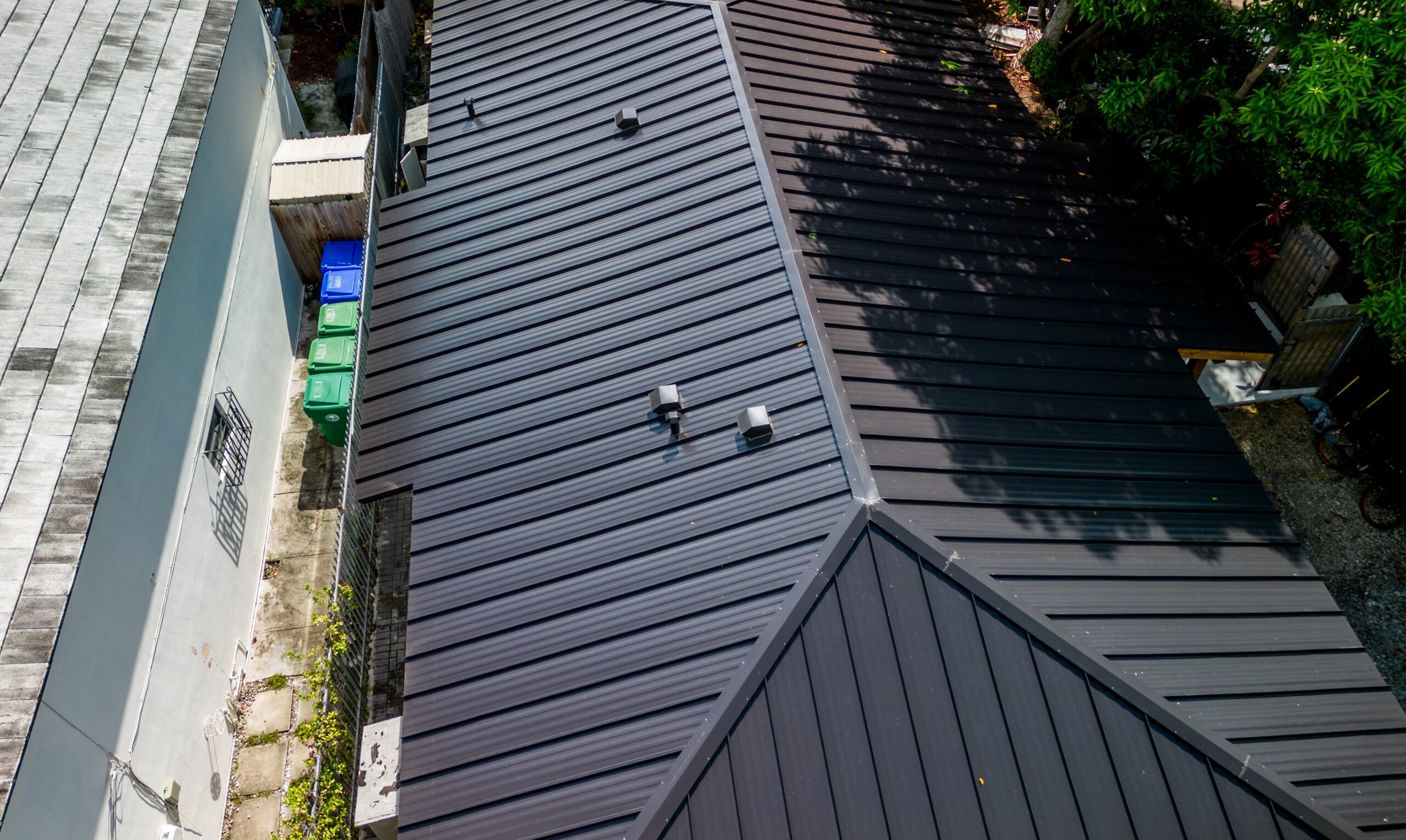
Shingles vs. Metal: The Comparison That Matters in Florida
The table below compares the two most common residential roofing choices on the criteria South Florida homeowners ask about most. Costs are typical installed ranges for Miami-Dade, Broward, and Palm Beach and will vary based on roof size, pitch, substrate condition, and product selection.
| Factor | Asphalt Shingles | Metal Roofing |
|---|---|---|
| Typical installed cost (1,500–2,000 sq ft home) | $9,000–$20,000 | $18,000–$45,000+ |
| Estimated lifespan (South Florida climate) | 15–25 years | 40–70 years |
| HVHZ product availability | Yes (limited NOA-approved list) | Yes (standing-seam and select panels) |
| Wind-resistance rating (installed, HVHZ-spec) | Up to 130–150 mph (product-dependent) | Up to 160–180 mph (product-dependent) |
| Insurance premium impact | Neutral to slight discount (new roof credit) | Potential significant discount (insurer-specific) |
| UV / heat performance | Degrades faster under intense South Florida UV | Reflective coatings reduce heat gain |
| Standing water / ponding tolerance | Vulnerable if slope is low or flashing fails | Better — continuous panels shed water faster |
| Salt-air corrosion (coastal homes) | Not applicable (granules protect) | Requires galvalume or coated aluminum — verify spec |
| Noise during rain | Quieter | Can be louder — insulation mitigates |
| HOA restrictions (FL SB 293) | Rarely restricted | HOA cannot block for storm-resilience reasons |
A second useful way to think about cost is annualized — dividing total installed cost by expected useful life:
| Material | Mid-Range Installed Cost | Expected Lifespan (FL) | Approx. Annual Cost |
|---|---|---|---|
| Asphalt shingles | $14,000 | 20 years | $700 / yr |
| Metal roofing | $30,000 | 50 years | $600 / yr |
These are illustrative ranges only — your actual numbers depend on roof complexity, current substrate condition, and product selection. The point: metal’s higher sticker price does not always mean a higher lifetime cost.
What the Numbers Mean
How Each Material Actually Performs in South Florida Conditions
Asphalt shingles are the most common residential roofing material nationwide. They install quickly, cost less upfront, and have a broad contractor base. In South Florida, however, they face conditions they weren’t originally designed for: relentless UV that accelerates granule loss, heat cycling that causes thermal cracking, and driving rain that tests every flashing detail. A 30-year shingle in a northern climate may realistically deliver only 15–20 years in Miami-Dade before it needs replacement. Quality matters significantly — 3-tab shingles are rarely appropriate for South Florida; if you go asphalt, architectural (dimensional) shingles with a valid HVHZ NOA are the baseline.
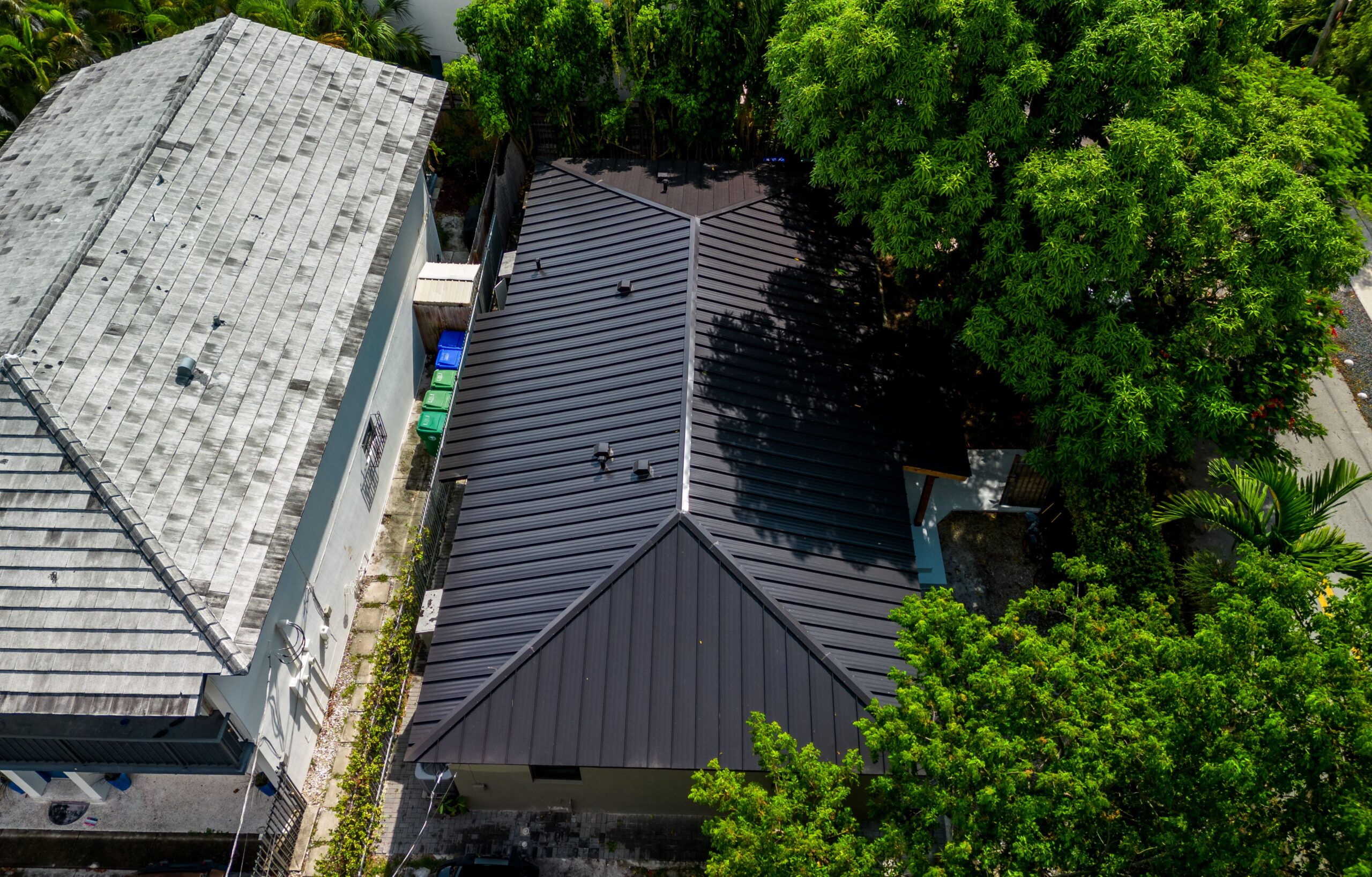
Metal roofing — standing-seam panels in particular — handles South Florida’s climate differently. Reflective or cool-roof coatings reduce attic heat gain. Continuous interlocking panels eliminate the individual-fastener vulnerabilities that give shingles their Achilles heel in hurricane-force wind. In coastal areas, the right metal spec matters: galvalume-coated steel or aluminum panels are more resistant to salt-air corrosion than bare steel. Ask for the specific product’s Miami-Dade NOA number and verify it on the Miami-Dade product approval portal before signing a contract.
One nuance worth knowing: metal roof performance in national marketing materials is often tested under laboratory conditions that don’t fully replicate South Florida’s combination of heat, humidity, UV intensity, and storm-force wind. Ask your contractor which specific product they plan to install, what its NOA covers, and whether the installation method matches the NOA’s tested assembly.
For homes with low-slope or flat sections — common in South Florida ranch and mid-century construction — neither standard shingles nor standard standing-seam panels are the right answer. Those areas typically require a separate flat-roof system (modified bitumen, TPO, or similar). A contractor experienced with multi-trade structural scope can evaluate whether your roof geometry requires different systems for different sections, and coordinate them under a single permit pull — rather than leaving you to manage two separate subcontractors and two separate inspections.
Why License Breadth Matters Here
A Certified Roofing Contractor — Plus General Contractor Authority
A licensed roofing contractor, not a lead aggregator passing your job to a sub.
When a roof replacement uncovers rotted decking, failed hurricane straps, or structural damage at the eave line — scenarios that are common in South Florida homes after years of storm exposure — a roofing-only contractor must stop work and call in a general contractor. Bigfoot holds a Certified General Contractor (CGC1531370) license, which means structural repairs, hurricane strap upgrades, and code-driven scope can be addressed under the same contract, the same permit, and the same inspection sequence. You don’t need to source a second contractor mid-project.
“The honest answer is: the right roof depends on your budget, your timeline, and what your specific home needs — not what’s cheapest to install today.”
President, Bigfoot Windows & Roofing
Insurance & Savings
What Your Insurer Thinks About Your Roof Material
Florida’s homeowner insurance market has contracted significantly since 2020. Many remaining carriers now factor roof age, material, and wind-resistance rating directly into underwriting decisions — not just premium calculations. A qualifying metal roof can reduce annual premiums for some homeowners, but the discount amount and eligibility criteria vary by carrier. Do not assume a number; ask your insurance agent for a quote comparison before you commit to a material.
What most carriers look for: a roof that is relatively new (many carriers now require replacement of roofs over 15–20 years old), rated for the wind speeds in your zone, and installed to code. A valid HVHZ NOA and a passed final inspection are documentation your insurer may request. Keep both on file.
Some carriers also offer discounts for roofs installed with secondary water barriers (SWBs) — a peel-and-stick underlayment that provides protection if the primary roofing system is compromised in a storm. Ask your roofing contractor whether the proposed installation includes an SWB and whether your insurer recognizes it.
How It Works
The Replacement Process: Estimate Through Final Inspection
Whether you choose shingles or metal, the replacement process in South Florida follows a similar sequence. Understanding it helps you evaluate bids and avoid surprises.
- Estimate and scope review: A qualified contractor walks the roof, checks decking condition, evaluates flashing and penetrations, and identifies any structural concerns — including hurricane straps and eave connections — before pricing.
- Permit application: All residential roof replacements in Miami-Dade, Broward, and Palm Beach require a permit. Your contractor pulls it. If a contractor proposes skipping the permit, walk away.
- Material delivery and tear-off: Old material is removed, decking is inspected (and repaired if necessary), and underlayment is installed per the FBC and the product’s NOA requirements.
- Installation: Metal or shingle installation per the manufacturer’s approved assembly and the NOA specification. Fastener pattern, overlap, and flashing details must match the tested assembly.
- Final inspection: The municipality’s building inspector signs off. This is your documentation for insurance and future resale.
For homes with complex roofing needs — multiple slopes, additions, flat sections, or previous storm damage — the scope review step is where the most important decisions get made. Budget time for it.
Not sure which material is right for your home? We’ll walk you through the options without a hard sell.
Who We’re Not the Right Fit For
We believe in being straight with homeowners before they call us — not after.
- You need the absolute lowest bid today. Bigfoot is not a volume discounter. We pull permits, use NOA-compliant products, and don’t cut corners on underlayment or flashing. If the only decision criterion is the lowest number on the page, we’re probably not your contractor.
- You want the job done without a permit. Every residential roof replacement in South Florida requires a permit. We will not skip it. If another contractor offers to, that’s a red flag — not a deal.
- Your project is outside South Florida. We serve Miami-Dade, Broward, and Palm Beach counties. We don’t have crews or permit relationships in other markets.
- You need an emergency patch and nothing else. We focus on full replacements and significant repairs. For a small emergency patch, a specialized repair contractor may mobilize faster than we can.
Common Questions
Frequently Asked Questions
What’s the difference between shingles and metal roofing for a Florida home?
Asphalt shingles cost less upfront but typically last only 15–25 years under South Florida’s UV, heat, and storm conditions. Metal roofing costs more to install but can last 40–70 years, often handles high winds better, and may qualify for insurance discounts. The right choice depends on your budget, how long you plan to stay in the home, and your insurance situation.
Is metal roofing worth the extra cost in South Florida?
For many South Florida homeowners, yes — when viewed over the roof’s full life. Metal’s higher upfront cost ($18,000–$45,000+) can work out to a lower annualized cost than replacing shingles twice in the same period. Add potential insurance premium reductions and reduced maintenance, and the economics often favor metal for homeowners planning to stay 15+ years.
How does metal roofing perform in hurricanes compared to shingles?
Standing-seam metal panels, when properly specified with a valid Miami-Dade NOA and installed to the tested assembly, can achieve wind-resistance ratings of 160–180 mph. HVHZ-compliant architectural shingles typically rate up to 130–150 mph. Both can meet HVHZ code requirements — but the specific product and installation method must match the NOA. Material category alone doesn’t guarantee performance.
What does my insurance company prefer — shingles or metal?
Many Florida insurers offer premium credits for qualifying metal roofs, particularly those with high wind-resistance ratings and Miami-Dade NOAs. However, discount amounts and eligibility vary by carrier. Ask your insurance agent for a specific quote comparison before you commit to a material. Keep your final inspection certificate and product NOA on file — insurers may request them.
Can my HOA block me from putting on a metal roof?
Florida SB 293 (effective July 1, 2023) prohibits HOAs from categorically blocking metal roofing when a homeowner’s reason involves storm or wind resistance. Your HOA may still regulate color or visible profile, but it cannot ban metal roofing on resilience grounds. This is a matter of Florida law — consult an attorney if your HOA disputes it.
Do I need a permit to replace my roof in South Florida?
Yes. All residential roof replacements in Miami-Dade, Broward, and Palm Beach counties require a building permit. Your contractor must pull it before work begins. Skipping the permit can void your homeowner’s insurance coverage, create title issues at resale, and expose you to code-violation fines. Any contractor who suggests skipping the permit is not someone you want working on your home.
What’s a Miami-Dade NOA and why does it matter?
A Notice of Acceptance (NOA) is a product approval issued by Miami-Dade County’s building department confirming a product has passed HVHZ wind-resistance testing. Any roofing product installed in the HVHZ must carry a Miami-Dade NOA or a Florida Product Approval that covers HVHZ use — not just a national ASTM test result. Ask your contractor for the specific NOA number for the product they propose and verify it on the Miami-Dade product approval portal.
Sources
- Florida Building Code, 8th Edition — Chapter 15 (Roofing)
- Miami-Dade County Building Department — Product Approval / NOA Search: miamidade.gov/building
- Florida Senate Bill 293 (2023) — HOA Metal Roof Prohibition
- ENERGY STAR Roofing Products — Cool Roof Ratings: energystar.gov
- Florida Department of Financial Services — Citizens Property Insurance underwriting guidelines (2025)
Ready to get a straight answer on which roof is right for your home?
We’ll review your current roof, walk you through material options with HVHZ-compliant products, and give you a clear written estimate.
Request a Free Roofing Estimate
Or call us directly: 786-886-2088