
Key Takeaways
- Your roof, windows, and doors are one connected system — a failure in any part can fail them all.
- One non-impact window or a worn roof edge can let pressure collapse your entire structure.
- Miami-Dade and Broward HVHZ codes are the strictest in the U.S. — every opening must meet the requirements of a Miami-Dade NOA or a Florida Product Approval that covers HVHZ use.
- Waiting for a named storm watch to prepare is too late — lead times for impact windows run 6–14 weeks.
- A Certified General Contractor can coordinate structural scope, hurricane straps, and window-roof transitions in a single permitted project.
The Real Risk
Most Homes Have at Least One Weak Link — and One Is All It Takes
A single compromised opening changes everything when a hurricane arrives.
Your home’s roof, windows, and doors are one connected pressure system — and in a South Florida hurricane, a single weak opening in that system can cause the entire structure to fail. Storm protection works only when every component of the building envelope meets code together; a single non-impact door or a worn roof edge is enough to trigger a chain reaction that compromises everything else.
Here is the scenario engineers and building inspectors see repeatedly after major storms: a homeowner replaced most of their windows with impact glass, kept the old sliding glass door in the back bedroom, and had a roof that was fifteen years old but “still looked fine.” When the storm hit, the door failed. Internal pressure spiked. The roof lifted at the rake edge. The home was not destroyed by the storm itself — it was destroyed by a chain reaction that started with one weak point.
This is not a worst-case story. It is the documented physics of how building envelopes fail. The Florida Building Code and Miami-Dade product-approval standards are built around exactly this understanding: your home is a pressure vessel, and impact-rated windows and doors are not optional accessories — they are part of the structural system.
South Florida Context
HVHZ, Miami-Dade NOA, and Why Your Home’s Code Standard Is the Highest in the Country
Miami-Dade and Broward sit in the High Velocity Hurricane Zone — the strictest residential building code standard in the United States.
The High Velocity Hurricane Zone (HVHZ) designation covering Miami-Dade and Broward counties was established after Hurricane Andrew’s catastrophic 1992 damage revealed that homes built to the then-current code could not withstand a major storm. The revised code requires that every opening — every window, every door, every skylight — hold a Miami-Dade Notice of Acceptance (NOA) or a Florida Product Approval that meets HVHZ performance levels.
What that means in practice: not every “impact window” qualifies. A product that passes Florida Product Approval for the rest of the state may not hold a Miami-Dade NOA. If you are replacing windows in Miami-Dade or Broward, the permit inspector will check. Products without proper approval fail inspection — and the homeowner bears the cost of replacement.
| Code Level | Where It Applies | What It Requires |
|---|---|---|
| Standard Florida Building Code | Palm Beach and north | Florida Product Approval on all openings |
| HVHZ (High Velocity Hurricane Zone) | Miami-Dade & Broward | Miami-Dade NOA or HVHZ-specific approval on every opening |
| Coastal Wind Zone | Within 1 mile of coast, statewide | Enhanced wind-load ratings, sometimes NOA-equivalent |
Understanding the System
What the Building Envelope Actually Is — and Why It Must Be Complete
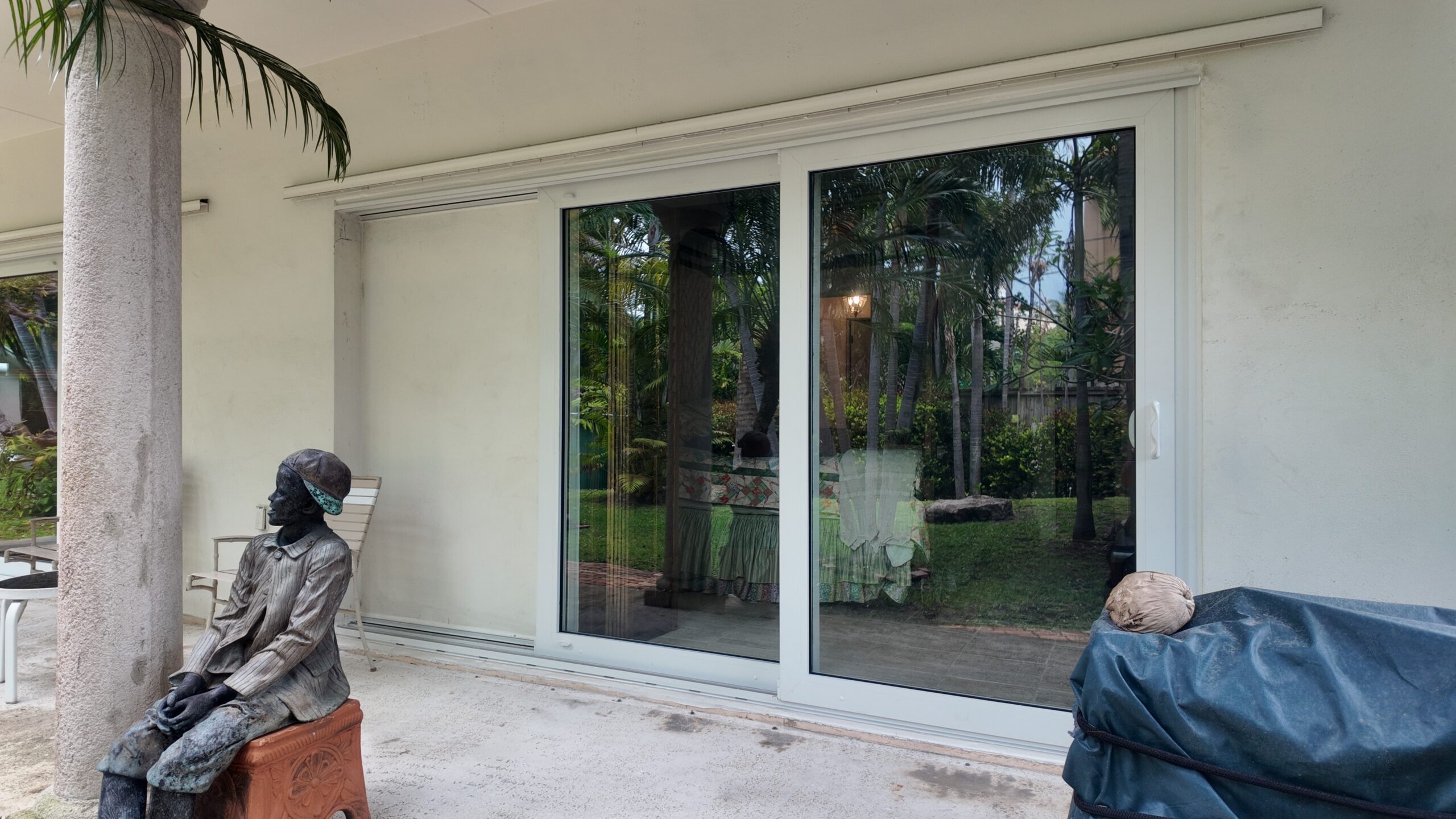
The “building envelope” is the technical term for every surface that separates the inside of your home from the outside: the roof, exterior walls, windows, doors, and any penetrations (vents, utility entries). In a hurricane, the envelope works like the hull of a ship — it either holds pressure or it doesn’t.
Structural engineers describe what happens when an opening fails as a sudden internal pressurization event. Wind enters through the failed opening, pressure inside the home rises dramatically, and the roof — which is held down by negative pressure differential — can no longer resist uplift. This is why post-hurricane surveys routinely find that roofs fail at the edges and corners first: those are the points of highest uplift load, and they are also where aging materials, improperly installed flashing, or missing hurricane straps create vulnerabilities.
The interdependence works in all directions:
- A weak window undermines a strong roof. If a bedroom window fails, internal pressure increases and pushes outward on the roof deck.
- A compromised roof edge undermines strong windows. If flashing fails or the roof deck lifts at the perimeter, the wall-to-roof connection degrades and the window frame can rack out of square.
- A single non-impact door in an otherwise impact home creates the same risk as no impact protection at all. Insurance underwriters and wind-mitigation inspectors treat mixed-compliance homes accordingly.
Wind-mitigation inspectors evaluate your home on a form that scores roof covering, roof deck attachment, roof-to-wall connection, roof shape, opening protection, and secondary water resistance — separately and together. A home with excellent roof deck attachment but no opening protection scores poorly and pays accordingly in insurance premiums.
| Building Envelope Component | Primary Failure Mode in HVHZ | Upgrade That Addresses It |
|---|---|---|
| Roof covering (shingles/tile/metal) | Blow-off, delamination, uplift | Code-compliant re-roof with secondary water barrier |
| Roof deck attachment | Ring-shank nail pull-through, OSB delamination | Re-nail to code; full deck replacement where needed |
| Roof-to-wall connection | Strap pull-out, toe-nail failure | Hurricane strap installation (GC scope) |
| Windows & doors | Glazing failure, frame racking, pressure spike | Impact-rated openings with valid NOA |
| Secondary water resistance | Water infiltration after covering loss | Full-deck peel-and-stick underlayment |
Piecemeal vs. Whole-Home
Upgrading One Trade at a Time vs. Planning the Whole Envelope Together
Both approaches can eventually produce a protected home — but the sequencing and coordination costs differ significantly.
| Approach | Typical Outcome | Risk Period | Permit Coordination |
|---|---|---|---|
| Piecemeal (roof one year, windows the next) | Partial coverage for 1–3 years; mixed compliance on wind-mit form | Extended — home is not fully protected until final trade is complete | Multiple separate permits; possible re-inspection conflicts |
| Whole-envelope plan (roof + windows + doors scoped together) | Full opening protection achieved in one project cycle | Compressed — protection gap is the install window only | Single general contractor scope; permits coordinated in sequence |
The piecemeal path is not wrong if budget genuinely requires it — but it should be a plan, not an accident. The homeowner who replaces windows this year and plans the roof replacement for next year has a clear timeline. The homeowner who defers both because “the next storm will miss us” is the one facing emergency repairs after a direct hit.
Why Scope Coherence Matters
One Contractor Authorized Across All Four Trades
A licensed contractor, not a lead aggregator — authorized across roofing, windows, doors, and structural scope.
“A homeowner shouldn’t need three different contractors arguing over whose scope caused the leak at the window-to-roof transition. One authorized scope means one point of accountability.”
Darryl Rosenbaum
President, Bigfoot Windows & Roofing
When a roofing project uncovers that the roof-to-wall connection relies on toe-nails rather than rated hurricane straps, that is a structural finding — not just a roofing finding. A contractor authorized only to roof cannot legally direct the structural strap work. A Certified General Contractor (CGC1531370) can coordinate that scope in-house, keeping the permit, the sequencing, and the inspection trail under one authorized party. Homeowners do not need to hire a separate contractor to resolve structural items found during a re-roof.
What Goes Into a Whole-Home System
Matching the Right Materials to Each Part of the Envelope
Not every product marketed as “hurricane-rated” performs the same in South Florida conditions. Heat, UV, salt air, and the specific pressure demands of HVHZ all filter which materials hold up over time.
Windows and doors: Bigfoot installs Mr. Glass aluminum-frame impact windows and doors as the primary line. Aluminum frames are more time-tested in HVHZ heat, humidity, and UV exposure than vinyl alternatives. For homes where energy efficiency is a priority, thermally broken aluminum frames provide a thermal barrier without sacrificing the structural performance aluminum delivers. All Mr. Glass products carry Florida Product Approval; the Series 2500T door holds Miami-Dade NOA for both in-swing and out-swing configurations — an important distinction since many competing doors are tested and certified in only one direction. Learn more about impact window options and specifications.
Roofing: The right roof system for a South Florida home depends on the structure, HOA rules, insurance goals, and budget. GAF architectural shingles with the Wind Proven warranty (no maximum mph rating, not voided by named storms in the county) are appropriate for homes where shingles are the right call. Standing seam metal — fabricated on-site from 24-gauge steel with a clip system that allows thermal float — is the premium long-duration choice. Tile remains the HOA-preferred option in many Broward and Palm Beach communities; concrete and clay tile with proper underlayment and foam-set installation perform well in HVHZ. Florida SB 293 prohibits HOAs from blocking metal roofing or impact windows, so homeowners in deed-restricted communities have more options than they may realize.
How the Project Works
From Assessment to Final Inspection: What Whole-Envelope Planning Looks Like
- Whole-home assessment. A site visit evaluates the current roof age and condition, existing window and door product approvals, roof-to-wall connection type, and any structural items that surface during the walkthrough.
- Scope definition and sequencing. Roof and window work are permitted separately but sequenced so the roof-to-wall transition and flashing details are resolved before window frames are set into openings that touch the roof line.
- Permit pull and NOA verification. Every product installed in Miami-Dade or Broward is verified against its NOA before the permit is pulled. Products that do not hold valid HVHZ approval are not installed.
- Installation and structural scope. If hurricane strap upgrades or structural modifications are identified, those are handled under the Certified General Contractor license — not subbed out to a separate party.
- Wind-mitigation inspection. After installation, a licensed wind-mitigation inspector documents the completed improvements. The resulting report is submitted to the homeowner’s insurer and often produces a meaningful reduction in the wind premium. A new metal roof, fully code-compliant impact openings, and a secondary water barrier can each contribute to a lower rate. Homeowners interested in financing options for whole-envelope projects can review available financing programs, including PACE, which attaches to the property tax bill rather than requiring traditional credit approval.
Hurricane season doesn’t wait. Neither should your envelope assessment.
Impact window lead times run 6–14 weeks. Permit queues fill before named storms form. The time to plan is now.
Related Reading
Articles on Whole-Home Storm Protection
Related Articles

Written by Darryl Henry Rosenbaum, Founder of Bigfoot Windows & Roofing.
Darryl Henry Rosenbaum, doing business as Bigfoot Windows and Roofing, holds four active Florida licenses recognized by the Florida Department of Business and Professional Regulation (DBPR): Certified General Contractor (CGC1531370), Certified Residential Contractor (CRC1331693), Certified Roofing Contractor (CCC1333168), and Certified Specialty Contractor with a Glass & Glazing Specialty (SCC131153098).
Who We’re Not the Right Fit For
- Homeowners seeking the lowest-cost bid only. Bigfoot specifies NOA-compliant products and pulls permits on every job. If the goal is to avoid permit costs or use non-approved materials to lower the number, we are not the right contractor for that project.
- Buyers who need work completed in under three weeks. Impact window fabrication runs 6–14 weeks from order. We do not have an inventory of pre-made units. If you need emergency boarding after a storm, that is a different service.
- Homeowners whose project is limited to one small window or one door with no structural findings. Our model is built around whole-envelope planning. A single-unit replacement with no permit requirement may be better served by a smaller specialty shop.
- Commercial high-rise projects. Our licenses cover residential and light commercial scope. Large-scale commercial curtain wall or high-rise work is outside our current service model.
Frequently Asked Questions
How should I prepare my home for hurricane season in South Florida?
Start with an assessment of your building envelope — roof age and condition, window and door product approvals, and roof-to-wall connections. Replace any openings that lack valid impact ratings or HVHZ product approval. Plan roofing work before hurricane season begins; permit queues and fabrication lead times mean last-minute preparation is not realistic. A wind-mitigation inspection after upgrades documents the improvements for your insurer.
Why does my whole home need to work as one system?
Your home is a pressure vessel. When one opening fails in a hurricane, internal pressure spikes and the roof — held down by pressure differential — faces dramatically increased uplift forces. A single non-impact window in an otherwise protected home creates the same internal-pressure risk as having no impact protection at all. The Florida Building Code and HVHZ standards are designed around this physics.
What is the building envelope?
The building envelope is every surface that separates your home’s interior from the outside: the roof, exterior walls, windows, doors, and any penetrations. In hurricane engineering, it is evaluated as one integrated system. A weakness in any component — a worn roof edge, a non-impact door, an improperly flashed window — creates a vulnerability for the entire structure.
Can one weak window actually fail my whole home?
Yes — this is documented physics, not worst-case speculation. When wind breaches an opening, internal air pressure rises sharply. That spike pushes outward on the roof deck and wall panels simultaneously. Post-storm engineering surveys consistently find that homes with mixed opening protection (some impact, some not) experience the same catastrophic internal pressurization as homes with no impact protection. Every opening must meet the code standard for the system to work.
When should I upgrade my windows and roof before hurricane season?
Plan at least four to six months before June 1. Impact window fabrication typically runs 6–14 weeks from order confirmation, and permit review adds additional time in Miami-Dade and Broward. Roofing permit queues fill as the season approaches. Homeowners who begin planning in January or February have the most scheduling flexibility and the widest product availability.
Do I need both impact windows and a strong roof, or will one alone protect me?
Both are necessary for a fully protected envelope. A strong roof without impact-rated openings leaves your home vulnerable to the internal pressure spike that causes roof uplift. Impact windows without a code-compliant roof leave the structure exposed to blow-off and water intrusion after covering loss. Wind-mitigation inspectors and insurance underwriters score both categories separately — partial compliance produces partial premium benefits at best.