
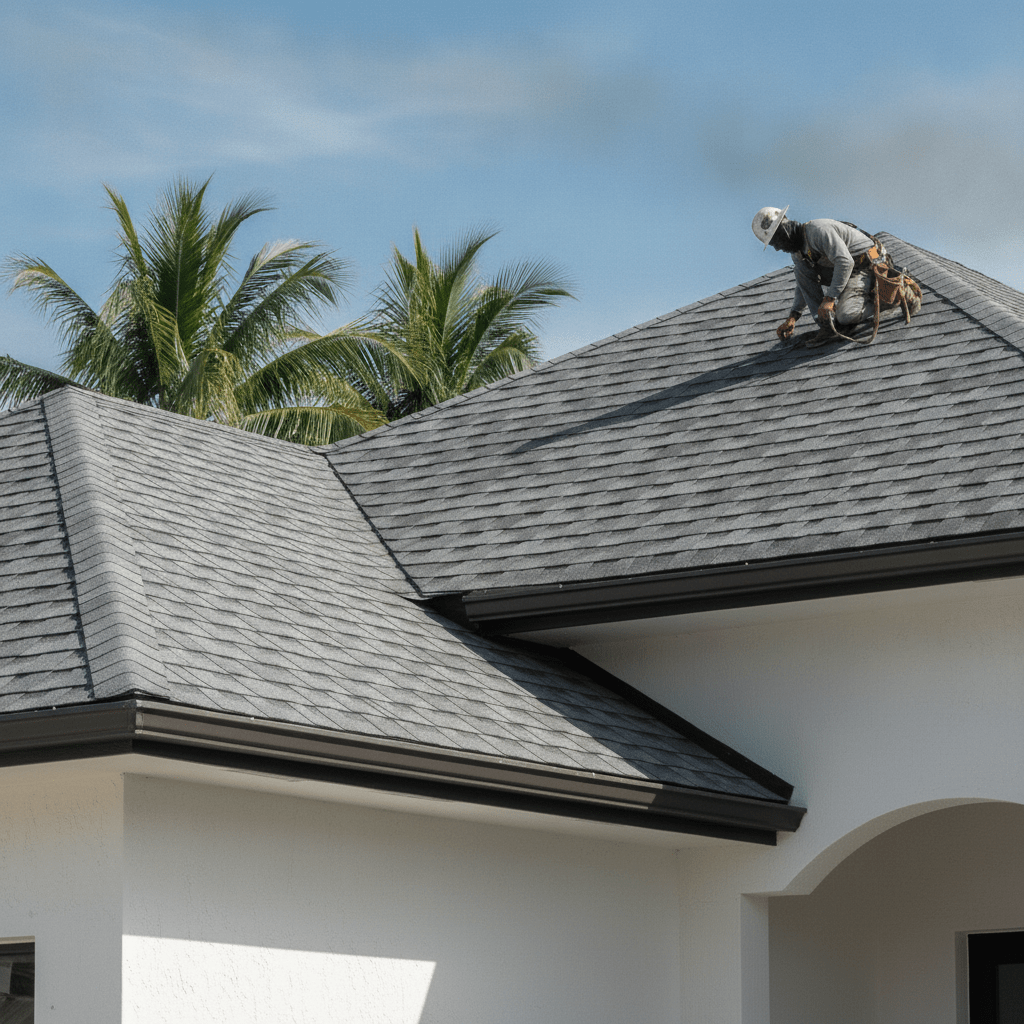
In Florida, liability for construction defects generally follows the permit. Whoever pulled the permit for a given scope of work — roofing, windows, or structural — is the licensed party accountable to the Florida Building Code for that scope. When two separate contractors each pull their own permits, each bears liability for their own work, and homeowners are left coordinating any dispute between them.
Key Takeaways
- Permit responsibility = liability responsibility under Florida law and the Florida Building Code.
- When multiple licensed contractors each pull separate permits, each is liable for only their own scope.
- Florida Statute 489 requires all contractors on a project to hold the appropriate license class for their trade; using an unlicensed sub shifts liability to the permit-holder.
- Chapter 558 of the Florida Statutes sets the pre-suit notice process when a construction defect spans overlapping scopes — critical in Miami-Dade HVHZ projects.
- An open permit during a renovation can complicate a homeowners insurance claim — especially with Citizens Property Insurance.
- One contractor holding a Certified General Contractor license can coordinate multi-trade scope under a single permit structure, reducing the accountability gap.
The Problem
Two Contractors, One Leak — and Nobody Takes Responsibility
The most common renovation nightmare in South Florida: you hire a roofer, then hire a window company. Both finish. Then the next rain event brings water inside — and each contractor points at the other.
This scenario plays out regularly in Miami-Dade and Broward. Your roofer says the water is coming through the window rough opening. Your window installer says the flashing detail around the roof deck is the source. Neither has a financial incentive to accept blame, and you’re stuck in the middle with a damaged interior and two open warranty claims going nowhere.
Understanding how Florida assigns liability when multiple contractors work on the same home is not just legal trivia — it directly affects your ability to get repairs done, file an insurance claim, and protect your property value in the HVHZ.
South Florida Context
Why Miami-Dade Makes Multi-Contractor Liability More Complex
HVHZ requirements and Miami-Dade Building Department inspection sequencing create overlapping responsibility windows between trades that don’t exist in most other jurisdictions.
The High Velocity Hurricane Zone (HVHZ) — covering Miami-Dade and Broward counties — operates under the strictest residential building code in the United States. When a roofing contractor pulls a permit in Miami-Dade, they are committing to a specific inspection sequence: roofing inspected before soffit and fascia close-out. That inspection sequence matters because it determines when one trade’s work is formally accepted and another trade’s scope begins.
If a window installer begins work on rough openings before the roofing inspection is finalized, there is an overlap window where responsibility for any resulting damage is genuinely ambiguous. The Miami-Dade Building Department will not resolve that ambiguity for you — they verify code compliance, not contract disputes.
Under Florida Statute 489, every contractor must hold the license class appropriate to the work being performed. A roofing contractor cannot legally supervise or take responsibility for window installation, and vice versa. If either party uses an unlicensed subcontractor to fill a gap in scope, liability for any defect from that sub’s work reverts to the permit-holder. This is not theoretical — it is the mechanism Florida uses to protect homeowners, and it matters enormously in HVHZ projects where code tolerance is near zero.
You can review your contractor’s license status directly through the Florida Department of Business and Professional Regulation (DBPR) licensing portal.
How Florida Law Works
Permit Responsibility, Chapter 558, and the Economic Loss Rule
Three legal frameworks govern who pays when a defect spans roofing and window scopes on the same South Florida project.
1. Permit Responsibility Under the Florida Building Code
Whoever pulls the permit is the responsible party for compliance with the Florida Building Code for that scope. This is the foundational rule. It means that if your roofer pulled a permit and the roofing installation fails inspection or causes water intrusion traceable to the roofing scope, your roofer bears that liability — regardless of what another contractor did nearby.
When two contractors each pull their own permits, each is independently responsible. There is no automatic mechanism that assigns shared liability; you would need to pursue each separately, or establish in court that one contractor’s work caused or contributed to the other’s failure.
2. Chapter 558 Pre-Suit Notice for Construction Defects
Florida’s Chapter 558 of the Florida Statutes establishes a mandatory pre-suit notice process for construction defect claims. Before you can sue a contractor for a defect, you must serve written notice identifying the alleged defect, giving the contractor an opportunity to inspect and respond. When damage spans overlapping scopes — say, water intrusion at the junction of a new roof deck and a new impact window rough opening — you may need to serve Chapter 558 notices on both contractors simultaneously. Each has typically 30–45 days depending on whether the project is residential or commercial and the defect category involved — verify the applicable window with a Florida construction attorney for your specific situation — to respond. Failing to follow this process can forfeit your right to pursue the claim.
3. The Economic Loss Rule and Its Limits in Construction
Florida’s economic loss rule historically limited tort claims when the parties had a contract — meaning you were generally limited to contract remedies rather than negligence claims for pure financial losses. Florida courts have carved out exceptions for construction defects, particularly where damage extends beyond the contracted work itself (for example, water intrusion from a defective roof that damages flooring and furniture not part of the roofing contract). This distinction matters when you are deciding whether to pursue a contractor in contract or in tort — and why having a construction attorney review overlapping-scope damage in South Florida is advisable before you choose a strategy.
| Legal Framework | What It Governs | Who It Protects |
|---|---|---|
| Florida Building Code / Permit Pull Rule | Which contractor is accountable for code compliance per scope | Code compliance, not private disputes |
| Florida Statute 489 (Licensing) | Required license class for each trade; unlicensed-sub liability shift | Homeowner — defect shifts to permit-holder |
| Chapter 558 F.S. Pre-Suit Notice | Mandatory notice before filing a construction defect lawsuit | Both parties — structured resolution opportunity |
| Economic Loss Rule (with construction exceptions) | Limits on tort claims vs. contract claims for pure financial loss | Contractor — until damage exceeds contracted scope |
Insurance Implications
Open Permits and Your Homeowners Insurance Claim in Miami-Dade
An open permit during a renovation can directly affect how Citizens Property Insurance or a private carrier handles a loss.
When you have an open roofing or window permit and a storm or water event occurs during construction, your insurance claim enters contested territory. Citizens Property Insurance — the largest insurer in Florida and the insurer of last resort in coastal markets — will scrutinize whether the loss occurred because of the existing structure or because of the incomplete work. If the damage is attributable to an open-scope renovation, Citizens may argue the contractor’s general liability policy is the primary coverage, not your homeowners policy.
Private carriers in South Florida take similar positions. The key documents your adjuster will request: the permit number, the inspection status at the time of loss, and any contractor general liability certificates of insurance (COIs). If a contractor cannot produce a current COI naming your property, that gap comes back to you.
What you can do before work begins:
- Collect a current certificate of insurance from every contractor — not just the GC.
- Confirm each permit number with the Miami-Dade Building Department before work starts.
- Document the condition of your home with photos on the day each contractor begins.
- Ask each contractor to provide a written scope that clearly defines where their work begins and ends.
For more on how roofing decisions affect insurance outcomes, see our guide on roofing costs and options in South Florida.
Why It Matters
One Permit Structure, One Accountable Party
A contractor experienced with structural modifications, roofing, and window installation under a single license framework eliminates the accountability gap that multi-contractor projects create.
When Bigfoot Windows & Roofing coordinates both roofing and impact window scope on the same project, the structural scope — including hurricane strap upgrades and header resizing that sometimes arise during window installation — can be addressed in-house under the Certified General Contractor license (CGC1531370). That means one permit structure, one point of contact, and a defined scope boundary that does not leave a seam between trades for water to find.
Florida licensed: CGC1531370 · CRC1331693 · CCC1333168 · SCC131153098
“The most expensive phone call I see homeowners make is the one where they’re trying to get their roofer and their window company to agree on who caused the leak. One accountable contractor is not a luxury — it’s protection.”
Founder & President, Bigfoot Windows & Roofing
How to Protect Yourself
Step-by-Step: Managing Liability Before, During, and After a Renovation
| Phase | Action | Why It Matters |
|---|---|---|
| Before signing | Verify license class for each trade via DBPR | Confirms the contractor can legally pull the permit for their scope |
| Before signing | Collect COIs from all contractors and subs | Establishes coverage chain if a loss occurs during work |
| Before work begins | Document existing conditions with photos | Baseline for any pre-existing vs. contractor-caused damage dispute |
| Contract stage | Define scope start and end points in writing per trade | Eliminates ambiguity at the scope boundary — the most common dispute origin |
| During work | Track permit numbers and inspection statuses | Key data for any insurance claim filed while permits are open |
| After completion | Confirm final inspection sign-off per permit | Closed permit = completed code compliance for that scope |
| If defects appear | Serve Chapter 558 pre-suit notice before filing any lawsuit | Required by Florida law; skipping it can forfeit your claim |
If your project is in Miami-Dade or Broward, the HVHZ inspection sequencing adds one more step: confirm roofing inspection is finalized before window rough-opening work closes in. The Miami-Dade Building Department’s inspection portal allows homeowners to verify inspection status by permit number. Keeping that record is straightforward and takes less than five minutes — but it can be decisive if a dispute arises later.
For projects that include impact door installation alongside roofing work, the same permit-boundary logic applies: each permitted scope has its own responsible party under Florida Statute 489.
One Contractor. One Permit Structure. Clear Accountability.
Bigfoot Windows & Roofing holds four active Florida licenses — roofing, windows, residential, and general contracting — so your project does not require a handoff between trades.
Who We’re Not the Right Fit For
Bigfoot Windows & Roofing is not the right contractor for every project or every homeowner. Here is an honest look at situations where we are probably not your best option:
- You need the lowest possible bid and price is the only criterion. We do not compete on the cheapest price. Our four-license structure, in-house structural scope, and HVHZ permitting experience carry overhead that a single-trade shop without a general contractor license does not have. If your decision is purely price-driven, a single-trade specialist may be a better fit for a simple, no-complexity job.
- You need work completed in under two weeks from contract signing. We cannot guarantee installation within two weeks of contract signing due to permitting and material delivery scheduling. Miami-Dade Building Department permit review for standard residential replacements typically takes two to six weeks. Contractors who promise faster timelines without addressing the permit queue are not being candid with you.
- You want a commercial high-rise window project. Our Mr. Glass Series 350 windows are rated for residential use only. Commercial and high-rise projects require Series 200 or Series 300 with project-specific design pressure verification — and some commercial scopes exceed what a residential contractor license covers. We will tell you this upfront.
- You have an active lawsuit against a prior contractor and need a contractor to testify as an expert witness. We do not provide expert-witness services. We build and install — we do not litigate.
FAQ
Frequently Asked Questions
If my roofer and window installer both worked on my house and I have a leak, who is responsible in Florida?
Responsibility follows the permit. Whoever pulled the permit for the scope closest to the water-intrusion point is the liable party under the Florida Building Code. If both scopes contributed, you may need to serve Chapter 558 pre-suit notices on both contractors and let the resolution process determine which scope caused the damage — or establish that both did. A construction attorney familiar with Miami-Dade HVHZ projects can help you sequence this correctly.
Does the general contractor or the subcontractor carry liability for a roofing defect in Miami-Dade?
If the general contractor pulled the roofing permit, the GC carries primary liability for code compliance — even if a roofing subcontractor did the physical work. Under Florida Statute 489, using an unlicensed sub does not shift liability away from the permit-holder; it makes the situation worse for the GC. If the sub pulled their own permit independently, the sub bears liability for their own scope.
What does the Florida Building Code say about who must pull the permit when multiple trades work on a South Florida home?
The Florida Building Code requires that whoever performs licensed work pull the permit for that specific scope — or that a contractor holding the appropriate license class for that scope pull it on their behalf. In HVHZ jurisdictions like Miami-Dade and Broward, each trade scope (roofing, windows, structural) typically requires a separate permit pulled by the appropriately licensed contractor for that work.
Can I sue both my roofing contractor and my window contractor if their scopes overlap and cause damage?
Yes, but Florida’s Chapter 558 requires you to serve written pre-suit notice to each contractor before filing a lawsuit. Each contractor then has typically 30–45 days depending on whether the project is residential or commercial and the defect category involved — verify the applicable window with a Florida construction attorney for your specific situation — to inspect and respond. If the damage genuinely spans both scopes, you may be pursuing both simultaneously. Florida’s economic loss rule has construction-defect exceptions, so tort claims may be available when damage extends beyond the contracted work itself. Consult a Florida construction attorney before filing.
How does an open permit affect my homeowners insurance claim in Miami-Dade during a renovation?
An open permit signals to your insurer that your home was in an altered state at the time of loss. Citizens Property Insurance and private carriers may argue the contractor’s general liability policy — not your homeowners policy — is the primary coverage if the damage relates to the open scope. Collect certificates of insurance from all contractors before work begins, track permit numbers, and photograph existing conditions. These documents protect your claim if a loss occurs mid-project.
Does having one contractor handle both roofing and windows reduce my liability risk as a homeowner?
Structurally, yes — when one contractor holds the appropriate licenses for both scopes, there is one permit-holder accountable for the work at the boundary between trades. There is no seam between two separately permitted scopes for a dispute to fall into. This is a structural advantage grounded in license authority, not a guarantee of a specific outcome. It does not replace the need for a clear written scope or for verifying the contractor’s licenses through DBPR.
What is a Notice of Commencement and when is it required in Florida?
A Notice of Commencement (NOC) is a recorded document required under Florida Statute 713.135(1)(d) for projects over $2,500. It must be filed before the first inspection. The NOC establishes the legal chain of lien rights for the project — it is one reason why having a single permit-pulling contractor simplifies lien exposure. On multi-contractor projects, each permitted scope may require its own NOC, and each contractor’s subcontractors retain independent lien rights under Florida Statute 713.06.
Schedule Your Free Estimate
Ready to get started? Request a free estimate — no phone call required.
Sources
- Florida Statute 489 — Contractor licensing requirements and license class authority: flsenate.gov
- Florida Statute 558 — Construction defect pre-suit notice process: flsenate.gov
- Florida Statute 713.135 — Notice of Commencement requirements: flsenate.gov
- Florida Statute 713.06 — Notice to Owner and lien rights: flsenate.gov
- DBPR Contractor License Verification: myfloridalicense.com
- Miami-Dade Building Department — Permit and Inspection Information: miamidade.gov/building
Don’t Leave a Liability Gap Between Your Roofer and Your Window Company
Bigfoot Windows & Roofing holds four active Florida licenses — so your roofing scope and your window scope can share a single accountable contractor. Financing options are also available for qualifying homeowners.
Request a free estimate — no phone call required Or call 786-886-2088