
How Much Do Metal Roofs Cost in Florida? | Bigfoot Windows & Roofing
Updated July 2026
Key Takeaways
- Standing seam metal roofs in Florida typically run $1,050–$1,300 per square (per 100 sq ft installed).
- Metal tile and stone-coated options range from $1,175–$1,400 per square installed.
- HVHZ requirements in Miami-Dade and Broward add material and inspection costs — budget accordingly.
- Roof pitch, tear-off of the existing roof, and structural conditions are the biggest price drivers beyond material choice.
- A qualifying metal roof paired with impact windows can reduce insurance premiums meaningfully — but no specific dollar savings can be guaranteed.
The South Florida Roofing Problem
Why Florida Homeowners Are Seriously Considering Metal Roofs Right Now
Asphalt shingles in South Florida last 12–15 years — not the 25–30 years they might last in a cooler climate. Heat, UV, salt air, and hurricanes accelerate aging fast. When it’s time to replace, metal is the question everyone asks.
If you’re pricing a metal roof in Florida — especially in Miami-Dade, Broward, or Palm Beach — you’ve already figured out that asphalt isn’t forever. You’re comparing long-term value against a higher upfront cost, and you want real numbers, not vague ranges.
This article gives you those numbers, explains every cost driver, and helps you decide whether metal is right for your specific situation. If it isn’t, we’ll say that too.
South Florida Context
Why Metal Roof Costs Are Higher in the HVHZ — and Why That’s the Point
The High Velocity Hurricane Zone (HVHZ) covers all of Miami-Dade and Broward counties. The Florida Building Code sets materially stricter standards here than anywhere else in the United States.
In the HVHZ, every roofing material must carry a valid Florida Product Approval or Miami-Dade Notice of Acceptance (NOA). Installation methods — fastener type, clip spacing, underlayment specification — are codified in detail and verified by a third-party inspection. That adds cost. It also means a roof installed to HVHZ code is engineered to perform in conditions most of the country will never see.
Within 2 miles of the coast, materials must also meet additional corrosion resistance requirements. Galvalume steel, for example, is generally excluded from direct coastal applications; painted aluminum or steel with appropriate coastal finishes is the spec of choice. A contractor who skips this distinction is exposing your home — and your warranty — to a problem you won’t discover until after the next storm.
Florida also requires permits for all roof replacements. There are no permit exemptions for routine re-roofing. This is not optional, and the cost of the permit and inspection is part of every legitimate bid you receive.
Cost Breakdown
Metal Roof Pricing in Florida: What to Expect by Material Type
All prices below are installed cost per square (per 100 square feet) and reflect South Florida market conditions as of mid-2026. Ranges reflect variation in roof complexity, pitch, tear-off requirements, and permit costs.
| Metal Roof Type | Installed Cost per Square | Typical Lifespan (FL) | HVHZ Compatible |
|---|---|---|---|
| Standing Seam Steel (Englert or Metal Alliance) | $1,050 – $1,300 | 40–50+ years | Yes (with correct clip/NOA) |
| Metal Tile / Stone-Coated Steel | $1,175 – $1,400 | Lifetime warranty | Yes |
| Flat Roofing (TPO / Membrane) | $800 – $1,400 | 20–30 years | Yes |
| Asphalt Shingle (for comparison) | $750 – $850 | 12–15 years (FL) | Yes (product-dependent) |
Important range note: A simple single-story hip roof on a 2,000 sq ft home sits at the lower end. A multi-gable two-story roof with complex valleys, penetrations, and a steep pitch will sit at the upper end — or above it. Never accept a per-square quote without knowing which variables apply to your home.
What Drives the Price Beyond Square Footage
Square footage gets you to a ballpark. These factors move you within — or beyond — that range:
| Cost Driver | Why It Matters | Typical Impact |
|---|---|---|
| Roof pitch (steep slope) | Steeper roofs require more labor time, safety rigging, and slower panel placement | Moderate to high |
| Roof complexity (valleys, hips, penetrations) | Each penetration and valley requires custom flashing and more cut panels = more waste and labor | Moderate to high |
| Tear-off and disposal | Removing an existing tile or metal roof costs more than removing asphalt; two-layer tear-offs cost more still | Moderate |
| Structural condition | Rotted decking, missing hurricane straps, or substandard sheathing found during tear-off must be remediated before installation | Variable — can be significant |
| HVHZ clip and fastener spec | Manufacturer-approved clips at the spacing its product approval specifies vs. knockoff clips — inspection-fail risk with non-stamped hardware | Low per clip, high if roof fails inspection |
| Underlayment specification | Full-deck peel-and-stick qualifies as a secondary water barrier for insurance; 30-lb felt does not | Low upfront, meaningful insurance impact |
| Permit and inspection fees | County-specific; Miami-Dade permit fees differ from Palm Beach or Broward | Low to moderate |
One structural cost driver that surprises homeowners: when a tear-off reveals inadequate hurricane straps or deteriorated decking, those items must be corrected before new roofing can be installed. Because Bigfoot holds a Certified General Contractor (CGC1531370) license in addition to the Certified Roofing Contractor (CCC1333168), structural remediation — hurricane strap upgrades, decking replacement, code-driven structural scope — can be handled in the same project without bringing in a separate contractor. That keeps coordination tight and reduces the number of parties who need to be on-site and sign off before the inspector arrives.
Material Comparison
Standing Seam vs. Metal Tile vs. Stone-Coated: Which Is Right for Your Home?
| Feature | Standing Seam | Stone-Coated Steel (Unified Steel) | Metal Tile (Barrel/Flat) |
|---|---|---|---|
| HOA Appearance Approval | Modern / commercial look — some HOAs restrict | Mimics tile — HOA-friendly | Matches barrel tile — HOA-friendly |
| Wind Resistance | Highest — continuous panel, no seams | VSH-rated; no named storm exclusion | Poly Set foam: 180 mph; mechanical: 160 mph |
| Warranty | Standing seam: set by the panel manufacturer; listed on your proposal | Lifetime | Lifetime (product-dependent) |
| Cost Range (per sq) | $1,050 – $1,300 | $1,175 – $1,400 | $1,175 – $1,400 |
| Installed Weight | Lightest | Moderate | Moderate |
| Named Storm Exclusion | None (clip system) | None | Check warranty language carefully |
When standing seam is the better fit: Modern architecture, flat or low-slope sections, maximum wind resistance as the top priority, or when the homeowner has no HOA restriction on exposed metal panels.
When stone-coated or metal tile is the better fit: HOA requires a tile appearance; homeowner wants the look of traditional barrel tile with the weight and wind performance of metal; concrete tile was previously installed and the structure is already rated for tile weight.
Note on Florida SB 293: HOAs cannot legally prohibit metal roofing or impact windows in Florida. If an HOA has told you metal is not permitted, that restriction is not enforceable under current state law — but aesthetic guidelines (color, profile) may still apply.
Why Licensing Matters on a Metal Roof Project
A Certified Roofing Contractor — Not a Lead Aggregator
Metal roofing in the HVHZ is not a commodity installation. The clip spec, the NOA, the underlayment, and the permit are all audited. Who signs the permit matters.
“The clip spec on a standing seam roof is not optional. We use manufacturer-approved clips at the correct spacing because that’s what the NOA requires and what the inspector checks. Knockoff clips fail inspection and the homeowner pays to redo the roof.”
Darryl Rosenbaum
President, Bigfoot Windows & Roofing
Materials We Install
The Metal Roofing Products Bigfoot Specifies for South Florida
Not every metal roofing product is approved for the HVHZ. Not every panel system handles Florida’s thermal expansion the same way. Here is what we actually install and why.
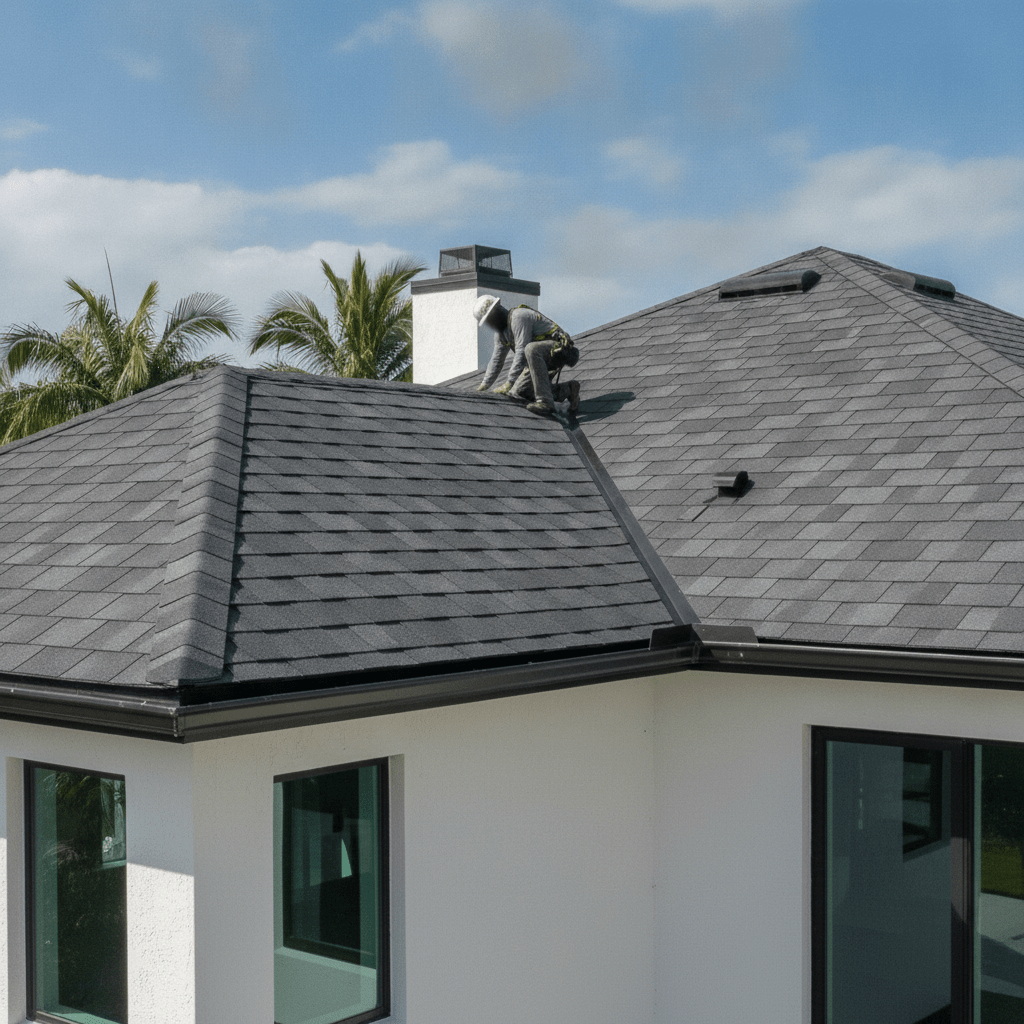
Englert or Metal Alliance standing seam: Panels are fabricated custom and roll-formed on-site from 24-gauge Galvalume or aluminum. Each panel runs one continuous piece from ridge to eave — no horizontal seams, which is a structural advantage in a hurricane event. The Kaner multi-coat proprietary paint system outperforms single-coat competitor paint in UV and salt-air exposure. The clip system uses the manufacturer’s approved clips, at the spacing its product approval specifies — the specific hardware the NOA references. Using non-stamped clips is a common shortcut that fails inspection; when it does, the homeowner bears the cost of a full redo.
Westlake / Unified Steel stone-coated: VSH-rated wind resistance. Critically, Unified Steel’s warranty carries no named-storm exclusion and no saltwater exclusion — two clauses that appear in some competing products’ warranty language and that can leave a Florida homeowner without coverage after the exact event they installed the roof to survive.
GAF shingle system (for comparison): Where the project calls for shingles rather than metal, Bigfoot holds GAF Certified Plus certification. The GAF System Plus warranty (50 years, non-prorated, covers shingles, labor, tear-off, and accessories) is available on qualifying installations. The GAF Wind Proven warranty carries no maximum mph limit and is not voided by a named storm making landfall in your county — a meaningful distinction from most competitor shingle warranties capped at 130 mph.
What we do not install: Galvalume steel in direct coastal applications (within 2 miles of salt water) — the combination of Galvalume and salt air accelerates corrosion in a way that voids manufacturer warranties. If a bid you’ve received specifies plain Galvalume for a coastal home, ask the contractor about their coastal finish spec before signing.
For homeowners also considering impact windows and doors as part of the same project, having a contractor with the authority to coordinate both trades under one permit set simplifies the inspection process and eliminates the scheduling conflicts that arise when two separate specialty contractors are working the same job.
What to Expect
The Metal Roof Installation Process in Miami-Dade and Broward
Understanding the sequence helps you evaluate contractor bids and know what is and is not normal.
- Estimate and scope: A thorough estimate requires a site visit, not just satellite imagery. Pitch, penetrations, existing condition, and structural findings all affect final price. Get a written scope before comparing bids.
- Permit application: Your contractor pulls the permit. You should see a permit number before installation begins. If a contractor suggests starting without a permit, stop.
- Tear-off and inspection: Existing roofing is removed and the deck is inspected. Any rotted sheathing, inadequate hurricane straps, or code-deficient structural conditions are documented and addressed at this stage. Because Bigfoot holds a Certified General Contractor license (CGC1531370), structural scope — including hurricane strap upgrades — can be handled in-house rather than requiring a separate contractor.
- Underlayment installation: Full-deck peel-and-stick underlayment qualifies as a secondary water barrier for insurance purposes; 30-lb felt does not. This is a decision made at the start of the job, not after.
- Panel fabrication and installation: Englert or Metal Alliance panels are roll-formed on-site to the exact run length. Clips are installed at specified spacing. Panels are set and locked.
- Inspection: County inspector verifies clip spec, underlayment, and fastener pattern against the NOA. This is mandatory and non-negotiable in the HVHZ.
- Final walk-through: Flashing, trim, and penetration seals are reviewed. You receive warranty documentation and the closed permit record.
Get a Written Metal Roof Estimate for Your South Florida Home
No satellite guesses. A real site visit, a real scope, and a real number — before you commit to anything.
Or call us directly: 786-886-2088
Related Articles
Who We’re Not the Right Fit For
Honest answers matter more than winning every bid. Here are situations where Bigfoot Windows & Roofing is probably not your best match:
- Budget-first, lowest-bid projects: Metal roofing to HVHZ code requires manufacturer-approved clips, proper underlayment, and a permit with a real inspection. That is not the cheapest path. If the primary goal is the lowest number on the page, a different contractor will be more comfortable cutting in places we won’t.
- Commercial high-rise or multi-story condo buildings: Our residential and roofing licenses cover residential scope. Large-scale commercial roofing projects on high-rise structures fall outside what we take on.
- Homeowners who want to skip the permit: Every roof replacement in Florida requires a permit. We do not install without one. If a contractor offers to skip the permit to reduce cost, the risk lands entirely on the homeowner at resale or claim time.
- Projects in counties outside South Florida: We serve Miami-Dade, Broward, and Palm Beach. Projects farther north or on the Gulf Coast are outside our service area.
- Insurance claim supplement / public adjuster work only: We do not act as a public adjuster. If you are in active dispute with your insurer and need an advocate, a licensed public adjuster is the right first call. We can install once scope and funding are settled.
Common Questions
Frequently Asked Questions
Are metal roofs worth the investment in Miami-Dade’s hurricane zone?
For most South Florida homeowners, yes — when the total cost of ownership is considered. Asphalt shingles in South Florida last 12–15 years before heat and UV degrade them. A standing seam metal roof is rated for 40–50 years or more. The higher upfront cost is offset by fewer replacement cycles, lower maintenance, and meaningful insurance premium reductions on qualifying homes after a wind mitigation inspection.
What type of metal roof is most durable for South Florida’s heat and humidity?
Standing seam steel with a multi-coat paint system and correct coastal finish performs best in Miami-Dade and Broward’s salt-air environment. Galvalume steel without a protective coating is generally excluded from direct coastal applications within 2 miles of the water. Stone-coated steel with a VSH wind rating and no named-storm warranty exclusion (such as Unified Steel) is a strong second option, particularly when a tile appearance is required.
How much can a metal roof save me on home insurance in Florida?
Specific savings vary by insurer, policy, home age, and wind mitigation results — no contractor can guarantee a dollar figure. A new metal roof that passes a wind mitigation inspection typically qualifies for credits on the opening protection, roof covering, and roof deck attachment categories. Some homeowners see significant premium reductions. Get a wind mitigation inspection after installation and share the results with your insurance agent to find out what applies to your policy.
What is the typical lifespan of a metal roof in Florida?
A properly installed standing seam metal roof in South Florida is rated for 40–50 years or more. Stone-coated steel products typically carry lifetime warranties. Actual lifespan depends on installation quality, coastal exposure, and maintenance. The biggest lifespan risk is installation error — incorrect clip spacing, inadequate underlayment, or improper flashing — not the material itself.
Do metal roofs increase home value in South Florida?
Generally yes, for two reasons. First, a newer metal roof removes a known inspection concern for buyers and lenders — older roofs over 20 years can be difficult to insure in Florida’s current market. Second, the insurance premium advantage of a metal roof is transferable to the new owner, which is a tangible financial benefit that sophisticated buyers price in. Specific value increase figures vary by market and home; a licensed appraiser is the right source for a number tied to your property.
Can I finance a metal roof replacement in Florida?
Yes. PACE financing (paid through your property tax bill, not a bank loan) is one option — current rates are approximately 9.49%, and a 20-year term produces the lowest monthly payment. A $15,000 project at 20 years runs roughly $173 per month. There is no prepayment penalty and no credit score impact. The My Safe Florida Home grant program offers up to $10,000 for qualifying homeowners and can be stacked with PACE financing. Consult your CPA regarding any potential tax benefits — we do not advise on tax matters.
Does Florida law allow HOAs to prohibit metal roofing?
No. Florida SB 293 prohibits HOAs from banning metal roofing and impact windows. An HOA can still regulate the aesthetic profile and color of a metal roof — but a blanket prohibition on metal roofing as a material is not enforceable under current Florida law. If your HOA has told you metal is not allowed, verify with a Florida real estate attorney before walking away from the option.
Sources
- Florida Building Code — Existing Building (7th Edition) — roofing replacement permit requirements and HVHZ material standards.
- Florida Senate Bill 293 (2023) — HOA restrictions on roofing and fenestration materials.
- GAF Wind Proven Warranty terms — no maximum mph, not voided by named storm county landfall.
- Unified Steel Stone Coated warranty documentation — VSH rating, no named-storm exclusion.
- My Safe Florida Home Program — grant eligibility and funding amounts (myfloridacfo.com).
Ready to Get a Real Number on Your Metal Roof?
We visit the property, measure the actual scope, and give you a written estimate — not a satellite guess. Serving Miami-Dade, Broward, and Palm Beach.
Prefer to call? 786-886-2088
Florida licensed: CGC1531370 · CRC1331693 · CCC1333168 · SCC131153098