Impact Windows and Home Value in South Florida: The Math
Yes — impact windows raise home value in South Florida. Nationally, window replacement typically recovers roughly two-thirds of its cost at resale, and in HVHZ zip codes across Miami-Dade and Broward we routinely see stronger recovery. Two drivers do the work: documented wind-mitigation insurance credits and heavy buyer preference for homes that already meet code.
What Impact Windows Actually Add to a South Florida Home’s Value
When appraisers and buyers evaluate impact windows home value South Florida gains, three concrete mechanisms show up in the math:
- Insurance-adjusted carrying cost. A buyer’s agent runs an insurance quote before closing. A home with permitted, Miami-Dade NOA-approved openings quotes hundreds to thousands of dollars per year cheaper than the identical home without them. Lower carrying cost supports a higher sale price.
- Deal survival. In today’s Florida insurance market, some carriers decline to write new policies on homes with unprotected openings. Impact windows keep your buyer pool full instead of shrinking it to cash buyers willing to self-insure.
- Direct resale recovery. Industry cost-vs-value research has for years put replacement windows among the top-recovering exterior projects, commonly in the 60–75% range of cost recovered at resale. That national figure does not price in Florida’s insurance dynamics, which is why the effective number here trends higher.
So do impact windows increase home value? Here, they also protect the sale itself.
Insurance Savings by the Numbers: OIR-B1-1802 Wind Mitigation Credits
Florida law (s. 627.0629, F.S.) requires insurers to offer premium credits for construction features that reduce wind loss. Those features are documented on the OIR-B1-1802 uniform wind mitigation inspection form. The line that matters for windows is Opening Protection: to earn the top credit tier, every glazed and non-glazed opening — windows, doors, garage door, skylights — must be protected to a Miami-Dade-approved impact standard.
The credit applies to the wind portion of your premium, which in Miami-Dade and Broward is usually the majority of the bill. How big can the swing be? In our sit-down with an insurance expert on the Bigfoot Windows & Roofing YouTube channel, he re-quoted the same Miami house two ways: with no wind-mitigation credits (older roof, basic truss attachments) the annual premium came in at over $9,000; with the full credit stack documented, the same policy dropped to about $3,000 — roughly a $6,600-per-year difference, driven mostly by whether the home meets the post-2002 Florida Building Code and can prove it with permits. Your numbers will vary with the home’s value, carrier, and other mitigation features (roof shape, roof-to-wall attachment, roof deck) — but that is the mechanism every Miami-Dade underwriter runs.
Two practical notes: partial protection earns partial or no credit — one unprotected garage door can forfeit the entire opening-protection line — and the credit only exists once a licensed inspector files the 1802 with your carrier. We hand every customer the closed-permit documentation an inspector needs.
What Impact Windows Cost Per Opening — and What Comes Back at Resale
Real pricing, from the estimates we write daily as a licensed contractor (CGC1531370):
- Standard bedroom/bath windows: roughly $900–$1,500 per opening, installed, permitted, and inspected.
- Larger horizontal rollers and picture windows: roughly $1,400–$2,500 per opening.
- Sliding glass doors: typically $3,000–$6,500+ depending on width and panel count.
- Typical whole-home project (12–18 openings): most land between $18,000 and $45,000.
Against that spend, the return stacks in three layers: resale recovery in the 60–75%+ range, annual insurance savings that compound every year you own the home, and measurable cooling savings (below). That is the honest impact window installation cost vs value picture: any hurricane impact windows ROI conversation must include the insurance line, not just the appraisal.
What a Typical Miami-Dade Project Looks Like: Costs, Credits, and Outcome
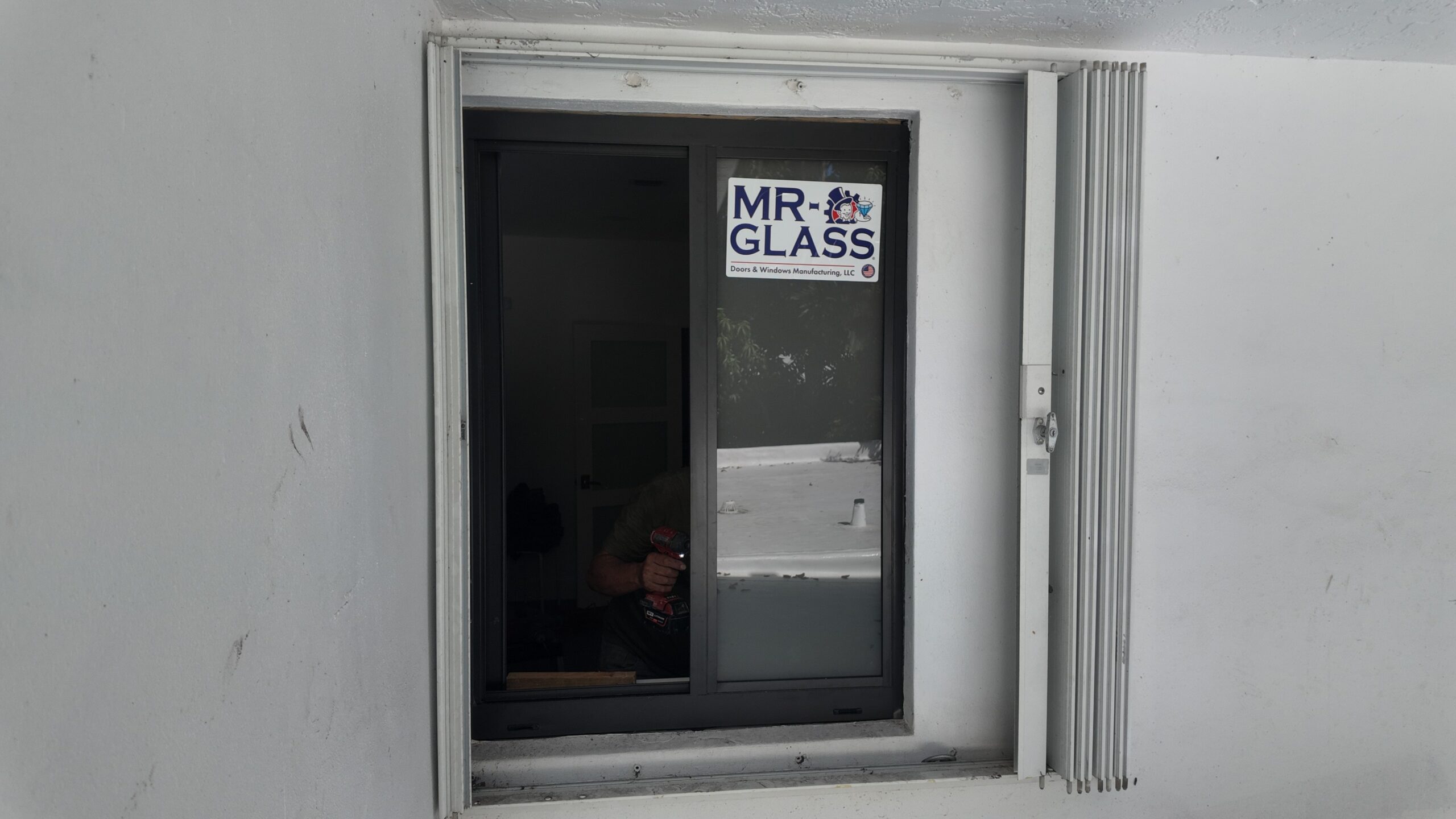
A representative scenario for the projects we see across unincorporated Miami-Dade: an older CBS ranch home with original openings, replacing roughly 12–18 windows plus a sliding glass door — all impact, all NOA-listed product. Based on the per-opening pricing above, a project of that scope generally lands in the $25,000–$35,000 range including permit, engineering, installation, and final inspection.
The typical arc: permit approval in roughly 2–6 weeks depending on the municipality, installation completed in a few working days, and final inspection passing on the first visit when the product labels and anchoring match the NOA. A post-project wind mitigation inspection that moves the opening-protection line to the top credit tier commonly trims the renewal premium by several hundred to a couple thousand dollars per year — and the home then carries the documentation appraisers and buyers look for on day one.
HVHZ, NOA, and TAS 201/202/203: Why Miami-Dade Approval Drives Value
Miami-Dade and Broward sit in Florida’s High-Velocity Hurricane Zone (HVHZ), the strictest wind-borne-debris region in the Florida Building Code. Products installed here must hold a Miami-Dade NOA or a Florida Product Approval that covers HVHZ use, which means they passed TAS 201 (large-missile impact), TAS 202 (structural pressure), and TAS 203 (cyclic pressure) testing as a complete assembly — glass, frame, anchors, and all.
This is where value gets created or destroyed. HVHZ Miami-Dade NOA approved windows come with a paper trail: an NOA number tied to the exact product series, verifiable in the county’s public Product Control database, referenced on the permit, and confirmed at inspection. We install established NOA-listed lines — including PGT WinGuard, CGI, and ES Windows product families — and the NOA for your specific series and size is listed on your permit documents, not asserted from memory. A “hurricane window” without a current NOA or a Florida Product Approval that covers HVHZ use is, for HVHZ resale purposes, not an impact window. Appraisers know it, insurers know it, and buyer’s inspectors increasingly check it.
Impact Windows vs. Hurricane Shutters: Which Holds Value Long-Term?
Shutters can earn the same 1802 opening-protection credit for less money up front, so why does the impact windows vs hurricane shutters value comparison still favor glass? Because shutters only deliver value when deployed, and they deliver nothing the other 51 weeks a year. Impact windows provide 24/7 protection with no ladder work, plus laminated-glass security, noise reduction, UV filtering, and energy performance — and they present at resale as a finished, permanent upgrade rather than hardware in the garage. For impact windows resale value versus shutters, glass wins on every line except initial cost.
Energy Efficiency Gains That Show Up on Your FPL Bill
South Florida is Florida Energy Code Climate Zone 1 — one of the heaviest cooling loads in the country. Modern energy efficient hurricane windows Miami homeowners install today use laminated glass with low-E coatings and insulated frames that block a large share of solar heat gain compared to the single-pane aluminum windows still common in pre-2002 housing stock. Customers consistently report cooler west-facing rooms, less fading on floors and furniture, and a meaningful drop in summer FPL bills. Energy savings are the smallest of the three value layers, but the one you feel every month.
Permit Timelines: Miami vs. Hialeah vs. Unincorporated Miami-Dade
Permit timelines vary by municipality, and honest expectations matter. From our recent project files (timelines shift with department workload):
- City of Miami: typically 2–4 weeks for a straightforward like-for-like window permit.
- Hialeah: often the fastest of the three — commonly 1–3 weeks when the package is clean.
- Unincorporated Miami-Dade (county RER): typically 2–6 weeks, longer if structural revisions or size changes trigger additional review.
The single biggest driver of speed is submission quality: correct NOAs matched to opening sizes, proper anchor schedules, and complete energy forms. That is contractor work, and it is exactly where an unlicensed or out-of-county installer costs you months.
From Permit to Final Inspection: How Installation Works
- Measure and engineering: every opening measured, product series and NOA matched to size and design pressure.
- Permit submission: we pull the permit under our license — never a homeowner permit for our scope.
- Manufacturing lead time: usually 4–8 weeks for NOA-listed product, overlapping the permit clock.
- Installation: most whole-home jobs take 2–5 working days, openings sealed watertight every night.
- Final inspection: the municipal inspector verifies product labels and anchoring against the NOA; the closed permit becomes part of your home’s permanent value record.
An open or missing window permit surfaces in every title and lien search and can stall or kill a sale years later.
Who We’re Not the Right Fit For
We are a licensed impact window contractor Miami-Dade Broward homeowners hire for permitted, inspected, NOA-documented work — and that is not the cheapest way to buy windows. If you want uninstalled windows to self-install, a no-permit “weekend swap,” or a bare-minimum rental patch job, we are not your company, and we will say so at the estimate. We do not serve areas outside Miami-Dade and Broward. One more honest note: many window contracts today are sold by lead aggregators who resell your information. We are the installing contractor of record — the license on your contract is the license on your permit.
Frequently Asked Questions
Do impact windows increase home value in South Florida?
Yes. Replacement windows commonly recover 60–75% of cost at resale nationally, and in Miami-Dade and Broward the effective return runs higher because buyers also inherit lower insurance premiums and guaranteed insurability. Permitted, NOA-documented installations are a recognized value signal to appraisers and buyer’s inspectors.
How much can impact windows save on homeowners insurance in Miami-Dade or Broward?
With all openings protected, the wind-mitigation credit typically cuts the wind portion of the premium substantially — for most of our customers that translates to several hundred to a couple thousand dollars per year, depending on home value, carrier, and other mitigation features on the 1802 form.
Do impact windows qualify for a wind mitigation inspection discount?
Yes — via the Opening Protection section of the OIR-B1-1802 form. To earn the full credit, every opening (windows, doors, garage door, skylights) must be impact-rated. You then file the inspection report with your carrier; the credit is required by Florida law but not applied automatically.
Are impact windows a better long-term investment than hurricane shutters?
For most homeowners, yes. Shutters can earn similar insurance credits for less money up front, but impact windows add year-round security, noise, UV, and energy benefits, require no deployment before a storm, and present as a permanent upgrade at resale rather than removable hardware.
How long does an impact window permit take in Miami-Dade?
In our recent experience: roughly 1–3 weeks in Hialeah, 2–4 weeks in the City of Miami, and 2–6 weeks in unincorporated Miami-Dade, assuming a clean submission with correct NOAs and anchor schedules. Product lead time (4–8 weeks) usually overlaps the permit clock.
What is the cost per opening for HVHZ-rated impact windows?
Installed and permitted: roughly $900–$1,500 for standard windows, $1,400–$2,500 for large windows, and $3,000–$6,500+ for sliding glass doors. Most whole-home projects of 12–18 openings land between $18,000 and $45,000.
Related Articles
- Impact Windows vs. Hurricane Shutters: The Full HVHZ Comparison
- How the Miami-Dade NOA Process Works — and Why Your Permit Depends on It
- Wind Mitigation Inspections Explained: Reading Your OIR-B1-1802 Form
- What Impact Windows Cost in Miami-Dade and Broward: A Contractor’s Breakdown
Ready for a free estimate? Call 786-886-2088 or fill out our contact form.
Schedule Your Free Estimate
Ready to get started? Request a free estimate — no phone call required.