
How Much Does a Full Roof Replacement Cost in South Florida?
Last updated: July 2026 by the Bigfoot Windows & Roofing editorial team.
Key Takeaways
- Shingle roofs typically run $750–$850 per square (per 100 sq ft installed) in South Florida.
- Metal standing seam typically runs $1,050–$1,300 per square; tile runs $1,000–$1,350 per square.
- Roof complexity, deck condition, permit fees, and local HVHZ requirements drive the final number.
- Shingle roofs last 12–15 years in South Florida heat; metal and tile can last 40–50+ years.
- GAF Certified Plus certification and proper clip/fastener systems are material to Florida code compliance.
- Financing options — including PACE through property tax — can reduce up-front cost significantly.
The Problem
Why Roof Replacement Pricing in South Florida Is Confusing
Four quotes, four wildly different numbers — here is why.
If you have already called a few roofers, you have probably received quotes ranging from a wide low to a jaw-dropping high on the same house. That gap is not random. South Florida roofing pricing depends on material type, roof complexity, existing deck condition, permitting, hurricane-clip requirements, and whether the contractor is licensed to pull permits in Miami-Dade County. Miss any of those variables and a quote is just a guess.
This article breaks down the real cost drivers, gives you honest installed-price ranges by material, and explains what separates a compliant South Florida roof from one that will fail its inspection — or fail in a storm.
South Florida Context
Miami-Dade, HVHZ, and Why Your Roof Costs More Here
The strictest building code in the country applies to your home.
Miami-Dade and Broward counties sit inside the High Velocity Hurricane Zone (HVHZ) — the most stringent wind-load building code jurisdiction in the United States. Every roofing product installed here must carry a Miami-Dade Notice of Acceptance (NOA) or Florida Product Approval. That requirement alone eliminates low-cost builder-grade materials and drives minimum standards up compared to the rest of the country.
Salt air, sustained UV exposure, and a two-to-four-month hurricane season compound material degradation faster than in northern climates. A shingle roof that lasts 25 years in Ohio may last 12–15 years in South Florida. That shorter lifespan must factor into the value equation when comparing materials.
Citizens Insurance has also become a significant local cost driver: the insurer has been non-renewing policies on roofs 20–25 years and older. A roof replacement is sometimes not optional — it is required to maintain coverage. For more on protecting your home beyond the roof, see our guide on impact window options for South Florida homes.
Cost Education
South Florida Roof Replacement Cost by Material Type
Installed price per square (100 sq ft). Ranges reflect material + labor + permit.
| Material | Price Range per Square | Typical Lifespan (South FL) | HVHZ Compliant |
|---|---|---|---|
| Architectural Shingle (GAF) | $750 – $850 | 12 – 15 years | Yes (Miami-Dade NOA or a Florida Product Approval that covers HVHZ use required) |
| Metal Standing Seam (Englert or Metal Alliance) | $1,050 – $1,300 | 40 – 50+ years | Yes (stamped clips required) |
| Metal Tile / Stone-Coated (Westlake) | $1,175 – $1,400 | 50 years | Yes (VSH-rated) |
| Concrete / Clay Tile (Westlake Saxony, Barcelona) | $1,000 – $1,350 | 40 – 50 years | Yes (Miami-Dade NOA or a Florida Product Approval that covers HVHZ use required) |
| TPO Flat Roofing | $800 – $1,400 | 20 – 30 years | Yes (membrane type dependent) |
To put those ranges into a real-world estimate: a 2,000 sq ft footprint equals roughly 20 squares. A shingle reroof would typically land between $15,000 and $17,000 installed. A standing-seam metal roof on the same home would range from $21,000 to $26,000. These are representative ranges — final cost depends on the factors in the next section.
Interested in exploring financing so the cost does not have to be paid all at once? See our roofing financing options, including PACE programs paid through your property tax bill.
What Drives the Range
Key Cost Factors: What Raises or Lowers Your Final Quote
| Cost Factor | Low Impact | High Impact |
|---|---|---|
| Roof pitch / complexity | Low slope, simple hip | Steep pitch, multiple valleys, hips & ridges |
| Deck condition | Sound OSB/plywood | Rotted decking requiring partial or full replacement |
| Layers to remove | Single layer tear-off | Two or more layers (adds labor + disposal) |
| Hurricane straps / clips | Already installed and compliant | Missing or non-compliant — full re-strap required by code |
| Permit complexity | Standard residential | Historic district, HOA review, condo association approval |
| Secondary water barrier | Full-deck peel-and-stick (P&S) | 30-lb felt (does NOT qualify for insurance discount) |
| Roof size | Under 20 squares | Over 35 squares |
A note on secondary water barriers: Under the 2024 Florida Building Code, full-deck peel-and-stick underlayment is permitted and qualifies for an insurance secondary water barrier discount. Standard 30-lb felt does not qualify. Ask every bidder which underlayment they are specifying — this single line item affects both your insurance premium and your home’s resilience in a named storm.
On hurricane straps: If your home lacks compliant hurricane clips connecting the roof structure to the wall framing, a full replacement triggers a code requirement to install them. This is structural work that a roofing-only contractor may not be authorized to address. Bigfoot holds a Certified General Contractor (CGC1531370) license, which means structural tie-in work and code-required framing modifications can be handled within the same scope — you do not need to coordinate a separate structural contractor for that work.
Why It Matters Who You Hire
License Authority in a High-Velocity Hurricane Zone
A licensed contractor — not a lead aggregator.
“In HVHZ, the difference between a compliant roof and a non-compliant one is the inspector, the clip, and the product approval. Every one of those things is checked on every job we do.”
President, Bigfoot Windows & Roofing
Material Guidance
Which Roof Type Is Best for South Florida?
There is no single right answer — it depends on your budget, how long you plan to stay in the home, and your insurance situation. Here is how we frame the options for homeowners in Miami-Dade and Broward:
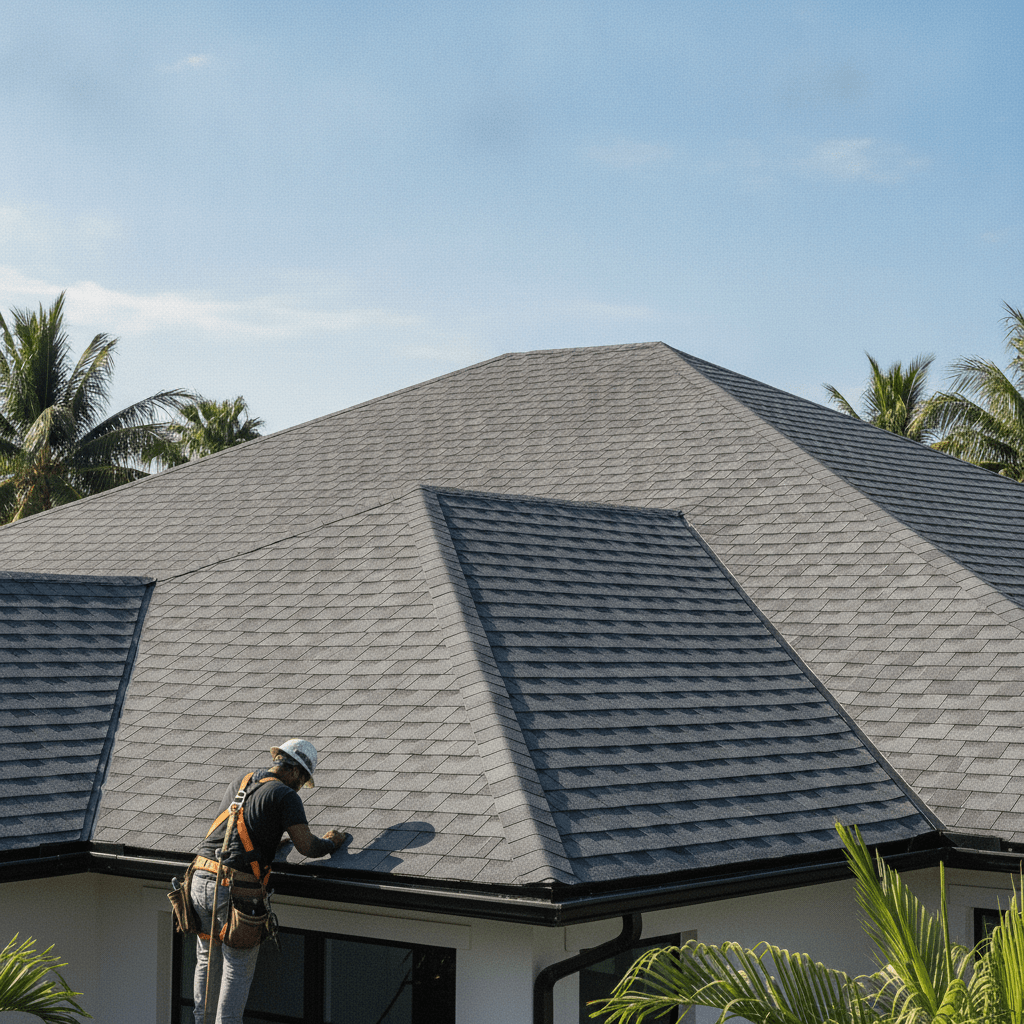
- Architectural shingle (GAF): Lowest installed cost. Best choice if budget is the primary constraint or if you plan to sell within 10 years. We install GAF shingles with Layer Lock technology — 1.81-inch nail line for accuracy — and Wind Proven warranty (no maximum mph, not voided by a named storm in your county). We hold GAF Certified Plus certification, and System Plus warranty (50-year non-prorated, covers shingles, labor, tear-off, and accessories) is available. Note: shingle lifespans in South Florida average 12–15 years due to heat, UV, and storm stress.
- Metal standing seam (Englert or Metal Alliance): Highest long-term value. Panels run continuously from ridge to eave — no horizontal seams — which is a structural advantage in hurricane-force winds. We use Englert or Metal Alliance 24-gauge Galvalume or aluminum with proprietary Kaner multi-coat paint and manufacturer-approved clips. The clip system allows thermal float, eliminating oil canning and buckling. Panels are fabricated on-site, custom per job.
- Tile (Westlake Saxony, Barcelona): Preferred by many HOAs and historically the dominant South Florida roof type. Concrete tile (Saxony 900 flat, Barcelona barrel) is the most popular. Westlake Unified Steel stone-coated tile carries a 50-year warranty with no named storm, saltwater, or act-of-God exclusion clauses.
- TPO flat roofing: Required on flat or low-slope sections. Cost range varies significantly based on whether tapered insulation, ISO board, or Dens Deck cover board is specified — ask the bidder to itemize.
For homeowners also considering storm protection upgrades at the same time, impact door replacement and impact window installation are often coordinated with roofing projects for a single-permit, single-mobilization efficiency.
The Process
What Happens After You Approve a Roof Replacement Estimate
- Scope confirmation: We measure the roof, inspect the deck, document existing conditions, and confirm the material specification. If structural items such as hurricane straps or deck rot are found, those are noted in writing before any work begins.
- Permit submittal: We pull the building permit with the applicable county — Miami-Dade, Broward, or Palm Beach. No permit, no job. Every licensed roofing contractor in Florida is required to pull a permit for a full replacement.
- Tear-off and deck inspection: The existing roof is removed and the deck is inspected. Any rotten or damaged decking is replaced and documented before new material goes down.
- Underlayment and secondary water barrier: Full-deck peel-and-stick is installed first if selected, followed by the specified product (shingle, metal, or tile).
- Final inspection: The county inspector verifies product approvals, clip/fastener compliance, and code adherence before the permit is closed.
Ready to get a straight-line estimate — no vague ranges, no bait-and-switch?
Keep Reading
Related Articles
Who We’re Not the Right Fit For
We want to be straight with you before you call:
- Homeowners seeking the absolute lowest bid: If price is the only criterion and you are comfortable with a contractor who does not pull permits or skips product-approval verification, we are not competitive on price with that contractor — and we are not trying to be.
- Projects under $8,000–$10,000 in total scope: Very small patch-and-repair jobs or single-square partial repairs are not a category we prioritize. A local licensed roofing repair specialist is a better fit for that scope.
- Homeowners who need work started within 48 hours: HVHZ permit timelines and product procurement mean we typically cannot mobilize on an emergency timeline. If you have active storm damage and need emergency tarping today, call your insurer first and find a 24-hour emergency service.
- Out-of-state investment property owners who prefer remote-only management: We do our best work when there is clear communication with someone who can make decisions locally. Fully absentee projects with no local point of contact tend to create friction on both sides.
Common Questions
Frequently Asked Questions
How much does a new roof cost in South Florida?
A full roof replacement in South Florida typically runs $750–$850 per square for architectural shingle, $1,050–$1,300 per square for metal standing seam, and $1,000–$1,350 per square for tile. On a 2,000 sq ft home (roughly 20 squares), expect $15,000–$17,000 for shingle and $21,000–$26,000 for metal. Final cost depends on roof complexity, deck condition, hurricane strap compliance, and permit requirements.
What is the best roof for South Florida?
Metal standing seam offers the best long-term value — 40–50+ year lifespan, superior wind resistance, no horizontal seams, and strong insurance premium reduction potential after a wind mitigation inspection. Tile is the traditional choice and HOA-preferred. Architectural shingle has the lowest upfront cost but the shortest lifespan (12–15 years) in South Florida’s heat and UV environment. The best choice depends on your budget and how long you plan to stay.
How long does a roof last in South Florida?
Lifespan varies by material. Architectural shingle: 12–15 years in South Florida due to intense UV, heat, and storm cycles. Concrete or clay tile: 40–50 years with proper maintenance. Metal standing seam: 40–50+ years. TPO flat roofing: 20–30 years. These are shorter than national averages because South Florida’s climate accelerates material degradation significantly compared to northern markets.
How long do shingle roofs last in South Florida?
Architectural shingle roofs typically last 12–15 years in South Florida — compared to 20–25 years in cooler, less storm-prone markets. Heat, UV exposure, and annual hurricane season stress accelerate granule loss and adhesive breakdown. GAF’s Wind Proven warranty (no maximum mph, not voided by named storms) and Layer Lock shingle technology improve durability, but the shorter replacement cycle is a real cost to factor into your material decision.
How long do tile roofs last in South Florida?
Concrete tile roofs (such as Westlake Saxony 900 flat or Barcelona barrel) typically last 40–50 years in South Florida with proper underlayment and maintenance. The tile itself is durable, but the underlayment beneath it — which must also meet HVHZ standards — has a shorter service life and may need replacement before the tile does. Clay tile has a similar lifespan but higher installed cost. Stone-coated metal tile (Westlake Unified Steel) carries a 50-year warranty with no named storm exclusions.
Can I use the My Safe Florida Home grant toward a roof replacement?
Yes. The My Safe Florida Home program offers up to $10,000 in matching grants for qualifying hardening improvements, which can include roof upgrades. The grant can be stacked with PACE financing — PACE is paid through your property tax bill, not a traditional loan, at approximately 9.49% with no prepayment penalty. Roofing and window PACE applications must be submitted separately. Consult your CPA regarding any potential tax implications; we do not provide tax advice.
Sources
- Florida Building Code, 8th Edition — HVHZ roofing requirements and permit standards.
- GAF Roofing — Layer Lock Technology and Wind Proven warranty program documentation.
- Westlake Royal Roofing Solutions — Unified Steel stone-coated warranty terms.
- Florida SB 293 — HOA restrictions on metal roofing and impact windows.
- My Safe Florida Home Program — FDEM grant eligibility and matching requirements.
Get a straight-line estimate for your South Florida roof replacement.
No vague ranges. No pressure. Just an honest scope review based on your actual home.