
Metal Tile Roof Price: Color & Shape Impact | Bigfoot Windows & Roofing
Last updated: July 2026 by the Bigfoot Windows & Roofing editorial team.
Key Takeaways
- Color adds $0–$150 per square for premium or custom finishes; standard palette colors cost the same.
- Barrel-profile and heavily textured shapes add 10–20% in labor over flat metal tile profiles.
- Cool roof–rated light colors can improve energy efficiency and may support wind-mitigation credits.
- HVHZ fastening requirements apply regardless of color or shape — compliance is never optional in Miami-Dade or Broward.
- Specialty or custom colors may add 2–6 weeks to material lead times in South Florida.
The Real Question
Does Picking a Color or Profile Actually Change What You Pay?
For most homeowners in Miami-Dade, the short answer is: color has a small impact; shape has a larger one.
When you start pricing a metal tile roof in South Florida, you will quickly notice that two quotes for what looks like the same product can differ by hundreds of dollars per square. Contractors sometimes blame “material costs” without explaining which material decision drove the gap. This article breaks that down specifically: how much does color add, how much does profile shape add, and what does neither one change at all?
The baseline price range for metal tile roofing in South Florida runs roughly $1,175–$1,400 per square (per 100 square feet installed). Where you land in that range depends on more variables than color alone — but color and shape are real line items, and South Florida homeowners deserve a clear explanation of both.
South Florida Context
Why HVHZ Rules and the Florida Climate Make Color & Shape Matter More Here
Miami-Dade and Broward counties sit inside the High Velocity Hurricane Zone (HVHZ) — the strictest residential building code jurisdiction in the United States. That matters for your metal tile choice in two specific ways:
- Product approval is profile-specific. A Florida Product Approval (FPA) number covers a specific panel shape, clip system, and fastening schedule. Swapping to a different profile, even with the same brand, may require a different approval number and a different fastening layout.
- Cool roof and energy code requirements. South Florida sits in ASHRAE Climate Zone 1A. The Florida Building Code sets solar reflectance and thermal emittance thresholds for low-slope and steep-slope roofing. A very dark metal tile on a qualifying roof surface may need an energy compliance pathway review depending on the project scope and the percentage of assessed value being altered.
Neither of these requirements adds cost by penalizing a color choice arbitrarily — but they do mean that a specialty dark color on certain roof configurations requires more documentation work, which translates to real project hours. Ask your contractor whether the color you want has a current FPA for your roof pitch before you fall in love with it.
Cost Breakdown
How Color Affects Metal Tile Roof Pricing
For most standard metal tile lines — including stone-coated steel profiles — colors within the manufacturer’s standard palette cost the same. You are choosing between terracotta, charcoal, slate gray, or aged copper from a pre-made stock, and those options carry identical material pricing.
Price differences appear in three scenarios:
- Custom or specialty colors: A color outside the standard palette typically requires a custom paint or coating run. Depending on minimum order quantity, this can add $50–$150 per square in material cost and 2–6 weeks to lead time. That lead time extension is real in the South Florida supply chain, especially post-storm season.
- Premium coating systems: Some homeowners request a Kynar-500-type fluoropolymer finish for superior UV and salt-air resistance — a legitimate concern within two miles of the coast. Premium factory coatings can add $75–$125 per square compared to standard polyester paint finishes. In a coastal environment, the durability difference is meaningful.
- Cool roof compliance upgrades: If your selected color does not meet the Florida Building Code’s solar reflectance index (SRI) threshold and your project triggers energy code compliance, you may need to select a different color or document an alternative compliance path. This is not common for steep-slope metal tile, but it does come up on low-slope or low-pitch sections.
| Color Scenario | Typical Material Adder | Lead Time Impact |
|---|---|---|
| Standard palette color | $0 | None |
| Premium cool-roof rated light color | $0–$50/sq | None to 1 week |
| Specialty / non-standard color | $50–$150/sq | 2–6 weeks |
| Kynar-500 or premium fluoropolymer coat | $75–$125/sq | 1–3 weeks |
How Shape (Profile) Affects Metal Tile Roof Pricing
Profile shape has a larger influence on installed cost than color does, primarily through labor complexity and product approval scope.
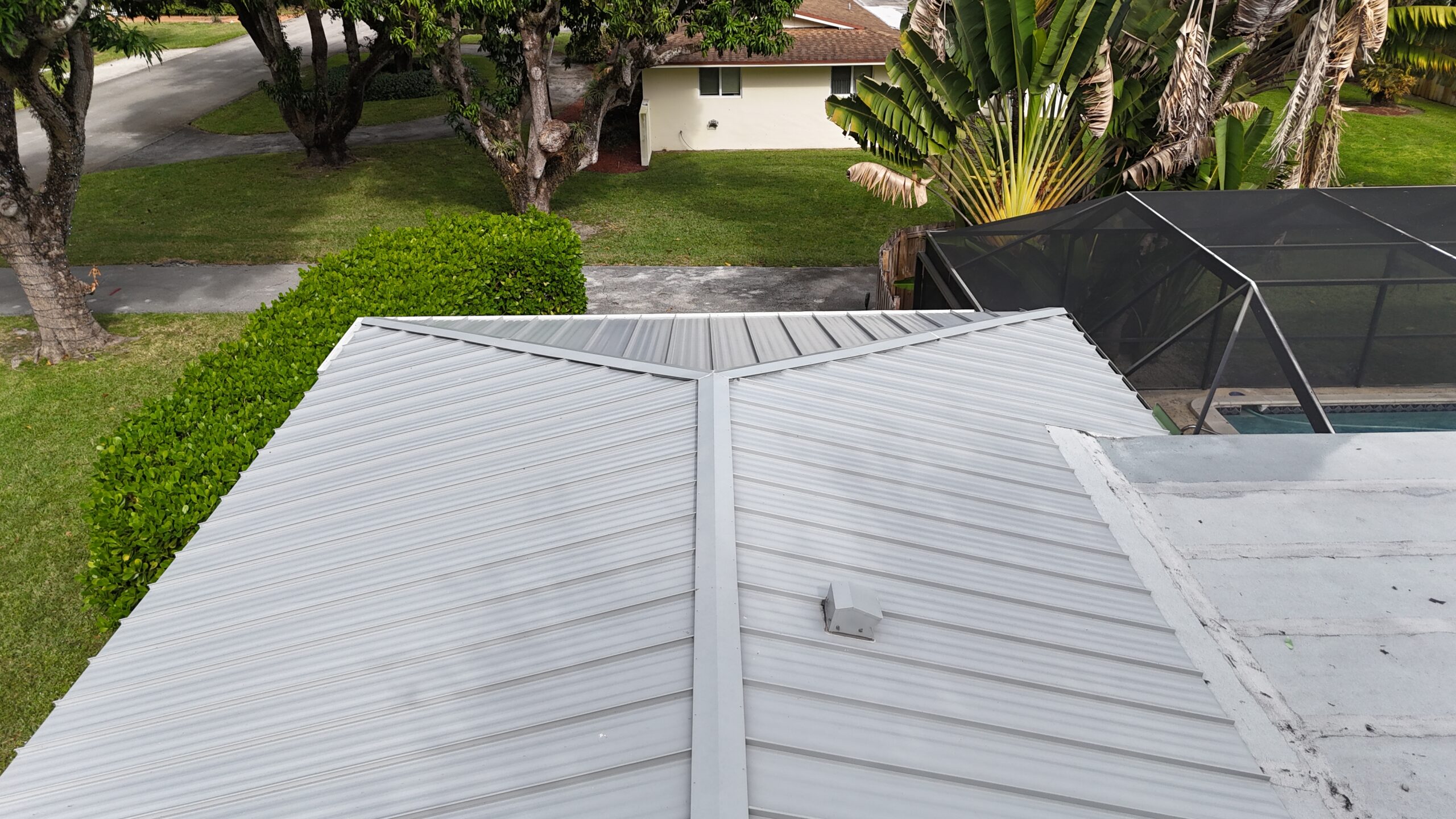
A flat or low-profile metal tile installs quickly and is forgiving on irregular hip and valley cuts. A barrel tile profile — the most popular shape in Southeast Florida — requires more precise cutting at ridges, hips, and rakes. Heavily embossed or three-dimensional stone-coated profiles add handling time because the texture increases the chance of coating damage during cutting if the installer is not careful.
In practical terms, a standard flat metal tile in South Florida installs at roughly the same labor rate as a composite shingle. A barrel-profile metal tile or a heavily textured stone-coated panel adds approximately 10–20% to the labor portion of the estimate. On a 30-square roof, labor might run $3,000–$4,500 on a flat tile and $3,300–$5,400 on a complex barrel profile — a real difference.
Comparison
Metal Tile Profile Shapes: Cost & Complexity Compared
| Profile Shape | Material Cost Range (per sq) | Labor Complexity | FPA Availability | Best For |
|---|---|---|---|---|
| Flat / low-profile | $1,175–$1,250 | Low | Widely available | Modern, contemporary homes |
| Barrel / S-curve | $1,200–$1,350 | Medium-High | Available; profile-specific | Mediterranean, Spanish-style homes |
| Stone-coated flat | $1,200–$1,300 | Low-Medium | Available | Shingle look, HOA neighborhoods |
| Stone-coated barrel | $1,250–$1,400 | Medium-High | Available; profile-specific | Tile-look, HOA neighborhoods |
| Custom / decorative profile | $1,350–$1,500+ | High | Verify before specifying | Unique architectural projects |
Note: ranges above are installed estimates per square (100 sq ft) in South Florida as of 2026. Actual pricing varies by roof complexity, tear-off requirements, and permit scope. Always request a line-item written estimate.
Why This Matters
A Licensed Contractor Who Reads the Approval Before the Color Swatch
Licensed contractor, not a lead aggregator.
“Color is the last decision, not the first. We confirm the product approval, the clip schedule, and the energy compliance pathway before the homeowner ever picks a swatch.”
President, Bigfoot Windows & Roofing
Because Bigfoot holds a Certified General Contractor (CGC1531370) license in addition to a Certified Roofing Contractor (CCC1333168) license, we can handle structural scope that a roofing-only contractor cannot legally take on. If a roof inspection reveals deteriorated sheathing, compromised hurricane straps, or structural deck issues, we address those items in the same permitted project — you are not juggling a separate general contractor to finish what the roofer found. That kind of coherent multi-trade accountability is grounded in our license breadth, not a marketing claim.
Product Guidance
Which Metal Tile Lines Does Bigfoot Actually Install?
For metal tile roofing in South Florida, we work primarily with Westlake / New Point / Unified Steel stone-coated profiles and Englert or Metal Alliance standing-seam and panel systems. Here is what that means for color and shape decisions:
- Westlake Unified Steel (stone-coated): Available in flat and barrel profiles. Carries a 50-year warranty with no named storm, no saltwater, and no act-of-God exclusion clauses — a meaningful difference from some competing stone-coated brands that do include named-storm exclusions. Color selection is within the standard palette; custom colors require a separate order.
- Englert or Metal Alliance standing-seam panels: Fabricated custom per job using 24-gauge Galvalume or aluminum with a proprietary multi-coat paint system. Color choice is more flexible than stone-coated because panels are roll-formed on-site; however, the steel coil color must be ordered in advance. Lead time for non-stock coil colors can add 3–4 weeks to a project timeline.
For metal roofing in South Florida, we also confirm that the clip system used is manufacturer-approved. Knockoff clips have caused failed inspections that result in full roof removal and reinstallation — a costly problem that is entirely avoidable when the product approval is followed exactly.
Homeowners in coastal neighborhoods (within roughly two miles of the water) should specify a 2605-grade finish minimum; the standard 2604 wood-grain finish loses its 10-year warranty in salt-air environments.
What to Expect
How Color & Shape Decisions Fit Into the Project Process
- Estimate and product approval review: We confirm which profiles carry a current Florida Product Approval for your roof pitch, your wind zone, and your county before presenting color options.
- Color selection and lead time confirmation: Standard palette — no delay. Specialty or Kynar finish — we order immediately and lock lead time into the project schedule.
- Permit application: The permit drawings reference the specific product approval number, profile, and fastening schedule. Color does not appear on permit documents, but profile does.
- Installation and inspection: HVHZ inspections are profile-and-clip-specific. We use only the manufacturer-stamped clip system referenced in the approval.
For homeowners exploring roof financing options, note that PACE financing requires separate applications for roofing and window scope — these cannot be combined into one application. Financing can cover the full installed cost including any premium for specialty colors or profiles. For qualifying property owners, there may be tax benefits available — please consult your CPA.
Get a line-item estimate that breaks out material, color, and labor costs — no surprises.
Related Articles
Who We’re Not the Right Fit For
- Homeowners who need the lowest possible price above all else: If budget is the only criterion and you plan to get the cheapest metal tile regardless of product approval status or clip system, we are probably not your contractor. We will not cut corners on the fastening schedule to win a bid.
- Projects requiring custom architectural profiles with no current FPA: If you have a unique decorative profile in mind that has not gone through Florida product approval, that product legally cannot be installed in an HVHZ jurisdiction. We will tell you that upfront rather than figure it out at inspection.
- Homeowners who want to combine roofing and window financing into one PACE application: PACE rules require separate applications for different trades. If a single bundled loan is essential to your financing plan, we will explain the actual process honestly — it may not match what you were told elsewhere.
- Very large commercial or high-rise projects: Our primary focus is residential and light-commercial scope in Miami-Dade, Broward, and Palm Beach. For a large commercial complex, a commercial-specialty roofing contractor may be a better operational fit.
Frequently Asked Questions
Do darker metal tile roof colors increase my AC bill in Miami-Dade?
They can. Dark colors absorb more solar radiation, which raises attic temperatures and increases cooling load. In South Florida’s Climate Zone 1A, this effect is more pronounced than in northern states because of year-round sun intensity. A cool-roof-rated light color with a high Solar Reflectance Index (SRI) can meaningfully reduce heat gain. Whether the difference shows up as a significant reduction on your FPL bill depends on your attic insulation, HVAC efficiency, and shading — no contractor can guarantee a specific dollar savings figure.
Are metal tiles shaped like barrel tiles more expensive to install in South Florida?
Yes, typically by 10–20% on the labor portion. Barrel profiles require more precise cuts at ridges, hips, rakes, and valleys compared to flat or low-profile metal tiles. The cuts take longer and require more care to avoid damaging the stone coating or paint finish. On a 30-square roof, that labor premium can add $300–$900 or more to the installed cost depending on roof complexity.
Does the color of my metal roof affect its lifespan in Florida’s sun?
The coating system matters more than the color itself. A standard polyester paint finish — regardless of color — degrades faster under South Florida UV and salt air than a premium fluoropolymer or Kynar-type finish. Dark colors can run slightly hotter, which accelerates coating oxidation over decades, but a quality factory finish rated for coastal environments will outperform a cheap finish in any color. Specify the coating grade, not just the color.
Can a specific metal tile color help me qualify for energy efficiency incentives in Florida?
A cool-roof-rated color may support compliance with Florida Building Code energy requirements, and a wind mitigation inspection after a qualifying metal roof installation can help reduce homeowner insurance premiums. The My Safe Florida Home grant (up to $10,000) covers qualifying roof improvements regardless of color. For tax-related questions about energy credits, consult your CPA — we do not provide tax advice.
What’s the cost difference between a standard metal tile and a custom profile in the HVHZ?
Custom profiles can add $175–$325 per square or more over a standard product in material cost alone, plus higher labor due to complexity. More importantly, a custom profile must carry a Florida Product Approval for HVHZ use before it can legally be installed. Verifying or obtaining that approval adds time and cost. In practice, most HVHZ projects use profiles with existing, tested approvals — it is the safer and more cost-predictable path.
Do I need a permit to replace my metal tile roof in South Florida, and does color choice affect permitting?
Yes, a permit is required for roof replacement in Miami-Dade and Broward — there are no routine replacement exemptions in the HVHZ. Color does not appear on permit documents, but the product profile and approval number do. Changing profile after permit issuance requires an amendment. Choosing a standard stocked profile with a current FPA avoids delays; custom or specialty profiles may require additional documentation before the permit is issued.
Sources and References
- Florida Building Code, 7th Edition — Energy Conservation, Section C402 (commercial) and R402 (residential) for solar reflectance requirements.
- Miami-Dade County Building Code Compliance Office — HVHZ product approval and fastening schedule requirements.
- Florida Department of Financial Services — My Safe Florida Home program eligibility and grant amounts.
- ASHRAE 90.1 / Climate Zone designations — South Florida Climate Zone 1A classification.

Ready to price your metal tile roof with full color and profile transparency?
Get Your Free Roofing Estimate
Or call Bigfoot Windows & Roofing directly at 786-886-2088.