
Last updated: July 2026 by the Bigfoot Windows & Roofing editorial team.
For South Florida homeowners planning to stay 20+ years, tile is usually the better long-term investment. For homeowners on a tighter budget or shorter timeline, properly installed GAF architectural shingles remain code-compliant and functional. The right answer depends on your structure, budget, and HOA.
Key Takeaways
- Tile roofs last 50+ years in South Florida; GAF architectural shingles typically 12–15 years in the heat and UV.
- Tile costs more upfront ($1,000–$1,350/sq installed) versus shingles ($750–$850/sq installed).
- Both must meet Florida’s High-Velocity Hurricane Zone (HVHZ) code in Miami-Dade and Broward counties.
- New shingle technology (GAF Layer Lock + Wind Proven warranty) closes much of the wind-resistance gap.
- Insurance premium savings from tile vary by carrier; a wind mitigation inspection documents what you actually qualify for.
- HOA rules matter — Florida SB 293 limits HOA authority but does not eliminate style restrictions.
The Real Question Homeowners Are Asking
Why This Decision Is Harder Than It Looks
Both materials pass Florida code — but they serve different budgets, timelines, and home profiles.
You’re getting quotes. One contractor says tile is the only real choice in South Florida. Another says new shingles perform just as well for half the price. Both are oversimplifying. The honest answer depends on your home’s structure, your budget, your HOA, and how long you plan to stay. This article gives you the full picture so you can compare on equal terms.
South Florida Context
Why Florida’s Climate Changes the Math
South Florida is not a typical roofing market. Miami-Dade and Broward counties sit inside the High-Velocity Hurricane Zone (HVHZ) — the strictest residential building code jurisdiction in the United States. Every roofing product installed here must carry a Miami-Dade Notice of Acceptance (NOA) or Florida Product Approval. Salt air, relentless UV, attic temperatures regularly exceeding 140°F in peak summer,6 and hurricane-season wind loads compress shingle lifespan dramatically. A 30-year shingle rated for Georgia lasts roughly 12–15 years here. Tile is far less affected by UV degradation — the material itself is inorganic concrete or clay. That single fact drives most of the lifespan comparison.
Beyond weather, Citizens Insurance has been non-renewing policies on roofs 20–25+ years old across Palm Beach, Broward, and Miami-Dade. Your roofing choice today directly affects your insurability five years from now.
Material Education
How Each Material Actually Works
Concrete and clay tile are dense, heavy materials (9–12 lbs per square foot) that require engineered roof framing to support the added load. They shed water via a batten-and-dry-in system beneath the tiles — not via the tile surface itself. The underlayment beneath the tile is doing significant waterproofing work. Tile is UV-resistant and does not rot, but individual tiles can crack under impact (falling branches, foot traffic), and flashing and ridge caps eventually need attention.
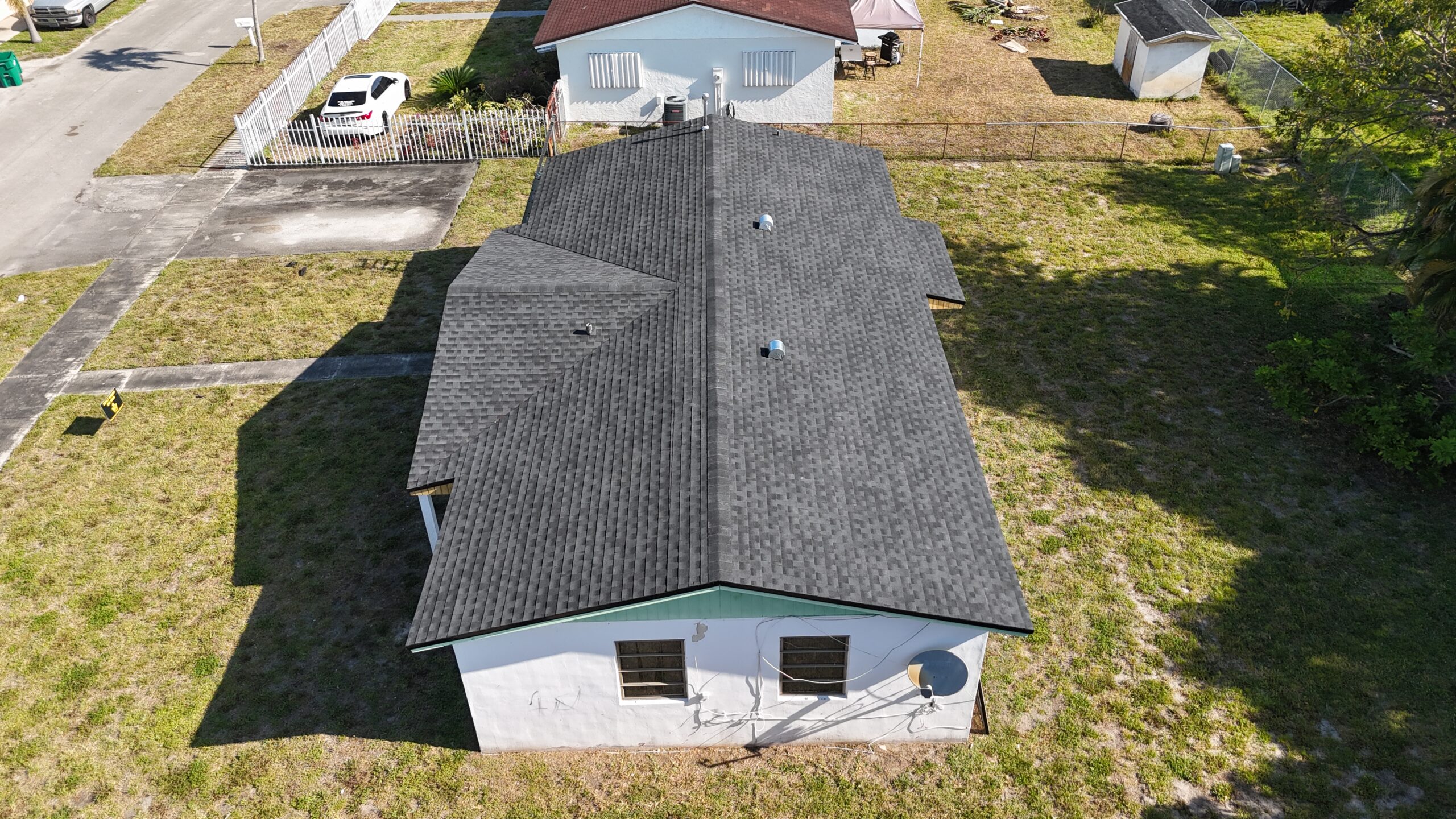
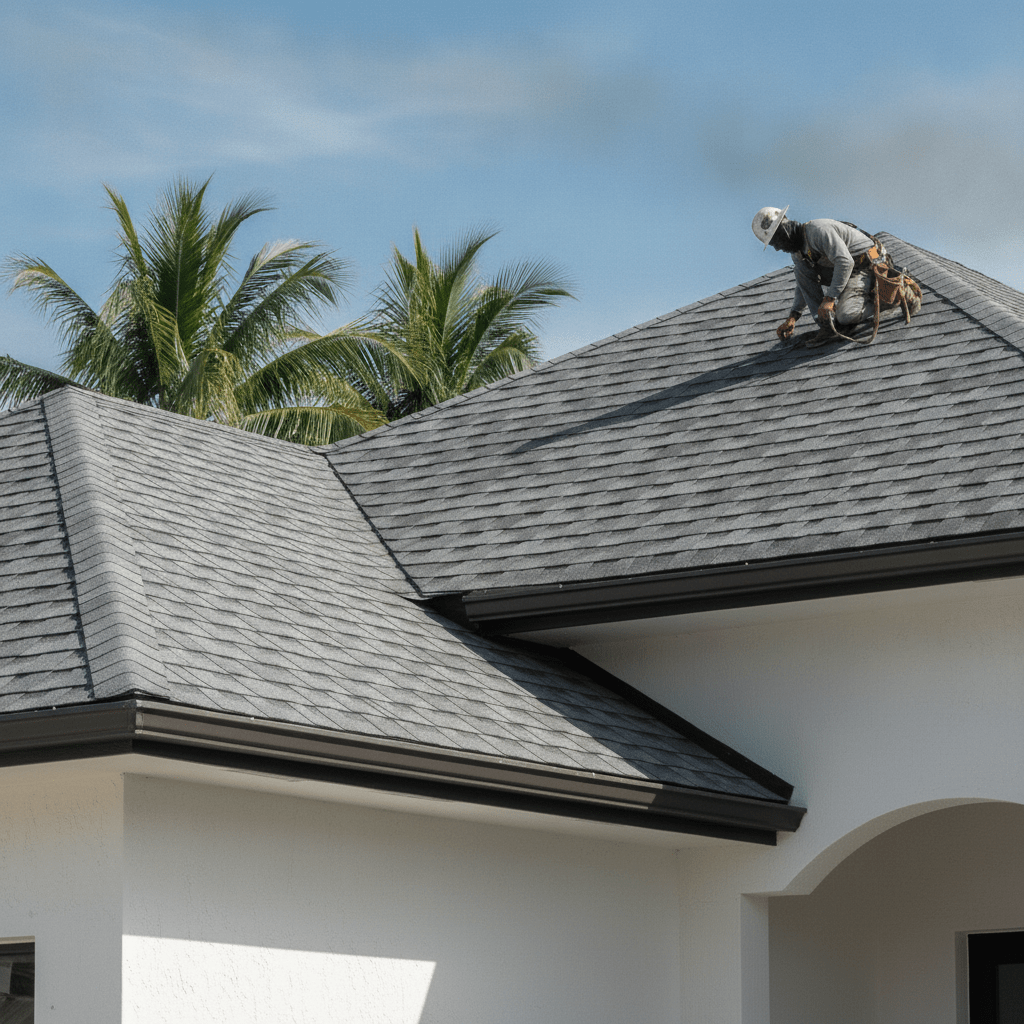
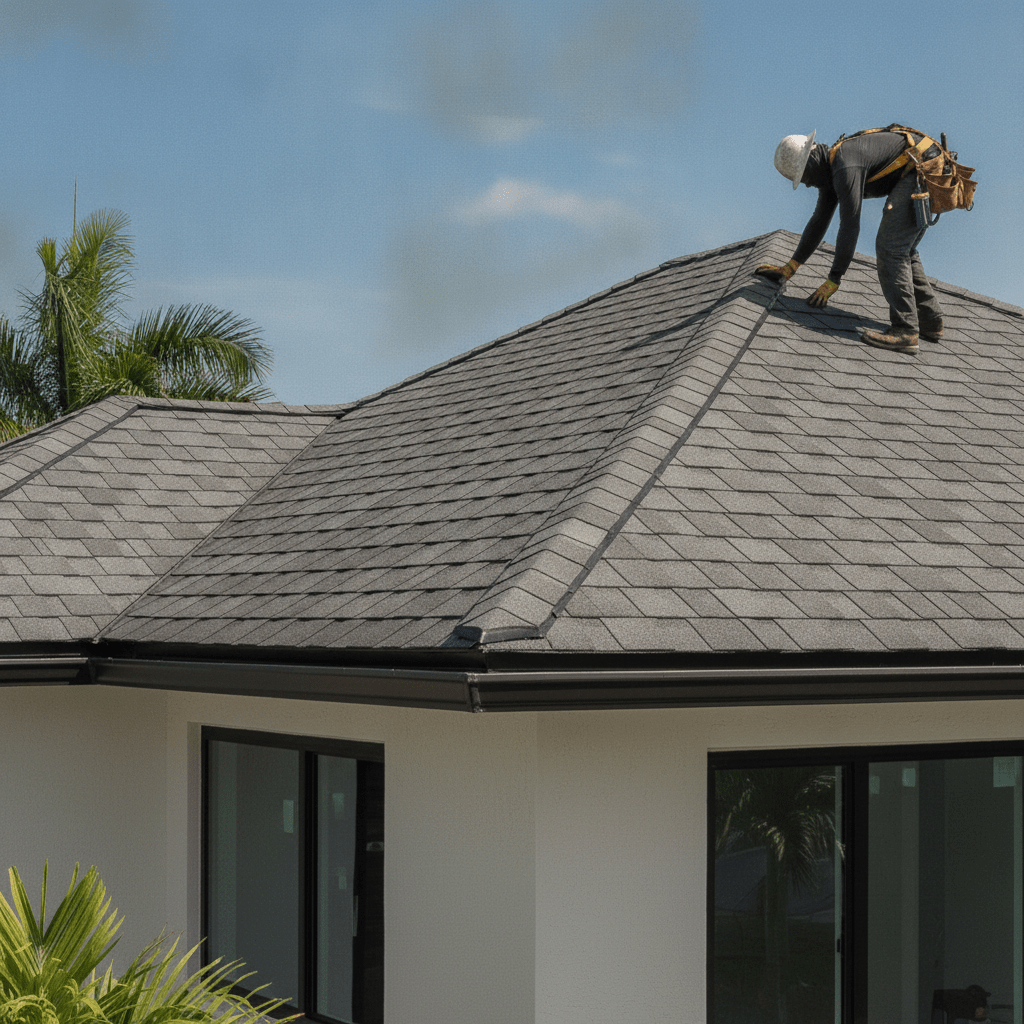
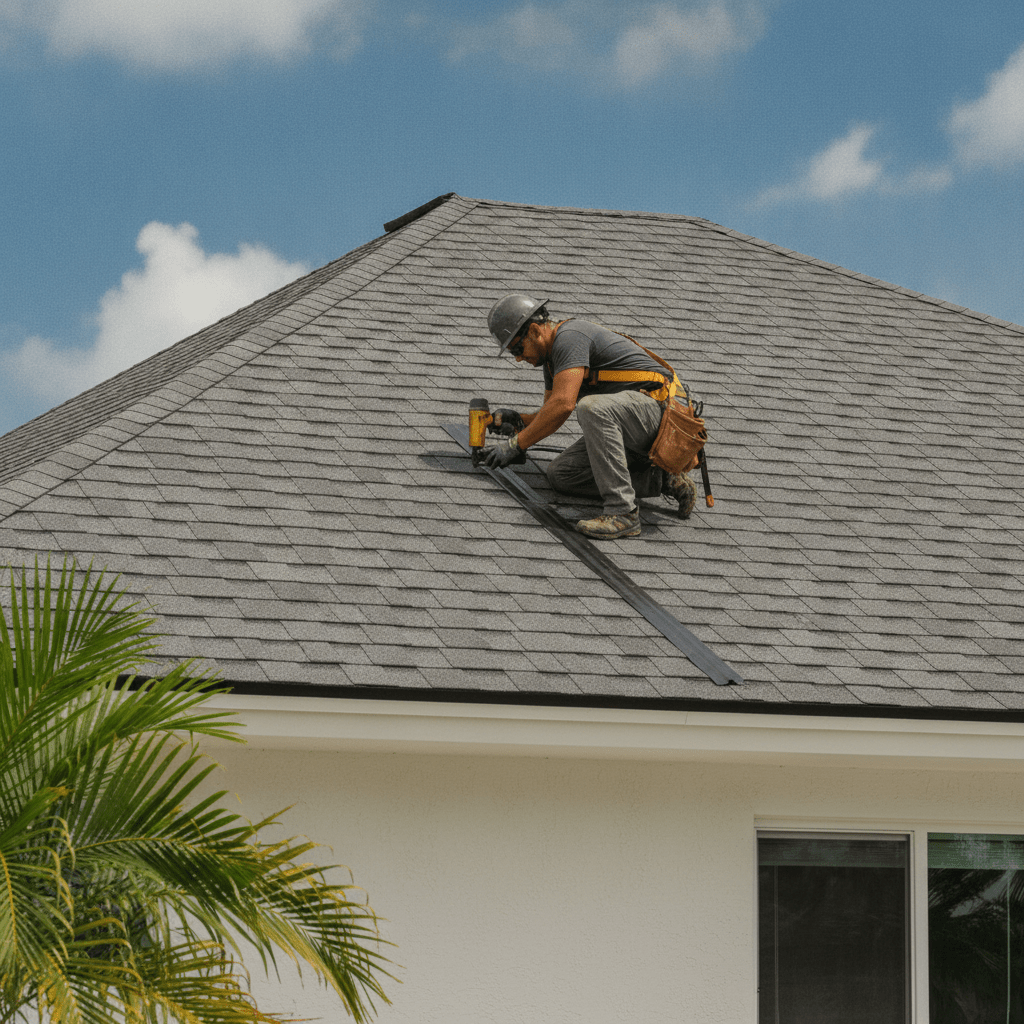
Architectural shingles (also called dimensional or laminate shingles) are asphalt-based and much lighter. GAF’s Layer Lock technology — introduced with post-2020 Timberline HDZ shingles — added 19 self-sealing dimples per shingle and widened the nail line to 1.81 inches (roughly 600% wider than pre-2020 designs), per GAF Timberline HDZ product specifications.7 GAF’s Wind Proven warranty carries no maximum mph limit and is not voided by named storms that hit your county — a meaningful upgrade over competitor warranties capped at 130 mph or voided by named-storm declarations. You can explore the full roofing services overview to see which products we install.
For South Florida homes, the 2024 Florida Building Code now permits direct-to-deck peel-and-stick underlayment as a secondary water barrier — and a full-deck peel-and-stick installation can qualify for an insurance secondary water barrier discount. Standard 30-lb felt does not qualify.
Head-to-Head Comparison
Tile vs. Shingle: The Core Trade-Offs
Criteria first — then the data. We compare on lifespan, cost, weight, wind performance, insurance impact, and maintenance.
| Factor | Concrete / Clay Tile | GAF Architectural Shingle |
|---|---|---|
| Typical South FL lifespan | 50+ years | 12–15 years |
| Installed cost (per sq) | $1,000–$1,350 | $750–$850 |
| Structural weight | Heavy (engineering may be required) | Light (standard framing) |
| HVHZ code compliance | Yes (with approved NOA) | Yes (with approved NOA) |
| Wind warranty | Varies by product | Wind Proven (no mph cap) |
| UV / heat degradation | Minimal (inorganic) | Moderate (asphalt ages faster in FL heat) |
| Insurance preference | Often preferred by carriers | Neutral to slightly lower premium |
| HOA compatibility | Often required by HOA | May be restricted in some HOAs |
| Impact resistance (foot traffic) | Tiles can crack | More flexible, less crack risk |
Cost Range Breakdown by Roof Size
| Roof Size (squares) | Tile Estimated Range | Shingle Estimated Range |
|---|---|---|
| 15 squares (1,500 sq ft) | $15,000–$20,250 | $11,250–$12,750 |
| 25 squares (2,500 sq ft) | $25,000–$33,750 | $18,750–$21,250 |
| 35 squares (3,500 sq ft) | $35,000–$47,250 | $26,250–$29,750 |
Estimates are installed ranges and depend on roof complexity, access, tear-off layers, structural condition, and permit fees. Contact us for a project-specific number.
If your home currently has shingles and you want to switch to tile, a structural assessment is required. The roof deck and framing must support the added load — in some cases, sistering the rafters or adding blocking is necessary. As a contractor holding a Certified General Contractor (CGC1531370) license, we can assess and address those structural modifications in-house, so you’re not coordinating a separate GC for framing work and a separate roofer for the tile system. That single-scope accountability matters when a structural finding surfaces mid-project.
Why It Matters Who Installs It
License Breadth = Fewer Surprises Mid-Project
A licensed contractor, not a lead aggregator — we hold the licenses, pull the permits, and stand behind the work.
“When we switch a home from shingles to tile, we often find structural items nobody anticipated. Holding a General Contractor license means we can handle that scope ourselves — the homeowner doesn’t have to bring in a third party and start the permit process over.”
President, Bigfoot Windows & Roofing
What We Install
Our Tile and Shingle Product Lines
For tile roofing, we install Westlake tile systems including the Saxony 900 flat concrete tile (most popular in South Florida) and the Barcelona barrel profile (dominant in southeastern Florida). We also install Unified Steel stone-coated tile — warranted for 50 years with no named-storm, no saltwater, and no act-of-God exclusion clauses, unlike some competitor products that contain those carve-outs.
For shingle roofing, we install GAF and hold GAF Certified Plus certification. Our shingle installations are eligible for the GAF System Plus warranty — 50 years, non-prorated, covering shingles, labor, tear-off, and accessories. For projects where long-term roof financing matters, we offer flexible roofing financing options including PACE programs paid through your property tax bill with no prepayment penalty.
Poly Set foam adhesive is available for tile installations where code allows — it achieves a 180 mph rating versus 160 mph for mechanical fasteners, and it also reduces heat transfer through the deck by sealing the gap between tile and substrate.
What the Process Looks Like
From First Call to Final Inspection
- On-site assessment: We evaluate your current roof structure, decking condition, existing layers, and whether your framing can support tile if that’s your direction. We identify any structural items before we quote.
- Permit pulled: We pull the permit under our license. In Miami-Dade and Broward, HVHZ permits require product approvals and manufacturer NOAs on file.
- Tear-off and deck prep: Existing material is removed; the deck is inspected and repaired as needed. Peel-and-stick secondary water barrier is installed per 2024 Florida Building Code.
- Installation and inspection: Tile or shingle system installed to manufacturer and NOA specifications. Final inspection closes the permit.
- Wind mitigation report: We recommend scheduling a wind mitigation inspection after project completion — it documents your new roof features and can support a meaningful insurance premium review with your carrier.
If you’re on Miami-Dade property and want to understand local permit and code specifics, our Miami-Dade roofing service page covers county-specific requirements.
Ready to compare tile and shingle quotes for your specific home?
Or use our roofing estimator to get a range before you call.
Keep Reading
Related Articles
Who We’re Not the Right Fit For
- Budget-first buyers who need the absolute lowest bid: We are not the cheapest quote in South Florida. Our pricing reflects licensed labor, proper permitting, and manufacturer-spec installations. If your primary filter is lowest number, we are probably not your contractor.
- Homeowners who want tile on a structurally unsuitable roof without addressing the framing: If an assessment finds the deck or rafters cannot safely support tile, we will tell you. We will not install tile over an inadequate structure to close a sale.
- Projects outside Miami-Dade, Broward, and Palm Beach counties: We do not serve counties outside our South Florida service area. If you are in a different region, you need a local contractor familiar with your local jurisdiction’s code and permit process.
- Investors looking for the fastest possible turnaround without permits: Every roofing project we do carries a pulled permit. If you are looking to skip the permit process to save time, we are not the right fit.
Common Questions
Frequently Asked Questions
What is the main difference between tile and shingle roofing in South Florida?
Tile is an inorganic, heavy material (concrete or clay) that lasts 50+ years and degrades minimally from UV. Architectural shingles are asphalt-based, lighter, and less expensive upfront but typically last 12–15 years in South Florida’s heat and sun. Both must meet HVHZ code in Miami-Dade and Broward. The right choice depends on your budget, structure, and how long you plan to own the home.
Is tile roofing worth the higher upfront cost in Florida?
For most long-term owners, yes — but it depends. Tile costs roughly $1,000–$1,350 per square installed versus $750–$850 for shingles. If you stay in the home for 20+ years, tile’s lifespan advantage reduces the total replacement cycles you will pay for. If you plan to sell within 10 years, shingles may offer better near-term economics. Your home’s structural capacity to handle tile weight is also a real factor.
How does tile roofing hold up in hurricane-force winds?
Tile installed with HVHZ-approved adhesive (Poly Set foam) achieves 180 mph wind ratings. Mechanically fastened tile reaches roughly 160 mph. Both methods require a Miami-Dade NOA or a Florida Product Approval that covers HVHZ use. Modern GAF shingles with Wind Proven warranty carry no mph cap and are not voided by named storms. Wind performance is now competitive between the two systems when both are installed to code.
What does my insurance company prefer — tile or shingles?
Many carriers in South Florida favor tile for its longevity, but there is no universal rule. What matters most to your carrier is your roof’s age, the presence of a secondary water barrier, and your wind mitigation inspection results. A wind mit report documenting your new roof’s features is the most reliable way to understand your specific premium impact — carrier responses vary significantly.
Can my HOA prevent me from choosing shingles if I want tile — or vice versa?
HOAs can still enforce architectural style rules under Florida SB 293. The law limits HOA authority over metal roofing and impact windows, but it does not prohibit HOAs from requiring tile in communities where tile is the established standard. Check your HOA’s CC&Rs before committing to a material. If your HOA requires tile, shingles may require a variance or board approval.
How long does each roof type actually last in Florida’s climate?
Concrete or clay tile: 50+ years with proper underlayment maintenance. GAF architectural shingles: 12–15 years in South Florida due to accelerated UV and heat degradation — significantly shorter than the nominal 30-year label suggests. The 30-year rating is based on temperate climate test conditions, not South Florida’s HVHZ environment. Underlayment under tile typically needs replacement every 20–25 years even when the tile itself is intact.
Sources
- Florida Building Code, 8th Edition (2023) — High-Velocity Hurricane Zone roofing requirements
- Miami-Dade County Product Control — Notice of Acceptance (NOA) database
- GAF Roofing — Wind Proven Limited Wind Wind Warranty terms and System Plus warranty documentation
- Florida SB 293 (2023) — HOA restrictions on roofing material and impact windows
- Citizens Property Insurance Corporation — Roof age underwriting guidelines (2024)
- Florida Solar Energy Center (FSEC) — Residential Attic Temperature Research, University of Central Florida
- GAF Timberline HDZ Product Data Sheet — nail line and sealing dimple specifications
Get a project-specific estimate — tile or shingle, we quote both honestly.
Prefer to talk? Call Bigfoot Windows & Roofing at 786-886-2088.