Last updated: July 2026 by the Bigfoot Windows & Roofing editorial team.
Key Takeaways
- Non-impact windows fail debris tests that laminated impact glass is built to survive.
- Tempered glass shatters on impact — it is NOT hurricane-rated or laminated.
- Wind-driven rain infiltration through unsealed frames is a separate, underappreciated failure mode.
- Miami-Dade and Broward (HVHZ) require products that carry a Miami-Dade NOA or a Florida Product Approval that covers HVHZ use — non-impact windows do not qualify.
- Shutters add a layer of protection but do not make a non-impact window code-equivalent in the HVHZ.
- Replacing non-impact windows may involve structural frame work — a scope that benefits from a contractor authorized for multi-trade coordination.
The Hidden Risk
Most Non-Impact Windows Were Never Designed to Stop a Hurricane
Understanding the gap between ordinary glass and a tested, rated opening-protection system.
If a two-by-four traveling at 50 mph hits your window, will it hold? That is essentially the question a large-missile impact test asks. Non-impact windows — even new ones, even tempered ones — are not designed to answer yes. They are designed for weather, not weaponized debris.
This article walks through what stress testing actually reveals about non-impact windows: the physics of failure, the HVHZ code requirements those windows cannot meet, and the wind-driven rain infiltration problem that causes damage even when a window does not shatter.
South Florida Context
HVHZ Rules Make Non-Impact Windows a Code Problem, Not Just a Safety Problem
Miami-Dade and Broward counties sit inside the High-Velocity Hurricane Zone (HVHZ) — the strictest building-code jurisdiction in the United States for wind-borne debris. The Florida Building Code requires that every exterior opening in the HVHZ be protected by a product carrying a Miami-Dade Notice of Acceptance (NOA) or a Florida Product Approval that covers HVHZ use. Non-impact windows do not carry a Miami-Dade NOA for impact resistance.
What that means practically: if you are in Miami-Dade or Broward and your home has non-impact windows, any permit-pulling renovation that touches those openings will trigger a requirement to upgrade. Insurers writing policies in South Florida are also increasingly inspecting for opening protection. According to industry reporting, Citizens Insurance, the state insurer of last resort, has been non-renewing policies on homes with aged or unprotected openings.6
For homeowners replacing windows and encountering structural rough-opening issues — cracked sills, rotted bucks, or frame damage from prior water intrusion — a contractor authorized to coordinate structural and glazing scope in a single permit can simplify the process significantly compared to hiring separate trades. That kind of multi-trade accountability is grounded in license breadth, not just convenience.
The Stress Test Breakdown
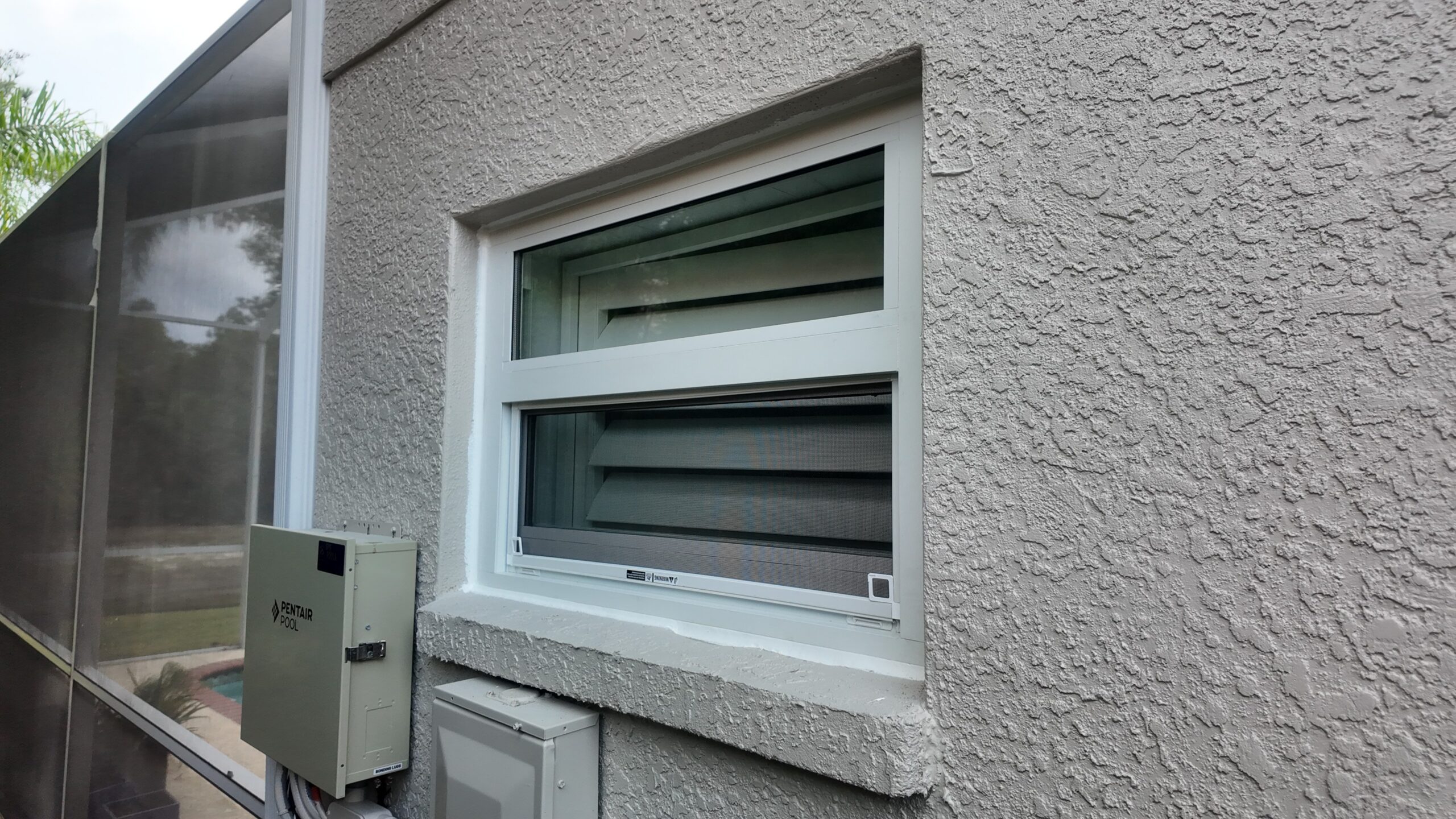
Four Ways a Non-Impact Window Fails Under Stress
Each failure mode is independently dangerous. Most homes with non-impact windows face all four simultaneously.
1. Large-Missile Impact: Debris Penetration
Florida Building Code Chapter 16 and ASTM E1996 define the large-missile test: a 9-lb 2×4 fired at 50 feet per second (roughly 34 mph) at the center and corners of the window unit. Impact-rated windows with laminated glass must survive this without the projectile passing through. Non-impact glass — including standard float glass and tempered glass — does not survive this test. Tempered glass is designed to shatter into small, relatively safe pieces to protect occupants from sharp edges; that same property means it provides no debris barrier after the first hit.
2. Cyclic Wind-Pressure Loading: Frame and Seal Fatigue
After a debris strike, the ASTM E1886 protocol applies cyclic positive and negative pressure loads that simulate a hurricane’s pressure oscillations. The frame, glazing pocket, and weather seals must hold through thousands of pressure cycles. Non-impact frames — typically thinner aluminum extrusions or vinyl profiles not rated for HVHZ — deflect, rack, and allow the glass to unseat from the glazing pocket. Even without glass breakage, a failed seal at the frame perimeter allows pressurization of the wall cavity, which can blow off the roof structure.
3. Wind-Driven Rain Infiltration: The Silent Damage Maker
ASTM E331 and E547 measure water infiltration under sustained pressure differentials. Non-impact windows are tested to lower pressure thresholds and with less rigorous water-resistance requirements. In a tropical storm or hurricane, wind-driven rain is pushed horizontally at pressures far exceeding what a standard window weep system or perimeter seal is designed to handle. The result: water enters behind the drywall, soaks insulation, and creates mold conditions within days — often without the window ever breaking.
4. Post-Storm Structural Vulnerability: The Pressure Envelope Break
Building science research from institutions including the Insurance Institute for Business & Home Safety (IBHS) shows that once an exterior opening fails during a storm, interior pressurization increases dramatically, putting uplift load on the roof deck from the inside. This is the mechanism that removes roofs during hurricanes — not the wind alone, but the pressure differential created by a failed opening. A shattered non-impact window is an opening failure. This is why the case for impact windows in South Florida is not primarily cosmetic or comfort-driven — it is structural.
| Test Protocol | What It Measures | Non-Impact Window Result | Impact Window Result |
|---|---|---|---|
| ASTM E1996 (Large Missile) | Debris penetration resistance | Fails — glass penetrated | Pass — laminate holds |
| ASTM E1886 (Cyclic Pressure) | Frame/seal fatigue under pressure cycles | Fails — frame deflects, seal breaks | Pass — rated frame holds |
| ASTM E331/E547 (Water) | Wind-driven rain infiltration | Fails at lower pressures | Pass at rated DP |
| Miami-Dade NOA | HVHZ product acceptance | Not issued — not applicable | Required — issued per product |
Glass Type Comparison
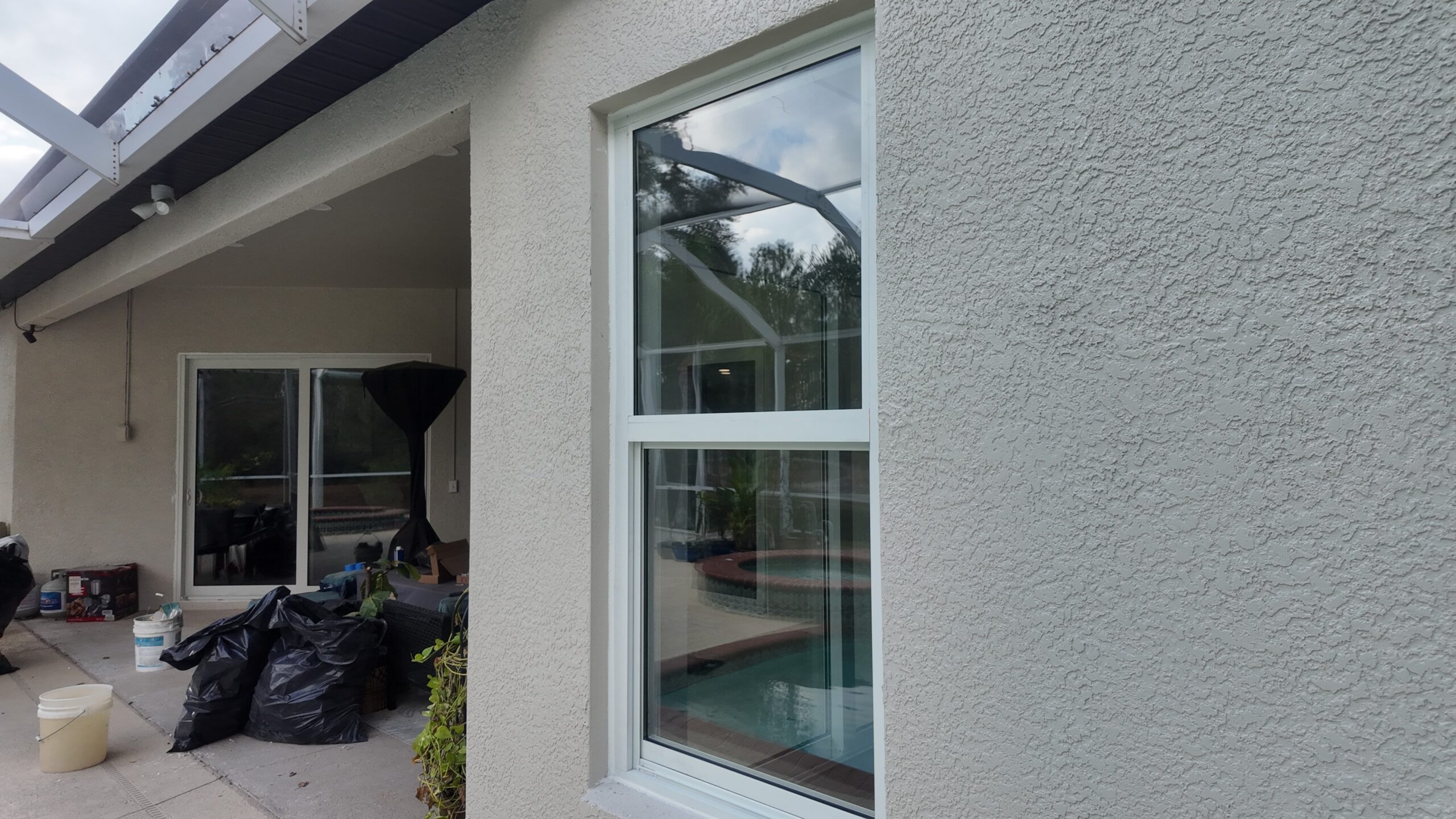
Tempered vs. Laminated Impact Glass: What the Labels Actually Mean
These two glass types are frequently confused. They behave in opposite ways under impact.
| Property | Tempered Glass | Laminated Impact Glass |
|---|---|---|
| How it breaks | Shatters into small cubes (by design) | Cracks but stays bonded to PVB interlayer |
| Post-break barrier | None — opening is exposed | Maintains barrier even when cracked |
| Large-missile rated | No | Yes (when combined with rated frame) |
| Miami-Dade NOA | No (for impact use) | Yes (product-specific) |
| HVHZ code compliant | No | Yes |
| Common South Florida use | Shower doors, interior doors | Exterior windows and doors |
The key distinction: tempered glass is a safety glass designed to minimize injury when it breaks. Laminated impact glass is a structural barrier designed to stay intact after a strike. In South Florida, impact-rated doors and windows use laminated glass in a rated aluminum frame system — not tempered glass alone.
When Shutters Are — and Are Not — the Answer
Accordion shutters and panel shutters do provide a tested opening-protection layer when properly deployed. A Miami-Dade NOA-rated shutter over a non-impact window can satisfy the HVHZ code requirement for that opening — if the shutter itself is rated and properly installed. What shutters cannot do: protect against wind-driven rain infiltration at the window frame perimeter (the shutter covers the glass face, not the frame joint), replace the thermal and noise benefits of laminated glass, or remove the burden of manual deployment before every storm. For full-time, passive opening protection with no deployment requirement, impact windows are the complete solution.
Why Licensing Matters Here
A Contractor Authorized for the Full Scope
Impact window replacement in South Florida is not always just a glazing job.
“When we open a rough opening and find rotted framing or a compromised sill, we don’t stop the job and call another contractor. We hold all four licenses to handle it in one permitted scope. That matters in the HVHZ, where inspections are thorough and sequencing errors cost weeks.”
Darryl Rosenbaum
President, Bigfoot Windows & Roofing
Product Guidance
What Impact-Rated Aluminum Window Systems Actually Look Like
Bigfoot installs Mr. Glass aluminum impact window systems as our primary line. Aluminum frames are our preference for South Florida — they are more time-tested in HVHZ heat, humidity, UV exposure, and hurricane-force wind loads than vinyl alternatives. Aluminum does not warp, does not off-gas plasticizers in heat, and holds Miami-Dade NOA approvals across a wider pressure-design range.
Mr. Glass Series 200 (flagship single-hung) and Series 300 (flagship horizontal roller) both carry Florida Product Approval. The Series 2500T thermally broken impact door has been tested in both in-swing and out-swing configurations — most competitors test only one direction. For projects near the coast (within two miles of saltwater), we specify a 2605 finish to protect against corrosion and preserve the 10-year product warranty.
Glass specification matters too. We primarily recommend SB 70 Low-E glass for South Florida — it delivers the strongest solar heat block and is available in the 7/16" and 9/16" thicknesses required for high-rise and HVHZ applications. If you are replacing all windows in a full-house project, Climate Guard 6227 (identical specs to SB 70) is available as a complementary upgrade.
How It Works
The Replacement Process: Permit to Inspection
In Miami-Dade and Broward, impact window replacement requires a permit, an inspection by the local building department, and — for the HVHZ — products with a current Miami-Dade NOA or a Florida Product Approval that covers HVHZ use on file. The sequence matters:
- Site assessment: We measure each opening, document frame conditions, and identify any structural rough-opening issues before ordering product.
- Permit application: We pull the permit. Homeowners should never allow a contractor to propose "permit-exempt" window replacement in the HVHZ — it does not exist for exterior openings.
- Product order and lead time: Custom-fabricated aluminum impact windows typically have a lead time of several weeks depending on series and configuration.
- Installation: Frames are set, flashed, and sealed to the Florida Building Code water-infiltration standard. Structural issues (rotted bucks, damaged sills) are addressed in the same permitted scope where our license breadth allows.
- Inspection: Building department inspects the installation against the product’s NOA requirements. We do not close walls or finish until the inspection passes.
If you want to explore financing options for impact window replacement, PACE financing (paid through your property tax bill) is one path — typically no prepayment penalty and no credit score requirement — terms vary by program; confirm with your PACE provider. The My Safe Florida Home grant program offers up to $10,000 for qualifying homeowners and can stack with PACE.
Ready to find out where your windows stand?
We assess non-impact windows against current HVHZ requirements and give you a straight answer — no pressure, no inflated scopes.

Written by Darryl Henry Rosenbaum, Founder of Bigfoot Windows & Roofing.
Darryl Henry Rosenbaum, doing business as Bigfoot Windows and Roofing, holds four active Florida licenses recognized by the Florida Department of Business and Professional Regulation (DBPR): Certified General Contractor (CGC1531370), Certified Residential Contractor (CRC1331693), Certified Roofing Contractor (CCC1333168), and Certified Specialty Contractor with a Glass & Glazing Specialty (SCC131153098).
Who We’re Not the Right Fit For
- Homeowners outside South Florida: Our licensing, code knowledge, and product relationships are built for Miami-Dade, Broward, and Palm Beach. If your project is in Central or North Florida, a contractor with local HVHZ experience and permit history in your jurisdiction will serve you better.
- Projects requiring only shutter installation: If you have determined that NOA-rated shutters satisfy your code requirement and you are not replacing the windows themselves, we are not the best fit — we focus on full window and door replacement, not shutter-only installs.
- Buyers prioritizing the lowest possible bid above all else: HVHZ permits, inspections, and properly rated product cost more than non-permitted work or non-NOA product. If price is the only filter, we will likely not be the low bidder — and we will not suggest skipping permits to get there.
- Commercial high-rise projects requiring Miami-Dade NOA on the window unit itself: Mr. Glass carries Florida Product Approval on all lines; Miami-Dade NOA is confirmed only on the Series 2500T door unit. If your project specification requires a Miami-Dade NOA on the window itself (common in high-rise commercial), let us confirm product availability before you engage us.
Common Questions
Frequently Asked Questions
What happens to a non-impact window in a hurricane?
A non-impact window typically fails in one of three ways during a hurricane: the glass shatters from debris impact, the frame deflects and unseats the glass under cyclic wind pressure, or the perimeter seal fails and allows wind-driven rain to enter the wall cavity. Once an exterior opening fails, interior air pressure rises sharply, which increases roof uplift load from the inside. This is the mechanism behind many South Florida roof losses.
Are non-impact windows allowed in Miami-Dade?
Non-impact windows are not compliant as-installed opening protection in Miami-Dade or Broward under the High-Velocity Hurricane Zone (HVHZ) requirements of the Florida Building Code. Every exterior opening in the HVHZ must be protected by a product with a Miami-Dade Notice of Acceptance (NOA) or a Florida Product Approval that covers HVHZ use for impact resistance, or by an HVHZ-approved storm shutter system over the opening. Existing non-impact windows in older homes trigger an upgrade requirement when a permit is pulled for related work.
Do non-impact windows pass a stress test?
No.