Windows and Roofing Virtual Showroom: Miami Buyer’s Guide
A windows and roofing virtual showroom is an interactive 3D product viewer that lets you inspect impact windows, doors, and roofing materials from your phone or computer before anyone visits your home. Miami-Dade and Broward homeowners use it to verify NOA approvals, design pressure ratings, and glass construction before committing to an in-home quote.
By the Bigfoot Windows & Roofing editorial team — licensed Florida contractors (CGC1531370, CCC1333168, CRC1331693, SCC131153098) installing impact windows, doors, and roofing across Miami-Dade and Broward. Reviewed by our in-house permit and installation staff.
What Is a Virtual Showroom for Windows and Roofing?
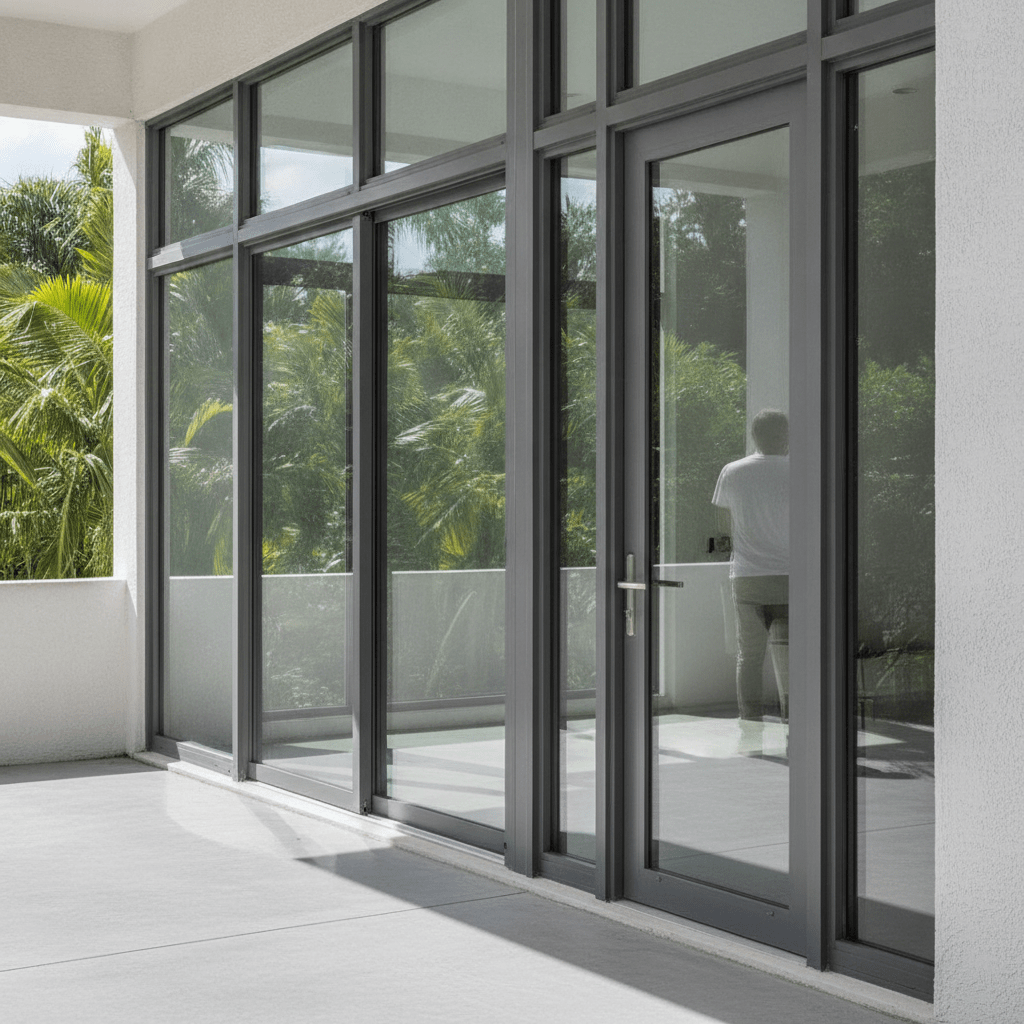
A virtual showroom is a browser-based, walk-through replica of a physical product showroom: full-size window and door displays you can rotate, zoom, and interrogate for specifications without an appointment. Instead of judging products from a brochure photo, you explore window products online in person-style — checking frame profiles, glass makeup, hardware, and manufacturer documentation at your own pace.
For South Florida buyers, that matters more than convenience. Every opening in Miami-Dade and Broward sits inside Florida’s High-Velocity Hurricane Zone (HVHZ), so your product must carry the right approvals and pressure ratings — not just look good. The Florida Building Code defines the HVHZ as Miami-Dade and Broward Counties, where the most stringent wind-borne debris standards in the state apply (source: floridabuilding.org). A virtual showroom tour for home remodeling lets you verify those details before a salesperson sits at your kitchen table: a genuinely no-pressure window shopping experience.
How to Use the Bigfoot Virtual Showroom (Quick Walkthrough)
Access the showroom from the Virtual Showroom menu on bigfootwindowsandroofing.com or bfcmiami.com — every showroom link leads to the same interactive space. Once inside, the walkthrough takes about a minute to learn:
- Go full screen. Click the three-line icon to expand the view. It works on phone, tablet, or desktop; VR goggles are optional.
- Navigate freely. Turn, move, and zoom as you would on a physical floor. The navigation menu jumps straight to a specific window or door series — including the exact model on your quote.
- Use the hotspots. Interactive 3D showroom hotspots sit near each display; tapping the information icon opens a PDF with product specifications, performance details, and manufacturer data.
- Zoom into details. Pinch-to-zoom or mouse-zoom to inspect finishes, hardware, frame depth, and sightlines.
The video above walks the space on camera, but treat it as a supplement — the impact window product viewer itself is the tool, open 24/7.
The Remote Buyer’s Checklist: What to Verify Before You Buy Impact Windows
Before you sign anything, verify five items for every product on your quote — all five can be checked remotely from the showroom’s spec PDFs:
- Approval document: a Miami-Dade Notice of Acceptance (NOA) for Miami-Dade installations, or the applicable Florida Product Approval elsewhere.
- Design pressure (DP) rating: the positive and negative pressures the assembly is rated for.
- Impact rating: large-missile certification for openings within 30 feet of grade — the standard for nearly every South Florida home.
- Glass makeup: laminated impact glass construction, interlayer type, and overall thickness.
- Frame material and finish: how the frame holds up in coastal salt air, and what the finish warranty covers.
The sections below explain how to evaluate each, so you can compare windows before buying instead of taking a sales pitch on faith.
Miami-Dade NOA vs. A product with a current Florida Product Approval (FL number) that covers HVHZ use is legal to install in Miami-Dade and Broward. A Miami-Dade NOA is an additional certification some products also carry; it is not required for the permit. The NOA is the county’s own certification, issued after testing to Miami-Dade’s HVHZ protocols — among the most demanding wind-borne debris testing in the country. You can look up and confirm any NOA directly through the Miami-Dade Product Control search (source: miamidade.gov). Outside Miami-Dade, Broward and most other Florida jurisdictions accept a statewide Florida Product Approval with HVHZ compliance where the code requires it.
Practically, two homes ten miles apart can have different paperwork requirements for the identical window. When we install in Miami-Dade, we pull the current NOA for each series and confirm its expiration date before the permit package goes in — on a recent Cutler Bay job we caught an NOA that had been renewed with a new number since the manufacturer’s older cut sheet, and updated the paperwork before submittal. When you review a product PDF in the windows and roofing virtual showroom, look for the NOA number and its expiration date — NOAs expire and get renewed, and your permit package must reference a current one. As a licensed Florida contractor (CGC1531370, CCC1333168, CRC1331693, SCC131153098), we put the approval number in writing on every contract; expect the same from anyone bidding your project.
Design Pressure Ratings and HVHZ Code Requirements Explained
A design pressure rating tells you how much wind load — pushing in and sucking out — a window assembly is engineered to resist, in pounds per square foot (PSF). In the HVHZ, the Florida Building Code requires every opening to be protected and every assembly to meet the design pressures calculated for its size, elevation, and position on the building. The HVHZ is built around design wind speeds in the range of roughly 170–195 mph ultimate for Miami-Dade and Broward, per the Florida Building Code and ASCE 7 wind maps (source: floridabuilding.org). Corner openings and upper floors see higher negative (suction) pressures than a mid-wall ground-floor window, so one house can legitimately need different DP ratings at different openings.
Spec sheets in the showroom list ratings like +50/−65. Do not fixate on the biggest number — what matters is that the rating meets or exceeds the engineering calculation for your openings, produced during permitting. The virtual showroom lets you confirm the product family on your quote is rated for HVHZ service at all, before measurement day.
Laminated Impact Glass: What’s Inside the Pane
Laminated impact glass is a sandwich: two sheets of glass permanently bonded to a tough polymer interlayer, so the pane can crack under impact but stays in its frame instead of opening a breach. That interlayer — commonly PVB (polyvinyl butyral) or the stiffer ionoplast type — is what earns the “impact” in hurricane impact windows South Florida homes rely on. When wind-borne debris strikes, the assembly holds the building envelope closed — the whole game in a hurricane. FEMA notes that once the building envelope is breached, the resulting internal pressurization can lead to roof and wall failures (source: fema.gov).
In the showroom PDFs, look at the glass makeup line. Thicker interlayers and heat-strengthened glass generally mean stronger assemblies; laminated insulated units add an air gap for energy efficiency on west-facing Miami elevations. According to the U.S. Department of Energy, heat gain and loss through windows are responsible for about 25%–30% of residential heating and cooling energy use (source: energy.gov) — which is why glass makeup matters for comfort as well as storm protection. Impact glass also cuts outside noise and blocks most UV — side benefits clients mention as often as storm protection.
Aluminum vs. Vinyl Frames in Coastal Salt Air
For most Miami-Dade and Broward homes, aluminum frames are the workhorse choice: they carry the strength for large HVHZ-rated openings and hold slim sightlines, while quality vinyl offers better thermal performance in smaller openings. The honest trade-offs:
- Aluminum supports big glass spans and the highest design pressures. In coastal salt air the finish is the battleground — look for a quality painted or anodized finish, and rinse frames occasionally near the water.
- Vinyl never corrodes and insulates better, which helps cooling bills. But vinyl is bulkier for the same strength, fewer vinyl products carry HVHZ ratings at large sizes, and frame color stability in direct salt-and-sun exposure is worth asking about.
In the virtual showroom you can zoom into both frame types side by side, compare profile thickness and hardware, and open each spec PDF to see the sizes and pressures each series is actually approved for — a comparison brochures never make easy.
Comparing Roofing Materials in the Virtual Showroom
The showroom is not only glass: it doubles as a roofing materials online showroom for comparing shingle, metal, and tile systems. The HVHZ logic is identical — roofing products installed in Miami-Dade need current NOAs — or Florida Product Approvals that cover HVHZ use — covering the specific assembly (panel or shingle, underlayment, fastening pattern), and your permit will reference them. Broadly: architectural shingles are the value option with solid wind ratings; metal panels cost more but shrug off salt air and typically outlast two shingle roofs; concrete and clay tile deliver the classic South Florida look with excellent longevity when the attachment is done right. Reviewing these remotely means the roof conversation at your estimate starts from an informed baseline.
Using the Virtual Showroom to Review Your Window Quote
The showroom’s highest-value use is to review your window quote online, line by line, against the actual products. Navigate straight to the manufacturer, series, and model on your quote and confirm three things: it looks the way you expected, its spec PDF shows a current NOA or Florida approval, and its ratings fit HVHZ service. Then compare it against the adjacent series — is the upgrade tier a meaningfully different product, or mostly a finish change?
Doing this from home removes surprises later. Shop for replacement windows from home at midnight or with family on a Sunday — revisit the space as often as you need and come back with sharper questions. An educated buyer is a better client.
Visit the Physical Showroom: 7250 SW 39th Ter, Miami
The virtual showroom has a physical counterpart at 7250 SW 39th Ter, Miami, FL 33155, where you can operate real impact windows and doors, feel the weight of laminated glass, and talk through your project with our team. Many clients explore the windows and roofing virtual showroom first to shortlist products, then visit in person to confirm the final pick. Call 786-886-2088 before you come by and we will have your quote’s products ready to demonstrate.
Related Articles
- Impact Windows in Florida: What Homeowners Need to Know
- Impact Windows: Products and Services Overview
- How Miami-Dade NOA Approval Protects Your Window Investment
- Choosing a Roofing System for South Florida’s HVHZ
Quotable Facts: Miami Impact Windows and Roofing by the Numbers
- The HVHZ covers two counties. The Florida Building Code defines the High-Velocity Hurricane Zone as Miami-Dade and Broward Counties, where the strictest wind-borne debris provisions in the state apply (source: floridabuilding.org).
- Ultimate design wind speeds reach roughly 170–195 mph. Wind maps in the Florida Building Code / ASCE 7 drive the design pressures required for openings in South Florida (source: floridabuilding.org).
- Windows drive 25%–30% of heating and cooling energy use. Per the U.S. Department of Energy, that share of residential HVAC energy is attributable to heat gain and loss through windows (source: energy.gov).
- Envelope breaches cause structural failures. FEMA documents that a failed opening allows internal pressurization that can lift roofs and push out walls (source: fema.gov).
- Every NOA is publicly verifiable. Miami-Dade County maintains a searchable Product Control approval database (source: miamidade.gov).
Frequently Asked Questions
What is a virtual showroom for windows and roofing?
An interactive, browser-based 3D space where you walk through full-size window, door, and roofing displays, zoom into details, and open manufacturer spec PDFs — from any phone or computer, no appointment needed — so you can vet products before an in-home quote.
How do I verify a Miami-Dade NOA number on an impact window?
Find the NOA number on the product’s spec sheet — in our virtual showroom, tap the information hotspot to open its PDF. Then confirm it against the Miami-Dade Product Control database at miamidade.gov. Check the NOA is current (not expired) and covers the exact model, size range, and installation method on your quote. Your contractor should put the number in writing.
What design pressure rating do windows need in Miami’s HVHZ?
There is no single number — the required rating depends on each opening’s size, height, and position on the building, calculated during permitting under the Florida Building Code’s HVHZ provisions (floridabuilding.org). Corner and upper-story openings need higher negative ratings; the product’s DP rating must meet or exceed the calculation for each opening.
Which counties are in Florida’s High-Velocity Hurricane Zone?
Miami-Dade and Broward Counties. The Florida Building Code designates these two counties as the HVHZ, where products must meet the state’s most stringent large-missile impact and wind-pressure standards (source: floridabuilding.org).
Do impact windows save energy?
They can. The U.S. Department of Energy attributes roughly 25%–30% of residential heating and cooling energy use to heat gain and loss through windows (energy.gov). Laminated insulated impact units add an air gap and often low-E coatings that reduce that loss, which is especially noticeable on west-facing Miami elevations.
Can I compare my written quote against products in the virtual showroom?
Yes — that is its best use. Jump to the manufacturer, series, and model on your quote via the navigation menu, confirm the appearance, and open the spec PDF to check the approvals and ratings behind the line item.
Do I still need a permit if I pick my windows online?
Yes. Every impact window, door, or roofing installation in Miami-Dade and Broward requires a permit regardless of how you selected the product; the package references the approvals and engineering for your openings, and a final inspection verifies the installation.
Is the virtual showroom a substitute for an in-home measurement?
No. Final pricing and permitting depend on exact opening dimensions, site conditions, and engineering calculations that require an on-site visit. Use the showroom to arrive at that visit already knowing what you want.
Ready for a free estimate? Call 786-886-2088 or fill out our contact form.
Schedule Your Free Estimate
Ready to get started? Request a free estimate — no phone call required.