
New Roof Cost Miami 2025 | Bigfoot Windows & Roofing
Updated July 2026
Key Takeaways
- Installed roof replacement in Miami-Dade typically runs $750–$1,400 per square (per 100 sq ft) depending on material.
- Miami-Dade's High Velocity Hurricane Zone (HVHZ) requires materials that carry a Miami-Dade NOA or a Florida Product Approval that covers HVHZ use and enhanced fastening — both add cost versus standard Florida installs.
- Miami-Dade County permit fees, mandatory deck inspections, and secondary water barrier requirements are real line items, not optional extras.
- Citizens Insurance is non-renewing roofs 20–25+ years old; a new roof can significantly reduce your annual premium.
- PACE financing spreads costs over 20 years at roughly $173/month per $15,000 financed — no bank credit-score hurdle.
The Real Problem
Why Roof Pricing in Miami Is Different
South Florida homeowners get quotes that vary by thousands — often with no explanation.
If you've called three Miami roofing contractors and received three wildly different numbers, you're not alone. The range is real, and it exists for reasons that have nothing to do with contractor honesty. Miami-Dade County sits inside the High Velocity Hurricane Zone (HVHZ) — the most stringent residential building code environment in the United States. Materials must carry a Miami-Dade NOA or a Florida Product Approval that covers HVHZ use. Fastening schedules are more demanding than the rest of Florida. A secondary water barrier is required, not optional. Each of those requirements has a dollar value, and contractors who omit them from quotes are either cutting corners or planning to fail inspection.
This guide breaks down exactly what drives the cost of a roof replacement in South Florida, what each material costs installed per square (per 100 sq ft), and what hidden line items most homeowners don't see until the final invoice.
Miami-Dade & HVHZ Context
What the Florida Building Code Adds to Your Bill
Miami-Dade and Broward counties are the only two Florida counties designated HVHZ under the Florida Building Code (FBC) 7th Edition. That designation translates to specific, non-negotiable requirements:
- Materials with a Miami-Dade NOA or a Florida Product Approval that covers HVHZ use only. Not every shingle, tile, or metal panel sold in the U.S. is approved for use in Miami-Dade. The product must hold a Miami-Dade NOA or a Florida Product Approval that covers HVHZ use. Using a product without HVHZ product approval means a failed inspection — and a roof you have to redo.
- Enhanced fastening schedules. FBC HVHZ requires closer nail spacing and specific fastener types. This means more labor time and more materials per square foot.
- Secondary water barrier (SWB). A full-deck peel-and-stick underlayment is required in HVHZ. It also qualifies as the secondary water resistance feature that insurers reward with a wind mitigation credit. Using 30-lb felt does not qualify.
- Miami-Dade County building permit. A permit is never optional for roof replacement in Miami-Dade. Permit fees vary by project value but commonly run $200–$600 on a residential re-roof. Mandatory inspections (dry-in and final) add scheduling time to the project.
- Deck inspection. When existing decking is exposed, the inspector may require damaged sheathing to be replaced before the roof proceeds. Deck repairs are priced separately — typically $2–$5 per sq ft of sheathing replaced.
All of these items add real dollars to the base material cost. A contractor quoting below market is likely skipping one or more of them.
Installed Cost by Material
What Each Roofing System Costs in Miami — Per Square (Installed)
The table below uses per-square pricing (one square = 100 sq ft of installed roof). A typical South Florida residential roof runs 20–35 squares. These are realistic installed ranges including material, labor, tear-off of one existing layer, permits, and secondary water barrier. They do not include structural repairs, decking replacement, or chimney/skylight work.
| Roofing System | Installed Cost / Square | Typical Lifespan (S. FL) | HVHZ NOA Available? |
|---|---|---|---|
| Architectural Shingle (GAF) | $750 – $850 | 12–15 years | Yes |
| Metal Standing Seam (Englert or Metal Alliance) | $1,050 – $1,300 | 40–50+ years | Yes |
| Metal Tile / Stone-Coated (Westlake) | $1,175 – $1,400 | Lifetime | Yes |
| Concrete / Clay Tile (Westlake) | $1,000 – $1,350 | 30–50 years | Yes |
| Flat / TPO Membrane | $800 – $1,400 | 15–25 years | Yes (system-dependent) |
On a 25-square roof, those ranges translate to roughly $18,750–$21,250 for shingles, $26,250–$32,500 for metal standing seam, and $25,000–$35,000 for tile. Flat roofing cost swings significantly depending on whether a tapered insulation system is needed and what cover board spec is required.
Side-by-Side Comparison
Roofing Material Comparison for Miami Homeowners
| Factor | Shingle | Metal Standing Seam | Concrete Tile | Flat / TPO |
|---|---|---|---|---|
| Installed cost (low) | $750/sq | $1,050/sq | $1,000/sq | $800/sq |
| Wind resistance | Wind Proven (no MPH cap with GAF System Plus) | Highest — continuous panel, no seams | High (poly-set — high wind ratings per Miami-Dade NOA; verify current NOA at the Miami-Dade Product Control database) | Moderate |
| Insurance premium impact | Moderate improvement | Largest reduction (metal + wind mit) | Good improvement | Moderate |
| South FL lifespan | 12–15 yrs | 40–50+ yrs | 30–50 yrs | 15–25 yrs |
| HOA restrictions? | None | FL SB 293 protects metal | None | None (flat roofs) |
Metal standing seam costs more upfront but delivers the longest lifespan in South Florida's heat, UV, and hurricane environment. Florida SB 293 prevents HOAs from prohibiting metal roofing or impact windows, so HOA rules are not a blocker. Shingle roofs have the lowest entry cost but must be replaced more frequently — in South Florida's climate, heat and UV accelerate aging to 12–15 years versus 20–25 years in cooler climates.
Why Licensing Matters Here
One Contractor for the Whole Scope
A licensed contractor, not a lead aggregator.
Roof replacements in Miami-Dade sometimes reveal structural issues — rotted rafters, failed hurricane straps, or compromised fascia — that a roofing-only contractor is not licensed to address. As a Certified General Contractor (CGC1531370), Bigfoot can handle structural modifications, hurricane strap upgrades, and code-driven structural scope in-house. You do not need to hire a second contractor, manage two separate permits, or wait for a GC to finish before the roofer can resume. That single-scope accountability is grounded in license breadth, not a marketing claim.
“Miami-Dade homeowners pay for HVHZ compliance whether or not it shows up in the quote. The only question is whether you pay for it upfront or when you fail inspection.”
President, Bigfoot Windows & Roofing
Material Guidance
Which Roofing Systems Does Bigfoot Install in Miami?
Bigfoot installs a curated list of HVHZ-proven systems:
- GAF Architectural Shingles — Bigfoot holds GAF Certified Plus certification and can deliver the System Plus warranty: 50-year non-prorated coverage including labor, shingles, tear-off, and accessories. The GAF Wind Proven warranty carries no maximum mph cap and is not voided by named storms hitting your county — review current warranty terms at gaf.com. The 2024 Florida Building Code now permits direct-to-deck peel-and-stick, and a full-deck application qualifies as a secondary water barrier for insurance wind mitigation credits.
- Englert or Metal Alliance Standing Seam Metal — Panels are fabricated custom for each job and roll-formed on-site. Englert or Metal Alliance uses 24-gauge Galvalume or aluminum with a proprietary multi-coat painted finish. Panels run as one continuous piece from ridge to eave — no horizontal seams means no horizontal entry point in a hurricane. The clip system (installed at the spacing its product approval specifies) allows thermal float and passes HVHZ inspection. Nail-strip systems used by some competitors cause oil-canning and buckling — they are not equivalent.
- Westlake / Unified Steel Tile — Westlake's Saxony 900 (flat concrete) and stone-coated steel products carry HVHZ ratings per Miami-Dade NOA — verify current NOA at the Miami-Dade Product Control database. Unified Steel stone-coated comes with a 50-year warranty with no named-storm or saltwater exclusion clauses — a notable difference from some competitor tile warranties.
- TPO Flat Roofing — For low-slope applications including townhomes and additions. Cost varies based on whether tapered insulation (crickets), ISO board, and Dens Deck cover board are required.
What the Process Looks Like
From Estimate to Final Inspection — Timeline in Miami
Understanding the steps helps you plan around permit timing and insurance requirements:
- Estimate & material selection — 1–3 days after your site visit. Review the scope, confirm material and warranty selections.
- Permit application — Miami-Dade County requires a permit before work begins. Application to approval typically takes 1–3 weeks for a straightforward residential re-roof; complex or structural scopes can take longer.
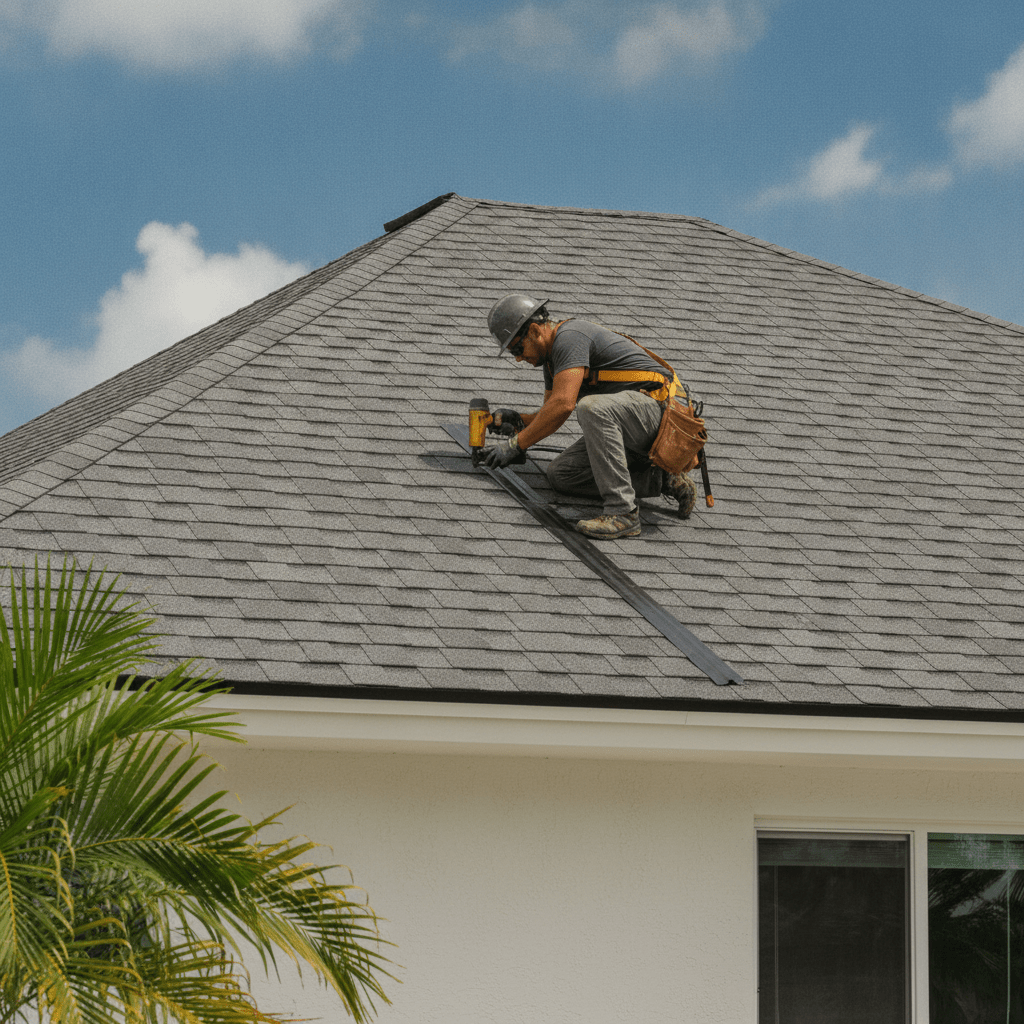
- Tear-off & dry-in inspection — Existing roofing is removed; deck is inspected for damage; peel-and-stick SWB is applied; a dry-in inspection is scheduled before any finish material is installed.
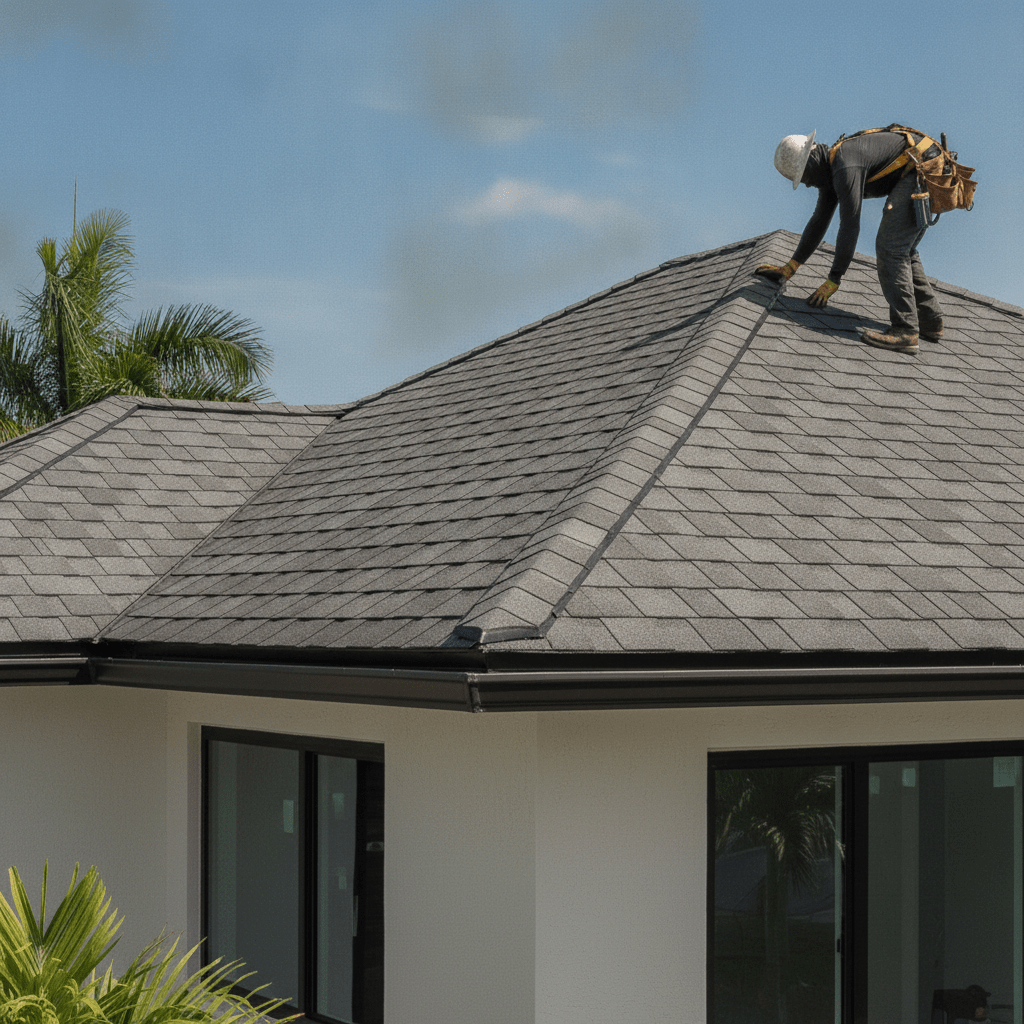
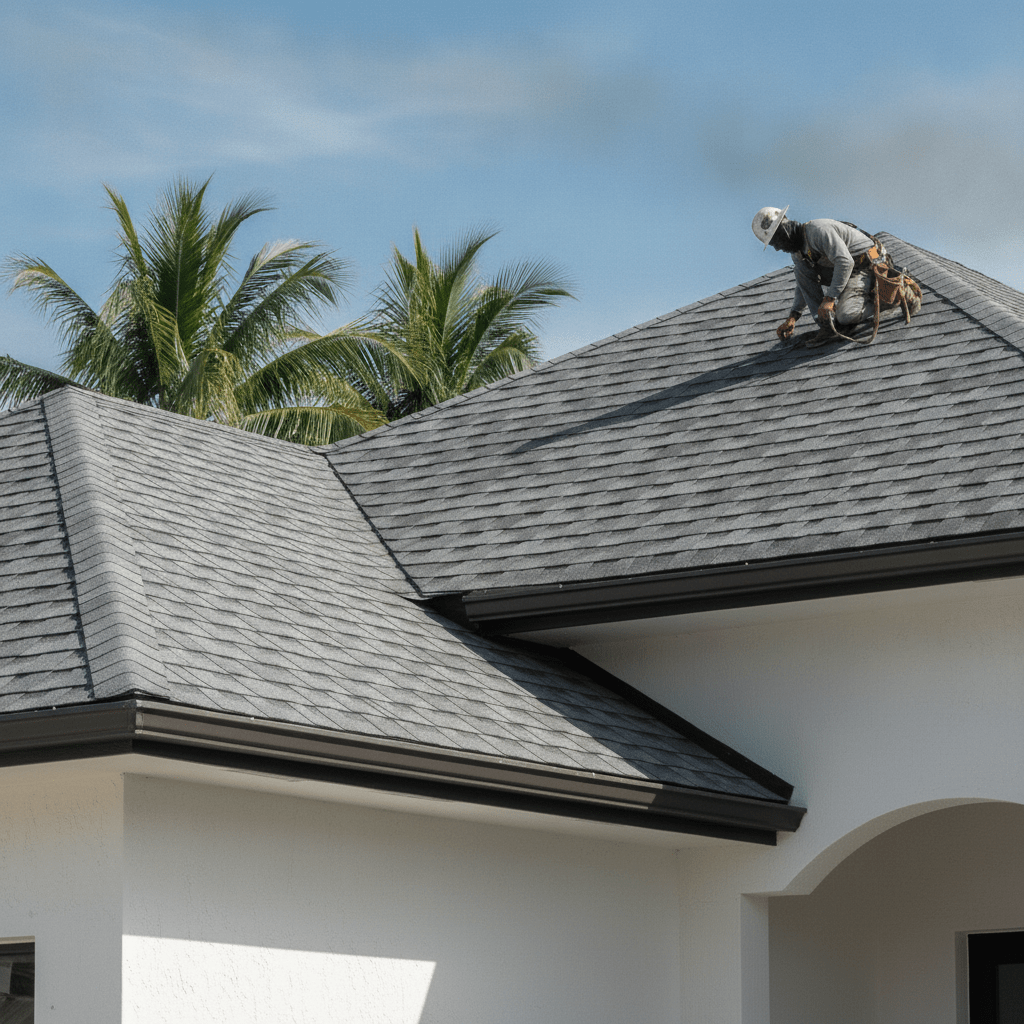
- Installation — Material-dependent: shingle installs typically complete in 1–3 days. Metal and tile take longer depending on roof complexity and square footage.
- Final inspection & wind mitigation report — The building department issues a final inspection. Once passed, you can commission a wind mitigation inspection — the report goes to your insurer for potential premium reduction.
Best time to schedule: late fall through early spring (October–April) tends to have fewer rain delays and shorter permit queues than peak summer months. That said, hurricane season runs June 1–November 30 — if your roof is aging, waiting for an ideal season is riskier than scheduling as soon as you're ready.
For roof financing options, PACE (Property Assessed Clean Energy) spreads project costs over up to 20 years through your property tax bill. A $15,000 project at 20 years runs approximately $173/month. No bank, no credit score impact. For qualifying homeowners, the My Safe Florida Home grant provides up to $10,000 in matching funds that can stack with PACE. For any tax-benefit questions, consult your CPA.
Ready to find out what your Miami roof replacement actually costs?
Or call Bigfoot Windows & Roofing at 786-886-2088
Schedule Your Free Estimate
Ready to get started? Request a free estimate — no phone call required.
Related Articles
Who We're Not the Right Fit For
- Homeowners seeking the absolute lowest bid. HVHZ compliance, NOA-approved materials, and proper fastening schedules cost more than non-compliant alternatives. If your priority is the cheapest number on paper, a contractor willing to skip permit requirements will beat our price. We are not that contractor.
- Projects requiring immediate same-week starts. Miami-Dade permits take time. If you need a roof replaced before a weekend closing, we cannot promise permit approval on your schedule — and neither can any compliant contractor.
- Commercial high-rise or large-scale industrial roofing. Bigfoot focuses on residential and small commercial. Large-scale industrial flat roofing is outside our core scope.
- Homeowners outside South Florida. We serve Miami-Dade, Broward, and Palm Beach counties. We do not operate in Central or North Florida.
Frequently Asked Questions
How much does a new roof cost in Miami in 2025?
Installed cost in Miami-Dade typically runs $750–$850 per square for architectural shingles, $1,050–$1,300 for metal standing seam, $1,000–$1,350 for concrete or clay tile, and $800–$1,400 for flat/TPO. On a 25-square home that translates to roughly $18,750–$32,500 before any structural repairs or deck replacement. HVHZ compliance requirements — materials with a Miami-Dade NOA or a Florida Product Approval that covers HVHZ use, enhanced fastening, and secondary water barrier — are included in those ranges, not added on top.
What roofing materials are required for Miami-Dade's High Velocity Hurricane Zone?
Any product installed in Miami-Dade must hold a Miami-Dade NOA or a Florida Product Approval that covers HVHZ use. Not every shingle or panel available in the U.S. qualifies. Your contractor must use products with a Miami-Dade NOA or a Florida Product Approval that covers HVHZ use, apply enhanced fastening schedules per the Florida Building Code 7th Edition, and install a full-deck secondary water barrier (peel-and-stick — 30-lb felt does not qualify). These are code requirements, not contractor preferences.
Does replacing my roof in Miami lower my homeowners insurance premium?
A new roof — especially metal — paired with a wind mitigation inspection report can significantly reduce your annual premium. Citizens Insurance is non-renewing policies on roofs 20–25+ years old, so a new roof may also make your home insurable again with better carriers. Specific savings depend on your carrier, coverage, and wind mitigation report results.
What permits are required for a roof replacement in Miami-Dade County?
A building permit from Miami-Dade County is required for every roof replacement — no exceptions. The permit process typically takes 1–3 weeks for a standard residential re-roof. Fees vary by project value but commonly run $200–$600. Two inspections are generally required: a dry-in inspection after the secondary water barrier is installed, and a final inspection once all finish material is complete. Skipping permits creates serious problems at resale and voids most manufacturer warranties.
How long does a roof replacement take in Miami?
The physical installation takes 1–5 days depending on roof size, complexity, and material. Shingle installs are typically the fastest; metal and tile take longer. The full timeline from signed contract to final inspection is usually 3–6 weeks, with most of that time spent waiting on permit approval. Late
Ready to get started? Get a free, no-pressure estimate from a licensed South Florida contractor.