
Metal Roof Replacement Cost in South Florida | Bigfoot Windows & Roofing
Metal roof replacement in South Florida costs $1,050–$1,300 per square for standing seam and $1,175–$1,400 per square for stone-coated metal tile, fully installed with HVHZ-compliant materials and permits included.
Key Takeaways
- Standing seam metal roofing in South Florida typically runs $1,050–$1,300 per square (per 100 sq ft installed).
- Stone-coated metal tile runs $1,175–$1,400 per square — higher due to labor complexity.
- HVHZ (Miami-Dade + Broward) code requirements add real cost: NOA-approved panels, code-compliant fastening, and secondary water barriers all matter.
- Permits are never optional for roof replacement in Florida — budget for permit fees and inspection time.
- A new metal roof can trigger a wind mitigation inspection that may meaningfully reduce your insurance premium.
The Real Problem
Why National Metal Roof Cost Guides Are Wrong for Miami-Dade
If you searched for metal roof replacement costs and landed on a national guide quoting $700–$900 per square, that number was not built for South Florida. Miami-Dade and Broward sit inside the High-Velocity Hurricane Zone (HVHZ) — the strictest residential building code jurisdiction in the United States. The Florida Building Code, 7th Edition, imposes wind-uplift testing requirements, fastening pattern mandates, and secondary water barrier rules that do not exist in most of the country. Every one of those requirements adds labor and material cost to your project.
This guide breaks down what metal roof replacement actually costs in South Florida, what drives the price range, and what you should expect to pay when your project is done correctly and to code.
South Florida Context
HVHZ, Salt Air, and the Florida Building Code
The HVHZ designation covers all of Miami-Dade County and Broward County. Under the Florida Building Code (FBC) 7th Edition, any roofing product installed in the HVHZ must carry a valid Miami-Dade Notice of Acceptance (NOA) or Florida Product Approval. That is not a technicality — it is a permit condition. If a contractor installs panels or clips that do not have the correct NOA or a Florida Product Approval that covers HVHZ use, the inspection fails and the roof has to come off.
Salt air accelerates corrosion on exposed fasteners and coatings. For this reason, standing seam systems — where no fastener is exposed to weather — outperform exposed-fastener metal in the coastal environment. At Bigfoot, we hold a Certified Roofing Contractor (CCC1333168) license and pull all required permits in Miami-Dade, Broward, and Palm Beach. Permit fees are a real line item; they vary by municipality but typically range from $300 to $1,000+ depending on project value and jurisdiction. Budget for them and ask your contractor to show you the permit receipt.
Cost Breakdown
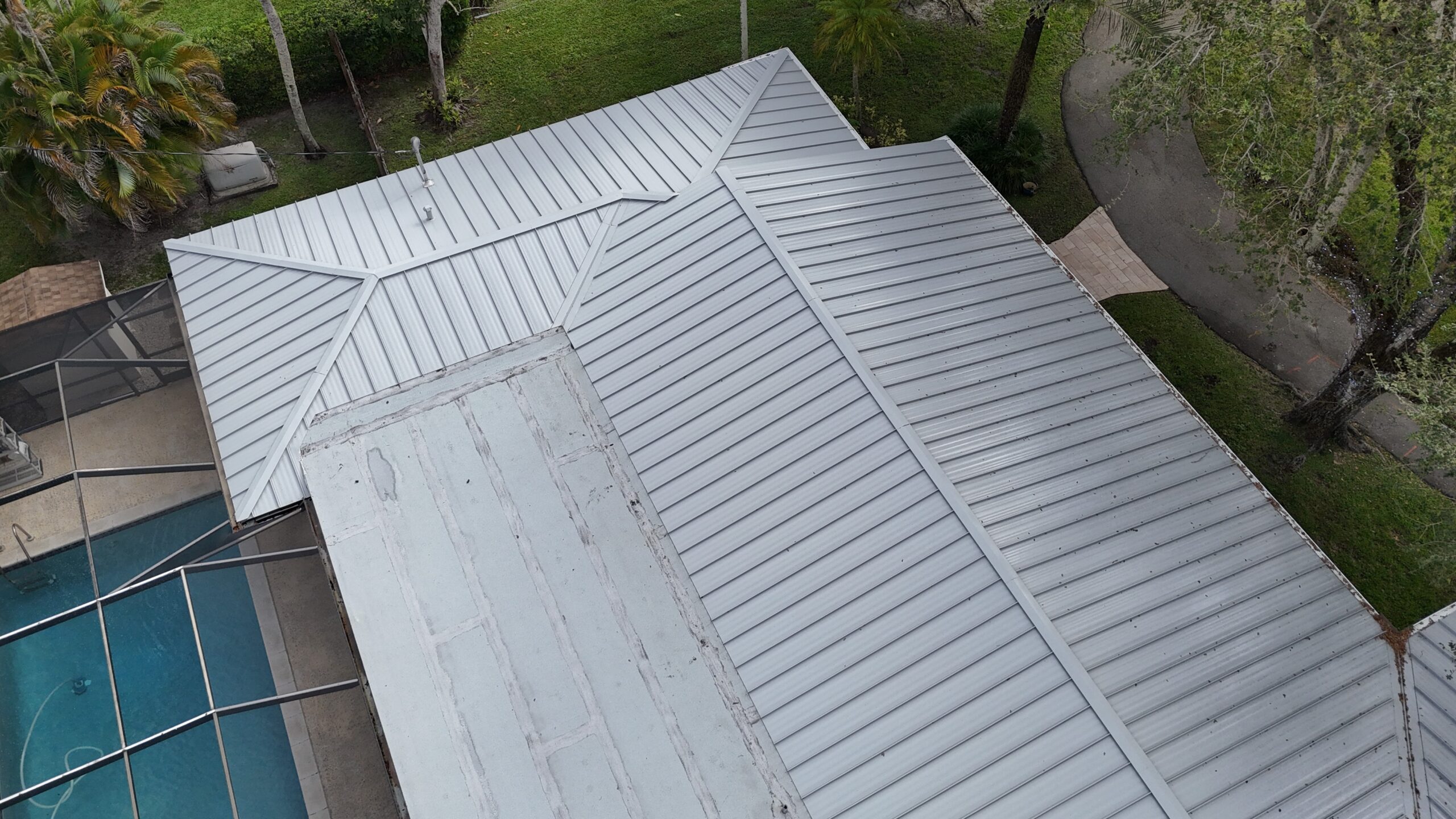
What Metal Roof Replacement Actually Costs in South Florida
The tables below use our current installed-price ranges. These are per square (per 100 sq ft) and include materials, labor, tear-off, permit, and standard accessories. They assume a straightforward residential roof with moderate pitch; complexity, roof-to-wall connection upgrades, and structural repairs are additional.
| Metal Roof Type | Installed Cost per Square | HVHZ NOA or a Florida Product Approval that covers HVHZ use Required | Best For |
|---|---|---|---|
| Standing Seam (Englert or Metal Alliance) | $1,050 – $1,300 | Yes | Long-term durability, insurance credits, coastal exposure |
| Stone-Coated Metal Tile (Westlake/Unified Steel) | $1,175 – $1,400 | Yes | HOA-preferred aesthetics, tile look with metal performance |
| Exposed-Fastener Metal Panel | $800 – $1,050 | Varies by product | Lower budget, non-coastal, low-slope utility buildings |
For a typical 2,000 sq ft South Florida home (roughly 20 squares), standing seam installed cost lands between $21,000 and $26,000. Stone-coated tile runs $23,500 to $28,000 for the same footprint. These are qualified ranges — your specific quote depends on pitch, access, existing deck condition, and whether structural work is required.
What Drives the Price Up — Line by Line
| Cost Driver | Typical Added Cost | HVHZ-Specific? |
|---|---|---|
| NOA-approved panels vs. standard metal | $50–$150/sq upcharge | Yes — HVHZ only |
| Code-compliant fastening pattern (FBC 1509) | $30–$80/sq in extra labor | Yes — HVHZ only |
| Secondary water barrier (peel-and-stick underlayment) | $20–$60/sq | Required statewide; HVHZ stricter |
| Roof-to-wall connection / hurricane strap upgrades | $500–$2,500 depending on scope | Triggered by FBC and permit inspection |
| Permit fees (municipality-dependent) | $300–$1,000+ | Required statewide |
| Deck replacement (rotted sheathing) | $80–$150/sheet | Discovered at tear-off |
One line item homeowners in Miami-Dade consistently overlook is the roof-to-wall connection upgrade. If the permit inspection reveals that your existing hurricane straps do not meet current FBC minimums, the inspector will require an upgrade before the roof passes. Because Bigfoot holds a Certified Roofing Contractor license and a Certified General Contractor (CGC1531370) license, we can handle structural modifications — hurricane strap upgrades, sheathing repairs, and code-driven structural scope — in-house. Homeowners who hire a roofing-only contractor may find themselves needing a second contractor for that structural work, which adds cost and coordination time.
Material Comparison
Standing Seam vs. Stone-Coated vs. Shingle — South Florida Side-by-Side
| Factor | Standing Seam Metal | Stone-Coated Metal Tile | Architectural Shingle |
|---|---|---|---|
| Cost per square (installed) | $1,050–$1,300 | $1,175–$1,400 | $750–$850 |
| Lifespan (South Florida) | 40–70 years | 40–70 years | 12–15 years |
| HVHZ NOA available | Yes (Englert or Metal Alliance) | Yes (Westlake/Unified Steel) | Yes (GAF) |
| Salt-air corrosion resistance | Excellent (no exposed fasteners) | Good (stone coating protects) | Moderate |
| Wind mitigation credit potential | High | High | Moderate |
| HOA acceptance | Often accepted (SB 293 protects) | High (tile appearance) | High |
Florida Senate Bill 293 means your HOA cannot legally prohibit you from installing metal roofing or impact windows — even in communities that historically required tile. Stone-coated metal tile is our most common recommendation when an HOA prefers a traditional aesthetic but the homeowner wants the durability of metal. Explore our full South Florida roofing options to compare all available systems.
Why It Matters Who Pulls the Permit
Licensed for Roofing, Structure, and Everything In Between
A licensed roofing contractor, not a lead aggregator or subcontractor network.
“When an inspector requires a hurricane strap upgrade mid-project, I don’t have to call a second contractor. We handle it in-house because we hold the right licenses. That matters for your timeline and your budget.”
President, Bigfoot Windows & Roofing
Products We Install
Metal Roofing Systems Bigfoot Installs in South Florida
Englert or Metal Alliance Standing Seam: Panels are roll-formed custom on-site from 24-gauge Galvalume or aluminum. The clip system uses the manufacturer’s approved clips, at the spacing its product approval specifies. This clip design allows thermal float (the panel expands and contracts without buckling), which is essential in South Florida heat. Oil canning and buckling are the two most common complaints about cheap nail-strip systems; the manufacturer-approved clip system avoids both. Warranty terms come from the panel manufacturer on your project (Englert or Metal Alliance) and are listed on your proposal.
Westlake / Unified Steel Stone-Coated Metal Tile: The Unified Steel product carries a Lifetime warranty with no named-storm exclusion and no saltwater exclusion — unlike some competitor warranties that void coverage when a named storm hits your county. The VSH (Very Severe Hail) rating is an added structural benefit. Poly Set foam installation may achieve higher wind resistance ratings than mechanical fasteners — refer to the product NOA for the specific tested values. Full-deck peel-and-stick underlayment qualifies as a secondary water barrier, which can generate an insurance discount at your next wind mitigation inspection (per Florida wind mitigation inspection form OIR-B1-1802).
If you are considering financing your metal roof, our PACE financing options allow payment through your property tax bill with no prepayment penalty and no credit score impact. A sample: $15,000 financed over 20 years at approximately $173/month. Roofing and window projects require separate PACE applications. For qualifying property owners, there may be tax benefits available — please consult your CPA.
What to Expect
The Metal Roof Replacement Process — Step by Step
- Free estimate: We measure your roof, assess pitch and complexity, inspect the deck for existing damage, and confirm which products carry a valid Miami-Dade NOA for your address.
- Permit application: We pull the permit from your municipality before any work starts. This is not optional in Florida — it is a legal requirement for roof replacement.
- Tear-off and deck inspection: Old roofing material is removed. Any rotted sheathing or structural issues identified at this stage are addressed before the new system goes on.
- Underlayment and secondary water barrier: Peel-and-stick underlayment is applied to the full deck. Full-deck peel-and-stick qualifies as a secondary water barrier, which can generate an insurance discount at your next wind mitigation inspection (per Florida wind mitigation inspection form OIR-B1-1802).
- Panel installation: Clips are installed to the FBC-required pattern, then panels are set. For Englert or Metal Alliance systems, panels run one continuous piece bottom to top — no horizontal seams, which is a structural advantage in hurricane conditions.
- Final inspection: The municipality inspector signs off. We do not consider the job complete until the permit is closed.
Ready to get an accurate South Florida metal roof estimate?
Or call Bigfoot Windows & Roofing directly: 786-886-2088
Schedule Your Free Estimate
Ready to get started? Request a free estimate — no phone call required.
Related Articles
Keep Reading
Related Articles
Who We’re Not the Right Fit For
- Homeowners needing the absolute lowest upfront price: If budget is the primary driver and you are open to exposed-fastener panels without verified HVHZ product approval, we may not be the right fit. We will not install products that are not code-compliant for your jurisdiction.
- Projects outside South Florida: We serve Miami-Dade, Broward, and Palm Beach counties. If your property is outside that area, you will need a local contractor familiar with your county’s building department.
- Investors seeking the fastest possible turnaround over code compliance: We pull permits on every job and will not skip the inspection process to hit an arbitrary timeline.
FAQ
Frequently Asked Questions
How much does it cost to replace a roof with metal in Miami-Dade County?
In Miami-Dade, expect to pay $1,050–$1,300 per square for standing seam and $1,175–$1,400 per square for stone-coated metal tile, fully installed. HVHZ requirements — NOA-approved materials or materials with a Florida Product Approval that covers HVHZ use, code-compliant fastening, and secondary water barriers — add cost that national averages do not reflect. A 2,000 sq ft home typically runs $21,000–$28,000 depending on system type, roof complexity, and any structural repairs discovered at tear-off.
Does a metal roof lower my homeowners insurance premium in Florida?
A new metal roof can trigger a wind mitigation inspection, and the results frequently reduce your premium. I have seen customers see significant reductions after a metal roof plus a wind mitigation inspection and policy review. The savings vary by insurer, policy structure, and inspection outcome — no contractor can guarantee a specific dollar amount. Citizens Insurance has also been non-renewing roofs 20–25 years or older, so a new metal roof can restore insurability as well as reduce cost.
What metal roofing materials are approved for the High-Velocity Hurricane Zone?
Any metal roofing product installed in the HVHZ must carry a valid Miami-Dade Notice of Acceptance (NOA) or Florida Product Approval. Englert or Metal Alliance standing seam systems and Westlake / Unified Steel stone-coated tile both carry current NOA approval. Fastening clips must also carry a Miami-Dade NOA or a Florida Product Approval that covers HVHZ use — knockoff clips fail inspection and can require full roof removal and reinstall. Ask your contractor to show you the NOA number before materials arrive on site.
How long does a metal roof last in South Florida’s heat, humidity, and salt air?
A properly installed standing seam or stone-coated metal roof in South Florida is designed for 40–70 years. Architectural shingles, by contrast, typically last 12–15 years due to UV intensity, heat cycling, and storm stress. Salt air is the primary enemy of exposed fasteners and certain coatings, which is why we recommend standing seam (no exposed fasteners) for coastal locations. For properties near saltwater, consult your contractor and product NOA for the applicable coating specification and distance threshold.
Do I need a permit to replace my roof with metal roofing in Miami-Dade?
Yes — permits are never exempt for routine roof replacement in Florida. In Miami-Dade, the permit triggers an HVHZ compliance review and a final inspection must be passed before the job is considered closed. Budget $300–$1,000+ in permit fees depending on your municipality and project value. A contractor who offers to skip the permit creates significant legal and insurance exposure for you as the homeowner. We pull every permit and close every inspection.
Can I finance a metal roof replacement and what does it cost per month?
PACE financing is available for qualifying homeowners. It is paid through your property tax bill — not a bank loan — with no credit score impact and no prepayment penalty. At approximately 9.49%, a $15,000 project financed over 20 years runs about $173/month. Roofing and window projects must be submitted as separate applications.
Ready to get started? Get a free, no-pressure estimate from a licensed South Florida contractor.