
BIGFOOT HOMEOWNER DECISION CENTER
Your South Florida Roof Replacement Guide: From First Inspection to Final Closeout
Understand the decisions, documents, people, and milestones involved in a South Florida roof replacement — in the order they actually happen.
Start the Guide Jump to Bigfoot’s Process
Written and reviewed by Darryl Rosenbaum, founder of Bigfoot Windows and Roofing — Florida licensed General, Residential, Roofing and Glass & Glazing contractor (CGC1531370, CCC1333168, CRC1331693, SCC131153098). Reviewed September 2026.
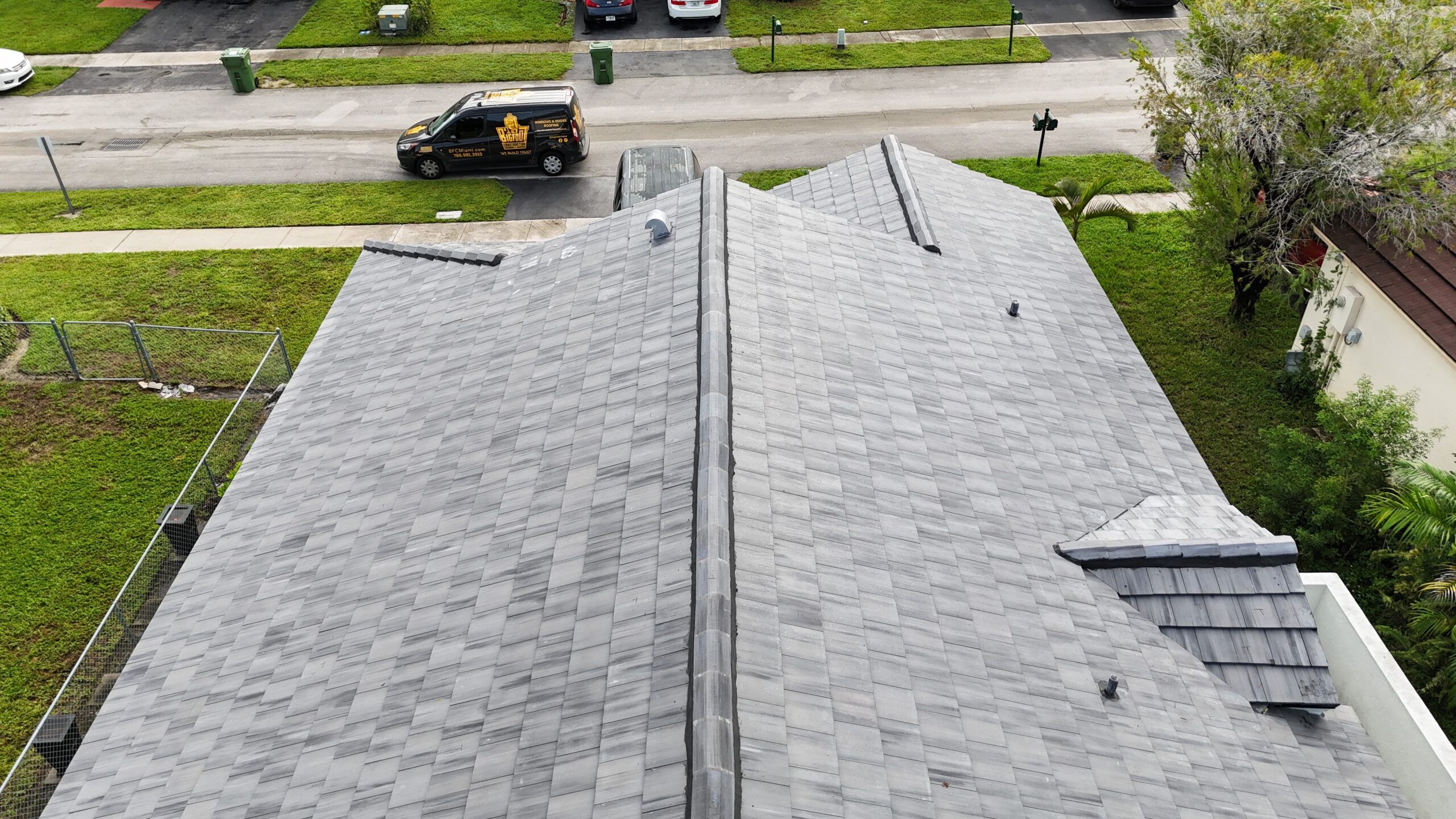
A completed Bigfoot shingle roof, seen from the air at closeout.
Where are you right now?
Pick the line that sounds like you. Each one jumps to the stage of the journey where your next decision lives. This is navigation, not a quiz — nothing is scored or stored.
- 1I am deciding whether I need a new roof.Start at Stage 1 — diagnose the roof condition.
- 3I am comparing roof types or proposals.Start at Stage 3 — choose the system, then compare written scopes.
- 7I signed and want to know what happens next.Start at Stage 7 — measurements, selections, permits and ordering.
- 8My project is starting soon.Start at Stage 8 — prepare the property and household.
The buyer’s journey in ten stages
Every stage below answers the same five things: the decision you are making, what Bigfoot does at that point, what you should verify or prepare, why it matters specifically in South Florida, and where the fuller answer lives. Use the numbered steps to move between stages; the previous and next buttons work with a keyboard.
- 1
- 2
- 3
- 4
- 5
- 6
- 7
- 8
- 9
- 10
Stage 1 — Diagnose the roof condition
Your decision
Is this a repair, a partial fix, or a full replacement — and who has looked at the roof closely enough to say so?
What Bigfoot does
Bigfoot’s process starts with an initial call to discuss your roofing needs and scope, followed by an on-site consultation with a thorough inspection and measurements.
What you verify or prepare
Note where you have seen staining, daylight in the attic, granule loss, cracked or slipped tiles, or ponding on a flat section. Ask the inspector to show you photos of what they found, not just a conclusion.
Why this matters in South Florida
Heat, UV and wind-driven rain age roofs faster here than in most of the country, and a roof that “looks fine” from the driveway can be failing at flashings and penetrations. Hurricane season runs June 1 to November 30 each year (NOAA National Hurricane Center climatology), so the diagnosis should also tell you how much storm season the roof can safely take.
Go deeper
Repair vs. replacement in South Florida — how to tell which you need
Stage 2 — Define the replacement goals and constraints
Your decision
What must the new roof do for you — storm protection, insurance position, resale, appearance, energy, a sale deadline — and what limits you: budget, HOA rules, an existing loan, or a window project you also need?
What Bigfoot does
During the on-site consultation Bigfoot identifies the roof type, materials and colour preferences with you, then prepares a detailed estimate and schedules an appointment to review it and answer questions.
What you verify or prepare
Write your goals down before you see any numbers. Pull your insurance declarations page and your HOA’s exterior rules if you have them. Decide whether roof and windows are competing for the same budget.
Why this matters in South Florida
Miami-Dade and Broward are the High-Velocity Hurricane Zone under the Florida Building Code (Florida Building Commission — Florida Building Code Online), which narrows the products you can choose and raises the documentation bar — so goals like “cheapest possible” and “meets code” are not always compatible here.
Go deeper
Stage 3 — Choose the appropriate roof system
Your decision
Shingle, concrete or clay tile, standing-seam metal, metal tile, or a low-slope membrane — chosen for your roof’s pitch, structure, neighbourhood rules and the length of time you plan to own the home.
What Bigfoot does
At approval Bigfoot takes final measurements and confirms roof orientation, materials and colours with you before anything is ordered.
What you verify or prepare
Ask which product approval each candidate system carries for your county, whether your structure needs an engineer’s review for a heavier system, and whether the sample or brochure you were shown is the exact product on the proposal. Bigfoot’s terms state that photos and brochures are examples and that actual materials can vary — so the product name and approval number, not the picture, are what you are buying.
Why this matters in South Florida
Every roofing product installed in the HVHZ needs a current Miami-Dade Notice of Acceptance or a Florida Product Approval for the assembly as installed (Miami-Dade Product Control search · Florida Product Approval search). A system that is fine in Orlando may not be approvable on your house.
Go deeper
Best roofing materials for Florida heat and humidity
Stage 4 — Compare written scopes, not just totals
Your decision
Which proposal actually describes the same roof? Two totals are only comparable when the tear-off, underlayment, fastening, flashings, ventilation, decking method, permits and cleanup are written the same way.
What Bigfoot does
Bigfoot’s proposal terms say proposals cover only the items stated in them, and that all terms and conditions must appear in writing on the contract — there are no oral promises outside the written agreement.
What you verify or prepare
Lay the proposals side by side and mark every line as the same, different, or missing. Anything one bid includes and another does not name is a question, not an assumption.
Why this matters in South Florida
HVHZ assemblies have more required components — secondary water barriers, specific fastening patterns, approved underlayments — than most of the country, which is exactly where a low bid usually goes quiet. A missing line item here is a code item, not a nice-to-have.
Go deeper
Why roofing quotes vary so much in South Florida
Stage 5 — Verify contractor, license, insurance, products and documentation
Your decision
Is the company on the proposal the licensed roofing contractor who will pull the permit — and can you prove it in five minutes?
What Bigfoot does
Bigfoot Construction, Inc. holds Florida General Contractor (CGC1531370), Residential Contractor (CRC1331693), Roofing Contractor (CCC1333168) and Glass & Glazing (SCC131153098) licenses, each verifiable on the state’s license portal.
What you verify or prepare
Look the license number up yourself on the Florida DBPR license search, confirm the name on the license matches the name on the contract, and ask for a certificate of insurance. Ask Bigfoot for a current certificate of insurance before signing and confirm in writing when and how it will be provided.
Why this matters in South Florida
Roofing in Florida is a licensed trade; an unlicensed installer cannot lawfully pull your permit, and the permit is what triggers the inspections that protect you. The county’s own guidance on hiring a contractor is short and worth reading (Miami-Dade County — hiring contractors).
Go deeper
How to verify a contractor is legitimate before you sign
Stage 6 — Review contract, allowances, exclusions, payment milestones and change-order rules
Your decision
Do you understand, before signing, how hidden wood is priced, when money is due, what is excluded, and how a change to the scope gets authorised?
What Bigfoot does
Bigfoot’s terms price concealed rotten or damaged wood at the Carpentry Replacement Rates published in the proposal, billed as used at the next progress payment; changes to the scope are made only by a written change order signed by both parties; and final payment is due on completion and final inspection by the building department.
What you verify or prepare
Find the carpentry rate sheet, the change-order clause, the payment schedule and the exclusions in your own copy. If any one of them is not there, it is “not stated” — which is a question to ask, not a promise either way.
Why this matters in South Florida
Older South Florida homes often have tongue-and-groove or undersized decking that only reveals itself at tear-off, so the wood-pricing method is the single most common source of a surprise on a roofing invoice here. Florida law also ties a contractor’s deposit to a duty to apply for the permit within a set period (Florida Statutes §489.126).
Go deeper
Hidden tear-off costs on older South Florida homes
Stage 7 — Complete measurements, selections, HOA items, engineering, permits and procurement
Your decision
Your colour and product selections are now final, your association has approved them where required, and you know who is filing what with the county.
What Bigfoot does
After approval Bigfoot sends the permit package via DocuSign for submission to the county, then places the material order; wait times vary with availability and with HOA approval where one applies.
What you verify or prepare
Return DocuSign items promptly, send Bigfoot your HOA or condo approval letter if your community requires one, and keep a copy of the permit number once it is issued. Confirm in writing who will record the Notice of Commencement, who is responsible for any required release, and when each document will be completed.
Why this matters in South Florida
Each county runs its own permitting portal and inspection sequence (Miami-Dade roofing permits · Broward Building Code Services · Palm Beach County Building Division), and a Notice of Commencement is recorded before work starts on most projects above the statutory threshold (Florida Statutes §713.13). Tile and metal are made to order, so nothing about a start date is real until the permit and the material are both in hand.
Go deeper
Stage 8 — Prepare the property and household
Your decision
What has to move, be covered, be unlocked or be told before a crew, a dumpster and a material delivery arrive?
What Bigfoot does
Bigfoot’s proposal includes a “Preparing Your Home” page the homeowner initials: clear the work area, expect dust, keep pathways clear, move vehicles so the crew can stage materials and the dumpster, plan for pets and children, secure attic items, take fragile pictures and mirrors off the walls, and cover pools near the roofline.
What you verify or prepare
Walk the house with the printable checklist below, photograph any interior stains that already exist, and tell your project contact about septic tanks, drain fields, gates, alarms or rooftop equipment. Bigfoot’s terms make the customer responsible for notifying the contractor of exposed sheathing, septic tanks and drain fields, protecting interior furnishings from debris that can fall through the deck, and removing satellite dishes, solar, signage and other rooftop items.
Why this matters in South Florida
Concrete-block homes with open attics and tile-over-batten roofs let a surprising amount of dust and debris through during tear-off, and screened pool enclosures sit exactly where material comes off the eave. Preparation here is about protecting what is under and beside the roof, not just clearing the driveway.
Go deeper
Print the homeowner preparation checklist
Stage 9 — Tear-off, dry-in, inspections, installation, cleanup and communication
Your decision
When the deck is exposed and something unexpected is found, you decide — in writing — how it is handled before the work continues.
What Bigfoot does
Bigfoot’s terms state that where rotten, damaged or non-code deck, sheathing or framing is found during tear-off, it is replaced at the published Carpentry Replacement Rates and documented by change order before the work proceeds, and that the customer is notified of the condition and the cost prior to replacement.
What you verify or prepare
Ask to see photos of any condition found before you sign a change order, keep a copy of every signed change order, and know who your single point of contact is for the duration. Before work begins, ask for the written dry-in and wet-weather plan, including how exposed areas are protected if weather interrupts the work.
Why this matters in South Florida
Afternoon storms are a daily possibility for half the year, and county inspectors check the roof at defined points before it is covered (Miami-Dade County — inspections), so the order of tear-off, dry-in and inspection is not the crew’s preference — it is the sequence that keeps water out and the permit valid.
Go deeper
Florida roofing process timeline
Stage 10 — Final inspection, punch list, permit closeout, warranty documents and homeowner records
Your decision
You accept the roof as complete only when the final inspection has passed, the punch list is closed, the permit is closed, and the documents you will need for insurance and resale are in your hands.
What Bigfoot does
Bigfoot’s stated commitment is that a job is not considered complete until the permit is closed and the homeowner has written confirmation in hand, followed by a 30-day follow-up call.
What you verify or prepare
Walk the roofline and the yard for leftover nails and debris, confirm the final inspection result on the county portal, and file the completion packet listed below. Bigfoot’s warranty page describes a 10-year workmanship warranty on its installation labour and states that manufacturer warranty documents are provided upon installation. Because warranty language can vary by contract and scope, rely on the duration, exclusions and repair coverage stated in your signed agreement and written warranty. Ask Bigfoot to reconcile any difference before signing.
Why this matters in South Florida
Your insurer, a future buyer and a wind-mitigation inspector will each ask for proof — permit, final inspection, product approvals, and roof-to-wall attachment where it applies. A closed permit is the record that outlives everyone’s memory of the job.
Go deeper
Roofing warranties in Florida: materials vs. workmanship
Previous stage Next stage
Bigfoot’s process, stage by stage
This section separates statements documented in Bigfoot’s current proposal (marked source: proposal) from items that homeowners should confirm in writing for their specific project. It does not promise durations; schedules depend on permitting, product availability, weather, inspections and site conditions.
+Stage 1 — Diagnose the roof condition
- Who owns the stepBigfoot’s office takes the initial call and schedules the site visit; the on-site consultation is done by a Bigfoot estimator. source: proposal
- What you seeA Bigfoot inspection and measurement visit that identifies roof type, materials and colour preferences. source: proposal
- Documents producedAsk which inspection records and before, during and after photos will be included in your closeout package, and have that commitment written into the agreement.
- DependenciesRoof access and daylight; attic access where interior evidence needs to be checked. Confirm the required inspection sequence for your jurisdiction and whether the crew or inspector will need attic or interior access.
- What can delay itBigfoot’s terms note the proposal is based on visual conditions — anything that cannot be seen without opening the roof is handled later under the unforeseen-conditions clause, not guessed at now. source: proposal
- How Bigfoot communicatesOne named contact from the day you sign to the day the permit closes; the public number is 786-886-2088. source: proposal
- What you must doProvide access to the property when requested by Bigfoot between 7 AM and 6 PM. source: proposal
- Complete whenBigfoot has prepared the detailed estimate and scheduled the appointment to review it with you. source: proposal
+Stage 2 — Define the replacement goals and constraints
- Who owns the stepBigfoot’s estimating team — architect-led estimators who guide selection, scope and budget from day one. source: proposal
- What you seeA detailed estimate from Bigfoot and a review appointment where questions are answered. source: proposal
- Documents producedThe Estimate — which Bigfoot’s terms define as a good-faith estimate, not yet a contract, effective for one week and superseding all prior oral negotiations. source: proposal
- DependenciesBigfoot’s terms say prices are subject to change depending on final engineering or architectural analysis, so a structural question raised at this stage can move the number. source: proposal
- What can delay itLetting the estimate expire — Bigfoot’s terms give one week to return a signed copy and three weeks from acceptance to execute the contract. source: proposal
- How Bigfoot communicatesClear process, regular updates and quick responses through your go-to contact at Bigfoot. source: proposal
- What you must doBring your goals, HOA rules and insurance questions to the review appointment. Confirm whether Bigfoot will submit the HOA or ARC application or only provide supporting documents; the written proposal should identify the responsible party and any related fees.
- Complete whenYou have reviewed the estimate with Bigfoot and made your final decisions on orientation, materials and colours. source: proposal
+Stage 3 — Choose the appropriate roof system
- Who owns the stepYou choose; Bigfoot confirms roof orientation, materials and colours at approval. source: proposal
- What you seeSamples, photos and brochures — which Bigfoot’s terms describe as examples, with actual materials able to vary. source: proposal
- Documents producedThe product approval (Miami-Dade NOA or Florida Product Approval) for the assembly on your proposal. Request the applicable Miami-Dade NOA or Florida Product Approval information for the proposed roofing system and confirm that the approved assembly matches the written scope.
- DependenciesRoof pitch and structure; heavier systems can need an engineer’s review. If structural review or an engineer’s letter may be required, confirm who orders it, who pays for it and whether it is included before authorizing the work.
- What can delay itBigfoot’s terms exclude responsibility for products the customer selects from outside Bigfoot’s represented product lines — a special-order request restarts the approval question. source: proposal
- How Bigfoot communicatesBigfoot confirms the final selections with you at the approval appointment before the deposit is collected. source: proposal
- What you must doConfirm colour and product in writing; obtain HOA colour approval where your community requires it. Confirm whether Bigfoot will submit the HOA or ARC application or only provide supporting documents; the written proposal should identify the responsible party and any related fees.
- Complete whenBigfoot has your confirmed orientation, materials and colours on record. source: proposal
If your roof is tile — Bigfoot’s terms note that white mineral marks (efflorescence) on concrete tile are naturally occurring from curing and moisture and are not a defect. Ask how product lead times, field measurements, fabrication and permit approval affect scheduling; treat any timing estimate as dependent on written approvals and manufacturer availability.
If your roof is standing-seam metal or metal tile — Bigfoot’s terms note that minor waviness or “oil-canning” on metal systems is an aesthetic characteristic inherent to the material, not a performance defect.
If your roof is low-slope or flat — For flat or low-slope roofs, ask the proposal to identify drainage and transition details, the approved system and the inspections required by the permitting jurisdiction.
+Stage 4 — Compare written scopes, not just totals
- Who owns the stepYou do. Bigfoot’s estimator answers questions about Bigfoot’s scope; nobody at Bigfoot interprets a competitor’s proposal for you. Bigfoot can explain its own written scope. When comparing proposals, ask each contractor to clarify its own inclusions, exclusions, allowances and omitted items in writing.
- What you seeBigfoot’s proposal states its scope of work; its terms say the contract does not include permit, architectural or engineering fees or additional insurance requirements unless noted in the Scope of Work. source: proposal Do not assume permit, architectural, engineering or HOA/association charges are included. The signed Scope of Work should state each inclusion, exclusion and fee explicitly.
- Documents producedBigfoot’s proposal includes a published Carpentry Replacement Rates page so hidden-wood pricing is visible before you sign. source: proposal
- DependenciesBigfoot’s terms say the cost of any item inadvertently omitted from a proposal is added to the total — so the written scope is the comparison, not the cover price. source: proposal
- What can delay itBigfoot’s terms make the estimate expire one week after its date; a long comparison may require a fresh estimate. source: proposal
- How Bigfoot communicatesIn writing — Bigfoot’s terms assume no responsibility for oral promises. source: proposal
- What you must doAsk for anything missing from a proposal to be added in writing before you compare totals — Bigfoot’s terms say the cost of an item inadvertently omitted is added to the total quoted. source: proposal
- Complete whenYou can name, for each proposal, every line that is the same, different or missing — and for Bigfoot’s proposal, the written scope is the only scope its terms recognise. source: proposal
+Stage 5 — Verify contractor, license, insurance, products and documentation
- Who owns the stepYou do — the license portal is public and takes minutes, and Bigfoot’s proposal prints its license numbers with their state lookup links. source: proposal
- What you seeBigfoot presents itself as a licensed General, Residential, Roofing and Glass & Glazing contractor, Florida licensed and insured. source: proposal
- Documents producedBigfoot’s four license numbers with their state lookup links: CGC1531370, CRC1331693, CCC1333168, SCC131153098. source: proposal
- DependenciesThe contracting entity on the license must match the entity on the contract — Bigfoot’s terms define “we” as Bigfoot Construction, Inc. source: proposal
- What can delay itNothing on Bigfoot’s side — the four license numbers appear on the proposal’s credentials page; a homeowner who skips this step and later discovers a mismatch has a much harder problem. source: proposal
- How Bigfoot communicatesAsk Bigfoot for a current certificate of insurance before signing and confirm in writing when and how it will be provided.
- What you must doVerify the license, request the insurance certificate, and check that the product approval on the proposal matches the product name. Ask Bigfoot for a current certificate of insurance before signing and confirm in writing when and how it will be provided.
- Complete whenLicense, insurance and product approval each check out against a primary source, not a brochure — Bigfoot’s proposal states it is Florida licensed and insured, and the state portal is where you confirm the license part. source: proposal
+Stage 6 — Review contract, allowances, exclusions, payment milestones and change-order rules
- Who owns the stepBoth parties — Bigfoot’s terms say the Estimate has no effect until a signed copy is received at Bigfoot’s office and acceptance is acknowledged in writing, and that a Master Service Agreement is executed. source: proposal
- What you seeThree pages of terms you initial, including the unforeseen-conditions, hidden-conditions carpentry, change-order and payment clauses. source: proposal
- Documents producedThe signed proposal; any later change is a written “Change or Additional Work Order” signed by both owner and contractor, with the contract sum and time adjusted accordingly. source: proposal
- DependenciesPayment milestones: Bigfoot’s terms name a deposit, progress payments and a final payment due on completion and final inspection by the building department. source: proposal Use only the deposit amount and payment milestones written in your specific signed contract; confirm the event that triggers each payment before signing.
- What can delay itBigfoot’s terms note that a design, estimating and coordination fee may apply to pricing a requested change, whether or not the change is elected. source: proposal
- How Bigfoot communicatesChanges are communicated and authorised only through the written change order; one signature from each party executes it. source: proposal
- What you must doDecide whether to pre-purchase an estimated wood allowance — Bigfoot’s proposal offers a 20% discount for doing so and refunds unused wood at close-out. source: proposal If concealed deck damage is found, do not assume an owner-repair option. Ask Bigfoot to document the available choices, price, effect on schedule and warranty before work proceeds.
- Complete whenBigfoot has acknowledged your signed acceptance in writing. source: proposal
+Stage 7 — Measurements, selections, HOA items, engineering, permits and procurement
- Who owns the stepBigfoot’s estimator/permitting coordinator prepares the permit package and manages municipal submissions. source: proposal
- What you seeA DocuSign permit package from Bigfoot, then order placement; wait times vary with availability and HOA approval if applicable. source: proposal
- Documents producedThe permit application and, once issued, the permit; the Notice of Commencement where required. Confirm in writing who will record the Notice of Commencement, who is responsible for any required release, and when each document will be completed.
- DependenciesCounty plan review; HOA approval where applicable; manufacturer availability for made-to-order tile and metal. Ask how product lead times, field measurements, fabrication and permit approval affect scheduling; treat any timing estimate as dependent on written approvals and manufacturer availability.
- What can delay itBigfoot’s terms exclude responsibility for delay from manufacturing or delivery delays, storms and other causes beyond its control. source: proposal
- How Bigfoot communicatesBi-monthly updates on order status while materials are on order; Bigfoot flags any delays proactively. source: proposal
- What you must doSign the DocuSign package promptly and deliver any HOA approval letter. Confirm whether Bigfoot will submit the HOA or ARC application or only provide supporting documents; the written proposal should identify the responsible party and any related fees.
- Complete whenThe permit is issued and Bigfoot’s material order is confirmed ready for installation scheduling. source: proposal
Jurisdiction differences — Miami-Dade and Broward are HVHZ jurisdictions; Palm Beach County is not, though it remains a wind-borne-debris region under the Florida Building Code (Florida Building Code Online). Each county and many municipalities run their own permit portal and inspection sequence. Permit procedures vary by county and municipality. Confirm the current requirements directly with the authority having jurisdiction and the project permitting coordinator.
+Stage 8 — Prepare the property and household
- Who owns the stepYou do; Bigfoot’s proposal gives you the “Preparing Your Home” page to initial. source: proposal
- What you seeEight preparation items on Bigfoot’s proposal: clear the work area, expect dust, provide access, move vehicles, plan for pets and children, secure attic items, protect interiors from vibration, and cover pools near the roofline. source: proposal
- Documents producedYour initialled preparation page in the signed proposal. source: proposal
- DependenciesAccess from 7 AM to 6 PM as requested; Bigfoot’s terms make the customer responsible for scheduling other contractors so they do not interfere. source: proposal
- What can delay itRooftop items — Bigfoot’s terms require the customer to remove or relocate satellite dishes, solar, signage and other rooftop items at the customer’s expense. source: proposal
- How Bigfoot communicatesBefore installation, confirm the name and contact information of your project contact and how often you should expect updates during ordering and active work.
- What you must doNotify Bigfoot of exposed sheathing, septic tanks and drain fields; protect interior furnishings from debris; keep children and pets away from the work until substantial completion. source: proposal
- Complete whenEvery item on the printable checklist below is done the evening before the crew arrives. Review the project-specific preparation instructions with your Bigfoot contact; only the requirements confirmed in writing for your job should be treated as mandatory.
Storm season — Weather decisions are project- and condition-specific. Ask for the current severe-weather and temporary-protection plan before tear-off begins.
+Stage 9 — Tear-off, dry-in, inspections, installation, cleanup and communication
- Who owns the stepBigfoot’s project manager keeps the job moving; operations and administration sit under the same roof. source: proposal
- What you seeInstallation scheduled once the order is ready; Bigfoot installs the roof and the required inspections are passed. source: proposal
- Documents producedA change order for any rotten, damaged or non-code deck, sheathing or framing found at tear-off, documented before the work proceeds. source: proposal
- DependenciesWeather and inspections — Bigfoot’s terms name sudden rain, storms and windstorms among causes of delay beyond its control. source: proposal Before work begins, ask for the written dry-in and wet-weather plan, including how exposed areas are protected if weather interrupts the work.
- What can delay itConcealed deck conditions — Bigfoot’s terms say the customer is notified of the condition and the cost prior to replacement. source: proposal When concealed damage is found, require written documentation, price and schedule impact before authorizing a change; confirm how the affected area will be protected while a decision is pending.
- How Bigfoot communicatesUnforeseen conditions are performed only after the customer has been notified, on a time-and-materials or firm-bid basis. source: proposal
- What you must doBigfoot’s terms place possession of and responsibility for material with the customer once it is delivered to the job site, and ask the customer to remove items from walls and ceilings before the job starts. source: proposal
- Complete whenThe roof is installed, the required inspections have passed, and any finishing touches or repairs have been discussed. source: proposal
+Stage 10 — Final inspection, punch list, permit closeout, warranty documents and records
- Who owns the stepBigfoot — a job is not considered complete until the permit is closed and you have written confirmation in hand. source: proposal
- What you seeInspections passed, finishing touches completed, then the remaining balance is collected once the job is complete and inspections pass. source: proposal
- Documents producedManufacturer warranty documents provided upon installation and Bigfoot’s workmanship warranty. source: proposal Before final payment, request a written closeout checklist identifying the signed proposal, change orders, permit and inspection records, applicable releases, product approvals, warranty documents and paid invoice.
- DependenciesFinal payment is due on completion and final inspection by the building department unless there is an open permit, condition or violation not related to Bigfoot’s scope. source: proposal
- What can delay itClaims — Bigfoot’s terms require claims for non-fulfilment to be made in writing within fifteen days after completion. source: proposal
- How Bigfoot communicatesA 30-day follow-up call after every completed job; contact after completion is answered within two hours during business hours; anything needing attention is addressed within two business days. source: proposal
- What you must doDecide on the photography release — Bigfoot’s terms grant it the right to photograph completed work for marketing unless you opt out in writing before the project starts. source: proposal If wind-mitigation or roof-to-wall documentation is part of the scope, confirm who prepares it and include the required document in the written closeout checklist.
- Complete whenPermit closed, written confirmation received, and your warranty documents on file — Bigfoot’s warranty page states a 10-year workmanship warranty on installation by Bigfoot crews, not covering acts of God, vandalism, misuse, alterations by others or conditions outside its scope. source: proposal Because warranty language can vary by contract and scope, rely on the duration, exclusions and repair coverage stated in your signed agreement and written warranty. Ask Bigfoot to reconcile any difference before signing.
Roof-to-wall straps — where a customer elects strap installation, Bigfoot’s terms make no representation about eligibility for wind-mitigation insurance credits. Your insurer decides credits; the guide does not.
Who owns which question
This guide is the map, not the whole territory. Each question below gets a short orientation here and one link to the Bigfoot page or tool that owns the full answer.
Repair or replace?
A roof rarely fails all at once. It develops a weak area — a valley, a pipe boot, a section that ponds — and the honest question is whether fixing that area buys you years or months. Age of the roof, how many layers are on it, what the decking looks like from the attic, and how much storm season it has already absorbed all feed that call. A written inspection with photos is the only diagnosis worth paying attention to; a drive-by opinion is not. If the answer turns out to be replace, come back to Stage 2 of this guide.
Repair vs. replacement in South Florida — how to tell which you need
What will it cost?
An estimate moves through stages: a first range after the site visit, a detailed written proposal after measurements and selections, and a final contract sum that can still change through written change orders if concealed conditions are found at tear-off. What you can control is whether every stage is in writing and whether unit rates for hidden wood are disclosed before you sign. This guide deliberately carries no price figures — the pricing guide does that job, with current ranges by system and what drives them.
What a South Florida roof replacement actually costs (pricing guide)
Which roof material?
The choice is narrower in South Florida than the brochures suggest: the system has to carry a current product approval for your county, suit your roof’s pitch and structure, satisfy your association, and match how long you plan to stay. Shingle, concrete or clay tile, standing-seam metal, metal tile and low-slope membranes each trade off differently on weight, lead time, appearance and maintenance. Choose the system first, then the colour — not the other way round.
Best roofing materials for Florida heat and humidity
How do I compare bids?
Two proposals with different totals are usually describing two different roofs. One includes the secondary water barrier, the other calls it an option; one prices decking per sheet, the other says “as needed”; one names the permit, the other is silent. Line the scopes up item by item and treat every silence as a question. The tools in this Decision Center will help you do that; for now, the article on why quotes vary shows you where the differences hide.
Why roofing quotes vary so much in South Florida
Is the contractor qualified?
Preview of the verification checklist: the license number is on the proposal and is active on the state portal in the same company name; a certificate of insurance is offered without argument; the product approval numbers on the proposal exist and match the products named; the permit will be pulled under that license, not yours. Any one of those failing is a stop, not a negotiation.
How to verify a contractor is legitimate before you sign
What will create change orders?
Almost always: what is under the old roof. Rotten decking, undersized or non-code sheathing, damaged fascia, and truss ends that have been wet for years cannot be seen until tear-off. A written unit price or an allowance for that wood, agreed before the job starts, is the difference between a predictable invoice and an argument on the driveway. Scope you add mid-job — a new skylight, extra ventilation — is the other source, and it should follow the same signed change-order path.
Hidden tear-off costs on older South Florida homes
What permits are involved?
One project stage, in summary: the licensed contractor applies for the roofing permit with your county or municipality, plan review approves the assembly and its product approvals, a Notice of Commencement is recorded where required, inspections happen at defined points during the work, and the permit is closed after the final inspection passes. The Miami-Dade guide walks the full procedure; Broward and Palm Beach differ in portal and sequence.
How do warranties work?
Two different documents from two different parties. The manufacturer’s warranty covers the roofing materials and is written by the manufacturer, with its own registration and conditions. The workmanship warranty covers the installation and is written by the contractor. Neither one is a maintenance plan, and neither one is the same as the guaranty language in the contract terms — read all three before you file them.
Roofing warranties in Florida: materials vs. workmanship
How do I finance it?
A neutral prompt, not a pitch: decide whether you will pay from savings, a home-equity source, a contractor-arranged program, or a mix — and decide it before the proposal review, because the payment schedule in the contract should match the money’s timing. Ask what a program’s fees are and who pays them, and get the answer in writing.
Financing a new roof in Florida
What happens after I sign?
That is what this guide exists to answer. Stages 7 through 10 above walk that sequence — measurements and selections, county filing and material ordering, property preparation, the work itself, and closeout with your records — and describe the company’s own process with every policy statement sourced to the current proposal or flagged for confirmation. Nothing in that sequence is a promise of duration; each step depends on the one before it.
Bigfoot’s process, stage by stage
South Florida Roofing Buyer’s Guide — Bigfoot Windows and Roofing · 786-886-2088
Homeowner preparation checklist
Print this checklist
Items marked source: proposal come from Bigfoot’s current proposal pages. Other checklist items are practical questions or preparation steps that should be confirmed for the specific project.
- Move vehicles out of the driveway so the crew can stage materials and the dumpster. source: proposal
- Remove or cover patio furniture, décor and fragile items around the work area, inside and out. source: proposal
- Cover or remove valuables stored in the attic — dust and small debris filter through the decking during tear-off. source: proposal
- Take fragile pictures and mirrors off the walls — vibration from tear-off can dislodge them. source: proposal
- Plan to keep pets and children away from the active work area. source: proposal
- Keep pathways and access to the roof clear of obstacles for the installers. source: proposal
- Cover pools near the roofline; screen-enclosure work is by others. source: proposal
- Remove or relocate satellite dishes, solar equipment, signage and other rooftop items. source: proposal
- Tell Bigfoot about exposed sheathing, septic tanks and drain fields before the crew arrives. source: proposal
- Provide access to the property between 7 AM and 6 PM on the requested days. source: proposal
- Photograph any existing interior stains or leak indicators the evening before work starts. Review the project-specific preparation instructions with your Bigfoot contact; only the requirements confirmed in writing for your job should be treated as mandatory.
- Unlock gates, disarm exterior alarms and confirm where the crew can plug in. Review the project-specific preparation instructions with your Bigfoot contact; only the requirements confirmed in writing for your job should be treated as mandatory.
- Note gutters, screens and vibration-sensitive equipment you want protected or removed. Review the project-specific preparation instructions with your Bigfoot contact; only the requirements confirmed in writing for your job should be treated as mandatory.
- Confirm your HOA approval and final colour selections are on file. Confirm whether Bigfoot will submit the HOA or ARC application or only provide supporting documents; the written proposal should identify the responsible party and any related fees.
- Give your project contact an emergency phone number and your preferred way to receive updates. Review the project-specific preparation instructions with your Bigfoot contact; only the requirements confirmed in writing for your job should be treated as mandatory.
- Plan for noise: work-from-home calls, naps and pets will not be possible near the work during tear-off. Review the project-specific preparation instructions with your Bigfoot contact; only the requirements confirmed in writing for your job should be treated as mandatory.
What your written agreement should clarify
Read your proposal against these nine items and mark each one with exactly one status. The vocabulary matters: Not stated means the document is silent — it never means excluded, and it never means included. Silence is a question for the contractor before you sign.
Included
Excluded
Allowance
Not stated
Needs clarification
Exact roof system and components — product names, underlayment, fastening, flashings, ventilation, and the product approval for each. Bigfoot’s terms state that photos and brochures are examples; the named product controls.
Removal scope — how many layers come off, and what happens if more are found.
Decking and carpentry pricing method — unit rate, allowance, or firm bid. Bigfoot’s terms price concealed carpentry at the published Carpentry Replacement Rates, billed as used; an estimated allowance may be pre-purchased. Status on a Bigfoot proposal: Allowance or unit rate — never “not stated”.
Permits, inspections, engineering, municipal and association charges — Bigfoot’s terms say the contract does not include permit, architectural or engineering fees unless noted in the Scope of Work, so look for them in the scope. Do not assume permit, architectural, engineering or HOA/association charges are included. The signed Scope of Work should state each inclusion, exclusion and fee explicitly.
Exclusions and owner responsibilities — Bigfoot’s terms list rooftop-item removal, septic and drain-field notification, interior protection, and landscaping, screen enclosures, driveways and A/C units as outside its responsibility.
Payment milestones — deposit, progress and final. Bigfoot’s terms make final payment due on completion and final inspection by the building department. Use only the deposit amount and payment milestones written in your specific signed contract; confirm the event that triggers each payment before signing.
Change-order authorisation — Bigfoot’s terms require a written Change or Additional Work Order signed by both parties, paid at the next progress payment.
Workmanship and manufacturer warranties — duration, who issues each, and what is excluded. Because warranty language can vary by contract and scope, rely on the duration, exclusions and repair coverage stated in your signed agreement and written warranty. Ask Bigfoot to reconcile any difference before signing.
Cleanup, final inspection, closeout and records — Bigfoot’s stated commitment is that the job is not complete until the permit is closed and written confirmation is in your hands.
Already have proposals in hand? Use the roofing contract checklist to work through them line by line.
Your completion packet
Print this packet list
Keep these together — your insurer, a future buyer, and anyone servicing the roof later will ask for them. Items awaiting Bigfoot confirmation are flagged.
- Signed proposal and every signed change order. source: proposal
- Permit number, inspection results and the permit-closed confirmation. Before final payment, request a written closeout checklist identifying the signed proposal, change orders, permit and inspection records, applicable releases, product approvals, warranty documents and paid invoice.
- Notice of Commencement and release documents where applicable. Confirm in writing who will record the Notice of Commencement, who is responsible for any required release, and when each document will be completed.
- Product approval (NOA / Florida Product Approval) and material records for the installed system. Request the applicable Miami-Dade NOA or Florida Product Approval information for the proposed roofing system and confirm that the approved assembly matches the written scope.
- Manufacturer warranty documents, provided upon installation. source: proposal
- Bigfoot workmanship-warranty document. source: proposal
- Project photos — before, during and after. Ask which inspection records and before, during and after photos will be included in your closeout package, and have that commitment written into the agreement.
- Paid invoice and Bigfoot’s written closeout confirmation. source: proposal
- Wind-mitigation or roof-to-wall documentation when included or applicable — wind mitigation form and insurance credits. If wind-mitigation or roof-to-wall documentation is part of the scope, confirm who prepares it and include the required document in the written closeout checklist.
Journey questions
When should I choose my roof colour and system?
Before the proposal is final and before anything is ordered — system first, colour second. Bigfoot confirms roof orientation, materials and colours with you at the approval appointment, and the material order is placed only after that. If your community has an architectural review, get the colour approved in writing before you confirm it with the contractor.
What happens between signing and the day work starts?
Final measurements, the permit application, any HOA or engineering items, and the material order — in roughly that order, each depending on the last. Bigfoot sends the permit package via DocuSign, places the order, and sends bi-monthly updates on order status while you wait. Stage 7 above lists what you can do to keep it moving.
Why can a start date depend on permits, materials, inspections and weather?
Because none of those four is in the contractor’s control and all four gate the next step: no permit means no lawful start; made-to-order tile or metal has to arrive; inspections happen at defined points and can only be requested once the prior step passes; and a roof is not opened with a storm forecast. Bigfoot’s terms name manufacturing and delivery delays, storms and other causes beyond its control as reasons a schedule can move. That is why this guide gives dependencies, not dates.
What happens if damaged decking is found after tear-off?
Under Bigfoot’s terms the damaged deck, sheathing or framing is replaced at the published Carpentry Replacement Rates and documented by change order before the work proceeds, and you are notified of the condition and the cost before replacement. Ask for photos of what was found and keep the signed change order with your records.
What should I move or protect before work begins?
Vehicles, outdoor furniture and fragile items, attic belongings, wall hangings, pool covers, rooftop equipment — and tell the crew about septic tanks and drain fields. The printable preparation checklist above lists each item and where it comes from.
What documents should I have when the project is finished?
The completion packet above: signed proposal and change orders, permit and inspection records, product approvals, both warranty documents, photos, the paid invoice, and any wind-mitigation paperwork that applies. Bigfoot’s stated commitment is written confirmation once the permit is closed.
Want a clear plan for your roof? Schedule a Bigfoot roof evaluation.
One visit, one written proposal, one named contact from signing to permit closeout.
Schedule a Bigfoot roof evaluation Use the Roofing Proposal Checklist
Call 786-886-2088 · Text 786-358-7754. You do not need to share any contact information to read or print this guide.
Written and reviewed by Darryl Rosenbaum, founder of Bigfoot Windows and Roofing (Bigfoot Construction, Inc.), Florida license numbers CGC1531370, CCC1333168, CRC1331693 and SCC131153098. Reviewed September 2026.
Update log
- September 2026 — Draft created from Bigfoot’s current roofing proposal terms and public sources. Unconfirmed company-policy claims were replaced with instructions to verify project-specific details in writing.
Company-specific statements on this page describe Bigfoot’s own process and are not universal industry requirements. Code, permit and product-approval references link to the Florida Building Commission, county building departments, the Florida DBPR and the Florida Statutes; those sources change and were last checked September 2026.