
Impact pivot doors can qualify as hurricane-rated entry doors in Miami-Dade, but only when the specific product holds a Miami-Dade Notice of Acceptance (NOA) covering the pivot-door configuration, the rough opening is reinforced to handle the concentrated load at the pivot point, and the installation is permitted and inspected under HVHZ requirements.
Key Takeaways
- A product with a current Florida Product Approval (FL number) that covers HVHZ use is legal to install in Miami-Dade and Broward. A Miami-Dade NOA is an additional certification some products also carry; it is not required for the permit.
- Pivot hardware and floor pivots must meet Florida Building Code Chapter 16 wind-load requirements; standard residential hinges do not apply.
- CBS versus wood-frame rough openings require different header and jamb reinforcement strategies for oversized pivot panels.
- Laminated glass in an impact pivot door must meet ASTM E1300 design-pressure requirements for the specific opening size and design pressure.
- Permits, product approval lookup, and inspection sequencing all differ from a standard impact door — plan extra lead time in Miami-Dade.
The Problem
Why Impact Pivot Doors Trip Up Homeowners in Miami-Dade
A pivot door looks simple. The permitting path is not.
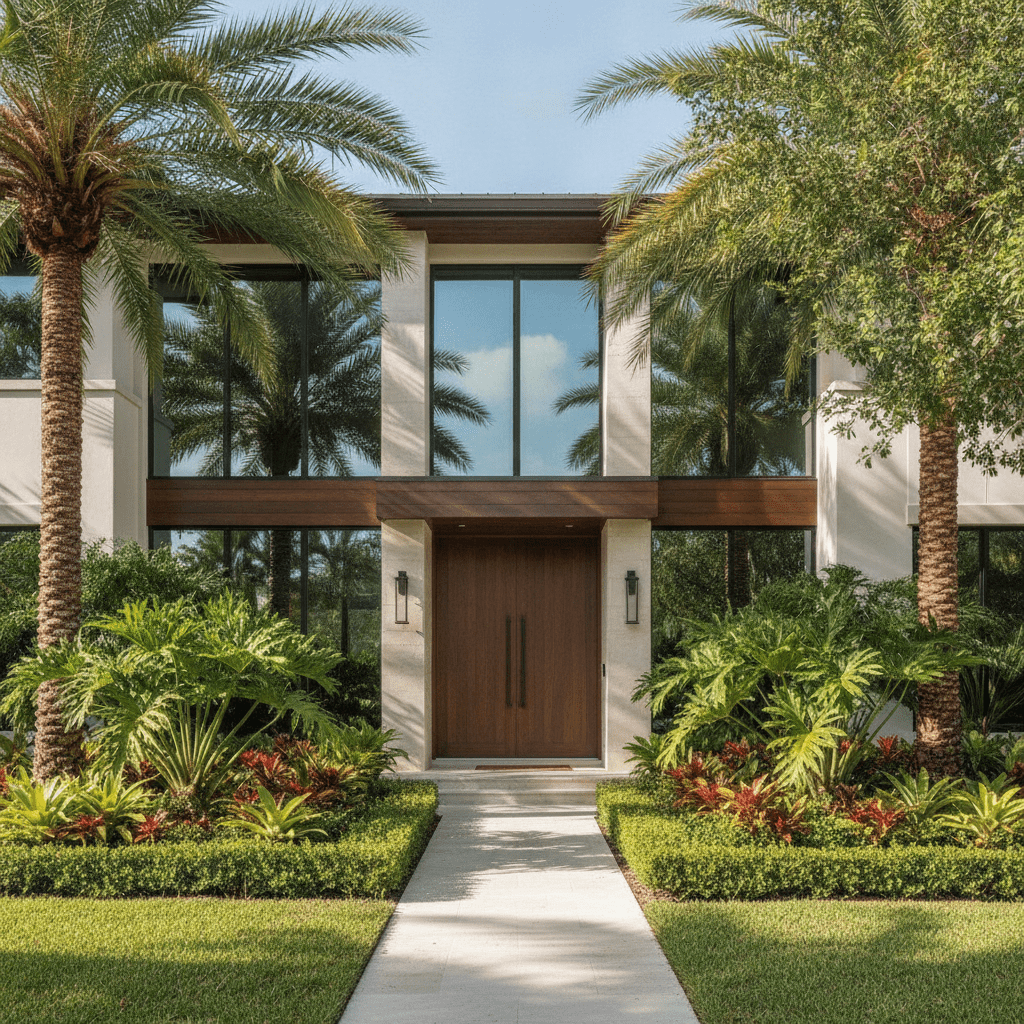
Pivot doors have become a popular front-entry choice for modern and contemporary homes across Miami-Dade and Broward — and for good reason. A large-format pivot panel creates a dramatic entry statement that no standard hinged door can match. But when a South Florida homeowner starts calling contractors, they quickly run into a problem nobody explains clearly: the approval path for an impact pivot door in the High-Velocity Hurricane Zone (HVHZ) is materially different from the path for a standard impact French door or sliding glass door.
Most standard impact doors in Miami-Dade are approved under a Florida Product Approval (FPA) that covers the HVHZ. Many pivot-door products, however, carry only a state-level Florida Product Approval for non-HVHZ jurisdictions — which means they cannot legally be installed as hurricane protection in Miami-Dade or Broward without a valid Miami-Dade Notice of Acceptance (NOA). If your contractor does not pull the product’s NOA before ordering, you may end up with a door that fails inspection or does not qualify for your homeowner’s insurance wind-mitigation credit.
Beyond the approval question, pivot doors concentrate load forces at a single pivot point at the floor and head — rather than distributing them across multiple hinge points along the jamb. That mechanical difference has structural implications for your rough opening, your header, and the slab or threshold below the door. None of this is difficult to execute correctly, but it requires a contractor who understands both the structural framing requirements and the HVHZ permitting sequence.
Local Context
HVHZ Rules That Apply to Every Pivot Door in Miami-Dade
Miami-Dade and Broward are the strictest building-code jurisdictions in the United States for openings.
The High-Velocity Hurricane Zone designation means that every exterior door — pivot or otherwise — must be tested and approved under the most rigorous impact and wind-load protocols in the country. For Miami-Dade, the product must hold a current Miami-Dade NOA issued by the Miami-Dade County Product Control Section. A product with a current Florida Product Approval (FL number) that covers HVHZ use is legal to install in Miami-Dade and Broward. A Miami-Dade NOA is an additional certification some products also carry; it is not required for the permit.
Pivot doors present an additional challenge: many manufacturers design and test their pivot systems for non-HVHZ markets, so NOA coverage for the pivot configuration may be limited to certain panel sizes, glass thicknesses, or hardware combinations. Before any pivot door is ordered for a Miami-Dade project, the NOA must be pulled from the Miami-Dade Product Control database and reviewed to confirm that the specific panel width, height, glass thickness, and pivot hardware all fall within the NOA’s tested scope.
Palm Beach County is not classified HVHZ, so impact pivot doors there need only Florida Product Approval — but the energy code (Climate Zone 1A) still applies, and laminated glass must still meet the applicable design-pressure rating for the opening size and wind exposure category.
Technical Education
NOA, Glazing Specs, and Structural Requirements for Impact Pivot Doors
What every South Florida homeowner needs to understand before ordering a pivot door.
1. Miami-Dade NOA vs. Florida Product Approval
A Miami-Dade Notice of Acceptance is issued by Miami-Dade County’s Product Control Section and is the gold-standard approval required for all exterior openings in the HVHZ. It certifies that the specific product — including frame material, hardware, glass laminate, and installation method — has been tested to Miami-Dade’s large-missile impact protocol and cyclic wind-pressure requirements. A Florida Product Approval is a state-level document issued by the Florida Building Commission; it covers non-HVHZ installations statewide but does not automatically satisfy Miami-Dade’s stricter requirements. When reviewing a pivot door’s NOA, confirm that the NOA covers the pivot-door product category (not just a hinged version of the same frame), and that the panel dimensions you want fall within the NOA’s tested range.
2. Glass Thickness and ASTM E1300 Design Pressure
The laminated glass in an impact pivot door must be selected to meet the design pressure (DP) rating required for your specific opening under the Florida Building Code. Design pressure is determined by the building’s height, wind exposure category, and the opening’s location on the building envelope. For large-format pivot panels — which can exceed eight feet in height and four feet in width — the required glass thickness and interlayer specification will be higher than for a standard residential door. Impact laminated glass for pivot doors commonly ranges from 7/16" for moderate design-pressure openings to 9/16" for larger panels or higher-DP applications. The applicable ASTM E1300 table governs glass thickness selection; the NOA will specify which glass assembly is approved.
3. Pivot Hardware and Florida Building Code Chapter 16
Unlike a hinged door where load is distributed across three or more hinge points along the jamb, a pivot door transfers the panel’s full dead load and wind-induced force through two pivot points — one at the floor and one at the head. Florida Building Code Chapter 16 governs structural wind-load design for building components and cladding, and the pivot hardware assembly must be engineered to carry those loads at the pivot locations. This means the floor pivot, head pivot, and any intermediate pivot must be specified by the product’s NOA and installed exactly as tested. Substituting hardware — even a visually identical piece from a different manufacturer — can void the NOA and cause a failed inspection.
4. Structural Framing: CBS vs. Wood-Frame Rough Openings
Most Miami-Dade homes are CBS (concrete block and stucco) construction, while many Broward and Palm Beach homes include wood-frame sections. The rough-opening reinforcement strategy differs significantly between the two.
In CBS construction, the lintel or bond beam above the rough opening must be sized and reinforced to carry the concentrated load delivered through the pivot head. If the existing lintel was designed for a standard door, a structural assessment — which falls within the scope of a Certified General Contractor (CGC1531370) coordinating the project — may be required before the rough opening can be accepted for an oversized pivot panel. If any structural modification to the lintel or surrounding masonry is needed, that work can be handled in-house rather than requiring a separate structural subcontractor, which keeps the scope coordinated under one license.
In wood-frame construction, the header above the rough opening must be engineered for the span and load, and the king studs and trimmer studs must be sized accordingly. Large pivot panels frequently require doubled or tripled headers and reinforced sill plates at the floor pivot location.
Comparison
Impact Pivot Doors vs. Other Large-Format Impact Entry Doors
Comparing pivot, French, and sliding configurations for South Florida entries.
| Feature | Impact Pivot Door | Impact French / Double Door | Impact Sliding / Folding Door |
|---|---|---|---|
| HVHZ NOA Availability | Selective — confirm per product | Widely available | Widely available |
| Typical Panel Width | Up to 60"+ single panel | Up to ~72" pair | Up to 144"+ multi-panel |
| Load Distribution | Concentrated at pivot points | Distributed across hinges | Distributed along track |
| Structural Framing Need | Header/sill reinforcement often required | Standard lintel usually sufficient | Standard lintel usually sufficient |
| Installed Cost Range (directional) | Higher — confirm with written quote | Varies by size; confirm with written quote | Varies by size; confirm with written quote |
| Design Impact | Maximum — single dramatic panel | Traditional / classic | Wide view / indoor-outdoor flow |
| Energy Code (Climate Zone 1) | SHGC ≤ 0.25 required | SHGC ≤ 0.25 required | SHGC ≤ 0.25 required |
Directional comparison only. Installed costs vary significantly by panel size, glass specification, structural conditions, and permit complexity. Always request a written itemized quote.
When a Standard Impact Door Is the Better Fit
A traditional impact French door or impact sliding door is often the more practical choice when: (a) the product approval path needs to be straightforward and the NOA is confirmed on a standard configuration, (b) the rough opening has limited header capacity and structural modification is not in the budget, or (c) the project timeline is tight and lead times for custom pivot systems are prohibitive. Pivot doors are a compelling option — but only when the approval chain is clean and the structure supports the installation. If either condition is uncertain, a hinged or sliding impact door delivers equivalent hurricane protection with a more predictable permitting path.
Why It Matters Who Pulls Your Permit
Licensed Contractor, Not a Lead Aggregator
Every pivot door installation in Miami-Dade requires a licensed contractor to pull the permit and take code responsibility for the installation.
“A pivot door NOA review takes twenty minutes if you know what you’re looking at — panel dimensions, hardware schedule, installation method. Skipping that step costs homeowners weeks of failed inspections and reorders.”
Founder & President, Bigfoot Windows & Roofing
Product Guidance
What to Look for in an Impact Pivot Door System
Not every impact door product is available in a pivot configuration with a valid Miami-Dade NOA.
When evaluating impact pivot door systems for a South Florida project, confirm the following before ordering:
- Current Miami-Dade NOA: Pull the NOA from the Miami-Dade Product Control Section website and verify it covers the pivot-door configuration (not just the brand’s hinged door line) and that the NOA has not expired.
- Panel size within tested scope: NOAs specify maximum tested panel dimensions. If your desired panel exceeds the tested width or height, the NOA does not apply — regardless of what the sales sheet says.
- Glass specification: Confirm the laminated glass assembly (thickness, interlayer type) matches what is listed in the NOA. Substituting a thinner laminate to reduce cost can void the approval.
- Hardware schedule: The floor pivot, head pivot, and any intermediate support must be the exact components listed in the NOA’s hardware schedule. This is non-negotiable in an HVHZ inspection.
- Aluminum frame: For South Florida’s coastal environment — salt air, humidity, UV, and hurricane wind loading — aluminum frames have a longer track record than vinyl. Bigfoot recommends aluminum for all HVHZ pivot door installations.
- SB 70 Low-E glass: In Miami-Dade’s Climate Zone 1, the Florida Energy Code requires a maximum SHGC of 0.25 for vertical glazed fenestration (FBC Energy Conservation, 8th Edition, Table R402.1.2). An SB 70 Low-E coating is our standard specification; it meets the SHGC requirement and reduces solar heat gain that your air conditioning must overcome.
Installation Process
How an Impact Pivot Door Installation Works in Miami-Dade
From NOA verification to final inspection — what to expect.
| Step | What Happens | Who Is Responsible |
|---|---|---|
| 1. NOA Review | Pull and verify the product’s current Miami-Dade NOA covers the specific pivot configuration and panel dimensions | Contractor |
| 2. Structural Assessment | Evaluate existing header, lintel (CBS) or wood-frame header capacity for the pivot load; identify any reinforcement needed | Contractor / Engineer if required |
| 3. Permit Application | Submit permit to Miami-Dade Building Department with NOA, product approval, and installation drawings | Contractor (license-holder) |
| 4. Rough Opening Preparation | Reinforce header, sill, and jambs as required; prepare threshold and floor-pivot substrate | Installation crew |
| 5. Door Installation | Set floor pivot in substrate, hang panel, set head pivot, verify plumb and operation; install per NOA method | Installation crew |
| 6. Building Inspection | Miami-Dade inspector verifies NOA, hardware schedule, installation method, and weather seal | Inspector / Contractor |
| 7. Wind Mitigation Inspection | Licensed wind mitigation inspector documents opening protection for insurance purposes | Homeowner arranges |
Because pivot door projects in Miami-Dade often involve structural header work alongside the glazing installation, having a contractor who holds both a Certified Specialty Contractor with a Glass & Glazing Specialty (SCC131153098) and a Certified General Contractor (CGC1531370) means the structural framing scope and the door installation scope remain under one coordinated license — no handoff between separate subcontractors, no gap in accountability when the inspector arrives. You can learn more about impact door options for South Florida homes to compare configurations before committing to a pivot system.
Ready to find out if your rough opening and preferred pivot door product have a clear NOA path in Miami-Dade?
Or call 786-886-2088 — no pressure, no obligation.
Who We’re Not the Right Fit For
- Homeowners with a tight timeline who need a door in two to four weeks: Custom large-format pivot door systems have longer lead times than standard stock impact doors. If your project has a hard deadline, a stock impact French or sliding door may be more practical.
- Projects where the pivot door NOA does not cover your panel size: If the product you want does not have a current Miami-Dade NOA for the dimensions you need, we will not install it in the HVHZ and represent it as code-compliant. We would rather help you find a product that qualifies than cut a corner that causes a failed inspection.
- Budget-constrained projects where structural reinforcement is a dealbreaker: If the existing rough opening requires significant header modification and that cost falls outside your budget, a standard hinged impact door may be the more suitable solution. We are straightforward about scope and cost before any work begins.
- Buyers expecting a price without a site assessment: Pivot door pricing depends on panel size, glass specification, structural conditions, and the specific NOA-approved product. We do not quote pivot door installations over the phone without reviewing the opening.
FAQ
Frequently Asked Questions
Do pivot doors qualify as impact-rated doors for Miami-Dade hurricane protection?
A pivot door qualifies for HVHZ hurricane protection only when the specific product holds a current Miami-Dade Notice of Acceptance (NOA) that covers the pivot-door configuration and the panel dimensions of your project. A product with a current Florida Product Approval (FL number) that covers HVHZ use is legal to install in Miami-Dade and Broward. A Miami-Dade NOA is an additional certification some products also carry; it is not required for the permit. Before ordering, pull the NOA from Miami-Dade’s Product Control database and verify that the pivot hardware, glass assembly, and panel size all fall within the NOA’s tested scope.
What is a Miami-Dade Notice of Acceptance (NOA) and do I need one for a pivot door?
A Miami-Dade NOA is a product-specific approval issued by Miami-Dade County’s Product Control Section. It certifies that a product has been tested to Miami-Dade’s large-missile impact and cyclic wind-pressure protocols — the strictest in the country. If your home is in Miami-Dade or Broward (both HVHZ), any exterior door installed as hurricane protection must have a current, applicable NOA. Many pivot door products hold only a state-level Florida Product Approval, which does not meet this standard.
How much does a large impact pivot door installation cost in South Florida?
Cost varies significantly based on panel size, glass thickness, the NOA-approved hardware required, and the structural condition of the rough opening. A pivot door installation is typically more expensive than a comparable hinged or sliding impact door because of the specialized hardware, potential structural reinforcement, and longer lead times. We do not quote pivot door projects without reviewing the specific product NOA and the rough opening. Request a free estimate for a written, itemized number for your project.
Can a pivot door replace my front entry door and still meet HVHZ building code?
Yes — if the product holds a valid Miami-Dade NOA for the pivot configuration and your panel dimensions, the rough opening is reinforced as required, and the installation follows the NOA’s documented method exactly. The permit must be pulled by a licensed contractor; a Miami-Dade building inspector will verify compliance. If the existing header or sill cannot support the pivot load without modification, that structural work must be completed before the door is set.
What glass thickness is required in an impact pivot door for Miami-Dade?
Glass thickness in an impact pivot door is driven by the design pressure (DP) rating required for your specific opening — determined by building height, wind exposure category, and opening location. For larger pivot panels, laminated glass commonly ranges from 7/16" for moderate-DP applications to 9/16" for larger panels or higher-DP requirements. The applicable NOA will specify the approved glass assembly; substituting a thinner glass to reduce cost voids the approval and can fail inspection.
Does Bigfoot handle the permit and Miami-Dade Building Department filing for pivot door projects?
Yes. As a licensed contractor, Bigfoot pulls the permit and submits the required documentation — including the NOA, product approval, and installation drawings — to the Miami-Dade Building Department. We also coordinate the building inspection sequence. If structural header work is required as part of the rough-opening preparation, that scope can be handled in-house under our Certified General Contractor license, avoiding a separate structural subcontractor and keeping the project under one coordinated scope.
Can I use PACE financing for an impact pivot door installation?
PACE financing is available for qualifying impact door installations in South Florida. Because PACE is repaid through your property tax assessment rather than as a bank loan, eligibility is generally based on home equity and property tax payment history rather than a personal credit check, according to Renew Financial. Repayment terms of up to 20 years are available for some projects. Through Florida’s My Safe Florida Home program, eligible homeowners may also qualify for a matching grant of up to $10,000, subject to program funding and eligibility. Confirm current terms with your PACE administrator and the program office. Visit our financing page for more detail.
Schedule Your Free Estimate
Ready to get started? Request a free estimate — no phone call required.
Sources
- Miami-Dade County Product Control Section — product approval lookup: miamidade.gov/permits/product-control.asp
- Florida Building Code, Chapter 16 (Structural Design / Wind Loads): floridabuilding.org
- Florida Building Code Energy Conservation, 8th Edition (2023), Table R402.1.2 — SHGC requirements, Climate Zone 1: floridabuilding.org
- My Safe Florida Home program — grant eligibility and amounts: mysafeflhome.com
- RenewPACE Florida — PACE financing eligibility and terms: renewfinancial.com
Have questions about impact impact doors or impact windows for your South Florida home? Our team reviews NOAs, assesses structural conditions, and handles permits — all under one license.
Or call Bigfoot Windows & Roofing at 786-886-2088.