
Hurricane Window Ratings Explained | Bigfoot Windows & Roofing

Last updated: July 2026 by the Bigfoot Windows & Roofing editorial team.
Bottom line: A hurricane window’s rating is not just about the glass. It is a system approval — frame, glazing, anchorage, and hardware tested together under ASTM E1886/E1996. A product with a current Florida Product Approval (FL number) that covers HVHZ use is legal to install in Miami-Dade and Broward. A Miami-Dade NOA is an additional certification some products also carry; it is not required for the permit. Products must also carry a Miami-Dade Notice of Acceptance (NOA) or a Florida Product Approval that covers HVHZ use. Understanding the difference between DP ratings, large/small missile testing, and NOA vs. statewide approval will help you buy the right window, pull a clean permit, and actually protect your home.
Key Takeaways
- DP (Design Pressure) ratings measure structural wind resistance — higher number means stronger window.
- Miami-Dade and Broward sit inside the High-Velocity Hurricane Zone (HVHZ), requiring a Miami-Dade NOA or a Florida Product Approval that covers HVHZ use.
- Impact ratings test both large-missile and small-missile strikes under ASTM E1886/E1996 — a window must pass both to qualify as impact-resistant.
- Glass type, frame material, and anchorage collectively determine a system’s rating — glass alone does not define it.
- Aluminum frames are the time-tested choice for South Florida’s HVHZ heat, humidity, salt air, and hurricane conditions.
The Homeowner’s Problem
Why Hurricane Window Ratings Confuse South Florida Homeowners
Two windows can both be called “impact-rated” and behave very differently in a storm — or at a permit office.
If you have shopped for impact windows in South Florida, you have probably seen stickers, labels, and spec sheets with numbers like DP-50, DP-60, and references to ASTM E1886 or E1996. Salespeople throw phrases like “NOA approved” and “Large Missile Impact” around without explaining what they mean or why they matter for your specific address.
The confusion is understandable. A product with a current Florida Product Approval (FL number) that covers HVHZ use is legal to install in Miami-Dade and Broward. A Miami-Dade NOA is an additional certification some products also carry; it is not required for the permit. Buying a window that has statewide approval but no NOA can kill your permit, delay your project, and leave you with a product that does not legally qualify for your home.
This article breaks down every major rating category in plain language so you can read a product label, ask the right questions, and confirm your windows will pass inspection before a single hole is drilled.
South Florida Context
The HVHZ: Why Miami-Dade and Broward Play by Stricter Rules
The High-Velocity Hurricane Zone is the toughest residential building code environment in the United States.
The High-Velocity Hurricane Zone (HVHZ) is defined by the Florida Building Code (FBC) as Miami-Dade and Broward counties. These two counties experienced the most catastrophic residential window and envelope failures during Hurricane Andrew (1992), which triggered a complete overhaul of South Florida’s building code. The result is a two-layer approval requirement that does not apply to most other Florida counties.
Outside the HVHZ — Palm Beach and northward — a window product only needs Florida Statewide Product Approval issued by the Florida Building Commission. Inside the HVHZ, that same window must also hold a Miami-Dade Notice of Acceptance (NOA), issued by the Miami-Dade Building Department’s Product Control Section, or a Florida Product Approval that covers HVHZ use. An NOA means the product was independently tested at a recognized laboratory and reviewed by Miami-Dade county staff — not just submitted for approval. The testing criteria under an NOA are generally more stringent than the statewide minimum.
When you pull a permit in Miami-Dade or Broward, the inspector will look for the NOA number on the product label. If it is missing, the installation fails — regardless of how much you paid for the window or what the salesperson told you.
| Approval Type | Where Required | Issued By | Lab Testing Required |
|---|---|---|---|
| Florida Statewide Product Approval | All FL counties | FL Building Commission | Yes |
| Miami-Dade NOA | Miami-Dade & Broward (HVHZ) | Miami-Dade Building Dept. | Yes — stricter criteria |
Education
DP Ratings, Missile Impact Testing, and What the Labels Actually Mean
Every number on a product approval label tells you something specific. Here is how to read them.
Design Pressure (DP) Rating
A Design Pressure (DP) rating measures the structural load — both positive (inward wind pressure) and negative (outward suction) — that a window system can withstand without failing. DP ratings are expressed in pounds per square foot (psf). A DP-50 window can handle 50 psf of wind pressure; a DP-60 can handle 60 psf.
The required DP rating for your home depends on your wind speed zone per ASCE 7 (the American Society of Civil Engineers load standard referenced by the FBC 8th Edition) and your specific parcel’s exposure category. Homes in coastal Miami-Dade routinely require DP-50 or higher. Taller buildings and corner units typically require even higher DP values. Your contractor should calculate the required DP for each opening based on your site’s wind speed map — not guess from experience.
Large Missile vs. Small Missile Impact Testing
ASTM E1886 describes the test method; ASTM E1996 describes the performance standard. Together they define two missile impact categories:
- Large Missile (LMI): A 9-pound 2×4 lumber piece fired at the window at 50 feet per second. Required for openings within 30 feet of the ground in wind-borne debris regions.
- Small Missile (SMI): Ten 2-gram steel balls fired at higher velocity. Required for openings more than 30 feet above grade.
In HVHZ installations, most residential windows must pass Large Missile testing. A product that passes LMI also passes the tougher structural exposure at lower floors — where most residential openings sit. Confirm which missile category is listed on the product’s NOA before you buy.
It Is a System Rating, Not a Glass Rating
This is the most important misconception to clear up. The DP rating and impact classification on a product approval apply to the entire tested assembly: frame, glazing (glass), hardware, and fastener pattern. Swapping any component — using thicker glass in a frame tested with thinner glass, or changing the anchor spacing — may invalidate the approval. The frame and installation must replicate the conditions of the original laboratory test exactly.
| Rating Element | What It Measures | Who Defines It |
|---|---|---|
| DP (Design Pressure) | Wind load resistance (psf) | ASCE 7 / FBC |
| Large Missile Impact | 9-lb 2×4 at 50 fps | ASTM E1996 |
| Small Missile Impact | 2-gram steel balls | ASTM E1996 |
| Miami-Dade NOA | Full system HVHZ approval | Miami-Dade Building Dept. |
| FL Statewide Approval | Minimum statewide compliance | FL Building Commission |
Product Guidance
Glass Type, Frame Material, and Why Aluminum Wins in South Florida
The assembly — not just the glass — defines how a window performs in a hurricane and over decades of South Florida weather.
Impact windows use laminated glass: two or more panes bonded by a polyvinyl butyral (PVB) interlayer. When struck, the glass may crack but the interlayer holds the fragments together, preventing penetration and maintaining the building’s pressure envelope. Common thicknesses are 5/16" (builder grade), 7/16" (standard mid), and 9/16" (high-rise or heavy-duty applications).
For homeowners near the coast — within two miles of salt water — Miami-Dade’s turtle lighting ordinance may require specific glass tints. Gray-tinted 9/16" glass auto-qualifies; lighter tints at thinner gauges may require review. Ask your installer to confirm compliance for your specific parcel before ordering.
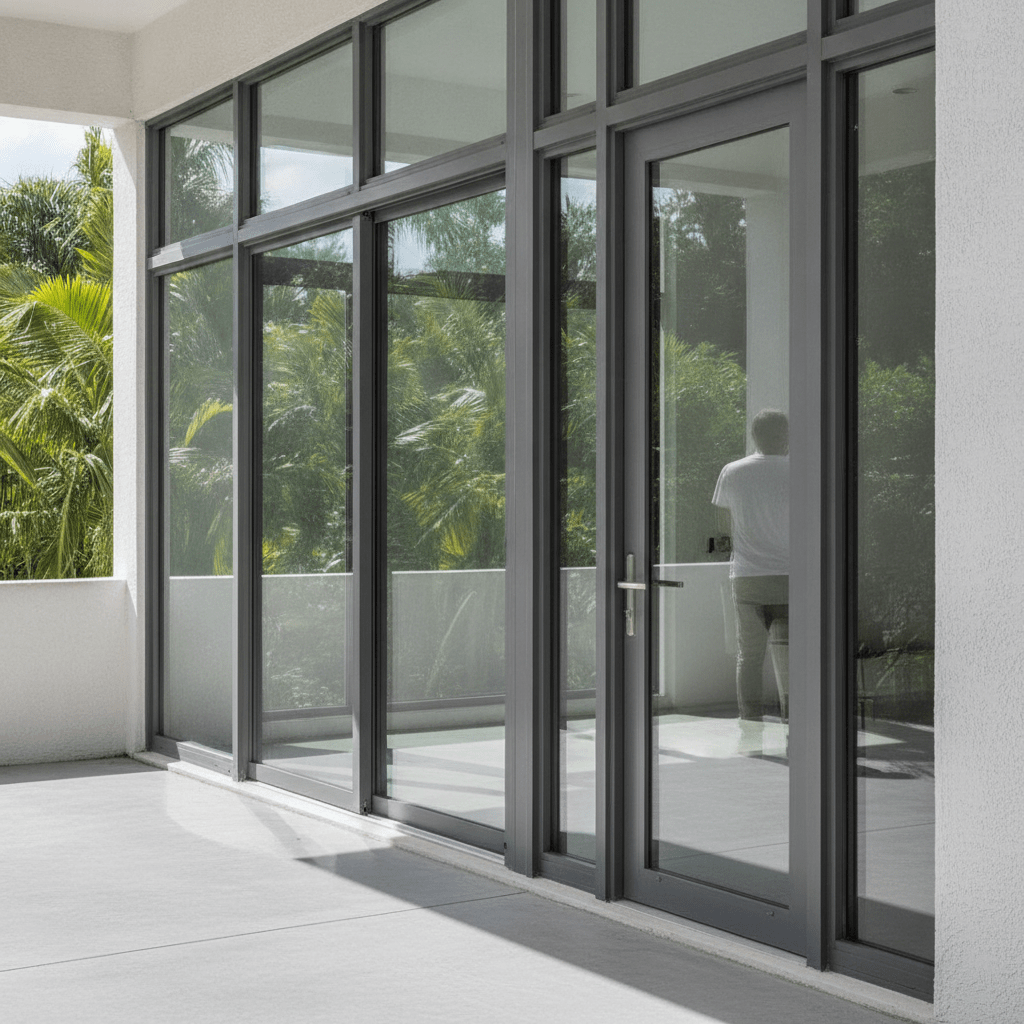
On frame material: we recommend aluminum frames for South Florida installations. Aluminum has a longer track record in HVHZ heat, humidity, UV exposure, and hurricane cycles than vinyl alternatives. For energy efficiency, look for thermally broken aluminum — a design that inserts a non-conductive barrier between the interior and exterior frame sections to reduce heat transfer. This matters in South Florida where air-conditioning costs are a year-round concern.
We install Mr. Glass impact windows as our primary line. All Mr. Glass series carry Florida Product Approval. The Series 2500T door carries Miami-Dade NOA approval. For residential single-family and mid-rise applications, the Series 200 and Series 300 aluminum lines are engineered for HVHZ conditions, with stainless steel hardware as the default — not an upgrade — and frame depth that does not change when you upgrade glass thickness.
If you are exploring impact door options alongside your window project, the anchorage and frame-system logic is identical: the tested assembly governs, not the glass alone.
License & Accountability
Why the Contractor’s License Matters as Much as the Product Label
A certified contractor — not a lead aggregator — pulls the permit and owns the installation.
An NOA-approved window installed with the wrong anchor spacing, the wrong fastener type, or the wrong sealant is not NOA-compliant in practice. The product approval only holds when the installer follows the approved installation drawings exactly. That is why the contractor’s qualifications are as consequential as the product spec sheet.
Darryl Henry Rosenbaum holds a Certified Specialty Contractor with a Glass & Glazing Specialty (SCC131153098) — a license specific to fenestration work. This means Bigfoot Windows & Roofing can pull its own permits, supervise its own crews, and stand behind the installation as the licensed entity of record. There is no subcontracting of the permit to a third party whose name you do not know.
Additionally, because Darryl also holds a Certified General Contractor (CGC1531370) license, projects that require structural modifications — reinforcing a rough opening, addressing hurricane strap connections, or managing code-driven structural scope during a window replacement — can be handled within the same contract. Homeowners do not need to hire a separate contractor for structural work that arises during a window installation. That is a meaningful difference from a windows-only specialty shop.
“Your window’s NOA number is only as good as the installation behind it. If the anchor pattern deviates from the approved drawing, you do not have an NOA-compliant window — you have a liability.”
Darryl Rosenbaum
President, Bigfoot Windows & Roofing
Comparison
HVHZ NOA vs. Florida Statewide Approval — Side by Side
| Criteria | FL Statewide Product Approval | Miami-Dade NOA (HVHZ) |
|---|---|---|
| Counties where required | All 67 FL counties | Miami-Dade & Broward only |
| Who reviews the test | FL Building Commission | Miami-Dade Building Dept. |
| Testing standard | ASTM E1886/E1996 | ASTM E1886/E1996 + stricter wind load criteria |
| Missile impact required | Yes | Yes — LMI for most residential openings |
| Permit acceptance in HVHZ | Not sufficient alone | Required — NOA number or Florida Product Approval number (covering HVHZ use) on label |
| Validity period | 5 years (renewable) | 5 years (renewable) |
When Statewide Approval Alone Is the Right Fit
If your home is in Palm Beach County or farther north — outside the HVHZ — a Florida statewide product approval is all that is required. You still want to confirm the DP rating matches your site’s required wind load under ASCE 7, and you still want Large Missile Impact testing for openings within 30 feet of grade. But the NOA requirement does not apply. If you are comparing quotes between a Miami-Dade NOA product and a statewide-only product for a Palm Beach home, the statewide product may be a legitimate and lower-cost option — as long as the DP rating is sufficient.
Process
How to Verify a Window’s Rating Before You Sign a Contract
- Get the NOA number from the product spec sheet or the window label and search it at the Miami-Dade Building Department’s online portal (miamidade.gov/building). Confirm the NOA is active and not expired.
- Match the DP rating to your home’s required wind speed zone. Your contractor should provide a calculation or reference your parcel on Florida’s Wind Speed Map (FBC 8th Edition, Figure 1609.3(1)).
- Confirm the missile impact category — Large Missile or Small Missile — matches your opening’s height above grade.
- Verify the installation drawings are included in the NOA and that your contractor will follow them exactly, including fastener type, spacing, and sealant specification.
- Check the contractor’s license at myfloridalicense.com. Confirm the licensee name matches the entity pulling your permit.
Have questions about your home’s required impact window ratings?
Call Bigfoot Windows & Roofing. We pull our own permits, verify NOA compliance before ordering, and serve Miami-Dade, Broward, and Palm Beach.
Related Reading
Articles You May Find Useful
Related Articles
Who We’re Not the Right Fit For
- Homeowners who want the absolute lowest upfront price regardless of compliance: We will not recommend a product that lacks the required product approval (a Miami-Dade NOA or a Florida Product Approval that covers HVHZ use) for your county to save a few hundred dollars. If price alone is your deciding factor, a less compliance-focused installer may quote lower.
- Projects that need a permit pulled under a different contractor’s license: We pull our own permits. If your GC or developer wants to use their own subcontractor list and pull their own permits, we are not the right fit for that arrangement.
- Homeowners wanting brands we do not carry: We do not install PGT or Marvin windows. If you have your heart set on one of those brands, you will need an installer who carries them.
- Commercial high-rise projects requiring NOA products outside our current commercial scope: Our primary focus is residential and low-rise. If your project is a large commercial tower with specialized engineering requirements, we will tell you honestly if it falls outside our current capacity.
Frequently Asked Questions
What impact rating do windows need to pass Miami-Dade hurricane code?
Windows in Miami-Dade must carry a Miami-Dade NOA or a Florida Product Approval that covers HVHZ use and pass Large Missile Impact testing under ASTM E1996 for openings within 30 feet of grade. They must also meet the required Design Pressure (DP) rating for your specific parcel’s wind speed zone per ASCE 7 and the Florida Building Code 8th Edition. A product with a current Florida Product Approval (FL number) that covers HVHZ use is legal to install in Miami-Dade and Broward. A Miami-Dade NOA is an additional certification some products also carry; it is not required for the permit.
What is the difference between hurricane-rated and impact-resistant windows in Florida?
The terms are often used interchangeably, but technically an impact-resistant window has passed ASTM E1886/E1996 missile impact testing. A hurricane-rated window typically refers to a product that meets structural wind load (DP) requirements. A compliant impact window in South Florida must do both — pass missile impact testing and achieve the DP rating required for your home’s wind zone.
What does DP-50 or DP-60 mean on an impact window label?
DP stands for Design Pressure, measured in pounds per square foot (psf). A DP-50 window can structurally resist 50 psf of wind load in both positive (inward) and negative (outward suction) directions. DP-60 can resist 60 psf. The required DP for your home depends on your location’s wind speed zone under ASCE 7. Coastal Miami-Dade homes frequently require DP-50 or higher; corner units and taller structures may require more.
Do I need Miami-Dade NOA approval even if the window has Florida statewide product approval?
Yes, if your home is in Miami-Dade or Broward County. These counties are in the High-Velocity Hurricane Zone (HVHZ), which requires a Miami-Dade NOA or a Florida Product Approval that covers HVHZ use. A product with a current Florida Product Approval (FL number) that covers HVHZ use is legal to install in Miami-Dade and Broward. A Miami-Dade NOA is an additional certification some products also carry; it is not required for the permit. Outside the HVHZ (Palm Beach and northward), statewide approval is sufficient.
What is the High-Velocity Hurricane Zone and which Florida counties does it include?
The High-Velocity Hurricane Zone (HVHZ) is defined by the Florida Building Code and includes Miami-Dade and Broward counties only. These counties experienced catastrophic building envelope failures during Hurricane Andrew in 1992, leading to the nation’s most stringent residential building code. Palm Beach County sits just outside the HVHZ and follows standard Florida statewide product approval requirements.
Can I finance my impact window replacement and stack it with a state grant?
Yes. The My Safe Florida Home grant program offers up to $10,000 for eligible homeowners. This can be stacked with PACE financing, which is paid through your property tax bill rather than a bank loan. PACE and grant applications for windows and roofing must be submitted separately. For qualifying property owners, there may also be tax benefits available — consult your CPA. See our financing page for details.
Sources
- Florida Building Code, 8th Edition — Chapter 16 (Structural Design) and Product Approval requirements.
- ASTM E1886-19 — Standard Test Method for Performance of Exterior Windows, Curtain Walls, Doors, and Storm Shutters Impacted by Missile(s) and Exposed to Cyclic Pressure Differentials.
- ASTM E1996-17 — Standard Specification for Performance of Exterior Windows, Curtain Walls, Doors, and Impact Protective Systems Impacted by Windborne Debris in Hurricanes.
- Miami-Dade Building Department — Product Control Section, Notice of Acceptance (NOA) database: miamidade.gov/building.
- ASCE 7-22 — Minimum Design Loads and Associated Criteria for Buildings and Other Structures.

Ready to verify your home’s window requirements?
Bigfoot Windows & Roofing serves Miami-Dade, Broward, and Palm Beach. We check NOA compliance, calculate required DP ratings, and pull our own permits.