
Last updated: July 2026 by the Bigfoot Windows & Roofing editorial team.
Key Takeaways
- A South Florida roof replacement follows 8 distinct steps — from inspection to wind mitigation report.
- Permits are required in Miami-Dade and Broward; skipping them creates insurance and resale problems.
- Deck re-nailing to Florida Building Code spacing is mandatory — inspectors verify it before covering.
- A peel-and-stick secondary water barrier is now required under the 2023 Florida Building Code for full replacements.
- The wind mitigation inspection (OIR-B1-1802) after completion is how you earn insurance premium savings.
- Total timeline is typically 3 to 8 weeks from signed contract to final inspection, depending on permit queue.
Why this matters
Most Homeowners Don’t Know What They’re Paying For
And that gap is where bad contractors hide shortcuts.
South Florida homeowners replace roofs for two main reasons: storm damage or age. Either way, the process is identical under Florida law — and it is more structured than most people realize. Miami-Dade and Broward County sit inside the High Velocity Hurricane Zone (HVHZ), the strictest residential building code jurisdiction in the United States. Every material, fastener pattern, and layer of underlayment is governed by code. A contractor who shortcuts any step risks failing inspection — or worse, leaving you with a roof that performs below standard in the next named storm. Knowing the steps puts you in control.
South Florida context
Why the HVHZ Changes Everything
Miami-Dade and Broward counties operate under the High Velocity Hurricane Zone provisions of the Florida Building Code. This means stricter product approval requirements (Miami-Dade NOA or Florida Product Approval), mandatory deck fastening schedules, and required secondary water barriers. Palm Beach County follows the standard Florida Building Code, which is still among the strictest in the country. Citizens Insurance — the state-backed insurer of last resort — will not renew policies on roofs 20 years or older. A new, code-compliant roof with a wind mitigation report can significantly reduce annual premiums. The process below applies to all three counties; HVHZ-specific notes are flagged where they differ.
The full process
The 8 Steps of a Roof Replacement in South Florida
From first visit to final report — here is exactly what should happen.
Step 1 — Inspection and Estimate
A qualified contractor walks the roof and the attic. In the attic, they look for deck condition, existing fastener patterns, signs of rot or moisture intrusion, and whether hurricane straps connect the roof structure to the walls. On the surface, they document the existing covering, number of layers, and any penetrations (vents, pipes, skylights). This is also when product selection happens — shingle, metal, tile, or flat membrane — and when the contractor identifies whether any structural repairs are needed before the new roof goes on. Because Bigfoot holds a Certified General Contractor license (CGC1531370), structural repairs — including rotted rafter repairs, hurricane strap upgrades, and load-path corrections — can be handled in the same project scope without hiring a separate contractor.
Step 2 — Product and NOA Selection
In the HVHZ, every roofing product must carry a Miami-Dade Notice of Acceptance (NOA) or a valid Florida Product Approval (FPA). Your contractor selects the approved system — covering, underlayment, fasteners, and adhesives — that meets code as a complete assembly, not just individual components. GAF shingles, for example, must be installed with the specific underlayment and fastener pattern listed in the NOA. Mixing non-approved components voids the approval and will fail inspection.
Step 3 — Permit Pulled Before Work Starts
This is non-negotiable. A roofing permit must be issued by Miami-Dade, Broward, or Palm Beach County before tear-off begins. The permit application includes the contractor’s license number, the product NOA or FPA numbers, and a scope of work. Typical permit turnaround in Miami-Dade is 5 to 20 business days, depending on workload. Broward and Palm Beach are generally faster. A contractor who suggests starting without a permit is creating a serious problem — unpermitted roofing work can block home sales, void insurance claims, and require full removal. Learn more about financing options that can bridge the gap while permits are processed.
Step 4 — Tear-Off and Deck Inspection
Once the permit is approved and posted, work begins. The existing covering is removed down to the wood deck. This is the moment of truth — the deck’s condition only becomes visible after tear-off. Inspectors look for soft spots, delaminated plywood, and improper repairs. Damaged deck sections must be replaced before proceeding. Florida Building Code requires plywood decking to meet minimum thickness standards (typically 19/32″ for new installations). All work stops at this stage until a framing/sheathing inspection is passed if structural repairs were made.
Step 5 — Deck Re-Nailing to Code
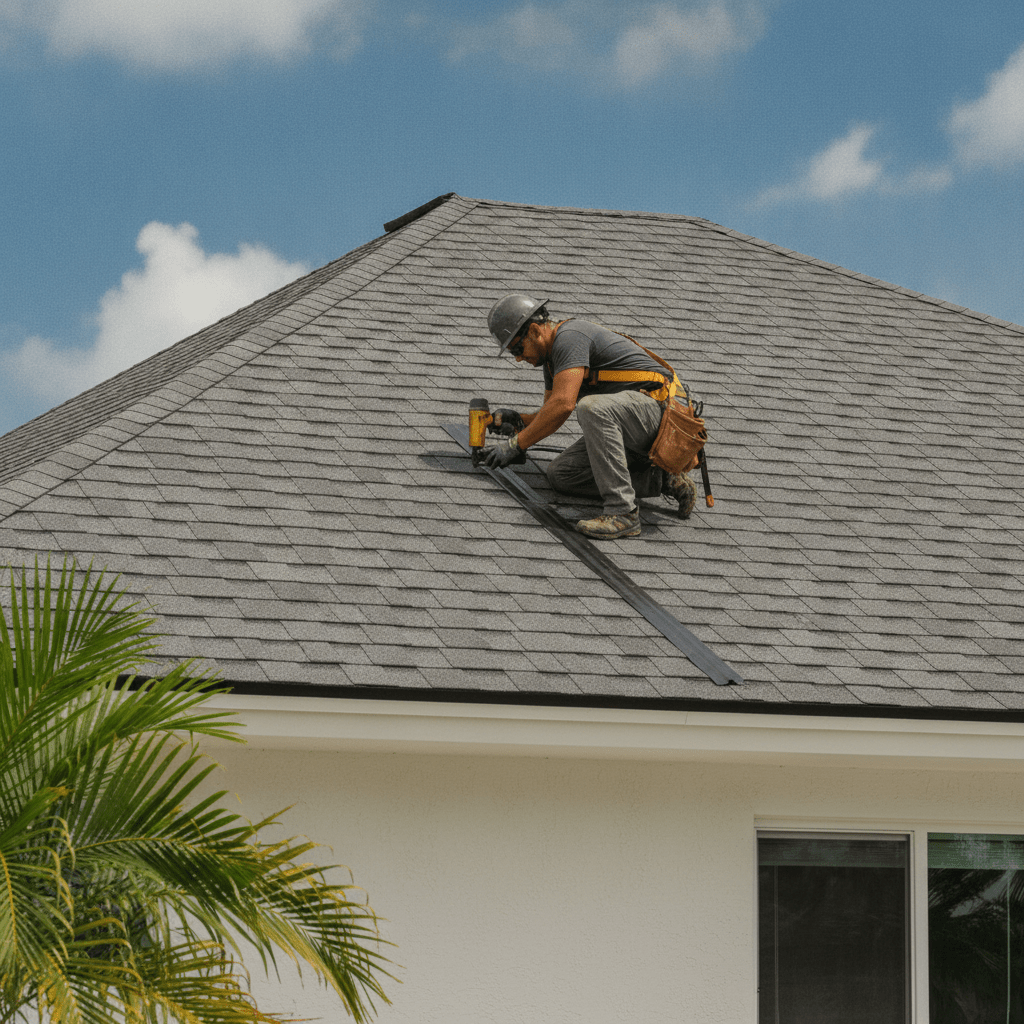
Even if the deck is in good shape, the fastening pattern almost always needs to be updated. Florida Building Code mandates 8d ring-shank nails at 6-inch spacing at panel edges and 12-inch spacing in the field for HVHZ. Older homes commonly have 4-inch or 6-inch spacing nails with smooth shanks — insufficient under current wind load requirements. The inspector must see and approve the re-nailed deck before underlayment goes down. This step alone is why roofing cannot legally be done as a rush job.
Step 6 — Secondary Water Barrier and Underlayment
The 2023 Florida Building Code requires a secondary water barrier (SWB) on all full roof replacements — this means a self-adhering peel-and-stick membrane applied directly to the approved deck. This is not the same as 30-lb felt. Felt does NOT qualify as a secondary water barrier. The SWB protects the home’s interior if the primary covering is damaged or lifted in a storm. Above the SWB, the primary underlayment goes down per the NOA requirements. For shingle systems, this is typically a fiberglass-mat underlayment. For tile, it is often a heavier ASTM D226 or D4869 product. Full-deck peel-and-stick application also qualifies for an insurance discount through Citizens and most private carriers.
Step 7 — New Roof Covering, Flashing, and Penetrations
The new covering — whether GAF architectural shingles, Englert or Metal Alliance standing-seam metal panels, Westlake concrete tile, or TPO flat membrane — is installed per the approved NOA system. Flashing at walls, chimneys, skylights, and all penetrations must be installed as part of this step. Metal flashings are typically galvanized or aluminum; in coastal zones within two miles of saltwater, stainless steel or other corrosion-resistant materials are preferred. Drip edge, valley flashing, and pipe boots are not cosmetic details — they are code-required leak prevention elements. The roofing installation is only complete when every penetration and transition is sealed and flashed correctly.
Step 8 — Final Inspection and Wind Mitigation Report
The county inspector performs a final inspection verifying the entire assembly — product, fastening, underlayment, and flashings — matches the permitted scope and approved NOA. Once the final inspection passes, the permit is closed. At this point, a licensed inspector (not the roofing contractor) performs the wind mitigation inspection and issues the OIR-B1-1802 form. This form documents the roof covering type, deck attachment method, secondary water barrier presence, and roof-to-wall connection method. Your insurance carrier uses this form to calculate premium credits. A new metal roof with full peel-and-stick and verified hurricane straps can produce substantial savings — I have seen customers move from very high annual premiums to significantly lower ones after this documentation was submitted.
Timeline and milestones
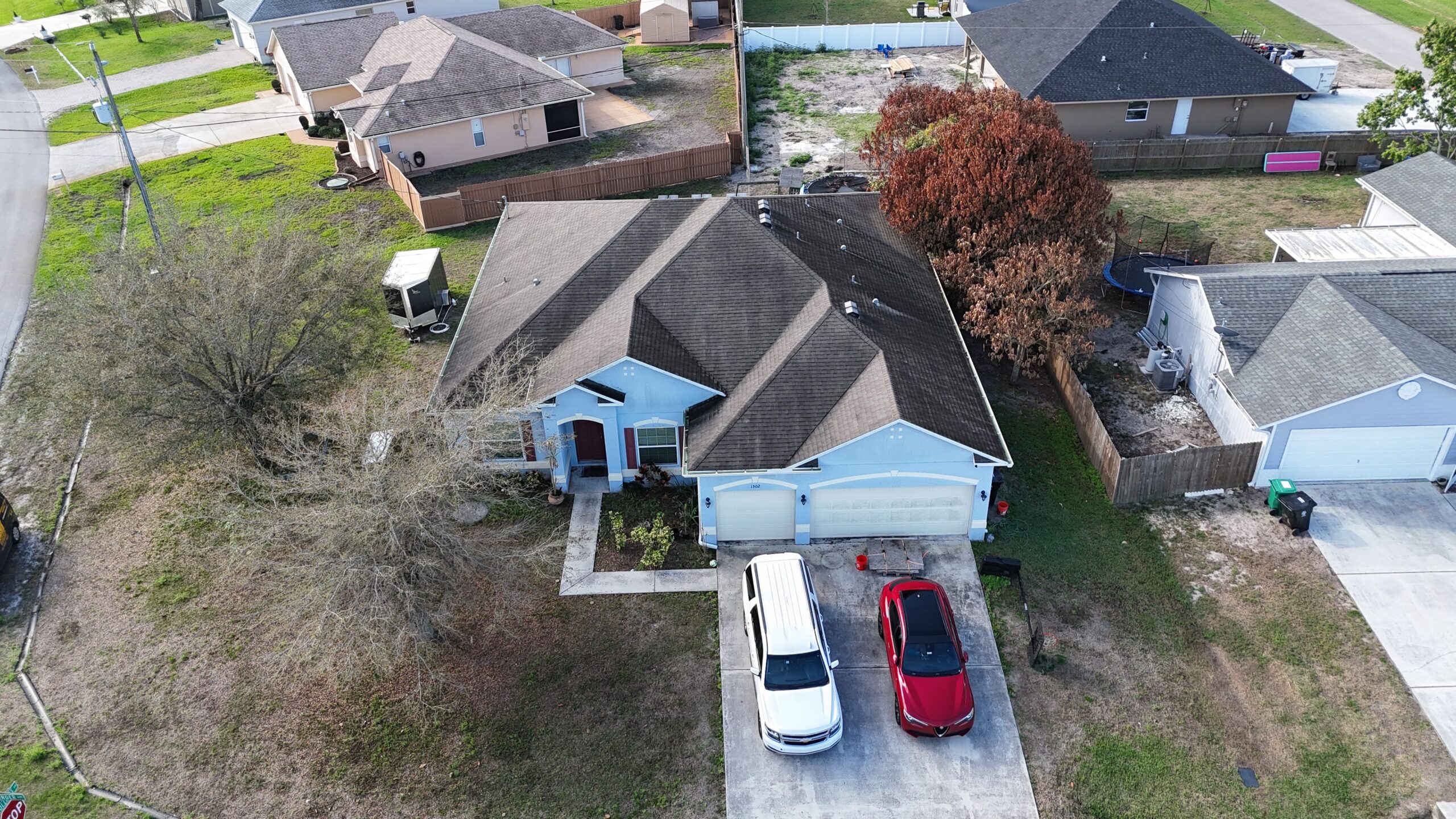
Typical Roof Replacement Timeline in South Florida
| Phase | Typical Duration | Who Controls It |
|---|---|---|
| Inspection and estimate | 1–3 days | Contractor |
| Contract and deposit | 1–5 days | Homeowner + contractor |
| Permit application and approval | 5–20 business days (Miami-Dade) | County |
| Tear-off, deck work, re-nail | 1–2 days | Contractor (inspector required) |
| Underlayment and covering | 1–3 days | Contractor |
| Final inspection | 3–10 business days after request | County |
| Wind mitigation inspection + report | 1–5 days after final | Third-party inspector |
Total elapsed time from signed contract to wind mitigation report: typically 3 to 8 weeks. The largest variable is permit queue time at the county building department — something neither the homeowner nor the contractor controls.
| Roof Type | Installed Cost Range (per 100 sq ft) | Typical Lifespan in South FL |
|---|---|---|
| Architectural shingle (GAF) | $750 – $850 | 12–15 years |
| Standing seam metal (Englert or Metal Alliance) | $1,050 – $1,300 | 40–50+ years |
| Concrete or clay tile | $1,000 – $1,350 | 30–50 years |
| Flat membrane (TPO) | $800 – $1,400 | 15–25 years |
Ranges depend on roof complexity, deck condition, number of penetrations, and whether structural repairs are needed. Always get a written scope of work itemizing each cost driver.
Why it matters who pulls your permit
License Scope Is Not Interchangeable
A licensed contractor, not a lead aggregator.
Florida roofing permits must be pulled by a licensed contractor — either a Certified Roofing Contractor or a Certified General Contractor. What matters for you: if deck inspections reveal structural issues — rotted rafters, missing hurricane straps, or load-path problems — a roofing-only license does not authorize structural repair work. A contractor authorized to coordinate multi-trade structural scope can handle both without stopping the job and calling a separate general contractor. That structural scope continuity matters in South Florida, where hidden deck rot and missing straps are common findings on homes built before the 2002 code overhaul.
“We pull every permit before the first nail comes out. If the deck inspection finds structural problems, we handle them in scope — homeowners don’t need to manage two separate contractors.”
President, Bigfoot Windows & Roofing
Roofing materials we install
Choosing the Right Roof System for South Florida
Product selection affects longevity, insurance discounts, and HOA compliance.
Bigfoot installs GAF architectural shingle systems, Englert and Metal Alliance standing-seam metal, Westlake concrete and clay tile, Unified Steel stone-coated metal, and TPO flat membrane. We do not install EMC, Sunshine, Big, or Ply Gem products — callback rates on those lines are high enough that we stopped using them. For South Florida conditions — salt air, intense UV, heat cycling, and hurricane wind loads — metal standing seam is the most durable long-term choice. Shingles are appropriate for budget-driven replacements with a shorter time horizon. Tile suits HOA-governed communities where aesthetics are regulated.
Under Florida SB 293, a homeowner’s association cannot prohibit impact-rated products or metal roofing — if your HOA has told you otherwise, that restriction is unenforceable under current Florida law. You can explore PACE financing options to spread the cost of a higher-durability system over 10 to 20 years, paid through your property tax bill.
What to expect from us
How Bigfoot Manages the Replacement Process
Our process follows the 8 steps above without shortcuts. Before signing a contract, we walk the roof and attic together so you see what we see. The permit is applied for before any scheduling. We schedule the county framing inspection after deck work and re-nailing — work stops until the inspector signs off. We do not cover the deck without that approval. After final inspection, we connect you with a qualified third-party inspector for the OIR-B1-1802 wind mitigation report. We do not perform that inspection ourselves — it must be independent to carry insurance validity.
Have questions about your specific roof or timeline? Talk to a licensed contractor before committing.
Related Articles
Written by Darryl Henry Rosenbaum, Founder of Bigfoot Windows & Roofing.
Darryl Henry Rosenbaum, doing business as Bigfoot Windows and Roofing, holds four active Florida licenses recognized by the Florida Department of Business and Professional Regulation (DBPR): Certified General Contractor (CGC1531370), Certified Residential Contractor (CRC1331693), Certified Roofing Contractor (CCC1333168), and Certified Specialty Contractor with a Glass & Glazing Specialty (SCC131153098).
Honest Note
Who We’re Not the Right Fit For
This guide isn’t for everyone, and neither are we. Bigfoot Windows & Roofing is likely not your best match if you’re choosing strictly on the lowest upfront price regardless of installation quality, if you want a manufacturer we don’t represent, or if you need a non-permitted or non-HVHZ-compliant installation. We focus on code-compliant, properly engineered roofing projects across Miami-Dade, Broward, and Palm Beach — if that’s what you’re after, we should talk.
Homeowner questions
Frequently Asked Questions
What are the steps in a roof replacement in Florida?
A Florida roof replacement follows eight steps: inspection and estimate, product and NOA selection, permit application, tear-off and deck inspection, deck re-nailing to code, secondary water barrier and underlayment installation, new covering and flashing installation, and final inspection followed by a wind mitigation report. Every step has a Florida Building Code requirement. Skipping any step — especially the permit or the deck re-nailing inspection — creates legal, insurance, and safety problems.
How long does a roof replacement take in South Florida?
Physical installation typically takes two to five days depending on roof size and complexity. The total elapsed time from signed contract to wind mitigation report is usually three to eight weeks, primarily because of permit queue time at Miami-Dade or Broward County building departments. Permit approval is the largest variable — neither party controls it. Plan for a minimum of four weeks from contract to closed permit in most Miami-Dade scenarios.
Do I need a permit to replace my roof in Miami-Dade?
Yes. A roofing permit is legally required for any full replacement in Miami-Dade, Broward, and Palm Beach County. The permit must be issued before tear-off begins. Unpermitted work can block home sales, void homeowner’s insurance claims, and require full removal. Any contractor who suggests starting without a permit is creating significant legal risk for you as the property owner.
What happens if the roof deck is damaged during tear-off?
Damaged deck sections must be replaced before the new roof system is installed. The county inspector verifies deck condition and fastening pattern before underlayment is permitted.
Ready to get started? Get a free, no-pressure estimate from a licensed South Florida contractor.
Do you need a permit for roof replacement process florida in Miami-Dade or Broward?
Yes. Miami-Dade and Broward require a permit for re-roofing and most roof repairs. A licensed roofing contractor pulls the permit and schedules the required inspections as part of the project.
Does financing typically cover roof replacement process florida?
Financing options may be available depending on the scope and your lender. Ask your contractor what programs apply to your specific project before you sign anything.