
How Long Does a New Roof Last in South Florida?
Last updated: July 2026 by the Bigfoot Windows & Roofing editorial team.
Key Takeaways
- 3-tab shingles last 12–20 years in South Florida; architectural shingles 20–28 years; premium metal or tile 40–50+ years.
- Florida’s UV, heat, humidity, and salt air cut manufacturer-rated lifespans by 20–30% versus northern climates.
- Proper attic ventilation is one of the single biggest factors in how long any roof lasts here.
- The warranty on a shingle package and the realistic lifespan in South Florida are two different numbers — know both.
- Citizens Insurance may non-renew roofs 20–25+ years old, making replacement a financial decision as much as a structural one.
The Real Question
Why South Florida Is Harder on Roofs Than Anywhere Else in the U.S.
Your neighbor’s roof in Ohio might last 30 years. Yours probably won’t. Here’s why.
South Florida is one of the most demanding roofing environments in the country. Miami-Dade, Broward, and Palm Beach counties combine relentless UV radiation, sustained heat above 90°F for eight or more months of the year, high humidity, salt air from the Atlantic and Gulf, and annual hurricane-season wind loads. That combination degrades roofing materials faster than almost any other U.S. climate. When a shingle manufacturer prints “30-year warranty” on the package, that rating was not derived from a South Florida install. It reflects an average national climate. Your roof lives in an outlier climate.
Understanding how long a new roof replacement in South Florida will realistically last requires separating three distinct concepts: manufacturer-rated lifespan, actual field lifespan under Florida conditions, and insurance-driven replacement triggers. All three numbers matter to your decision.
Local Context
HVHZ, Salt Air, and What the Florida Building Code Actually Demands
Miami-Dade and Broward counties fall inside the High Velocity Hurricane Zone (HVHZ) — the strictest residential roofing code in the United States. Every roofing product installed in the HVHZ must carry a Miami-Dade NOA or a Florida Product Approval that covers HVHZ use. That’s a structural floor, not a lifespan guarantee. Passing the NOA means the product can survive the wind loads; it says nothing about how well it holds up to 10 years of South Florida UV exposure on top of that.
Salt air is a separate stressor. Homes within roughly two miles of the coast face accelerated corrosion on metal fasteners, flashing, and roof-deck components. This is one reason coastal installations require specific finish grades on aluminum components — the Florida Building Code and manufacturer warranty terms often specify a 2605 finish for coastal proximity; a 2604 finish can void a 10-year warranty in that environment.
Lifespan by Material
How Long Each Roof Type Actually Lasts in South Florida
These are field-realistic ranges, not manufacturer marketing numbers.
| Material | Manufacturer Rating | Realistic South FL Lifespan | Key Degradation Driver |
|---|---|---|---|
| 3-Tab Asphalt Shingle | 25–30 years | 12–20 years | UV granule loss, heat cycling |
| Architectural (Dimensional) Shingle | 30–50 years | 20–28 years | Heat, humidity, wind uplift |
| GAF Premium Shingle (Layer Lock) | Lifetime (System Plus) | 25–35 years | Wind Proven rated; salt air is residual risk |
| Concrete / Clay Tile | 50+ years | 30–50 years | Underlayment degrades before tile |
| Standing Seam Metal | 50 years | 40–60 years | Fastener corrosion if clips are wrong |
| Stone-Coated Metal (Unified Steel) | Lifetime | 40–50+ years | No named storm or saltwater exclusions |
| TPO / Flat Membrane | 20–30 years | 15–22 years | UV degradation, ponding water |
3-Tab Shingles: The Honest Story
3-tab shingles are the thinnest, lightest asphalt shingle option. In South Florida, the UV index is among the highest in the continental U.S. That radiation bleaches and cracks the asphalt binder faster than the manufacturer’s northern-climate test data predicts. Granule loss accelerates, exposing the mat beneath. If your home has a 3-tab roof installed more than 15 years ago in Miami-Dade or Broward, it is likely approaching the end of its serviceable life — regardless of whether it is actively leaking.
Architectural Shingles: More Mass, More Durability
Architectural shingles are thicker, heavier, and bonded in a laminated construction that resists wind uplift better than 3-tab. In South Florida, a quality architectural shingle — properly installed with correct nailing patterns per the Florida Building Code — realistically delivers 20 to 28 years before granule loss and underlayment breakdown force replacement. GAF’s Layer Lock series improves on standard architectural designs with 19 bonding points per shingle and a 1.81-inch nail line, which translates to meaningfully better wind resistance in hurricane-season conditions.
Tile Roofing: Long Tile Life, Shorter Underlayment Life
Concrete and clay tile can physically last 50 years or more. The limiting factor in South Florida is almost always the underlayment beneath the tile, not the tile itself. Heat cycling and humidity cause the underlayment to degrade in 20 to 30 years. When that happens, water intrusion follows even if every tile above is intact. A tile roof replacement in South Florida is often an underlayment replacement with tile reinstallation — or a full re-roof when the existing tile is too old or fragile to salvage.
Metal Roofing: The Longest-Lived Option Available
Standing seam metal is the closest thing to a permanent roofing solution in South Florida’s climate. Properly installed with code-compliant clips — the clip system, for example, requires the manufacturer’s approved clips, at the spacing its product approval specifies — a standing seam metal roof can last 40 to 60 years. The panels run in one continuous piece from ridge to eave with no horizontal seams, eliminating a primary water-intrusion point during heavy storm rain. Learn more about metal and shingle roofing options for South Florida homes.
Warranty vs. Reality
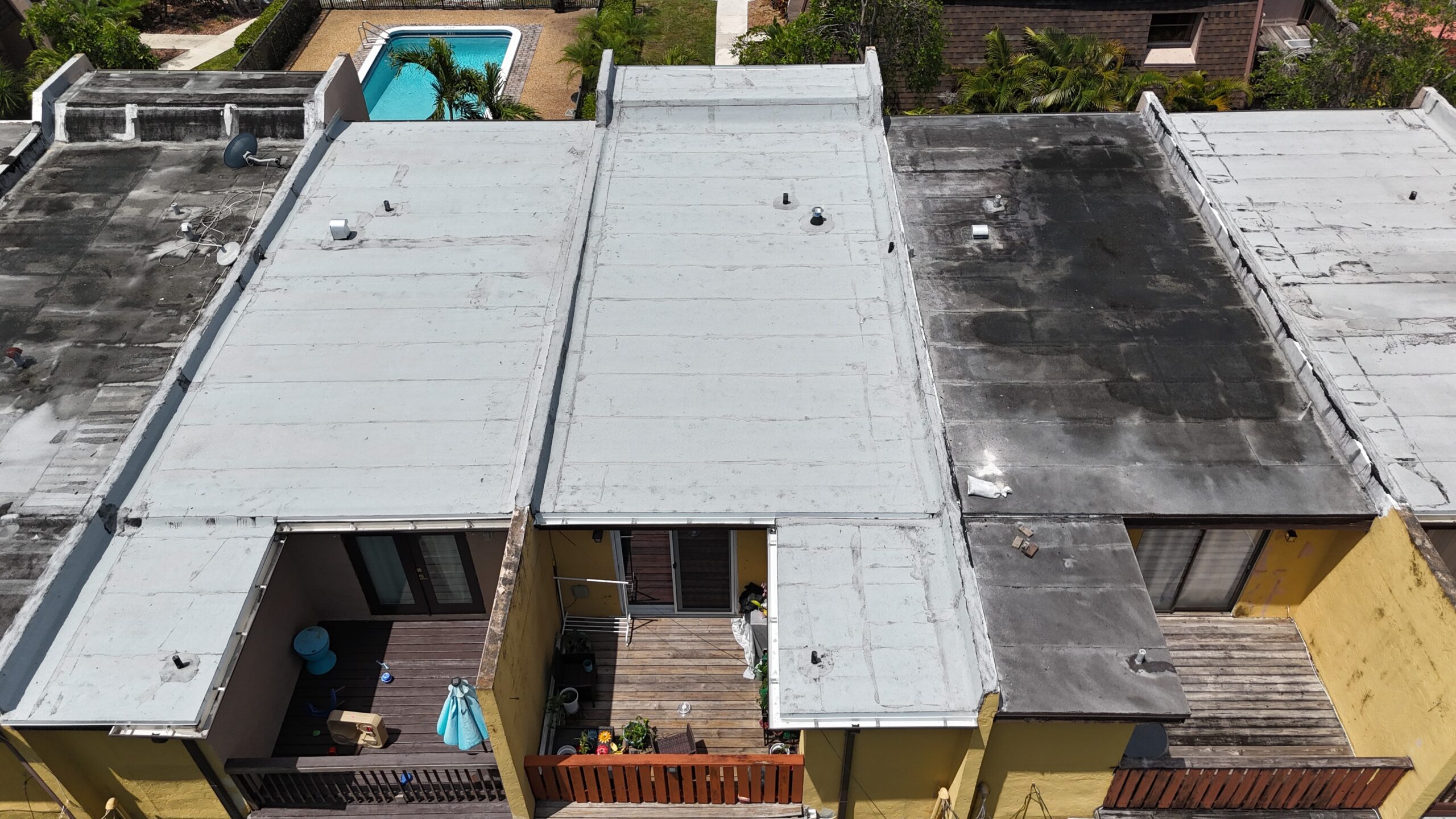
Manufacturer Warranty vs. Actual Lifespan — What the Fine Print Means in Florida
| Claim Type | What It Covers | Florida Reality Check |
|---|---|---|
| Manufacturer Material Warranty | Defective materials only | Does not cover UV degradation pace or storm-accelerated aging |
| Labor Warranty (contractor) | Installation workmanship | Bigfoot: 10-year workmanship warranty on roofing installs |
| GAF System Plus | 50yr non-prorated; shingles + labor + tear-off + accessories | Wind Proven (no mph cap, 15 years, not voided by named storms in county) |
| Competitor Wind Warranty (typical) | Capped at 130 mph or voided by named storms | Named-storm voidance is a real risk in South Florida hurricane season |
The GAF System Plus warranty — available through GAF Certified Plus contractors — covers shingles, labor, tear-off, and accessories for 50 years on a non-prorated basis. The Wind Proven component carries no maximum mph rating and is not voided by a named storm making landfall in your county. That distinction matters in South Florida, where a named storm can void a standard wind warranty even if your specific roof sustained zero damage.
Why Licensing Matters for Roof Longevity
A Certified Roofing Contractor — Not a Lead Aggregator
The installer controls as much of your roof’s lifespan as the material itself. Improper nailing, wrong clip spacing, and skipped underlayment steps all shorten a roof’s life regardless of the product tier.
“In South Florida, I have seen architectural shingle roofs fail at 15 years because of wrong nail placement alone. The material was fine. The installation wasn’t. Lifespan starts at the permit and the nail gun.”
President, Bigfoot Windows & Roofing
Ventilation & Installation
Ventilation: The Factor That Silently Kills South Florida Roofs Early
Attic ventilation is one of the most underrated lifespan variables for any South Florida roof. When attic air temperatures regularly exceed 150°F — which they do in Miami-Dade summers without adequate ridge and soffit ventilation — the heat radiates up through the roof deck and cooks the shingle adhesives and granule binders from below. This is called thermal cycling stress, and it accelerates granule loss, cracking, and adhesive seal failure on shingles by years, not months.
The Florida Building Code establishes minimum ventilation ratios for residential attic spaces. Meeting the code minimum is the floor, not the goal. In HVHZ climates, exceeding the code-minimum ventilation ratio by adding ridge vents, baffles, and balanced soffit intakes is a meaningful investment in shingle or tile lifespan. Ask your contractor where existing ventilation falls short before the new roof goes on — fixing it after the fact is more disruptive and more expensive.
Roof deck condition is equally important. In South Florida, peel-and-stick underlayment applied directly to the deck is now permitted under the 2024 Florida Building Code update. A full-deck peel-and-stick installation also qualifies for a secondary water barrier discount on homeowner’s insurance — 30-lb felt does not qualify. When you are already replacing a roof, the incremental cost of upgrading to a full peel-and-stick deck is one of the highest-return decisions available.
What to Expect
The Process: From Inspection to Final Permit
A properly executed South Florida roof replacement follows a permit-governed sequence. The contractor pulls the permit before work begins — not after. The permit triggers a required inspection by the local building department before the roof is closed in, and a final inspection once complete. This process is not optional in Miami-Dade or Broward; skipping it creates a title and insurance problem when you sell.
Because Bigfoot Windows & Roofing holds a Certified General Contractor license (CGC1531370) in addition to the Certified Roofing Contractor license (CCC1333168), structural issues discovered mid-project — rotted deck framing, compromised hurricane straps, or load-path problems that require structural modification — can be addressed in-house under a single contractor of record. That means you do not need a separate structural contractor to resolve framing damage before the new roof is installed. Structural scope continuity under one license holder reduces coordination gaps in a project where timing matters.
Financing is available for qualifying homeowners through PACE, which is paid through the property tax bill rather than a traditional bank loan. Review roofing financing options to understand PACE terms before your estimate appointment. My Safe Florida Home grants of up to $10,000 may also be stackable with financing for eligible properties.
Not sure how much life your current roof has left? Get a straight answer from a Certified Roofing Contractor.
Related Reading
More South Florida Roofing Guides
Related Articles
Who We’re Not the Right Fit For
We want to be honest about where Bigfoot Windows & Roofing is not the best match:
- Budget-first shoppers who need the lowest bid on the street. We do not cut underlayment or ventilation specs to win a price war. If price is the only criterion, a lower bid is available elsewhere — but understand what may be omitted.
- Homeowners who want to defer a permit. Every roof we install is pulled with a permit. If you want unpermitted work, we are not the right contractor.
- Projects where the homeowner wants to supply their own materials. We stand behind the products we install and carry the workmanship warranty. We do not install homeowner-supplied shingles or panels.
- Very small repair-only jobs under storm-damage minimums. We focus on full replacements and significant repairs. A small isolated patch is not our primary scope.
Common Questions
Frequently Asked Questions
How long will a new roof last in Florida’s climate?
It depends on the material. In South Florida, asphalt shingles realistically last 12–28 years depending on grade; tile roofs last 30–50 years (though underlayment may fail sooner); standing seam metal can last 40–60 years. Florida’s UV, heat, humidity, and salt air shorten all manufacturer-rated lifespans compared to northern climates.
What’s the difference between 3-tab, architectural, and premium shingles for longevity?
3-tab shingles are the thinnest and typically last 12–20 years in South Florida. Architectural (dimensional) shingles are laminated, heavier, and last roughly 20–28 years here. Premium shingles like GAF’s Layer Lock series add bonding points and a wider nail line for better wind resistance, extending realistic lifespan toward 25–35 years in Florida conditions.
Does Florida heat and UV affect how long my roof lasts?
Yes, significantly. South Florida has one of the highest UV indexes in the continental U.S. UV radiation degrades the asphalt binder and bleaches granules, which accelerates shingle aging. Sustained heat above 90°F for eight or more months per year adds thermal cycling stress. Expect 20–30% shorter lifespan than the manufacturer’s rated figure for most shingle products.
How does ventilation affect roof lifespan?
Poor attic ventilation traps heat that can exceed 150°F in South Florida summers. That heat radiates through the roof deck and degrades shingle adhesives and granule binders from below — shortening lifespan by years. Balanced ridge-and-soffit ventilation meeting or exceeding Florida Building Code minimums is one of the highest-return investments you can make when replacing a roof.
What’s the difference between the manufacturer’s warranty and how long the roof actually lasts?
Manufacturer warranties cover defective materials, not accelerated aging from UV or climate. A “30-year warranty” does not mean the roof lasts 30 years in South Florida — it means defective material is covered for 30 years. System-level warranties like GAF System Plus cover labor and accessories too, and Wind Proven has no mph cap and is not voided by named storms in your county.
Will Citizens Insurance drop my policy if my roof is old?
Citizens Insurance has been non-renewing policies on roofs 20 years old or older in many cases. If your roof sustains more than 25% damage in a storm, Florida law may require a full replacement rather than repair. An aging roof is a financial liability beyond just leaks — it can affect your insurability and the sale value of your home.
Is metal roofing worth it in South Florida?
For most South Florida homeowners, standing seam metal is the longest-lived option available — 40 to 60 years with proper installation. It also delivers the strongest wind-mit inspection results, which can meaningfully reduce homeowner’s insurance premiums. The higher upfront cost typically spans two shingle roof lifetimes, making the total-cost comparison more competitive than the initial price suggests.
Schedule Your Free Estimate
Ready to get started? Request a free estimate — no phone call required.
Sources
- Florida Building Code, 8th Edition — Residential Roofing Requirements and HVHZ provisions
- GAF Roofing — System Plus Warranty and Wind Proven Program terms
- Florida Department of Business and Professional Regulation (DBPR) — License verification
- Citizens Property Insurance Corporation — Roof age and renewal policy guidelines
- National Roofing Contractors Association (NRCA) — Ventilation best practices
Ready to find out how much life your current roof has — and what a replacement would cost?
Request a no-pressure estimate from a Certified Roofing Contractor serving Miami-Dade, Broward, and Palm Beach.